
Start by identifying the type of odour problem
Persistent pet urine smell on artificial turf calls for a diagnosis before another cleaning product. In dog-use areas, routine cleaning matters because urine smell can linger and become worse with heat and rain when the turf is not cleaned regularly. That pattern applies whether your turf is in a Kearney yard, a Kansas City dog run, or another frequently used pet area.
Start by asking what kind of problem you have: one small, recent accident in a known spot, or an odour that returns across a larger or heavily used area. The answer determines whether a careful home treatment is a reasonable first step or whether continued surface cleaning may be missing a deeper issue.
A small, recent accident in a known spot may be suitable for DIY enzyme treatment when the product label permits use on artificial grass and you can treat the area evenly. The word may matters: the condition of the turf, the product directions, and the size of the affected area still control the decision.
Recurring odour points to a different possibility. Residue can build up deep inside an artificial turf system, while rinsing or household cleaners may reduce surface smell temporarily without addressing underlying organic buildup. If the smell keeps returning after treatment, repeated applications are not a reason to keep adding stronger products.
Use this opening decision rule:
- Small and recent: Identify the spot, prepare the surface, and follow a product label that permits use on artificial grass.
- Returning after treatment: Stop adding products and request an assessment.
- Large, repeated, or heavily used area: Consider professional cleaning because consistent coverage, dilution, contact time, and rinsing are harder to manage across broad or recurring buildup.
This approach keeps a single accident from turning into unnecessary work while giving recurring odour the attention it needs.
What may be holding the smell
Surface residue is one possible source of pet odour on artificial turf. Rinsing can address material at or near the surface, but residue may also build up deeper inside the turf system. Household cleaners may make the surface smell better for a time without addressing that underlying organic buildup.
A temporary improvement is therefore not the same as a confirmed resolution. If the smell returns after the area has been treated and dried, treat the recurrence as useful information rather than applying product repeatedly.
The infill and backing may matter when waste has accumulated below the visible blades. Repeated surface applications may not reach buildup in the infill or backing. A persistent smell does not prove that the infill or backing is the cause, but it does justify stopping the guesswork and requesting an assessment.
The base material is another installation condition that can affect drainage and odour control. That point does not mean every smell comes from the base. It means a recurring problem may require attention to more than the visible grass fibers, particularly when the affected area is broad or the odour follows repeated pet use.
Your first inspection should separate what you can see from what you can infer:
- Surface residue, hair, leaves, or solid waste are visible maintenance issues.
- Odour that returns after surface treatment may point to buildup deeper in the system.
- A broad or recurring problem may involve infill, backing, or installation conditions that require assessment.
Use those observations to choose the next action. Do not treat a temporary reduction in smell as proof that every underlying condition has been addressed.
Prepare the area before applying anything
Visible solid waste and loose debris should be removed before any liquid cleaner is applied. Pick up feces and other solid material first, then clear leaves, hair, and loose debris so the treatment can reach the affected surface more evenly.
This preparation is simple, but it changes the starting conditions. Liquid applied over waste or a layer of debris cannot be expected to contact the turf evenly. Clearing the area also helps you see whether the suspected odour spot is limited or extends along a pet path, seam, corner, or surrounding surface.
The affected area should be inspected before treatment begins. Look at the known accident spot, nearby corners, seams, pet paths, and places beneath outdoor furniture where leaves or hair may collect. Brush or sweep loose material away without raking aggressively when the turf manufacturer’s care instructions prohibit that action.
Do not use the preparation step to diagnose an unseen drainage or backing problem. Use it to remove visible material and define the area you intend to treat. If the smell is present across a wide section rather than one identifiable spot, that observation supports a more cautious decision about home treatment.
A practical preparation checklist is:
- Remove visible solid waste.
- Clear leaves, hair, and loose debris.
- Identify the smallest area that can be treated evenly.
- Read the cleaner’s label and SDS before mixing or applying it.
- Check whether the turf care instructions allow the brushing or sweeping method you plan to use.
Complete the surface preparation before deciding whether the affected area is small enough for a home treatment.
Use a label-led cleaning sequence
The product label should control the cleaning process. Use only a cleaner intended for artificial grass or the specific surface you are treating, and read the label and SDS before mixing or applying it. Product directions govern dilution, protective equipment, ventilation, storage, and keeping pets or children away during cleaning.
Do not select a product merely because it is marketed for odour. Confirm that its directions permit the surface you have and follow the stated conditions. Do not improvise a dilution, contact time, or combination of products when the label does not direct you to do so.
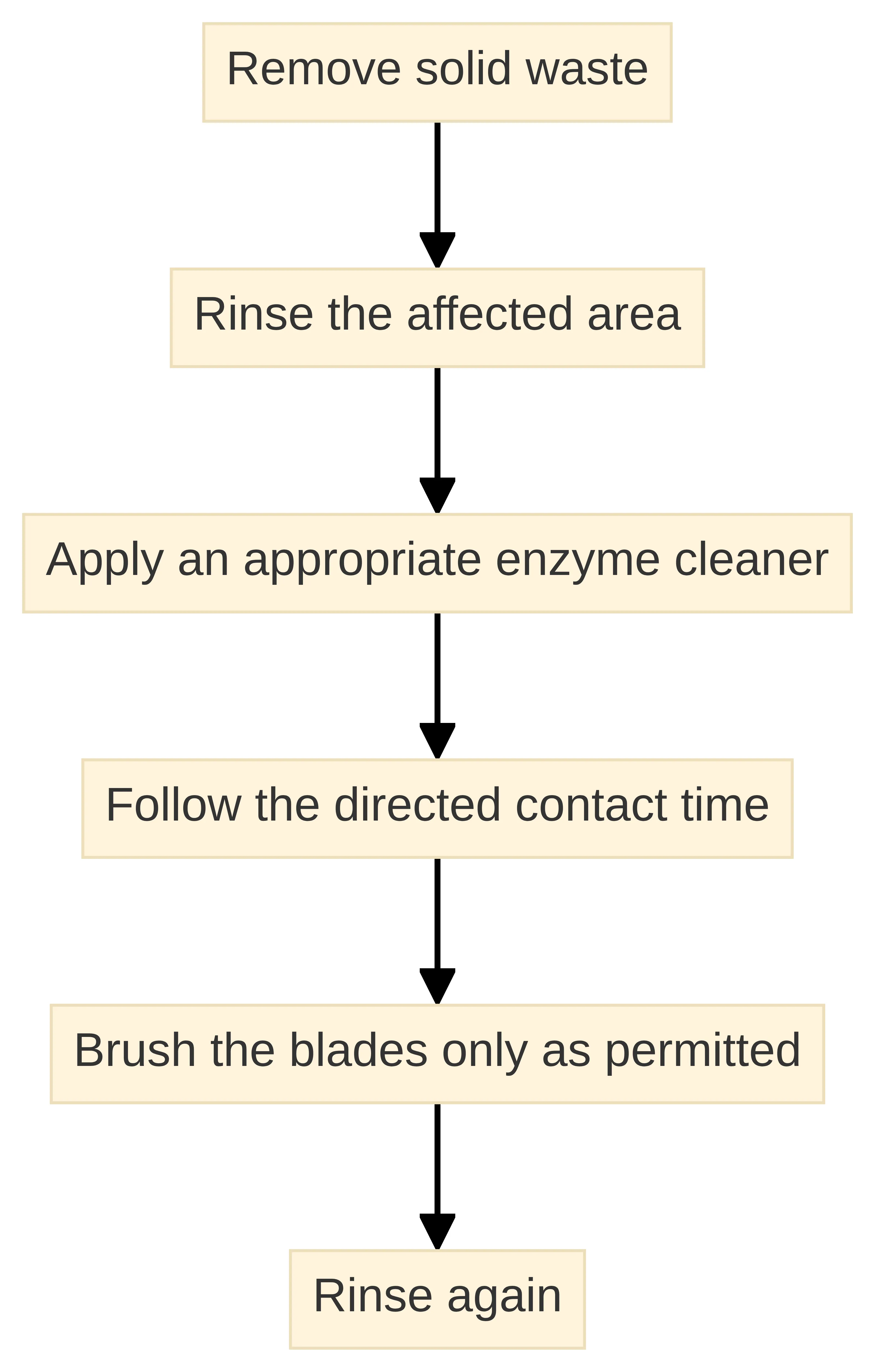
For one small, recent accident in a known spot, a general cleaning sequence is:
- Remove solid waste. Clear feces and other visible material before applying liquid.
- Rinse the affected area. Use the general sequence only within the conditions allowed by the product directions. Some products may call for a pre-rinse, while others may give different instructions.
- Apply an appropriate enzyme cleaner. Use it only when the label permits application to artificial grass and when you can cover the affected area evenly.
- Follow the directed contact time. Keep the area under the conditions the product label specifies rather than guessing at a longer or shorter interval.
- Brush the blades only as permitted. Use the care instructions for your turf and avoid aggressive raking when those instructions prohibit it.
- Rinse again. Remove leftover cleaner according to the product directions so residue does not remain on the surface.
The sequence is general guidance, not a product formula. The label and SDS control the details for the cleaner you choose.
The cleaning sequence should stay limited to the problem it can reasonably address. A small spot with even coverage may be appropriate for this approach. A large area, repeated pet accidents, or uncertain product coverage creates more room for inconsistent dilution, contact time, and rinsing.
If the product label does not permit use on artificial grass, do not apply it to the turf. If the label requires protective equipment, ventilation, storage conditions, or restricted access for pets and children, follow those requirements before, during, and after treatment.
Reassess after the area dries
The treated area should be reassessed after it dries. Inspect the same spot rather than judging the result only while the turf is wet, and compare the remaining smell with the original problem. Drying gives you a consistent point at which to decide whether routine care is enough or whether the odour is still returning.
A reduced smell after drying may mean the treatment addressed some surface residue, but it does not guarantee complete removal. Rinsing or household cleaners may reduce surface smell temporarily without addressing organic buildup deeper in the turf system.
A returning smell is the more useful decision signal. If the odour returns after treatment, stop adding products and request an assessment because waste may have accumulated in the infill or backing. Repeating the same surface application is not a substitute for finding out whether the problem extends below the visible blades.
Use three questions after the area dries:
- Is the original spot the only affected area?
- Has the smell stayed reduced, or has it returned?
- Can the area be treated evenly under the product’s directions?
A limited problem with a sustained reduction can move back into routine maintenance. A recurring or expanding problem should move toward assessment instead of repeated experimentation.
Prevent recurring odours with routine maintenance
Artificial turf still needs maintenance after installation. The routine includes keeping the surface clean, brushing the fibers, rinsing dust or pet areas, and checking for drainage or infill issues. Dog-use areas deserve regular attention because urine smell can linger and worsen with heat and rain when cleaning is delayed.
Routine care is different from an emergency response to a strong recurring odour. The purpose is to keep ordinary debris and pet-area residue from accumulating, while a persistent smell may require an assessment of conditions below the surface.
Build your maintenance routine around these practices:
- Remove solid waste before it remains on the turf.
- Rinse pet areas as part of regular care rather than waiting for a strong smell.
- Clear leaves, hair, and loose debris from the blades, corners, seams, and pet paths.
- Brush the fibers only in a way allowed by the turf care instructions.
- Watch for drainage or infill issues and record where the odour appears.
- Reassess areas that smell worse after heat or rain instead of assuming the visible surface is the only factor.
These actions support ongoing maintenance; they do not promise that every recurring odour will be prevented or removed.
Your maintenance notes can make the next decision clearer. Record whether the smell is limited to one pet-use area, appears across a dog run, returns after rinsing, or becomes more noticeable after heat or rain. A repeated pattern gives you a better basis for deciding whether routine cleaning remains appropriate.
Do not respond to every pattern by increasing the amount of product. When surface cleaning produces only temporary improvement, the deeper buildup described in the turf-maintenance guidance may still be present.
Know when to stop home treatment
Returning odour after treatment is the clearest reason to stop adding products. Waste may have accumulated in the infill or backing, and repeated surface applications may not reach it. Request an assessment instead of guessing at stronger chemicals or repeating the same treatment without a new basis.
A large area or repeated pet accidents also changes the decision. Broad contamination makes consistent coverage, dilution, contact time, and rinsing harder to manage. Professional tools and a planned process may be better suited to that kind of recurring buildup.
The same boundary applies to a heavily used dog area where treating one visible spot does not address the wider pattern. Stop home treatment when you cannot define the affected area or cannot treat it evenly under the product directions.
Use these escalation branches:
- The smell returns after a label-led treatment: Stop adding products and request an assessment.
- The affected area is large or accidents are repeated: Seek a planned cleaning process rather than relying on repeated spot treatments.
- The smell suggests a broader turf-system concern: Ask for an assessment that can consider buildup in the infill or backing and installation conditions such as the base material’s relationship to drainage and odour control.
- The product cannot be used on your surface under its label: Do not apply it; choose the next step based on the product instructions or request professional help.
These boundaries protect the distinction between a limited cleaning task and a turf-system problem that needs a closer look.
Request the next assessment when routine cleaning is not enough
A small, recent, known spot can justify a careful label-led home treatment followed by reassessment after drying. A returning smell, broad contamination, repeated accidents, or an area that cannot be treated evenly changes the decision: stop adding products and seek an assessment.
Hall Turf cleans, repairs, and restores synthetic lawns across Kansas City, including installations we did not build. If recurring odour raises questions about cleaning, repair, infill, backing, drainage, or related installation conditions, gather the affected area’s location, use pattern, treatment history, and when the smell returns so the next discussion starts with useful details.
Routine maintenance is appropriate only while it is addressing a limited problem under the product directions. Surface improvement without lasting control, or uncertainty about the turf system beneath the blades, is the point to move from home treatment to assessment.
Practical questions about recurring turf odour
How can I tell if my artificial turf needs professional cleaning?
If the odor returns after treatment, or if the affected area is large or has repeated pet accidents, it may be time to seek professional cleaning services.
What maintenance practices can help prevent pet urine odors on artificial turf?
Regularly remove solid waste, rinse pet areas, clear debris, and brush the turf fibers to maintain cleanliness and reduce odors.
What should I do if the smell persists after cleaning my turf?
If the smell persists, stop adding cleaning products and request a professional assessment, as the issue may be deeper within the turf system.
How does the base material of artificial turf affect odor control?
The base material can influence drainage and odor control, so it’s important to consider it when addressing persistent smells.