
Open a property-fit record
Start a zone-by-zone property-fit record rather than a product-first comparison. Pet turf means specialized artificial grass designed around dog-related demands such as urine, drainage, and repeated pet traffic. Standard synthetic turf may not address those demands in the same way. The record asks whether each proposed zone has a defined use, recorded drainage conditions, known sun and shade exposure, and an understood care routine.
Use the record to separate the visible surface from the conditions beneath it. Note the site boundary, supporting base, drainage route, turf and infill, edges and seams, sun exposure, and the care tasks the household will take on. Leave a field open when the proposal does not explain it; an unresolved field is a reason to ask a site question, not a reason to infer performance. A useful record has two layers. The first describes what the dogs and household need from each zone: relief, play, passage, sitting, or mixed use. The second describes what the proposed construction is expected to do in response. That distinction matters because the same visible turf may be considered for a general lawn, a concentrated relief area, or a defined dog run, yet the questions about the base, drainage, infill, edges, and cleaning will not be identical. Recording each zone rather than applying one property-wide label makes later answers easier to interpret. It also keeps a product description from standing in for a plan: a named turf or infill should be connected to a stated use and an identified care task. The record can distinguish a requirement from an unresolved question, so a missing answer remains visible instead of being treated as evidence that the system will perform a certain way. Add a traceability check: for every requested outcome, note the zone involved, the system component expected to support it, the site condition that could limit it, and the household task that remains. A drainage concern can therefore be connected to the base, route, outlet, and inspection routine rather than to a turf label alone. A wear concern can be connected to repeated turns or concentrated traffic, the proposed turf, and the treatment of edges and seams. If a proposal names a component without making those connections, mark the connection as unanswered. This makes the record useful during a quote discussion without turning a product description into a performance promise.
Bring the completed zone record to the quote discussion. The installer’s response should address each zone’s stated use, dog pressure, sun and shade, drainage history, existing surface, relief area, and cleaning expectation. If a site condition, system component, or care obligation remains unresolved, keep it open rather than treating the product description as proof of fit. If a dog area lacks natural or artificial shade and the selected study’s heat findings are relevant to the property, compare natural grass before committing to the turf option.
Describe the zone your dogs will use
The yard’s job should be written down before you consider turf features. A residential project may be intended to reduce mud, replace worn patches, limit mowing and watering, create a defined dog run, or provide a separate relief area. Your chosen job changes the layout, surface questions, drainage discussion, and care routine, so a general request for “dog-friendly grass” leaves too much unresolved.
Your dogs’ use pattern should be part of the project brief. Record the number and size of dogs, the hours they spend outside, their activity level, where they usually relieve themselves, how concentrated that use is in particular spots, and whether they run, turn sharply, dig, or repeatedly cross the same path. We recommend considering more resilient grass for active dogs that engage in vigorous activity. That recommendation does not select a product by itself; it tells you to make wear pressure part of the discussion. Activity is not only a question of whether a dog is described as active. Note where movement is concentrated, which routes are repeated, and which zones receive relief use. This helps distinguish a general resilience question from a question about concentrated wear or repeated turning. If the intended use changes by zone, record each zone separately rather than assigning one label to the whole lawn. A behavior or site detail that is uncertain should remain a question for the installer instead of being filled with a product assumption. The resulting profile gives the proposal a specific use pattern to address and gives you a way to compare its stated materials and construction details with the dogs’ actual routines.
Your starting record can be short:
- Write down the number, size, and activity level of your dogs.
- Mark the areas used for running, resting, play, and relief.
- Note whether the project addresses mud, worn patches, repeated lawn repair, or general lawn use.
- Record the cleaning routine you are prepared to follow.
- Identify whether the surface must serve people, furniture, or other yard functions as well as dogs.
This record gives you a practical basis for discussing the project in Kearney, Kansas City, or another location within your property plan. It also helps prevent a product feature from becoming the decision before the use case is clear.
A large lawn and a narrow dog run do not create the same design question. A separate relief area may concentrate waste handling in one zone, while a general-use lawn may spread traffic and cleaning across the property. State the intended zones before an installer evaluates materials. The surface should be selected to answer your recorded use pattern, not to solve an unnamed problem.
Mark the installation boundary
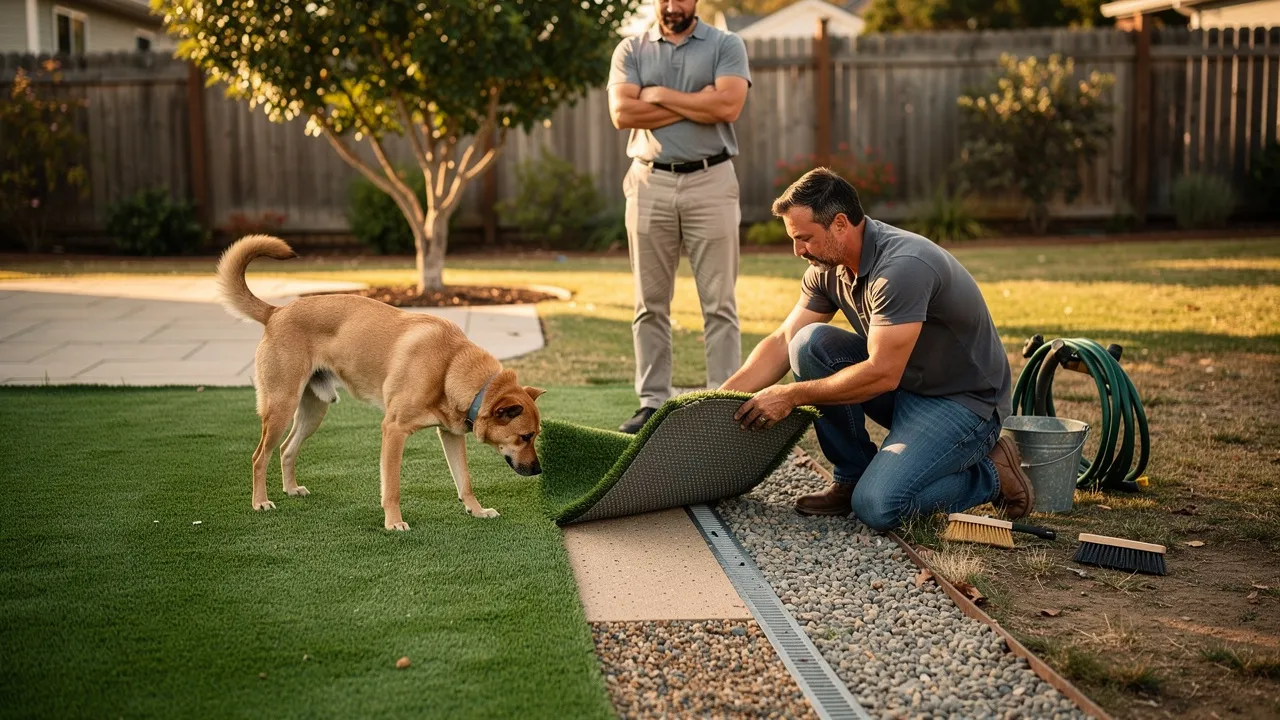
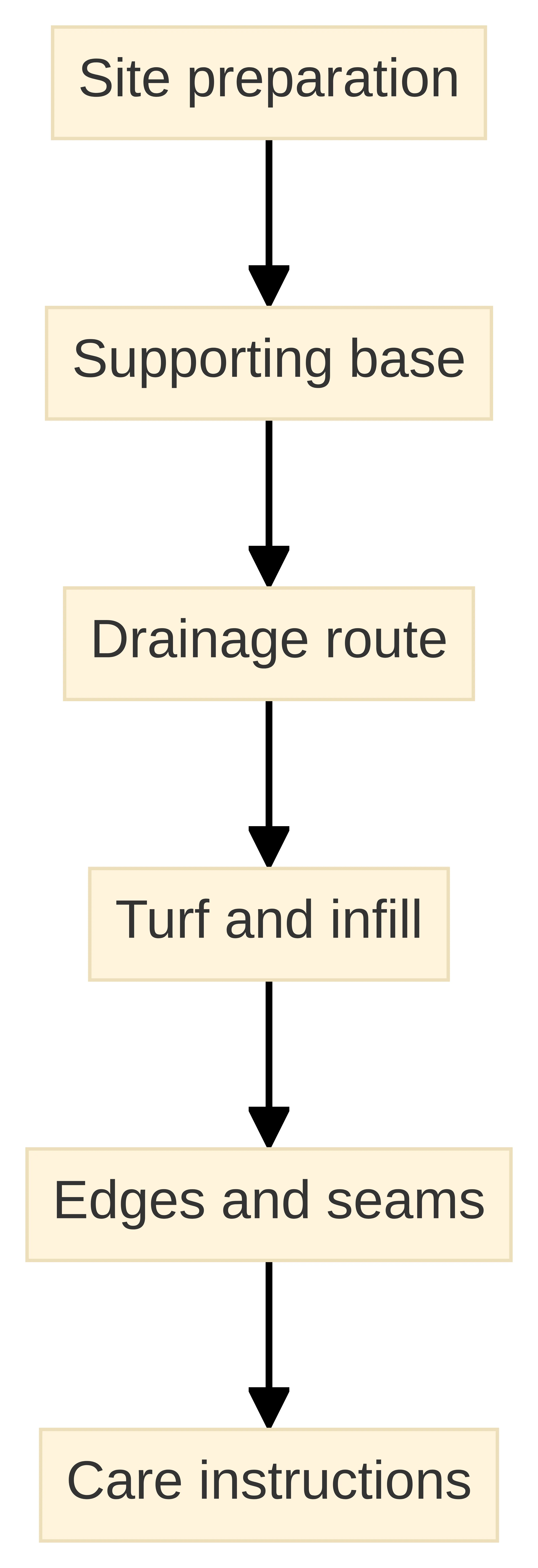
The installed system beneath visible turf deserves the same attention as the grass itself. Your evaluation should account for site preparation, the supporting base, the drainage route, the turf, infill, edges, seams, and the care instructions that follow installation. We prepare the site before installing artificial grass. Ask the proposal to show what that preparation includes for your property rather than treating preparation as an invisible allowance.
The surface appearance cannot answer every performance question. A site-specific drainage plan must address grades, outlets, and water paths, and those features may be outside the visible turf area. The same principle applies to dog use: a resilient-looking surface does not by itself explain how repeated traffic, concentrated relief use, or cleaning will be handled. Read the installation as a connected system.
Use this checklist when reviewing a design:
- What existing surface will be removed, retained, or repaired?
- What site preparation is included?
- What supporting base is specified, and how will it be installed?
- Where will rainwater and liquid from dog use travel?
- Which turf and infill are proposed, and what function does each serve?
- How will edges and seams be treated in the areas your dogs use most?
- What cleaning and routine-care instructions accompany the installation?
These questions do not promise a result. They make the system visible enough for you to judge whether the proposal responds to the job you recorded.
Give the water path its own check
Give the water question its own line in the record. Note where rainwater collects, where liquid from dog use is expected to move, and which low points, edges, or existing outlets need an answer. Keep the status open until the route is explained for this property; do not infer it from the turf’s appearance.
Your property history can guide the questions you ask. Record places where rainwater collects, areas that stay wet, nearby downspouts or outlets, changes in grade, and any existing drainage feature that the project must preserve or change. Then ask how the proposed system connects to those conditions. The goal is not to assume that turf fixes a drainage problem; the goal is to understand the planned water path before installation.
Urine use adds a second liquid-management question. Ask how repeated relief in the intended zone relates to the turf backing, infill, base, and drainage route, and ask what care routine is expected after use. Specialized artificial grass is designed around dog-related demands such as urine and drainage, but the installation still needs a property-specific plan. Keep any promise about odor or drainage tied to the proposed system and its conditions.
Before you approve a design, request clear answers to four questions:
- Where does water enter the system?
- Where does it leave the property or move to the planned outlet?
- What happens at existing low points and along property edges?
- Which maintenance checks will tell you whether the planned path remains usable?
If those answers are not clear, pause the surface decision and resolve the site question first. Read each answer as a different stage of the liquid path: entering the surface, moving through the installed layers, leaving through the planned route, and being managed through the care routine. A statement that liquid can pass through the turf addresses only one stage; it does not by itself establish where that liquid will go after reaching the base or property edge. For a concentrated relief zone, ask which part of the proposal addresses each stage and which part remains the homeowner’s responsibility. This distinction helps separate a surface description from a complete drainage explanation.
Leave product choice until site fit is clear
Do not let an infill label decide the property-fit result. Record any proposed material only after the use zone, water path, sun exposure, and care commitment are described. If a product is proposed, ask which defined function it is intended to serve and keep that answer in the record.
Smart Turf states that its ZeoFill Pet Infill is designed to trap and neutralize ammonia from pet urine and improve drainage and turf stability. This example shows why the infill name alone is not enough. Ask what the material is designed to do, where it will be placed, how much is included, and how the expected care routine relates to the product description.
Your infill questions should stay specific:
- What infill is included in the proposal?
- Which function is the material intended to address?
- Is the stated function tied to urine, drainage, odor management, turf stability, or another use?
- What cleaning or replenishment instructions apply?
- Are different zones receiving different materials?
Treat product-specific language as a reason to ask for details, not as an assurance that the entire installed area will remain odor-free or drain in the same way under every condition. Read an infill claim in three parts: intended function, installation scope, and care requirement. First, identify whether the stated purpose concerns fluid handling, ammonia, odor management, drainage, or stability. Next, confirm which zones and quantities the proposal includes. Finally, ask what routine is still expected after installation. This structure lets you compare two product descriptions without assuming that different labels promise the same system behavior.
Write down the care commitment
Your care plan should answer practical questions:
- How will you remove solid waste from the surface?
- Which cleaning method is intended for routine use?
- How will you treat a relief zone that receives repeated use?
- What should you inspect after heavy rain?
- Which signs indicate that drainage or odor management needs attention?
- Which tasks are expected from you, and which are part of any later service arrangement?
Write the answers down with the proposal. A care plan that exists only as a broad promise is difficult to compare with another installation.
The right question is not whether artificial turf is maintenance-free. It is whether the remaining tasks fit your household’s routine and the dogs’ use pattern. Standard synthetic turf may not address urine, drainage, and repeated pet traffic in the same way as a specialized system, while specialized features still depend on installation details and ongoing care. Choose a routine you can follow consistently.
Odor management should be treated as a continuing obligation rather than a one-time product promise. Ask what the proposed system is designed to address, what cleaning is expected, and how the drainage plan supports the intended use. Keep the conclusion narrow: a defined care routine can be part of a suitable design, but no general label establishes the outcome for every yard.
Screen sun and heat
Use heat as a screening condition, not a product label. In one study, dogs spent more time on natural turfgrass than on artificial turf, and natural turfgrass had lower temperatures and less compaction. The selected study also recorded artificial turf at up to 63.8 °C under mild conditions, while natural turfgrass did not exceed 40 °C. Mark direct sun, available shade, and hot-weather use in the record; the study advises caution above 25 °C and consideration of shade and irrigation in direct sunlight. These findings describe the study, not a forecast for every Kearney or Kansas City property.
The same study recorded artificial turf at temperatures as high as 63.8 °C under mild conditions, while natural turfgrass never exceeded 40 °C. Those measurements belong to that study’s setting and should not be copied into a promise about a Kearney or Kansas City installation. They do establish a practical boundary for your questions: ask how direct sun and surface heat will be handled in the areas your dogs actually use.
The study advises caution with artificial turf when environmental temperature exceeds 25 °C and recommends considering shade and irrigation in direct sunlight. Use that advice to map the property. Mark natural shade, possible shade structures, areas exposed for long periods, and times when the dogs are most likely to use the surface. Do not treat shade as a decorative feature; treat it as part of the use conditions you must resolve.
Your heat check can be completed before a quote discussion:
- Which zones receive direct sun, and for how much of the day?
- Where can your dogs move into shade?
- Will the main relief or play area remain exposed?
- What hot-weather routine can you follow?
- Would a smaller shaded zone meet the actual need better than a full-lawn conversion?
For a dog area without natural or artificial shade, the study suggests natural turfgrass may be more suitable because it can help maintain lower surface temperatures. If your planned area has no workable shade, keep natural grass in the comparison rather than forcing the design toward artificial turf.
Heat is a property-and-use constraint, not a detail to settle after installation. A proposal should identify how the planned zones relate to direct sunlight and shade. If the design leaves hot-weather use unresolved, the appropriate next step is to change the use plan, add a supported shade approach, or reconsider the surface—not to assume that the dog will adapt to the exposure.
Assign the property-fit result
Close the record by comparing the obligations that remain for this particular zone. Note the household’s ongoing care, the property’s water and heat conditions, and the ecological and use factors that matter to the decision. The output is not a ranking: it is a written reason to proceed to a quote discussion, resolve site questions first, or keep natural grass under consideration.
The table changes the decision from “Which surface looks better?” to “Which obligations fit this property and household?” Artificial turf may reduce routine lawn work, but it does not remove dog-waste or drainage tasks. Natural grass may carry more watering and continuing-care demands, while the reviewed surfaces showed differences in temperature and stormwater behavior. Keep those distinctions beside the conclusion they affect.
No single row should decide the project by itself. A shaded relief area with a clear drainage route presents a different question from an exposed full-lawn conversion on a property with recurring water problems. A household that values natural habitat may weigh the ecological role of living grass differently from a household focused on a defined dog run. Use the same criteria for both surfaces, then record which trade-offs you accept. Keep three types of consideration separate when you write that conclusion. Household obligations include mowing, watering, waste handling, cleaning, and continuing care. Site responses include heat exposure, water movement, stormwater behavior, and the availability of shade. Values and preferences include the importance you place on biodiversity, local wildlife, or a living surface. Separating these categories prevents one advantage from being counted as if it solved a different concern. It also gives you a clearer reason for the decision: the selected surface fits the routine and site conditions you are willing to manage, rather than being treated as universally superior.
Match resilience to the dogs’ pressure points
The cost guide warns that inferior materials may be less resistant to wear and may not drain water or prevent odors as effectively. This does not mean that a lower price always identifies an inferior project; it means the price should be read alongside the specified materials, preparation, drainage route, infill, seams, edges, and care instructions.
Ask the installer to connect each high-use zone with a proposed system detail:
- Which turf is intended for repeated running and turning?
- Which areas receive the most concentrated relief use?
- How do the proposed materials relate to wear, drainage, and odor management?
- What installation work is included at gates, edges, and transitions?
- Which care tasks are expected after heavy use?
Compare the answers, not just the headline price. A proposal that cannot explain how it responds to the dogs’ actual pressure points remains incomplete.
Turn the property record into quote questions
Your property record should become a concise brief for any installer you contact. Start by defining what you want the surface to solve: reducing mud, replacing worn patches, limiting mowing and watering, creating a dog run, or establishing a separate relief area. That goal affects the layout, surface selection, drainage questions, and care routine, so include it at the top of the brief. The brief should separate observations from preferences. Observations may include where water collects, where the dogs repeatedly travel, which areas receive direct sun, and what surface is present now. Preferences may include a smaller relief zone, a broader lawn, less routine lawn work, or retention of part of the existing yard. Both belong in the discussion, but they answer different questions. Include uncertainties as well: an outlet whose role is unclear, a boundary that may change, or a care task the household has not yet assigned. This gives the installer a defined set of conditions to address and gives you a written basis for checking whether the proposed layout and scope respond to the intended use. A concise brief need not decide the project in advance; it needs to make the property, dogs, priorities, and open questions specific enough for a proposal to answer.
Your site section should include:
- The property location in Kearney, Kansas City, or the relevant Kansas or Missouri service area.
- The existing surface and any area you want retained.
- Direct-sun and shade locations.
- Gates, boundaries, transitions, and areas with repeated traffic.
Your dog section should include the number and size of dogs, activity level, typical relief locations, repeated traffic routes, and any behavior that creates concentrated wear. Tell the installer where that activity occurs so the proposal can address the actual pressure points rather than an average use pattern.
Your care section should state what routine you can follow for solid waste, cleaning, drainage checks, and odor management. Artificial turf can reduce routine lawn work, but those pet-related tasks still need a plan. Ask the installer to explain the proposed routine in terms you can use after installation, including which tasks apply to the main lawn and which apply to a concentrated relief area.
End your brief with direct questions:
- What problem is the proposed layout solving?
- What site preparation is included before artificial grass is installed?
- How will grades, outlets, and water paths be handled?
- Which turf and infill are proposed for the dogs’ use pattern?
- What care routine should you follow for waste, cleaning, drainage, and odor management?
- Which work is included, and which work is excluded?
A complete brief gives the installer something specific to answer and gives you a consistent basis for comparing proposals.
Require the proposal to show its construction logic
The proposal should explain how the finished system is expected to work on your property. We prepare the site before installing artificial grass, and artificial turf drainage requires a site-specific plan for grades, outlets, and water paths. Ask the proposal to connect those two parts instead of listing a surface product without describing the work beneath it.
The written scope should identify:
- Existing-surface removal, retention, or repair.
- Site preparation and supporting base work.
- The planned drainage route, grades, outlets, and water paths.
- Turf type and the use that each proposed area must support.
- Infill type, intended function, and included quantity or placement.
- Seam and edge treatment, including gates and transitions.
- Cleaning guidance and continuing-care expectations.
- Warranty terms, included work, excluded work, and any later service assumptions.
You do not need every proposal to use identical wording. You do need enough detail to tell what you are paying for and how the design addresses your recorded use.
Read the scope line by line. Ask whether a price difference comes from project size, site preparation, drainage work, turf, infill, edges, or omitted scope. Do not treat the lowest headline number as a complete description of the system.
Compare proposals line by line against your property record. If one proposal names the drainage route and another only says “drainage included,” the two scopes are not equally documented. If one identifies the infill function and cleaning routine while another uses a broad pet-friendly label, record that difference. The purpose of documentation is to make the remaining decision concrete, not to promise that a written scope will eliminate every site variable. Use the comparison to identify decision blockers rather than to produce a single score. A missing answer about a gate or transition may require clarification, but an unexplained route for water in a relief zone affects the system’s core job and should remain a blocker. The same applies when direct sun and hot-weather use are central to the intended dog area, or when the household has not accepted the cleaning routine. Label each open item as core-fit, scope, or preference. Core-fit items concern whether the area can support the recorded dog and property use; scope items concern what the proposal includes; preference items concern choices such as retaining part of the existing yard. Resolve core-fit items first, then scope items, and leave preferences for the final comparison. This order keeps an attractive surface choice from distracting from an unresolved site condition. It also gives you a useful response to an incomplete quote: ask for the missing scope, ask how it relates to the recorded property condition, and record whether the answer changes the intended layout or care commitment. If it changes either one, update the brief before comparing prices. If it does not, keep the item as a preference or clarification rather than treating it as evidence of performance. For a final comparison, place each proposal into four simple categories: explicitly included, described but unclear, excluded, and still requiring a question. Apply those categories to preparation, the supporting base, the drainage route, turf, infill, edges, seams, cleaning guidance, and continuing care. If a detail appears only as a broad label or an informal statement, keep it in the unclear category until the written scope explains it. This prevents a detailed proposal from being compared with an incomplete one as though both covered the same work.
Use verification before committing to a system
Your decision record should include a documentation check before you commit. Ask which product certifications and testing documentation apply to the proposed components, and request CAD files where they are relevant to the project. Ask the installer to identify the contractor licensing information that applies to the work and jurisdiction. Keep each document tied to the specific turf system, infill, base, drainage design, or construction detail it is meant to describe.
The purpose of those documents is practical: match the proposed materials and construction details to the use you recorded. A certificate or test document should be identified by the product or component it covers. A CAD file should relate to the design where it is being used. Licensing information should identify the responsible installation party and applicable jurisdiction. Request clarification when a document is presented without that connection.
Documentation does not replace the site questions in this guide. Use it alongside the drainage plan, heat-and-shade review, dog-use record, infill explanation, cleaning routine, and written scope. If a proposal cannot identify the documents that apply to its stated materials or construction, leave that question open before you make a commitment. Use three statuses for the verification record: applies to a named component, not applicable with an explanation, or unanswered. A certificate or test document should be connected to the product or construction detail it describes, while a CAD file should be connected to the design where it is relevant. This prevents a general document from being treated as evidence for every layer of the installation. Keep the status beside the related proposal item so an unresolved document question remains visible during the final comparison. Requesting documents is most useful when each request has a defined question. For a product certification, ask which named component it covers and what property or use claim the document is intended to support. For testing documentation, ask which component or characteristic was tested and whether the document describes conditions that differ from the intended use; do not convert a test result into a guarantee for the whole installation. For a CAD file, ask which part of the proposed layout it represents, such as the boundary, zones, or drainage design, and compare it with the site record. For licensing information, ask which installation party it identifies and which jurisdiction applies. These requests answer different verification questions, so one document should not substitute for another. Keep the result beside the relevant quote line: verified document connection, an explanation that the document does not apply, or an unanswered request. Then state what remains a site or care question. A certification may identify a component without resolving the property’s water path; a drawing may show an intended layout without establishing how the household will clean or inspect it; licensing information may identify responsibility without proving that a proposed system fits the dogs’ use. If the installer supplies a broad packet without identifying these connections, ask for a component-by-component mapping before treating the proposal as fully documented. That mapping also helps separate a missing document from a missing design answer. If the relevant document exists but its connection is unclear, record clarification as the next action. If the document does not apply, retain the explanation with the proposal. If neither is supplied, keep verification open rather than filling the gap with a general statement about quality or safety.
Decide whether the remaining risks fit the property
Pause the artificial-turf decision when the planned dog area has unresolved direct-sun exposure or no workable shade. One study found that dogs spent more time on natural turfgrass than on artificial turf, and it found lower temperatures and less compaction on natural turfgrass. Resolve the exposure question before selecting the surface.
Keep natural grass in the comparison when biodiversity or the living character of the yard carries more weight for your property. We note that natural grass contributes to biodiversity, improves air quality, and supports local wildlife while requiring ongoing care and investment. That combination may fit your priorities better than a specialized artificial system.
Do not commit while the central trade-off remains hidden. An unclear drainage route, unspecified infill, missing care instructions, undocumented site preparation, or a price that omits important work is a proposal problem, not a detail to overlook. Ask for the missing condition in writing, compare the response with your property record, and keep the decision open until you can explain what the system is expected to do and what you will need to do after installation.
Request a property-specific next step
Your next step is to turn the decision guide into a short property record: state the yard’s job, describe the dogs’ use, mark sun and shade, note drainage history, identify the intended relief and play zones, and list the care routine you can follow. Bring the record into the project conversation so the proposed system, site preparation, drainage path, infill, scope, and ongoing obligations can be discussed against the actual property.
A documented installation discussion should leave you with clearer answers about what the area must perform, how the site will be prepared, where water will go, which components are proposed, and which tasks remain after installation. If those answers fit your dogs and property, continue with the project conversation. If they do not, keep the boundary clear and reconsider the layout or surface.
What should you confirm before requesting a pet-turf quote?
What factors should I consider when evaluating pet turf for my dogs?
Consider your dogs’ size, activity level, and typical behavior, such as where they relieve themselves. Additionally, assess the intended use of the area, drainage needs, and the maintenance routine you can commit to.
How should I prepare my property before installing pet turf?
Before installation, document the existing surface, drainage patterns, and any areas where water collects. This information will help ensure that the installation plan addresses your property’s specific needs.
What maintenance is required for pet turf after installation?
While pet turf can reduce routine lawn work, it still requires a plan for managing pet waste, cleaning, drainage, and odor control. Establish a care routine that fits your household’s capabilities.
What should I ask an installer when evaluating a pet turf proposal?
Inquire about the proposed drainage plan, the materials used, the infill’s function, and the expected maintenance routine. Ensure that the proposal addresses your specific property conditions and the needs of your dogs.
What are the potential risks of choosing a cheaper installation option for pet turf?
Opting for a cheaper installation may lead to the use of inferior materials that lack durability and effective drainage, potentially resulting in odor issues and a shorter lifespan for the turf.