
Start with the maintenance promise behind “no mow”
The phrase “no mow” describes a maintenance goal, not a single plant, product, or guarantee that your yard will need no care. It can refer to a living lawn selected to reduce mowing, or to artificial grass used as an alternative to a living lawn. Those two choices behave differently because one continues to grow and the other does not.
A reduced-mowing living lawn can still need attention for height, seedheads, fallen leaves, seasonal growth, and appearance. A reduced-mowing living lawn may grow to six to eight inches, with mowing used to manage seedheads, late-season growth, and a more manicured appearance. The practical promise is less frequent mowing under the right management plan, not maintenance-free ground cover.
Artificial grass removes mowing from the routine, but it should also be treated as low-maintenance rather than automatically maintenance-free. Guidance on artificial grass describes occasional cleaning and water as possible care requirements. The surface may be a better match if you want a stable appearance and less mowing, but you still need to consider cleaning, drainage, use, and the conditions of the installation.
For a Kansas or Missouri home, start with four questions: How much seasonal growth are you willing to manage? Do you want a living surface or a consistent manufactured appearance? Will pets, children, or frequent foot traffic use the area? What happens to water after rain? These questions put your intended use, maintenance expectations, appearance, drainage, and available project area into the same decision instead of treating “no mow” as the decision itself.
Separate a living lawn from an artificial-grass alternative
A living lawn alternative uses plants as the surface. Depending on the approach, that may involve reduced-mowing grass or another low-growing plant choice. Its appearance changes as the plants grow, respond to seasonal conditions, and receive care. Your decision therefore includes a maintenance rhythm and a tolerance for variation, not only a material choice.
An artificial-grass alternative uses a manufactured surface in place of growing turf. Artificial turf is described as staying green year-round, while natural grass may become patchy, muddy, or brown as seasons change or use increases. That contrast can matter if you want the yard to look consistent, but it does not by itself answer whether the surface suits your pets, children, traffic pattern, drainage, or budget.
Treat the two options as different maintenance systems. The living option asks you to manage growth and accept some seasonal change. The artificial option asks you to evaluate the installed surface, its ongoing cleaning needs, and the conditions that affect its use. Choosing between them depends on maintenance, appearance, cost, durability, and intended use rather than on a universal ranking.
Before you compare products, describe the job the area must perform. A front lawn used mainly for appearance may have different requirements from a backyard used by dogs, children, guests, or sports equipment. Write down the use, the traffic level, your preferred appearance, and your tolerance for seasonal growth. That description gives you a basis for comparing a living system with artificial turf without assuming they deliver the same experience.
Measure the living option by what still grows
The clearest test for a living reduced-mowing lawn is what you are willing to let grow. Normal growth may reach six to eight inches, making this a taller form than a conventional closely cut lawn. Fine fescues should not be cut below roughly 3.5 to 4 inches. If you expect a short, tightly clipped surface, the planned appearance may conflict with the way this lawn is managed.
“Less mowing” still leaves several management tasks. Plan for these distinct jobs rather than treating them as one vague maintenance category:
- Mow at the height needed to manage seedheads or preserve the intended appearance.
- Remove or mulch fallen leaves so they do not smother the turf over winter.
- Consider late-fall mowing when the lawn system calls for it.
- Accept that a manicured appearance may require mowing about once a month.
- Account for seasonal growth even when mowing is less frequent than with a conventional lawn.
The timing and frequency of those tasks affect how the yard feels to use. Taller growth can look informal compared with a closely cut lawn, and seedheads or leaves can change the surface during the year. That is not automatically a defect; it is a design and maintenance choice. The question is whether the appearance fits the part of your property where you plan to use it.
Use a simple living-lawn check before committing:
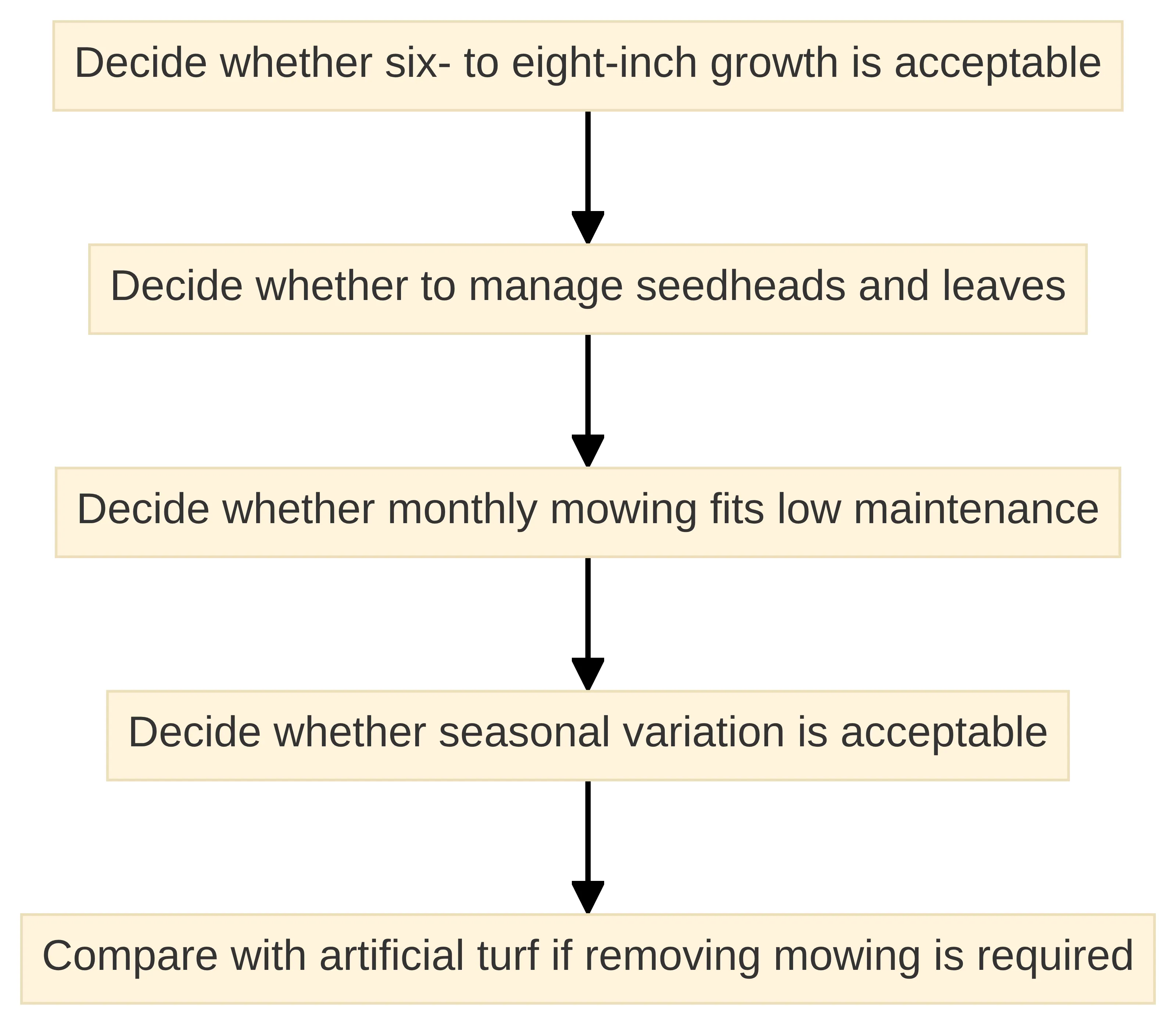
- Decide whether six- to eight-inch growth is acceptable in the intended area.
- Decide whether you will manage seedheads and leaves at the times described for the lawn system.
- Decide whether a monthly manicured schedule still fits your definition of low maintenance.
- Decide whether seasonal variation is acceptable beside paths, patios, play areas, or outdoor living spaces.
If your actual requirement is to remove mowing from the routine rather than reduce its frequency, compare the living option directly with artificial turf instead of calling both options equivalent.
Use Midwest growth patterns without assuming a local species recommendation
K-State identifies Kentucky bluegrass, perennial ryegrass, tall fescue, fine-leaf fescue, and creeping bentgrass among the cool-season turfgrasses commonly used in the Midwest. These grasses generally grow most actively in spring and autumn. K-State lists optimum growth at soil temperatures of 50°–65°F and air temperatures of 60°–75°F.
Those growth patterns give you useful questions for a Kansas or Missouri lawn, but they do not select a species for your property. Established tall fescue has good heat and drought tolerance in the K-State comparison, while several other listed cool-season grasses have less tolerance to heat and drought. That difference is a reason to ask how the proposed living lawn handles the conditions you expect, not a reason to apply one species recommendation to every yard.
Use the regional growth context to build a practical screening list:
- Which grass or plant mix is being considered for the area?
- During which seasons should you expect the strongest growth?
- What mowing height and schedule will preserve the intended appearance?
- How will the plan handle heat or drought conditions that affect your particular site?
- What leaf management and late-season care will be required?
- Does the expected height work beside the paths, doors, patio, or play space?
The key distinction is between regional context and a site-specific recommendation. Midwest cool-season patterns can help you understand why a living surface may grow more actively during particular parts of the year. They cannot, by themselves, establish which plant, seed mix, mowing schedule, or site treatment will suit your yard. Keep that boundary visible while you compare a living lawn with an artificial surface.
Compare routine work and year-round appearance
Maintenance and appearance are related, but they are not the same criterion. A living lawn may reduce mowing while continuing to grow and change. Artificial turf can replace mowing and provide a consistent appearance, while still needing care suited to the surface. Hall Turf describes our artificial turf as an alternative to traditional grass without watering, mowing, or fertilizing; separate artificial-grass guidance describes occasional cleaning and water as possible care. Keep both statements in view rather than converting low maintenance into no maintenance.
| Criterion | Reduced-mowing living lawn | Artificial turf |
|---|---|---|
| Mowing | May still require mowing for seedheads, height, leaves, or a manicured appearance | Replaces routine mowing, but does not remove every care task |
| Growth | Continues to grow; the fact sheet describes six- to eight-inch normal growth for its lawn system | Does not grow, so appearance is not governed by seasonal plant growth |
| Appearance | Can be taller and can change with seasons and use | Described in the comparison as staying green year-round |
| Water and care | Requires management appropriate to the living lawn system | Hall Turf describes our artificial turf without routine watering, mowing, or fertilizing; other guidance still identifies occasional cleaning and water as possible needs |
| Main trade-off | Less frequent mowing while accepting growth and seasonal management | Less mowing and a more consistent appearance while accepting surface-specific care and installation cost |
Use the table as a preference test. If you are comfortable managing height, leaves, and seasonal growth, the living option may remain in consideration. If your main goal is to stop routine mowing and keep a consistent green appearance, artificial turf deserves a closer project review. Neither conclusion answers questions about heat, drainage, traffic, or cost; carry those criteria forward.
That is a comparison of routine work, not a promise that every installation has identical care needs. Ask what cleaning, rinsing, traffic management, and other upkeep would apply to the specific system proposed for your yard.
Compare use, traffic, pets, and children separately from appearance
A lawn that looks suitable from the patio may not suit the way you use it. The comparison criteria should include pets, children, foot traffic, drainage or pooling, intended use, preferred appearance, tolerance for seasonal growth, and the area available for the project. Separate those questions from appearance so a green surface is not treated as proof that it will handle your household’s routine.
The AGL source says its artificial-grass products are designed to withstand pets, children, and heavy foot traffic. That statement applies to the products discussed by that source; it should not be generalized to every artificial-turf product. Hall Turf’s guidance also treats active dogs as a reason to consider more resilient grass that can withstand vigorous activity without visible wear. Product selection and the way the area is used therefore belong in the same conversation.
| Use question | What to examine in a living lawn | What to examine in artificial turf |
|---|---|---|
| Pets | Whether growth, mud, and seasonal appearance fit the way your pets use the yard | Whether the proposed product is specified for pet use and how its care requirements match your routine |
| Children | Whether the intended height and surface condition fit play and everyday movement | Whether the proposed product is designed for the expected child and foot traffic rather than relying on a general product label |
| Frequent traffic | Whether repeated use could leave the living surface patchy or muddy as seasons and use change | Whether the product and installation are intended for the expected traffic level |
| Drainage or pooling | Where water collects and how that affects the living area | How the proposed system addresses the site’s existing water conditions |
| Main purpose | Whether you want a growing lawn with seasonal variation | Whether you want a consistent surface for a defined residential use |
Walk the area while asking what happens during normal use. Mark the route your dog takes, where children play, where people cross the yard, and any place water collects. Note whether you want a lawn for viewing, casual activity, repeated traffic, or a defined pet area. Those observations do not determine suitability by themselves, but they give you specific questions instead of relying on a product name or a general promise.
Treat heat, drainage, and water as questions to verify
Heat comparisons require conditions, not a simple label. Artificial turf can retain more heat than natural grass under some comparisons, but heat comparisons depend on whether natural turf is irrigated, and evidence is limited when artificial turf is compared with both irrigated and unirrigated natural turf. Use sun exposure, irrigation, surface conditions, and intended use as questions to resolve rather than declaring one material universally cooler.
Drainage deserves its own review because pooling can change how you experience either lawn alternative. Before you choose, identify where water stands after rain, whether runoff crosses the proposed area, whether downspouts discharge nearby, and whether the area connects to a patio, walkway, or low point. The comparison framework supports considering drainage or pooling, but those facts do not establish how your particular site should be designed.
Water also means different things in the two systems. Hall Turf describes our artificial turf as an alternative without watering, mowing, or fertilizing, while artificial-grass guidance still identifies occasional water as a possible cleaning need. A living lawn has growing plants and a care schedule. Ask whether your priority is reducing routine irrigation, reducing mowing, simplifying cleaning, or changing the entire surface; those are related goals but not identical ones.
Use this verification list before making a heat or drainage conclusion:
- Which parts of the area receive direct sun, and when?
- Where does water collect or cross the proposed lawn?
- Is irrigation present, planned, or intentionally absent?
- How will people, pets, or children use the surface during warm conditions?
- What cleaning or watering routine applies to the proposed artificial surface?
- Which site conditions still need a project-specific answer?
Put upfront cost beside continuing obligations
Cost should be divided into the amount required to establish the surface and the work required after it is in use. A comparison describes artificial grass as having a much higher upfront cost than reduced-mowing alternatives. That comparison is not a Kansas- or Missouri-specific price, so use it as a reason to request a project-specific scope rather than as a budget figure.
| Cost question | Reduced-mowing living lawn | Artificial turf |
|---|---|---|
| Upfront work | Establishment and preparation depend on the lawn approach and area | Installation has an upfront cost that a general comparison places above reduced-mowing alternatives |
| Recurring work | Mowing, leaves, seedheads, height management, and seasonal care may remain | Routine mowing is removed, while cleaning and occasional water may still be part of care |
| Long-term calculation | Depends on the care schedule and the value you place on a living surface | Depends on project scope, maintenance, environmental factors, and the value of reduced routine work |
| Budget action | Define the appearance and maintenance schedule you will accept | Request a project-specific scope instead of applying a general price comparison |
Build your comparison around the obligations you can actually measure. Estimate how often you mow, water, fertilize, remove leaves, or repair worn areas now. Then list the artificial-turf care you would accept, including cleaning and water when applicable. Avoid presenting a precise savings figure unless you have your own property measurements and project scope; the general cost information does not establish a local price or complete lifecycle calculation.
Make the comparison symmetrical by using the same area, intended use, and time horizon for both options. A front lawn used mainly for appearance should not be compared with an artificial-turf estimate for a separate pet area, and a general statement about upfront cost should not be treated as a full account of future care. Keeping the area and purpose consistent makes the trade-off easier to see without pretending that the available information supplies a local price.
For the reduced-mowing option, record the work that remains part of the lawn system: mowing for seedheads or height, leaf management, late-season care, and any mowing schedule needed for the appearance you want. Also record whether the expected six- to eight-inch growth and seasonal variation fit the intended space. These details turn “less mowing” into a set of obligations that can be compared with the work you perform now.
For artificial turf, record the surface and installation questions that remain open rather than assigning a generic maintenance cost. The relevant record can include the approximate area, current surface, separate zones, access, places where water collects, intended pet or child use, and the cleaning or occasional water routine discussed for the proposed system. Those details do not calculate a price, but they identify the project information needed for a more specific discussion.
Separate one-time and continuing considerations in your notes. Establishment or installation is one part of the comparison. Mowing, watering, fertilizing, leaves, seedheads, cleaning, rinsing, and other care are continuing considerations. The value of reduced routine work also depends on which tasks matter most to your household; someone trying to reduce mowing may weigh the options differently from someone primarily concerned with mud, seasonal appearance, or a defined pet area.
Record uncertainty instead of filling it with an assumption. The supplied comparison does not establish Kansas- or Missouri-specific pricing, a complete lifecycle calculation, or how a particular site will be prepared. If the property has multiple zones, keep each zone’s use, area, drainage observations, and appearance goal separate. A mixed project may therefore need more than one comparison, even when all zones are on the same residential property.
Your cost notes can finish with a short list of unresolved questions: which work is included in the proposed scope, which care remains after installation, which site conditions could change the scope, and which product-specific information supports the intended use. This record gives Hall Turf a defined project to discuss while keeping general cost information, household preferences, and property observations distinct.
Choose by the maintenance trade-off you can live with
The choice becomes clearer when you state which maintenance trade-off fits your household. A reduced-mowing living lawn can suit you if you accept growth, a taller appearance, seasonal variation, and occasional mowing for height or appearance. Artificial turf can suit your project direction if replacing routine mowing and maintaining a consistent green appearance matter more than avoiding a higher upfront cost and surface-specific care.
Use these decision branches:
- Choose the living option for further evaluation if you want a plant-based surface and can manage its growth, height, leaves, seedheads, and seasonal appearance. Next action: write down the expected mowing schedule and the appearance you will accept.
- Move artificial turf into project review if your central goal is to remove routine mowing and keep a consistent green surface for a defined use. Next action: record the intended traffic, pets or children, drainage conditions, and area size before seeking a project scope.
- Keep both options open if you like the appearance of a living lawn but do not yet know how much growth or care you will accept. Next action: compare the same area, use, maintenance schedule, and cost assumptions side by side.
Do not make “maintenance-free” the pass-or-fail standard. The living option may still need mowing, and artificial grass may still need cleaning or water. A more useful standard is whether the remaining work, appearance, growth, use limits, and cost fit your priorities. That standard keeps the decision practical without promising that either surface eliminates every obligation.
If your answer changes by yard zone, divide the project before deciding. You might evaluate one area for appearance, another for pets, and another for repeated foot traffic. Record the same criteria for each zone: intended use, surface preference, growth tolerance, traffic, drainage, and available area. A mixed decision is still a decision, but each zone needs its own requirements.
Build a quote-ready project brief before contacting Hall Turf
A useful artificial-turf request starts with property information, not a product name. Before contacting Hall Turf, prepare a short brief that describes what the area must do and what conditions may affect the work. This lets you discuss the actual project rather than asking for a generic answer about artificial grass.
Include these details:
- Location: City and state, such as a Kansas or Missouri service area, plus the part of the property where the work would occur.
- Area: Approximate length, width, total square footage, and whether the shape includes curves, narrow passages, or separate zones.
- Current surface: Existing grass, bare soil, mud, hardscape, or another surface, along with any areas that are worn or uneven.
- Use: Everyday lawn, pet area, children’s play, entertaining, foot traffic, or more than one use.
- Traffic profile: Number and size of dogs, children’s activity, frequent walking routes, furniture, or other repeated loads.
- Water conditions: Places where water pools, downspout outlets, runoff routes, irrigation, and any area that stays damp.
- Appearance: Desired height, color consistency, tolerance for seasonal growth, and whether a living lawn remains under consideration.
- Maintenance goal: Which tasks you want to reduce, such as mowing, watering, fertilizing, mud management, or repeated reseeding.
- Budget frame: Whether you are comparing upfront installation cost with continuing lawn work, without treating a general comparison as a local price.
- Property access: Gates, paths, stairs, parking, and other facts that affect how the area can be reached and discussed.
Add photographs or a simple sketch if they help explain the area, and mark the places where pets, children, or foot traffic concentrate. A written record of water movement is especially useful because drainage or pooling belongs in the project discussion. Keep observations separate from conclusions: write “water collects beside the patio after rain,” not “this site needs a particular drainage system.”
Finish the brief with the questions you want answered:
- Which proposed surface is intended for the use you described?
- What care does that product require after installation?
- How does the proposed system address the drainage conditions you recorded?
- Which product claims apply to the actual product under consideration?
- What project assumptions would change the scope or cost?
This checklist does not determine whether artificial turf suits your property. It gives you a clear starting record for a project-specific discussion.
Use documentation to test the proposed artificial-turf system
Evaluate the proposed system as a complete response to your yard’s requirements, not as a generic green surface. Active dogs may require more resilient grass capable of withstanding vigorous activity without visible wear. The AGL passage limits its claims to AGL products, and Hall Turf’s dog-turf guidance identifies resilience as a consideration for vigorous activity. Ask which statements apply to the proposed system and under what conditions.
Ask for a written description of the proposed system and use it to check five areas:
- Surface identity: What product or product family is being proposed, and which stated characteristics belong to it?
- Use fit: What information supports the intended pet, child, or traffic use?
- Care: What cleaning, rinsing, water, and routine care should you expect?
- Water conditions: How does the project discussion account for pooling, runoff, and the existing surface?
- Boundaries: Which performance statements depend on product selection, site conditions, maintenance, or a particular use pattern?
If the proposal refers to product certifications, CAD files, or testing documentation, ask to see the documents and identify the product, system component, test condition, and intended use that each document covers. Documentation is useful only when you can connect it to the surface being proposed and to the job your yard must perform. A general statement about artificial turf does not answer a product-specific or site-specific question.
Keep heat and maintenance limitations beside the conclusions they affect. Ask how warm-surface questions should be evaluated for your exposure and use, because heat comparisons depend on conditions. Ask what occasional cleaning or water means for your routine, because low maintenance does not necessarily mean no care. These questions make the proposed system easier to compare with a living lawn without turning a general claim into a guarantee.
Request a project-specific Hall Turf quote when the trade-off fits
The decision is ready for the next stage when you can state the trade-off plainly. Choose the living option for further evaluation if you accept growth, seasonal variation, and the mowing or leaf work that remains. Move toward artificial turf if replacing routine mowing and maintaining a consistent appearance fit your use, while the higher upfront cost, cleaning questions, drainage review, and product-specific limits remain acceptable. A qualified professional must decide whether a particular system suits your property; this guide gives you a project brief and questions, not an individualized site assessment.
Bring the area measurements, use profile, traffic details, water observations, appearance goals, maintenance expectations, and cost questions together before you take the next step. That information gives Hall Turf a defined residential project to discuss and gives you a clearer basis for evaluating the proposed artificial-turf system.