
A quote brief for one defined residential use
A synthetic-turf quote should answer a narrower question than whether artificial grass is generally appealing: what is being installed for this one residential use? Artificial grass is often chosen for minimal upkeep, resistance to wear, and a year-round appearance. Those reasons explain why a homeowner may consider it, but they do not identify the materials and work included in a proposal.
The practical tool for this article is a quote brief. It connects one intended use with the scope lines that should be visible when a Kansas or Missouri homeowner requests pricing:
| Intended use | Detail to state | Scope lines to locate |
|---|---|---|
| Everyday lawn | Whether the area is mainly for appearance, walking, and entertaining | Measured area, turf selection, base preparation, edging, and labor |
| Pet area | Whether active dogs will use the space | Turf selection, infill, drainage-related work, and maintenance considerations |
| Play space | Who will use the area and the expected activity | Turf and infill documentation, base preparation, edging, and seams |
| Putting practice | Whether the project calls for a smooth, level finish | Turf choice and the preparation used for that surface |
These entries are prompts for a proposal, not product verdicts. They keep different residential uses from being treated as interchangeable. A detailed quote may itemize materials, labor, base preparation, infill, edging, and extras such as sprinkler relocation or drainage upgrades. When one of those items is relevant to the use, its presence or allowance should be visible rather than hidden inside a single surface total.
The installed system also includes work that is easy to overlook when reading a headline price. A typical installation may include removing existing grass or other landscaping, preparing an aggregate base, trimming turf to the site, aligning the grain, connecting seams, and anchoring the turf. Installation guidance describes this work as physically demanding and dependent on specialized tools and skill, so a proposal should make the priced work identifiable.
Base material is one example of a scope choice. Crushed rock or Class 2 road base is commonly used for stability and drainage, while decomposed granite may suit putting greens or other smooth, level areas. One installation guide gives a general 2–4-inch sub-base range adjusted to project needs and calls for thorough compaction. More road base may strengthen and dry the surface but can also increase labor costs; the proposed material, depth, and related labor therefore belong in the quote discussion.
Material documentation is another use-dependent question. Because turf materials and infills differ, ask for product-specific material-safety and lead-free-compliance documentation instead of assuming every product has the same profile. Infill choices also affect the scope: silica-sand infill is generally described as more affordable, while organic options such as cork or coconut fiber may require a larger investment. Maintenance can include cleaning and minor repairs as part of extending turf life.
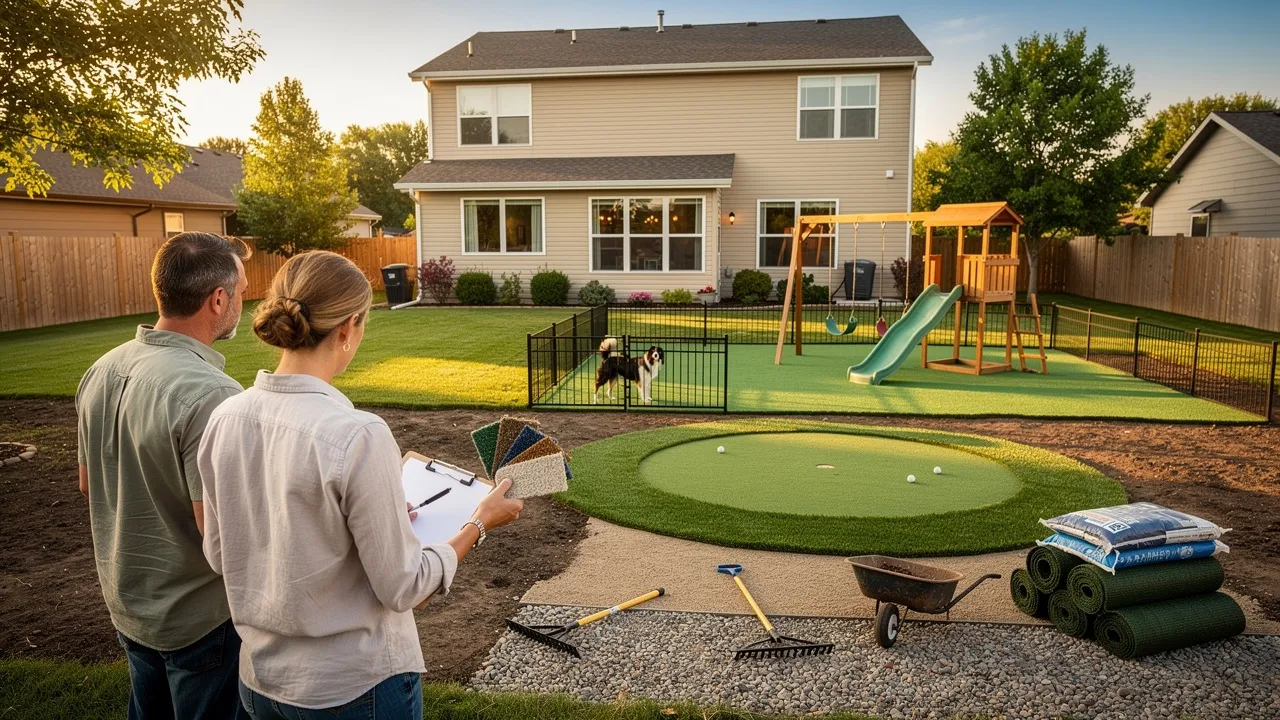
When requesting a Hall Turf quote, bring a brief that names the single use, describes the existing surface and access in plain terms, notes relevant drainage observations or nearby features, and lists the components you expect the proposal to address. The purpose is not to predict a final price from a headline number. It is to read turf, preparation, installation, and possible extras as parts of one defined residential project.
Map lawn, pet, play, and putting-green uses to different priorities
Residential synthetic turf uses create different design questions, so identify the dominant use before comparing products. The following map gives you a starting point for the scope conversation.
- Lawn and landscaping: Focus on the area’s appearance, walking patterns, edges, transitions, and the amount of routine care you want to perform. Artificial grass is often selected for a year-round appearance and minimal upkeep, while the installation still depends on suitable preparation beneath the surface.
- Pet area: Focus on the dog’s activity level, the location of the area, cleaning expectations, and the drainage and infill questions that belong in the quote. Hall Turf states that active dogs may require more resilient turf capable of withstanding vigorous activity without visible wear. That is a use-specific selection question, not a universal promise about every turf product.
- Play space: Focus on the children’s activities, surrounding surfaces, impact-related design questions, and product documentation. Do not treat a general lawn product as automatically appropriate for a play area; ask which materials and installation details apply to the intended use.
- Putting green: Focus on the playing surface, levelness, contours, cups, fringe, and the practice goal. A putting green is a specialized project rather than a lawn with a different color, so describe the playing features you want before asking for pricing.
Your use statement should also name what the surface must tolerate. Frequent foot traffic, dog activity, furniture, toys, or golf practice each affect the questions you need answered. The purpose is not to select a product from a label alone. The purpose is to make the requested scope specific enough that the quote addresses the use you actually have.
If two uses share one yard, separate them on your property sketch. A general lawn beside a dog area may require different priorities for cleaning, access, edging, or material selection. A play space beside landscaping may also need its own boundary and documentation questions. Treat each zone as a defined part of one project, and ask for the scope of each zone rather than accepting one broad description of “synthetic turf.”
Separate lower routine maintenance from the full ownership trade-off
Artificial turf can reduce the routine work associated with natural grass, but lower routine maintenance does not mean no ownership work. Hall Turf states that artificial turf can save homeowners time, water, and maintenance costs, and Hall Turf’s homeowner guidance describes its artificial turf as requiring less maintenance than natural grass, which typically involves mowing, watering, and fertilizing.
Artificial turf still belongs in a maintenance plan. Hall Turf recommends budgeting for cleaning and minor repairs as part of artificial-turf maintenance. Those tasks should be treated as part of ownership rather than as unexpected exceptions. Ask what cleaning your intended use calls for, how the surface will be inspected, and which minor repairs should be anticipated over time.
Use this distinction when comparing options:
- Routine effort: Identify the mowing, watering, fertilizing, and other recurring work you want to reduce.
- Installed-system care: Identify cleaning, minor repairs, edge care, and any care associated with the selected infill or surface.
- Project obligations: Identify the preparation and construction work required before the finished surface is usable.
Natural grass and synthetic turf place effort in different parts of ownership. Natural grass commonly requires recurring lawn care. Synthetic turf shifts attention toward the condition of the installed system and the care needed to keep the area usable. Neither comparison should be reduced to a promise that one option is maintenance-free.
Your decision becomes clearer when you estimate the work you are trying to avoid and write down the work you are willing to perform instead. If you dislike mowing and watering but can manage periodic cleaning, synthetic turf may fit the way you want to use the yard. If you want a surface with no ongoing care at all, the trade-off deserves closer attention before you request a quote.
Compare synthetic turf with natural grass on comfort and environmental trade-offs
Synthetic turf and natural grass involve different comfort, maintenance, and environmental trade-offs. Natural grass can provide evaporative cooling and ecosystem benefits such as carbon capture, dust reduction, habitat support, and soil-health benefits. Hall Turf also describes artificial turf as a low-maintenance option that can involve ecological challenges such as heat retention and waste management.
An Illinois Extension source reports that natural-grass athletic surfaces are cooler and more forgiving for sliding than synthetic fields, which can become hot. That source addresses athletic-field conditions, so use it as a reason to ask about surface comfort and shade rather than as a precise prediction for your residential yard. Your site, use, and local conditions still matter.
| Decision factor | Synthetic turf | Natural grass |
|---|---|---|
| Routine care | Often selected for minimal upkeep; plan for cleaning and minor repairs. | Typically involves mowing, watering, and fertilizing. |
| Surface comfort | Ask how heat exposure, shade, use, and the selected system will affect your plans. | Can provide evaporative cooling, and natural-grass athletic surfaces are reported as cooler in the cited comparison. |
| Environmental considerations | Low-maintenance convenience can come with heat-retention and waste-management questions. | Can provide carbon capture, dust reduction, habitat support, and soil-health benefits. |
| Use under activity | Can provide a uniform, resilient surface in the cited artificial-grass research. | Weather and heavy use may leave natural grass uneven or patchy. |
The table is a decision aid, not a prediction for your property. Ask how the proposed surface will function in the specific area where you intend to walk, play, entertain, or let pets move. A sunny south-facing area, a shaded side yard, and a covered patio conversion do not present the same planning questions.
Water use also needs careful wording. Hall Turf states that artificial turf can save homeowners water, but your actual result depends on what you replace, how you maintain the property, and what other landscape areas remain. Compare the complete landscape plan rather than judging a single surface in isolation.
Natural grass is a reasonable alternative when cooling, sliding comfort, habitat, soil, or a living landscape are high priorities for you. Synthetic turf is worth further consideration when reducing routine lawn work and maintaining a consistent surface matter more. Write down which priorities control your decision before asking for a material recommendation.
Test the property conditions that determine residential fit
Property conditions determine whether a residential synthetic-turf plan is straightforward or requires additional preparation. Examine the site as a construction area, not only as a patch of grass.
Start with these questions:
- What covers the area now: natural grass, soil, mulch, concrete, pavers, or another surface?
- Is the ground level enough for the intended use, or are slopes, low spots, ridges, and transitions visible?
- Where does water go after heavy rain, and are there places where water collects?
- How will materials and equipment reach the work area?
- Are fences, gates, retaining walls, trees, sprinkler lines, downspouts, or utility features close to the proposed edge?
- Will the finished surface meet a patio, driveway, walkway, foundation, or existing concrete?
A typical installation may include removal of existing grass or landscaping, aggregate-base preparation, precise trimming and grain alignment, seam connection, and anchoring. A selected installation guide describes crushed rock or Class 2 road base as commonly used for stability and drainage, while decomposed granite may suit putting greens or other smooth, level areas. The right preparation depends on the project rather than on a single universal layer specification.
One installation guide gives a general sub-base range of 2 to 4 inches, adjusted to project needs, followed by thorough compaction. More road base may strengthen and dry the surface, but it can also increase labor costs. Use those points to ask what the proposed base depth and material are intended to address; do not assume that a published range automatically applies to your yard.
Existing concrete deserves its own question. Hall Turf states that concrete condition must be assessed before installing artificial grass over it to help establish a solid foundation. Note cracks, settlement, drainage routes, and surface transitions in your property brief. Do not treat a concrete area as ready for turf merely because it is already hard and level.
For a Kansas or Missouri home, record the areas that become difficult after rain, the places exposed to strong sun, and the paths used most often. These observations do not determine the design by themselves, but they give the installer a factual starting point for discussing base preparation, drainage, access, and use.
Require material and infill documentation for family and pet use
Product documentation belongs in the decision whenever children, pets, or frequent close contact are part of the intended use. A National Center for Health Research passage reports that the CDC has warned that some plastic grass, infill, and rubber playground materials may present lead or chemical-exposure concerns. A separate safety source recommends asking for product-specific material-safety and lead-free-compliance documentation rather than assuming every product has the same profile.
Ask for the documents that identify the proposed materials and their stated compliance information. Keep the request specific:
- What turf material and infill are proposed for this use?
- What material-safety documentation applies to each component?
- What lead-free-compliance documentation is available for the selected products?
- Does the documentation cover the exact product or only a product family?
- Are different materials proposed for a lawn, pet area, or play area?
Infill is the material placed between artificial-grass blades. The selected guidance describes infill as a component that can add weight, support drainage and blade uprightness, and address odor or biological-growth concerns depending on the product. Infill choices also differ in price: silica sand is generally described as more affordable, while organic options such as cork or coconut fiber may require a larger investment.
Those descriptions are reasons to ask what the selected infill is intended to do, not reasons to assume a particular option is suitable for your family or pets. Product choice, use, cleaning expectations, and site conditions belong together in the scope discussion. If a quote names turf but does not identify infill, request that the material be made explicit before comparing totals.
Documentation does not replace project judgment. It gives you a concrete record of the products under consideration and lets you distinguish a general marketing description from the materials proposed for your property. Keep the documents with the quote so the use, material, and scope remain connected.
Understand the installation work behind a finished surface
Artificial turf installation is a construction process that affects the finished surface long after the grass-like material is delivered. Hall Turf states that professional installation is important for artificial turf. Selected installation guidance describes the work as physically demanding and dependent on specialized tools and skill.
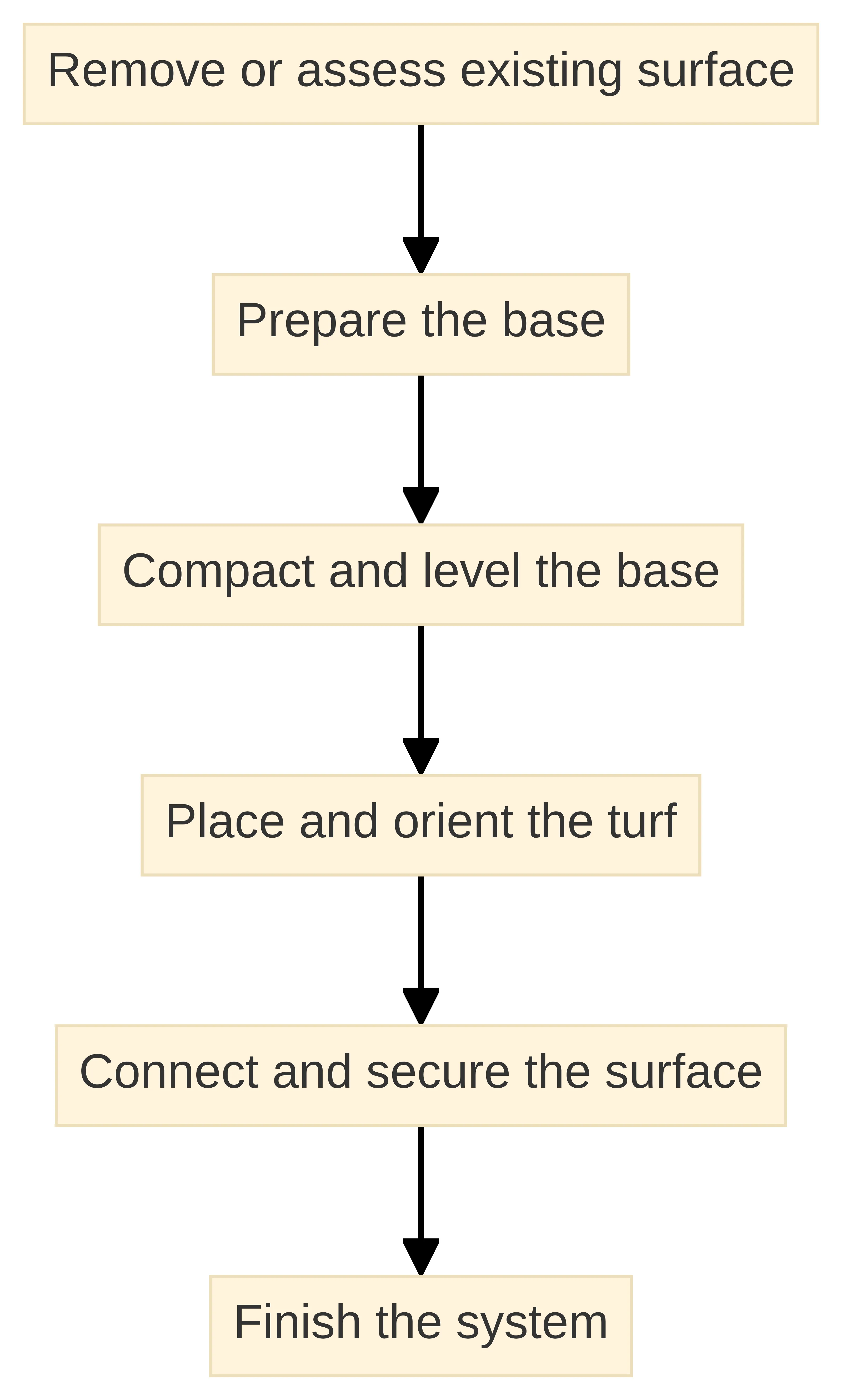
A high-level sequence may include:
- Remove or assess the existing surface. Existing grass, landscaping, concrete, or other material must be evaluated and may require removal or preparation.
- Prepare the base. Aggregate material is placed, spread, and adjusted to create the intended support and drainage conditions.
- Compact and level the base. One guide gives a general 2–4-inch sub-base range based on project needs and calls for thorough compaction until the base is firm and stable.
- Place and orient the turf. The material is trimmed to the site, with the grass grain aligned consistently.
- Connect and secure the surface. Seams are connected and the turf is anchored with nails or landscape pins as appropriate to the installation.
- Finish the system. Infill, edging, transitions, and any additional drainage or sprinkler work are addressed as part of the agreed scope.
The sequence explains why the visible turf surface is only one part of the project. A finished installation depends on the prepared ground, the fit of the pieces, the seam work, the anchoring, and the relationship between the surface and surrounding features.
Access can change the practical scope. A narrow gate, a long material path, stairs, retaining walls, or limited equipment access may affect how preparation materials reach the work area. Include those conditions in your request rather than waiting for a total that assumes easy access.
You do not need to specify the construction solution yourself. You do need to describe the existing surface, the use, the access route, and the visible drainage or grade issues accurately. Then ask the quote to identify which preparation and finishing steps are included.
Read the quote as a complete installed-system scope
A synthetic-turf quote should describe the complete installed system, not just the turf surface. A detailed quote may itemize materials, labor, base preparation, infill, edging, and possible drainage or sprinkler work. Use those categories to see what the total includes and which site conditions remain unresolved.
One Kansas City, Missouri cost source published August 22, 2026, reports an average synthetic-grass installation cost of $5,785, with projects ranging from $3,243 to $8,711. That source presents market estimates, not a Hall Turf quote. The same source says total price varies with project size, selected turf material, and local labor rates. Treat the figures as a planning reference for Kansas City, not as a promise for your property or a substitute for a measured scope.
A useful quote review asks whether the proposal identifies:
- The measured area and the unit used for billing.
- Turf material, infill, and any stated product documentation.
- Removal or preparation of the existing surface.
- Base material, planned depth, spreading, leveling, and compaction.
- Edging, seams, fasteners, transitions, and finish work.
- Drainage changes, sprinkler relocation, or other extras.
- Access assumptions, exclusions, and conditions that could change the total.
If you want a planning cost per square foot, divide the quoted total by the quoted area only after you know which scope lines are included. Keep that calculation attached to the same proposal; a per-square-foot figure from one scope cannot be compared fairly with a figure that excludes base work, edging, drainage, or labor.
More road base may strengthen and dry the surface, but the selected cost guidance also says it can increase labor costs. That is why the lowest visible allowance is not automatically comparable to a more complete preparation plan. Ask what each line is intended to address and whether the amount is based on observed site conditions.
Judge a quote by scope clarity first and total price second. A complete scope gives you something concrete to compare, question, and approve.
Prepare a property brief before requesting pricing
A property brief turns a general interest in synthetic turf into information an installer can use to discuss scope and pricing. Prepare the brief before requesting a quote so the conversation starts with the area’s actual purpose and conditions.
Include these items:
- Location and access: Give the property location, the route from the street or driveway, gate widths, stairs, and other access limits.
- Use by zone: Mark lawn, pet, play, entertainment, walkway, and putting-green areas separately.
- Measurements: Record approximate length and width for each zone, plus irregular edges, curves, and transitions.
- Existing surface: Note grass, soil, mulch, concrete, pavers, slopes, low spots, cracks, and visible settlement.
- Water observations: Mark places where water collects, downspouts discharge, or the ground becomes difficult to use after rain.
- Activity level: Describe foot traffic, dog activity, children’s play, furniture, sports, or practice equipment.
- Material questions: List the product-safety, lead-free-compliance, turf, and infill documentation you want.
- Scope questions: Ask about removal, base preparation, compaction, edging, seams, drainage, sprinkler work, and maintenance.
Photos can make the brief more useful. Take wide views of the whole area and closer views of gates, slopes, concrete cracks, downspouts, low spots, and transitions. Add a simple sketch showing dimensions and nearby structures. Mark which measurements are approximate so they are not mistaken for a final takeoff.
Use the brief to separate facts from preferences. “The gate is 36 inches wide” is a site observation. “I prefer a shorter-looking blade” is a material preference. “I want the dog area to be easy to clean” is a use requirement. Keeping those categories distinct helps you understand which questions relate to site preparation and which relate to product selection.
If you have an active dog, state the activity level rather than simply writing “pet turf.” Hall Turf states that active dogs may require more resilient turf to withstand vigorous activity without visible wear. If the proposed area is concrete, identify its condition because Hall Turf states that concrete condition must be assessed before artificial grass is installed over it.
Send the same brief with each quote request. Consistent inputs make scope differences easier to see.
Confirm fit and scope with Hall Turf’s documented quote
Synthetic turf is worth pursuing when the intended use, site conditions, maintenance trade-offs, material documentation, and installed scope fit the way you plan to use the property. You do not need to decide from the surface appearance alone. Bring your use statement, property brief, measurements, photos, drainage observations, and documentation questions into the quote conversation.
A qualified professional should determine whether the proposed system suits your individual property and intended use.
If those questions are ready and you want project-specific scope and pricing for your Kansas or Missouri home, the next step is to request a free quote.
What should a homeowner confirm before requesting a synthetic-turf quote?
What factors should I consider when deciding on synthetic turf for my Kansas or Missouri home?
Consider the intended use of the turf, such as whether it will be a lawn, pet area, play space, or putting green. Evaluate site conditions like drainage, existing surfaces, and access. Also, think about maintenance requirements and environmental impacts.
How does synthetic turf compare to natural grass in terms of maintenance?
Synthetic turf generally requires less routine maintenance than natural grass, which needs regular mowing, watering, and fertilizing. However, artificial turf still requires periodic cleaning and minor repairs.
What are the installation steps for synthetic turf?
Installation typically involves removing existing grass or landscaping, preparing the base with aggregate material, compacting it, placing and orienting the turf, connecting seams, and finishing with infill and edging.
What should I include in a property brief before requesting a quote for synthetic turf installation?
Include details about the property location, access routes, intended use by zone, measurements, existing surfaces, water drainage observations, activity levels, and any specific material or scope questions.
What documentation should I request regarding the safety of synthetic turf materials?
Request product-specific material-safety and lead-free-compliance documentation for the turf and infill materials, especially if children or pets will frequently use the area.
How can I ensure that the synthetic turf installation meets my specific needs?
Discuss your intended use, site conditions, and maintenance expectations with the installer. Ensure that the quote details all aspects of the installation, including materials, labor, and any additional work required.