
Start with the suitability decision
Artificial turf is a synthetic surface designed to resemble natural grass, but its suitability depends on how you use the space, how the site handles water, and what upkeep you are prepared to continue. The central decision is not whether the surface looks like grass. It is whether the installed system fits your property and priorities in Kansas or Missouri.
Synthetic grass may make sense when you want to reduce routine mowing, watering, and fertilizing, or when you need a defined surface for a backyard, pet area, play space, landscape feature, or putting green. Those conveniences come with continued cleaning and minor repair needs.
Your first suitability screen should answer four questions:
- What will happen on the surface? Everyday foot traffic, dogs, children’s play, decorative landscaping, and golf practice call for different priorities.
- What does the existing site do with water? A low area, compacted base, slope, or history of pooling deserves attention before material selection.
- What trade-off are you accepting? Lower routine lawn work does not eliminate upkeep, and a surface that changes mowing needs still requires a plan for runoff and other site conditions.
- What must be documented before you decide? Record the intended use, measurements, access, existing surface, drainage observations, and questions about the product and installation scope.
If you cannot describe the intended use or the site’s water behavior, pause before choosing a product. A property-specific assessment is the appropriate next boundary.
A practical decision path is to define the use, inspect the site, compare the trade-offs with natural grass and other landscape choices, and then take a written project brief to a professional. Installation scope can vary by project, and the surface’s lifespan can vary with maintenance and environmental conditions. Use general information to frame the conversation, not to predict the result for your yard.
The result you want from this process is not a universal yes or no. It is a documented explanation of what the space needs, which trade-offs you accept, and which questions still require a site-specific answer.
What artificial turf is and where homeowners use it
Synthetic grass is a manufactured material intended to resemble the appearance and feel of natural grass. Unlike living grass, it can minimize routine mowing, watering, and fertilizing rather than functioning as a living plant system. That distinction makes it a landscape-surface choice with different installation, drainage, maintenance, and end-of-life questions.
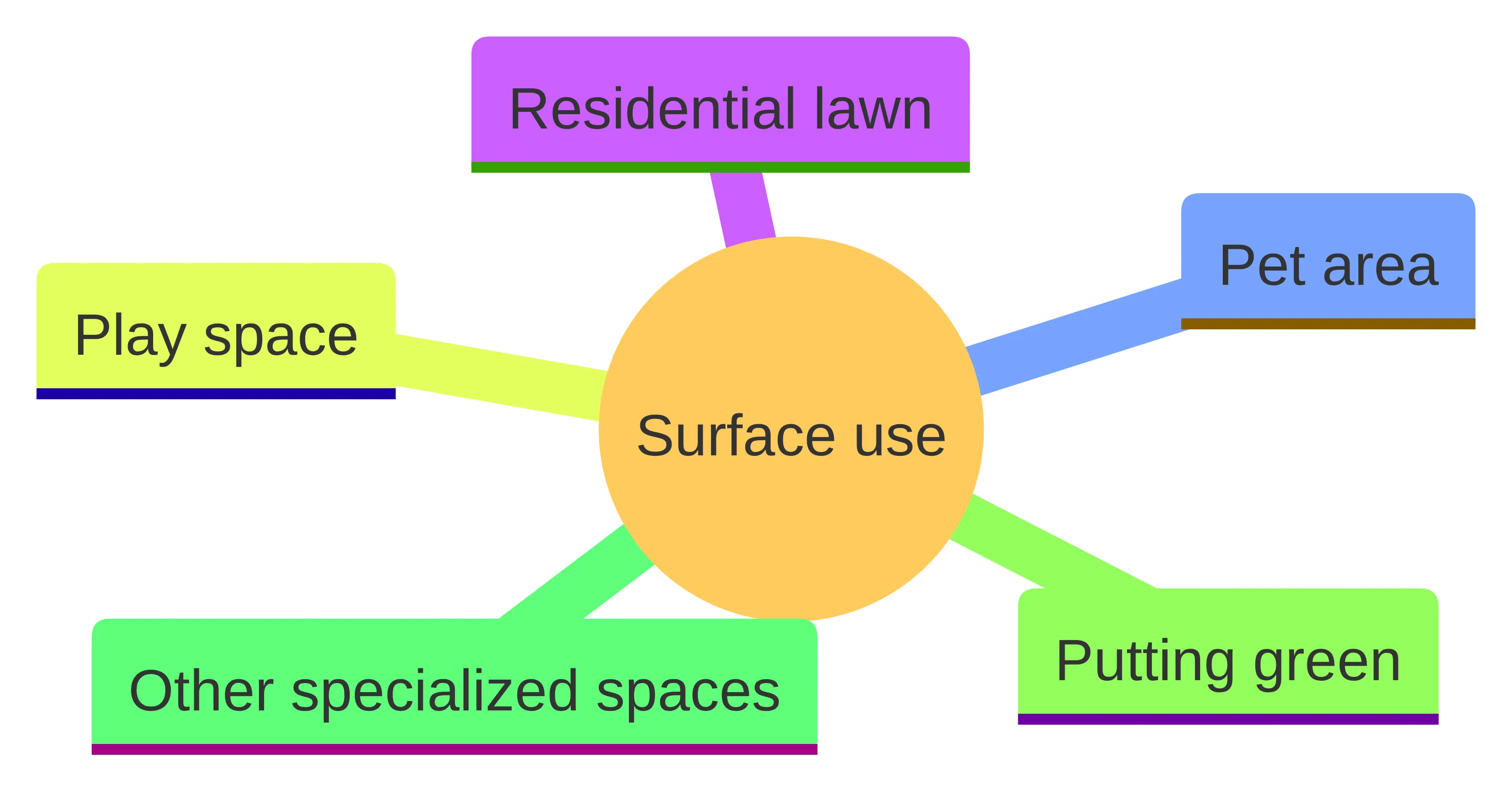
The intended use should guide the material. Common applications include:
- Residential lawns and landscaping: A defined green area, side yard, small courtyard, or landscape accent.
- Pet areas: A designated run or relief area where activity, cleaning, and drainage need to be considered together.
- Play spaces: A surface around children’s play equipment where the planned equipment, fall height, base, and documentation need separate attention.
- Putting greens: A specialized practice area with design requirements that differ from a general lawn.
- Other specialized spaces: Buying guidance also identifies sports areas, rooftops, and balconies as applications that may require different materials.
The same product should not be treated as interchangeable across all of these uses. Start with the activity, then ask what surface characteristics and installation details serve that activity.
At Hall Turf, we supply synthetic grass in Kansas City for golf greens, playgrounds, and landscaping, and we offer backyard putting-green installation for golf lovers. If your project is in one of those categories, describe the space by its use rather than calling it only a lawn. That description gives the consultation a clearer starting point.
Match the surface to how the space will be used
Your intended activity should determine the questions you ask about synthetic grass. A lawn, pet area, play space, and putting green may occupy similar-looking outdoor areas, but they do not place the same demands on the surface or the base below it. Write down the primary use first, then list secondary uses such as entertaining, walking through the area, moving furniture, or practicing golf.
This step prevents a common planning error: choosing a general lawn product before deciding what the area must support. The use should come first; product and installation questions follow from it.
A residential lawn or landscape area is usually evaluated around appearance, walking patterns, edges, planting beds, and the amount of routine lawn work you want to avoid. Synthetic grass can minimize mowing, watering, and fertilizing compared with natural grass, and our artificial turf has lower maintenance requirements than natural grass. That does not make the area maintenance-free. Plan for cleaning, inspection, and occasional repairs.
A pet area should be planned around the animal’s activity level and the way you will clean the space. For an active dog, consider a more resilient product designed to withstand vigorous activity and resist visible wear. Describe the number and size of pets, their usual route, and whether the area will be used as a dedicated run or as part of the main yard. Ask how the proposed surface, base, edges, and drainage plan address that use.
A children’s play space needs a more specific conversation than a general landscape installation. Identify the equipment, its planned location, the available fall area, and any surface documentation you expect to receive. Do not treat a grass-like appearance as proof that the surface addresses fall-height requirements. Ask for the product and installation information that applies to the exact play layout, then keep the project within what that documentation supports.
Because a play-area decision depends on layout as well as material, ask Hall Turf, a licensed contractor, for the project documentation that applies to the proposed system, including relevant product certifications, CAD files, and testing documentation. Use those records to compare the planned equipment footprint, fall area, base, and surface details. They do not replace a site assessment, but they make the scope reviewable and help identify which assumptions are documented versus still open. Record which questions the documents answer and which remain open; unresolved items should stay in the consultation rather than be inferred from a product label.
A backyard putting green is a specialized use rather than a lawn with a hole added afterward. Record whether you want practice putting, a defined feature within a larger landscape, or another golf-related use. At Hall Turf, we offer backyard putting-green installation, so include the intended playing area and its relationship to landscaping, pathways, and other yard features when you prepare the project brief.
Balance lower routine maintenance against ongoing upkeep
Synthetic grass can reduce the recurring lawn tasks associated with mowing, watering, and fertilizing. Our homeowner guidance describes our artificial turf as having lower maintenance requirements than natural grass. The practical benefit is a change in the kind of work you do, not the disappearance of all care. Installation does not remove the need to understand cleaning, surface condition, drainage, or repairs.
Your upkeep plan should include:
- Routine cleaning: Decide how leaves, dirt, and ordinary outdoor debris will be removed.
- Inspection: Watch for displaced material, seam or edge concerns, drainage changes, and areas that receive concentrated traffic.
- Minor repairs: Budget for repairs rather than assuming the original installation will never need attention.
- Use-based care: Adjust your maintenance expectations for pets, children, furniture, vehicles, or repeated foot traffic.
- Condition records: Keep the product information and installation details so future questions can be tied to the actual system.
We recommend budgeting for cleaning and minor repairs to help extend the surface’s lifespan. Lifespan varies with maintenance and environmental conditions, so avoid treating any general service life as a promise for your property.
The cost decision has two parts: the initial installation and the later upkeep. High-quality artificial grass can require a significant initial investment compared with maintaining a natural lawn, while our artificial turf can save homeowners time, water, and maintenance costs. Those points can both be true because a lower recurring workload does not establish a particular payback period or guarantee lower total cost for every site. Compare the complete scope and your own maintenance pattern instead of judging the choice by one cost category.
Your comparison should also account for preparation, drainage, access, edges, seams, infill, and any removal work. A surface-only number cannot describe the full project.
Treat drainage as a design question in Midwest weather
Drainage should be treated as part of the surface system, not as a detail to consider after the material is selected. In controlled rainfall experiments, the tested artificial lawns produced greater runoff volumes and proportions than living grass, while living grass retained more water and delayed drainage more effectively. The same study found significantly greater runoff from long artificial grass than from short artificial grass.
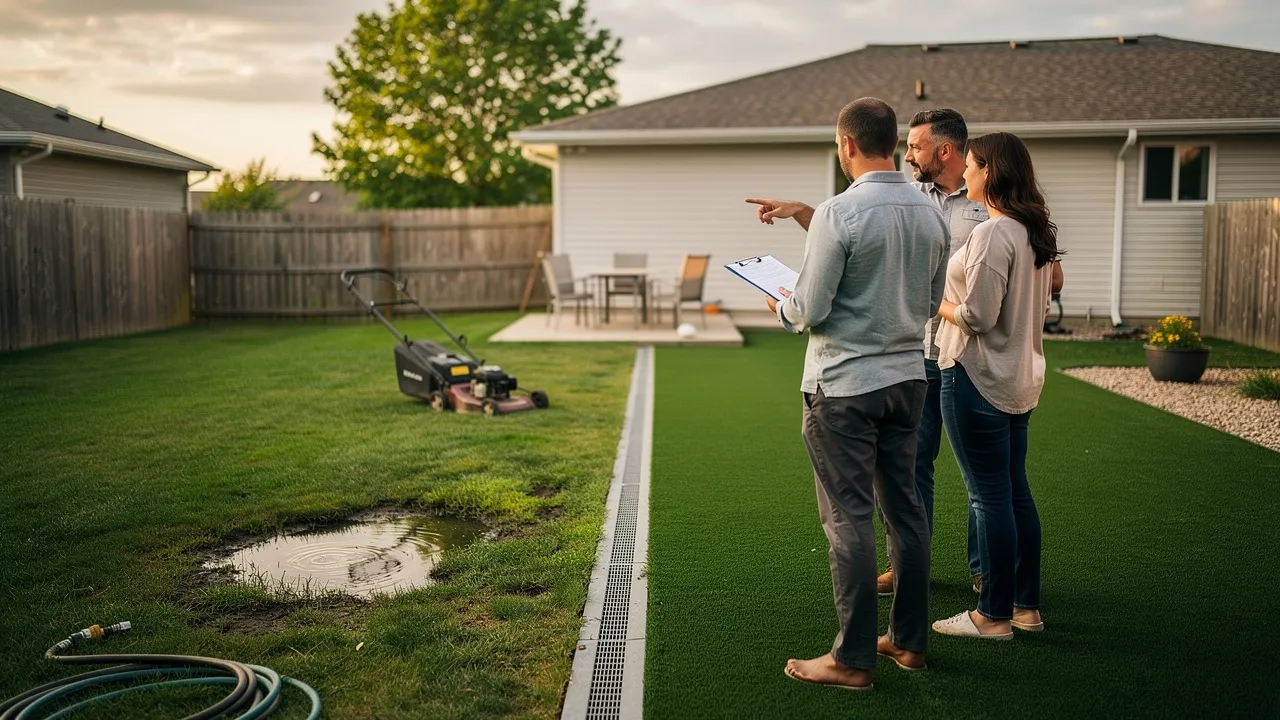
Those findings describe controlled tests, not the result for every Kansas or Missouri yard. Your soil, grade, base, surrounding hardscape, downspouts, and existing drainage path still matter. If your yard pools after storms or sends water toward a foundation, record that observation before requesting a design.
A professional installation outline can include site assessment, demolition, base preparation, drainage planning, turf placement, seaming, infill, and a final walkthrough. That outline comes from a Texas and Florida example, so the exact work in Kansas or Missouri varies by project. Use the sequence as a prompt for scope questions, not as a fixed local specification.
Ask how the proposed installation will address:
- existing low points and slopes;
- soil or base conditions;
- water entering from roofs, patios, or adjacent areas;
- the route water should take during heavy rain; and
- access for preparation and material delivery.
A quote that names only the visible surface may leave the site work unclear. Request a description of preparation and drainage work before comparing totals.
An existing concrete area needs its own suitability check. Before installing synthetic grass over concrete, we assess the concrete’s condition to help establish a solid foundation. Tell us whether the proposed area is soil, concrete, pavers, or another existing surface, and identify cracks, uneven areas, drainage outlets, and places where water collects. The underlying condition can change the work required before the visible surface is installed.
Compare artificial turf with natural grass and other landscape choices
Natural grass, synthetic grass, and water-wise landscaping solve different problems. The comparison below is a planning framework, not a universal ranking; local soil, irrigation, shade, weather exposure, use, and maintenance practices can change the result.
| Choice | Routine work | Water and drainage considerations | Environmental and cost questions |
|---|---|---|---|
| Natural grass | Requires recurring mowing, watering, and fertilizing, with the workload affected by the grass type and site conditions. | A controlled study found that living grass retained more water and delayed drainage more effectively than the tested artificial lawns. | The case study identifies lower surface temperatures, biodiversity support, reduced erosion, and carbon storage among natural-grass benefits. Water use varies; one source states that natural grass can require up to 1 million gallons per year in the United States. |
| Synthetic grass | Can minimize routine mowing, watering, and fertilizing, but still calls for cleaning, inspection, and minor repairs. | The tested artificial lawns produced more runoff than living grass in controlled rainfall experiments. Site drainage design remains necessary. | Initial installation can be significant, while maintenance and water-related costs may change. Product composition, heat behavior, durability, and end-of-life handling require product-specific review. |
| Water-wise landscaping | May use drought-resistant or native plants with maintenance needs that differ from a lawn or manufactured surface. | Water demand and runoff depend on the planting design, soil, irrigation, and rainfall conditions. | A source focused on western U.S. conditions identifies potential habitat, fertilizer, pesticide, and groundwater benefits, but those observations are not a Kansas or Missouri project assessment. |
Use the row that best matches your actual priority, then test that choice against your property rather than assuming one landscape type fits every yard.
Natural grass may deserve closer consideration if cooling, habitat, soil-water behavior, or living vegetation is central to your plan. Synthetic grass may deserve closer consideration if reducing routine mowing and watering is central, provided you address drainage and ongoing care. Water-wise planting may deserve consideration if you want a lower-water landscape with living plants, but the comparison comes from western U.S. conditions rather than Kansas or Missouri.
Choose by stated priorities. Do not treat a broad water-saving or low-maintenance label as proof of a lower total impact or lower total cost for your property. If your priorities conflict, write them down and decide which ones control the project before comparing materials.
Separate supported trade-offs from questions that require current review
Several planning points are clear enough to use now: synthetic grass can reduce routine mowing, watering, and fertilizing; cleaning and minor repairs still belong in the maintenance plan; lifespan varies with maintenance and environmental conditions; and controlled rainfall experiments found more runoff from the tested artificial lawns than from living grass. These points help you frame a project, but they do not determine whether a particular product or yard is suitable.
Other questions need current, product-specific, or site-specific review before you rely on an answer:
- Surface temperature: Ask how the proposed product behaves in direct sun, what shade or use limitations apply, and what information is available for the planned location.
- Play-area fall height: Ask how the exact equipment layout, fall height, base, and surface documentation fit together. Do not infer play suitability from appearance alone.
- Wear and traffic: Describe foot traffic, dogs, furniture, and other concentrated uses. For active dogs, consider more resilient turf designed to withstand vigorous activity and resist visible wear.
- Material and end-of-life handling: Ask what materials are included, how the installed system is maintained, and what removal, reuse, recycling, or disposal pathway applies at the end of service.
- Drainage outcome: Ask which site conditions were considered and where water is expected to move during significant rainfall.
These questions create a boundary around general guidance. They also give you a way to identify unresolved decisions before they become part of an installation scope.
A controlled test cannot predict the runoff, heat, wear, or maintenance experience of your individual yard. Use the findings to ask better design questions, then require the project discussion to address your actual use, site, and product rather than relying on a general promise.
Build a consultation-ready property brief
A consultation-ready property brief should let you describe the project without relying on memory. Prepare these details before you request a site discussion:
- Location and use: Give the city or county, identify the primary use, and list secondary uses such as pets, children, entertaining, or golf practice.
- Measurements: Record the approximate length and width of each area, irregular boundaries, planting beds, paths, steps, and objects that will remain.
- Existing surface: Note whether the area is natural soil, concrete, pavers, an existing lawn, or another material.
- Water behavior: Mark low spots, visible pooling, downspouts, slopes, drainage outlets, and any direction in which water currently travels.
- Access: Describe gates, narrow passages, stairs, parking, and the route for removing existing material or bringing in new material.
- Use intensity: Estimate routine foot traffic, dog activity, play equipment, furniture, or other concentrated loads.
- Maintenance expectations: State which routine tasks you want to reduce and which cleaning or repair work you are willing to continue.
- Open questions: List concerns about product selection, seams, edges, infill, drainage, surface temperature, play documentation, and end-of-life handling.
This brief is a decision aid. It organizes the information needed for a productive discussion; it does not calculate a final design or price.
Professional installation can involve more than placing a roll of material on the ground. A published installation outline includes assessment, removal, base preparation, drainage planning, placement, seaming, infill, and a final walkthrough, while the concrete guidance calls for assessing the existing surface before installation over concrete. Ask which of these categories apply to your property and which categories do not.
The outline is not a fixed Kansas or Missouri specification. Your brief should make the differences visible by documenting the site conditions that could change preparation, drainage, access, or finishing work.
Technical documentation is most useful when it can be tied to the actual property brief. Ask which drawing or specification reflects your measurements and intended use, and whether the cited certifications and testing documentation apply to the selected system. Keep the final scope and supporting records with your project notes so later maintenance questions can be matched to the installed system. This documentation does not determine whether the project is suitable by itself; it gives you a clearer basis for checking what was proposed, what was included, and what remains dependent on site conditions.
When you receive a project discussion or estimate, compare the scope rather than the surface label alone. Check whether the description identifies the measured area, intended use, existing-surface preparation, drainage work, seams, edges, infill, cleanup, and future maintenance expectations. Keep unresolved questions marked as unresolved instead of silently treating them as included.
A written brief also helps you revisit the decision if the design changes. If the use changes from a lawn to a pet run, play area, or putting green, update the brief before judging whether the proposed surface still fits. Bring photographs or a simple site sketch if they clarify access, slopes, obstacles, or areas that collect water.
Move from general suitability to a documented Hall Turf consultation
Use the information you gathered about measurements, use, existing surfaces, access, and drainage to make the next project conversation specific.