
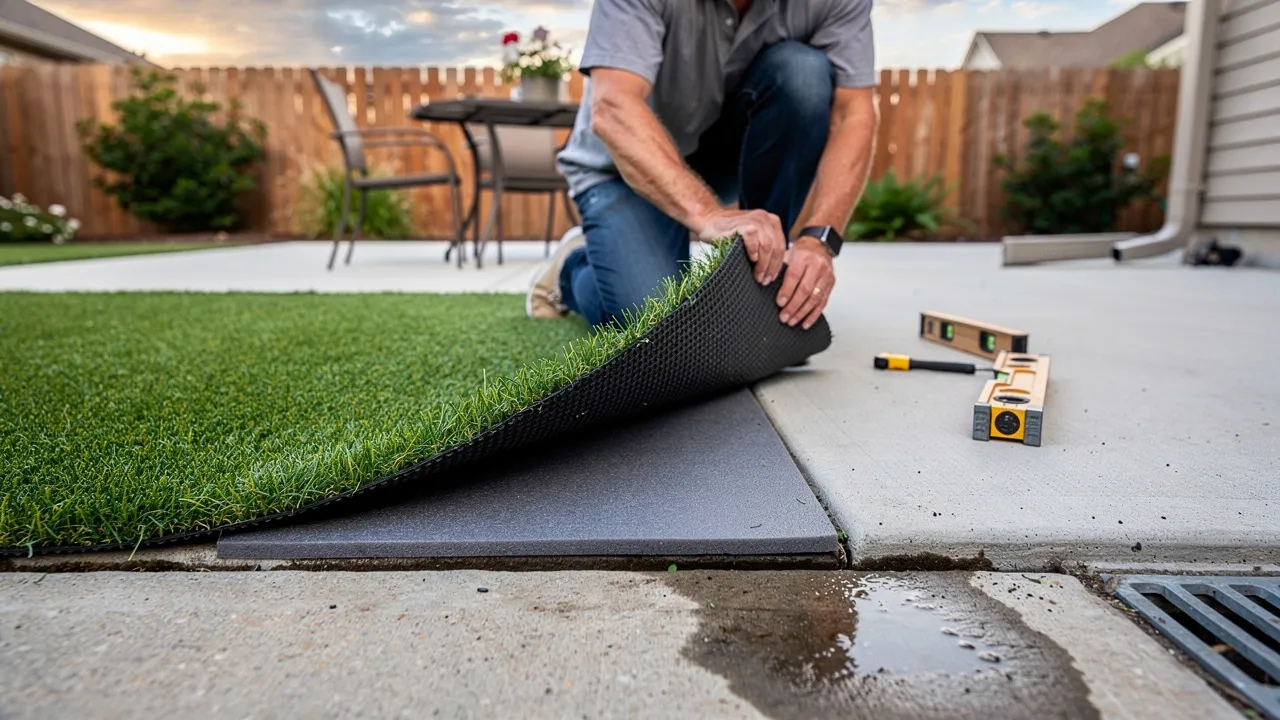

Underlay on concrete is a project-specific decision
Artificial grass can be installed over a concrete patio, balcony, or slab when the surface and installation system are properly prepared. Underlay is not automatically required for every concrete installation. The practical decision depends on what the slab is like, how water leaves the area, how you will use the space, how much cushioning you want, and how the finished system will handle Kansas and Missouri weather.
For a Kansas City homeowner, that means the short answer is conditional: underlay may be useful, and it may be part of the proposed system, but the concrete itself still needs to pass a separate suitability check. A soft pad cannot correct a slab that holds water, moves, crumbles, or has surface defects that will show through the turf.
A concrete-to-turf project has several decisions that are easy to combine incorrectly. Cushioning underlay changes the feel underfoot and may absorb some impact. A drainage mat creates channels or air space for water movement. Surface preparation deals with the condition and smoothness of the slab. These functions are related, but they are not interchangeable.
Some installation guidance describes underlay as usually necessary on concrete because concrete is hard and the pad can soften the surface or absorb shock from scrapes and falls. Other guidance treats underlay as a project-specific choice and gives priority to drainage, slab condition, intended use, and cushioning needs. The useful conclusion is not that one statement cancels the other. The useful conclusion is that you should identify the reason for adding a pad before you approve the complete system.
Kansas City, Overland Park, Olathe, Lee’s Summit, Shawnee, Lenexa, Liberty, Independence, and Blue Springs projects all need the same basic decision sequence: inspect the slab, trace the water path, define the use, and then select the layers. Kansas and Missouri projects also need planning for seasonal freeze-thaw, heavy spring rains, and summer heat. Those exposures make drainage, seam integrity, and snow or ice management relevant during design and installation.
Begin with the slab and the water path. Treat the underlay question as one part of that larger decision.
What cushioning underlay adds beneath artificial grass
Cushioning underlay adds a softer layer between artificial grass and the hard concrete surface. Concrete can feel hard and cold underfoot, while an underlay can make the finished area more comfortable to walk on. Some guidance also describes foam underlay as a way to absorb shock from scrapes or falls during garden play.
That benefit is about feel and impact response. It does not mean that every pad provides the same performance, that every pad drains in the same way, or that a pad resolves a damaged or poorly sloped slab.
A cushioning underlay is more relevant when the hard surface will be noticeable during ordinary use. You may place more weight on comfort when the area is a patio where people walk barefoot, a sitting area, or a space where children play. The same question applies to a small concrete balcony or deck: the available space may be sound, but the finished surface can still feel unforgiving without a cushioning layer.
Use the intended activity to define the requirement. If comfort is a stated project goal, ask which layer supplies it and how that layer still permits water to escape. If comfort is not a priority, the proposal should explain why a cushioning pad is included rather than treating it as an automatic addition.
A cushioning underlay does not replace a drainage solution. A foam pad may soften the surface, while a drainage mat provides channels or air space for water movement. If a pad is used over concrete, the pad should have drainage holes or channels, and the adhesive layout should leave a route for water to escape.
Ask for the function of each layer in plain language. A proposal that lists an underlay should identify whether the pad is intended for cushioning, drainage, or both. If the pad supplies cushioning only, the slab still needs an independent route for water to leave the turf system.
How underlay differs from drainage and surface preparation
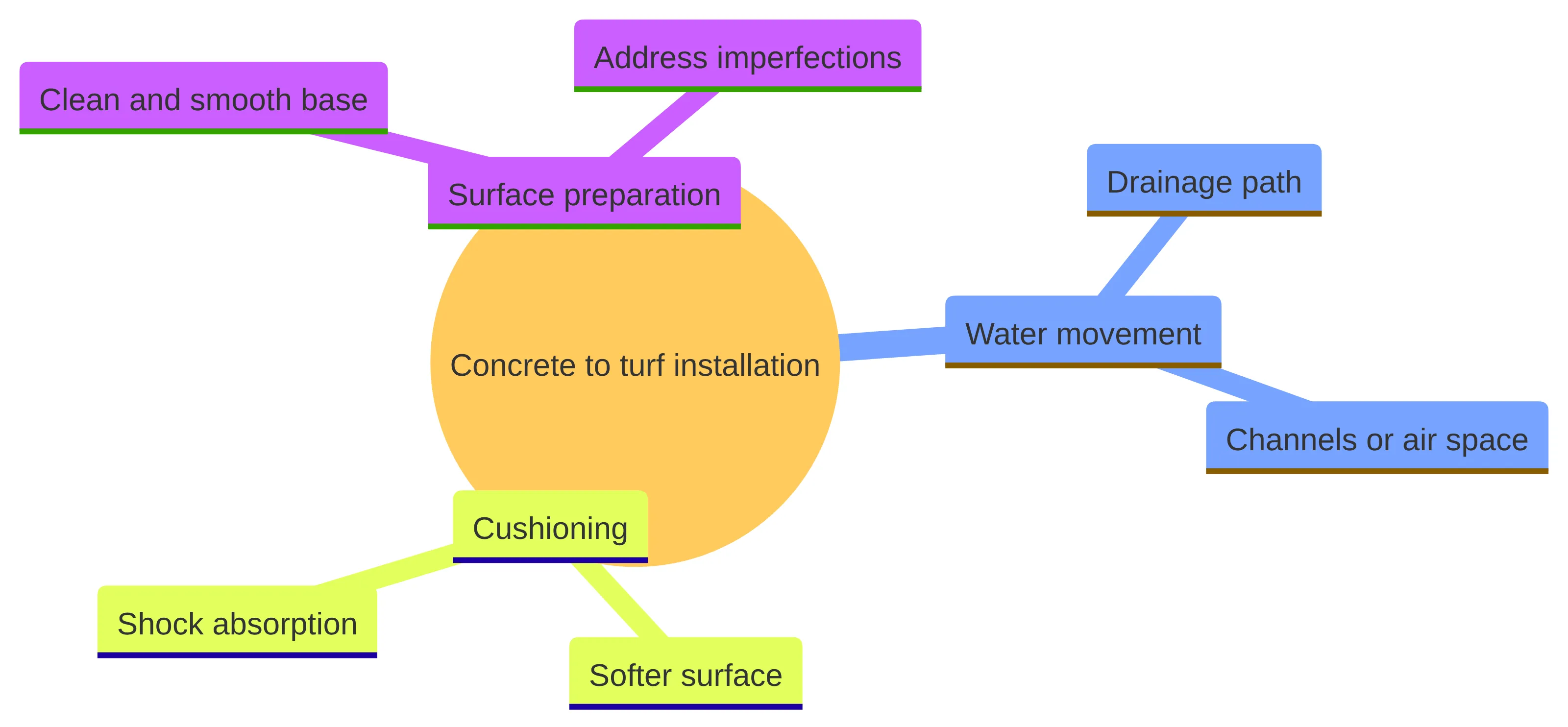
A concrete-to-turf installation has three separate functions to account for: surface preparation, water movement, and cushioning. Surface preparation makes the concrete clean and smooth and addresses imperfections that could show through the artificial grass. Drainage components create a path or channels for water. Cushioning underlay changes the feel and can provide shock absorption.
Surface preparation comes first because the turf follows the shape of the base beneath it. A self-leveling compound may be used to address surface imperfections that could show through the turf. That compound is not a substitute for a drainage mat, and neither component is automatically a substitute for a cushioning pad.
The difference between a cushioning pad and a drainage mat matters most when the concrete has limited drainage or the area receives regular rain and wash water.
| Component | Main function | Question for your project |
|---|---|---|
| Surface preparation | Creates a clean, smooth base and addresses visible imperfections | Will cracks, ridges, pits, or uneven areas show through the turf? |
| Cushioning underlay or shock pad | Adds softness and can absorb some impact | Will people, children, or pets benefit from a more forgiving surface? |
| Drainage mat | Creates channels or air space for water movement | Where will rain, wash water, or other moisture go after it reaches the system? |
The table separates the jobs; it does not establish that every project needs every layer. Select each component for a defined site condition or use requirement.
Adhesive placement is part of the drainage discussion on concrete. Guidance for installing a pad over concrete describes cleaning and drying the surface, using a pad with drainage holes or channels, and leaving gaps in the adhesive so water can escape. The turf is then attached to the pad.
Ask how the proposed adhesive pattern preserves water movement. Full coverage that blocks the intended drainage route would undermine the reason for using a drainage-capable layer. The installation plan should connect the pad design, adhesive placement, and slab drainage instead of treating them as unrelated choices.
Drainage determines whether the system can work
Concrete drainage determines whether artificial grass over a slab can function as planned. The slab needs a path for water to leave and enough slope for water to move. A flat or reverse-slope slab can allow water to stall beneath the turf, so the presence of a hard surface does not by itself answer the drainage question.
This is why drainage should be checked before you choose between a standard cushioning underlay, a drainage mat, both layers, or a different preparation approach. An underlay decision made before the water path is understood can solve the comfort problem while leaving the more consequential site problem unresolved.
The drainage principle applies to patios, balconies, walkways, and other concrete areas.
A drainage mat can be the more relevant component when the slab is flat or has a reverse slope, when the area receives heavy rain or frequent washdowns, or when freeze-thaw exposure makes moisture movement a design concern. The mat creates channels or air space; it does not change the slab’s underlying slope or repair structural movement.
Use the drainage path as the first decision branch:
- If water already has a clear route away from a sound, adequately sloped slab, discuss whether cushioning is useful for the intended use.
- If the slab is flat, reverse-sloped, or prone to pooling, ask how channels, weep holes, or a drainage mat will move water away from the area.
- If the water route cannot be explained, pause the turf and underlay decision until the site is assessed.
The direct action is simple: do not treat a soft pad as proof that the complete system will drain.
Inspect the concrete before covering it
Concrete condition determines whether the slab is ready to receive artificial grass. The surface should be clean and smooth, and a self-leveling compound may address imperfections that could show through the turf. Hairline cracks may be repairable depending on the project, while a crumbling or heaving slab may need removal before turf is installed.
A cushioning layer can hide the surface from view, but it does not make a moving or deteriorating slab suitable. A Kansas City patio with a few small cracks should be treated differently from a slab that lifts, breaks apart, or continues to change shape.
Inspect the concrete in a deliberate sequence before selecting turf or underlay:
- Clear furniture, planters, stored materials, and other objects from the installation area.
- Look for cracks, loose sections, crumbling concrete, raised edges, and areas that appear to have moved.
- Check whether ridges, pits, joints, or other imperfections could show through the finished turf.
- Note whether the surface is dirty, damp, or difficult to clean and dry.
- Mark any area where water remains after rain or washing.
A visual check can organize the conversation, but it does not decide whether a heaving or deteriorating slab can remain in place. That condition needs an installer’s site assessment.
Surface preparation and structural suitability are separate questions. Cleaning, smoothing, patching, or leveling may address finish-related imperfections. Those steps do not establish that the slab can support the proposed installation system or that the drainage path is adequate.
Write down the visible condition before requesting an estimate. Include photographs of cracks, heaved areas, low spots, drains, thresholds, and the edges where the patio meets adjacent surfaces. Give the installer enough information to discuss preparation rather than limiting the conversation to the grass layer.
Match cushioning to the area’s intended use
The intended use of the concrete area determines how much weight to place on cushioning. A surface used for quiet walking has a different comfort question from a space used for children’s play, active pet use, or frequent outdoor entertaining. Underlay can make artificial grass more comfortable over hard concrete, and some guidance describes foam as absorbing shock from scrapes and falls.
Describe the activity rather than asking only for a product name. Explain whether you expect barefoot walking, children’s play, dogs, furniture, frequent washing, or several uses in the same area. The use description gives the installer a reason to discuss cushioning and drainage together.
A play area over concrete calls for a more specific cushioning conversation. One selected guide recommends a foam underlay of at least 10 mm for fall-impact reduction and recommends pairing it with a drainage mat to help avoid trapped moisture. That recommendation applies to the guide’s described approach, so you should confirm the proposed system’s requirements rather than treating 10 mm as a universal rule for every project.
For a play surface in Overland Park, Olathe, or another Kansas City-area community, ask two separate questions: what layer supplies the cushioning, and what layer carries water away? Record the answer to both before approving the installation.
A pet-use area makes drainage and odor control part of the underlay discussion. A cushioning pad may improve comfort, but it should not be selected without explaining how urine, rain, and wash water can leave the system.
A mixed-use patio needs the same separation. If people want a softer walking surface while pets use part of the area, identify whether the proposed pad has drainage holes or channels and how adhesive placement preserves water movement. Choose the layer for the stated use, then confirm the water path.
Account for Kansas and Missouri weather exposure
Kansas and Missouri weather adds seasonal exposure to the concrete-to-turf decision. Projects should account for freeze-thaw conditions, heavy spring rains, and summer heat. Drainage, seam integrity, and snow or ice management deserve attention during design and installation because the finished system will face more than a single dry-weather day.
A pad selection should therefore be connected to the complete installation plan. Ask how moisture will leave the slab after spring rain, how seams will be handled, and what snow or ice management approach is appropriate for the surface. These questions matter in Kansas City and its surrounding communities, including Jackson County and Johnson County.
Weather exposure changes the emphasis of the decision without creating a universal underlay rule. A slab with reliable drainage may still need cushioning for comfort. A slab with a difficult water path may need a drainage solution even when softness is not a priority. Freeze-thaw exposure makes moisture movement worth examining rather than assuming that a pad alone will address the condition.
Use a weather-focused question set:
- Where does heavy spring rain go after it reaches the concrete?
- Could moisture stall beneath the turf on a flat or reverse-slope area?
- How will seams and edges be handled through seasonal movement?
- What snow or ice management practices fit the proposed system?
Resolve the drainage and installation details before treating underlay as the main decision.
Run practical checks before choosing turf or underlay
A hose test can reveal standing water before you buy turf or underlay. Run water across the concrete and watch where it moves, where it slows, and whether it remains after the flow stops. Pooling may indicate a need for weep holes, channels, or a drainage mat, so record the location rather than covering it with a pad.
The hose test is a screening step, not a guarantee about long-term drainage. Test more than one area, including corners, low spots, transitions, and places where water already collects after rain. Take photographs while the surface is wet and again after the water has stopped.
A pre-installation record should cover the conditions that change the underlay decision:
- Slab condition: Note cracks, heaving, crumbling, loose areas, ridges, pits, and uneven sections.
- Water movement: Record the hose-test result, existing drains, low spots, and any standing water.
- Surface preparation: Ask how the concrete will be cleaned, dried, smoothed, patched, or leveled.
- Intended use: Identify walking, children’s play, pet use, entertaining, furniture, or mixed use.
- Cushioning goal: State whether comfort or impact absorption is a project requirement.
- Drainage layer: Ask whether the proposed pad has holes or channels and where water will go.
- Adhesive route: Ask how adhesive placement will preserve the intended path for water.
- Weather exposure: Note direct sun, heavy-rain exposure, freeze-thaw exposure, and snow or ice management questions.
This record gives you an immediate way to compare the site condition with the proposed installation plan. It does not replace a site assessment where the slab or drainage is uncertain.
A written question list can keep the estimate focused on the complete system:
- Is the existing concrete suitable for artificial grass in its present condition?
- Which imperfections need repair, leveling, or another preparation step?
- Where will rainwater, wash water, and pet-related moisture leave the system?
- Is the proposed underlay for cushioning, drainage, or both?
- Does the pad include drainage holes or channels?
- How will the adhesive layout preserve water movement?
- What changes if the area is used for play or pets?
- How will the system account for Kansas and Missouri freeze-thaw, heavy spring rain, summer heat, and snow or ice?
An installer’s site assessment can determine whether existing concrete is suitable and what preparation the project needs. Use that assessment to resolve the questions that a photograph or general article cannot answer.
Choose the appropriate concrete-to-turf system
The appropriate concrete-to-turf system follows the site condition and intended use. No single underlay arrangement fits every patio, balcony, slab, or play area. Use the following branches to organize the decision:
- Sound, smooth, and adequately drained slab: Discuss whether cushioning is useful for comfort and whether the proposed turf attachment preserves water movement.
- Hard surface where comfort is a priority: Consider a cushioning underlay, then confirm that the pad has drainage holes or channels and that adhesive placement leaves water a route to escape.
- Flat or reverse-slope slab: Focus first on channels, weep holes, or a drainage mat because water may stall beneath the turf.
- Play area over concrete: Ask whether the proposed system follows the guide’s recommendation for a foam underlay of at least 10 mm paired with a drainage mat, and confirm the system requirements before proceeding.
- Pet-use area: Treat drainage and moisture movement as central questions because trapped water can contribute to mold, mildew, or odor problems.
- Cracked, heaving, or crumbling slab: Request a site assessment before choosing an underlay or approving turf installation.
Each branch ends with a different action. Comfort, drainage, play use, pet use, and slab repair should not be collapsed into one product decision.
A decision matrix can help you see which question controls the next step.
| Site or use condition | Main concern | Component or action to discuss |
|---|---|---|
| Clean, smooth slab with a clear drainage path | Comfort over a hard surface | Cushioning underlay, if comfort is a stated goal |
| Flat or reverse-slope slab | Water stalling beneath turf | Drainage mat, channels, or weep holes; request assessment if the route is unclear |
| Visible surface imperfections | Defects showing through the turf | Cleaning, patching, or self-leveling preparation |
| Children’s play over concrete | Cushioning and trapped moisture | Foam underlay and drainage mat as described by the selected guide; confirm system requirements |
| Pet-use area | Moisture and odor-related problems | Drainage-capable system and a clear water path |
| Crumbling or heaving slab | Suitability of the existing base | Site assessment before selecting the system |
The matrix is a planning aid. It does not establish a product specification or guarantee a result for your property.
A complete proposal should connect the selected system to the actual concrete. Look for a description of surface preparation, the purpose of each layer, the drainage route, and the adhesive approach. The proposal should also explain how visible imperfections will be addressed before artificial grass covers the slab.
If the proposal names an underlay without identifying its function, ask for clarification before accepting it. If the proposal describes cushioning without addressing water, ask where water leaves the installation. If the proposal relies on drainage without examining a low or moving slab, request a site assessment first.
Know when to request a site assessment
An installer’s site assessment is appropriate when the concrete condition, drainage path, or intended use creates a material design question. Request one when any of these conditions applies:
- The slab is cracked, heaving, crumbling, or visibly moving.
- Water remains after a hose test, rain, or washing.
- The slab is flat or slopes toward an area where water cannot leave.
- You cannot tell whether the proposed pad is for cushioning, drainage, or both.
- The area will be used for children’s play, pets, or several activities.
- The installation meets a threshold, drain, wall, pool, or adjacent surface that may affect the finished arrangement.
- The proposed system does not explain preparation, adhesive placement, or water movement.
An experienced artificial grass installer can help with the installation. General guidance can organize your questions; it cannot inspect the slab for you.
At Hall Turf, we have expertise in installing artificial grass on concrete. We assess the concrete condition to ensure a solid foundation before installing artificial grass.
Bring your photographs, hose-test notes, intended-use description, and questions about cushioning and drainage to the assessment. For a patio in Kansas City, a balcony in Overland Park, or a slab in Lee’s Summit, the useful outcome is a clear explanation of whether the existing surface is suitable and what preparation the proposed system requires.
Confirm the installation plan before proceeding
Artificial grass on concrete does not create an automatic underlay rule. The sound decision is to confirm the slab condition, water path, surface preparation, intended use, cushioning goal, and Kansas or Missouri weather exposure as one connected installation plan.
Use underlay when its purpose is clear and its design fits the drainage plan. Use a drainage solution when water movement is the controlling issue. Address surface imperfections before they are covered. Stop for a site assessment when the slab is damaged, the water path is uncertain, or the proposed system cannot explain how its layers work together.
A qualified professional should decide individual suitability for your property. The next step is to provide the site details needed to evaluate the concrete-to-turf system.
Prepare the slab history, photographs, hose-test observations, intended-use details, and weather-exposure questions before discussing the project. That information will make the underlay decision part of a concrete-specific installation conversation rather than a guess based only on the turf surface.
What should you ask before getting a concrete-to-turf quote?
What factors determine whether underlay is needed for artificial grass on concrete?
The need for underlay depends on the concrete slab’s condition, drainage capabilities, intended use of the area, and desired cushioning level. It’s not universally required for every installation.
How can I check if my concrete slab is suitable for artificial grass installation?
Inspect the slab for cracks, crumbling, or movement, and ensure it is clean and smooth. Conduct a hose test to check for standing water, which indicates drainage issues.
What should I consider regarding drainage when installing artificial grass on concrete?
Ensure the slab has a clear path for water to escape and sufficient slope to facilitate drainage. Poor drainage can lead to mold and odor problems, especially in pet areas.
When is it advisable to seek a professional site assessment for my concrete installation?
Request a site assessment if the slab is cracked, heaving, or if water remains after rain or washing. An assessment can determine the suitability of the concrete and necessary preparations.
What are the benefits of using cushioning underlay beneath artificial grass?
Cushioning underlay provides a softer surface, making it more comfortable to walk on and can absorb shock from falls, which is particularly beneficial in play areas.
How does Kansas and Missouri weather affect the installation of artificial grass on concrete?
Consider seasonal freeze-thaw cycles, heavy rains, and summer heat when planning your installation. These factors influence drainage, seam integrity, and overall system performance.
What steps should I take before choosing turf or underlay for my concrete project?
Prepare a checklist that includes the slab’s condition, drainage path, intended use, and any weather exposure concerns. This will help guide your decision-making process.