
Compare each turf zone by its main performance demand
Compare each proposed zone by the condition most likely to expose a mismatch, rather than by appearance alone. The three residential options answer different practical questions, but the deciding question changes with the zone:
- Pet-area branch: Will repeated dog activity, pet urine, and cleaning needs place the greatest demand on drainage, resilience, and upkeep? A drainage system can help water and pet urine move through the surface, while active dogs may need more resilient grass; site-specific results still require evaluation.
- Putting-green branch: Is the zone expected to support a particular practice experience? Start with pile height, ball speed, and roll, then review fiber type, density, infill, and the intended stimp rating.
- Play-surface branch: Will children’s activity and foot traffic make surface conditions, drainage, or direct-sun heat the main concern? Artificial grass can become hot in direct sunlight, and product design, shade, sprinklers, climate, and cooling infill can affect planning.
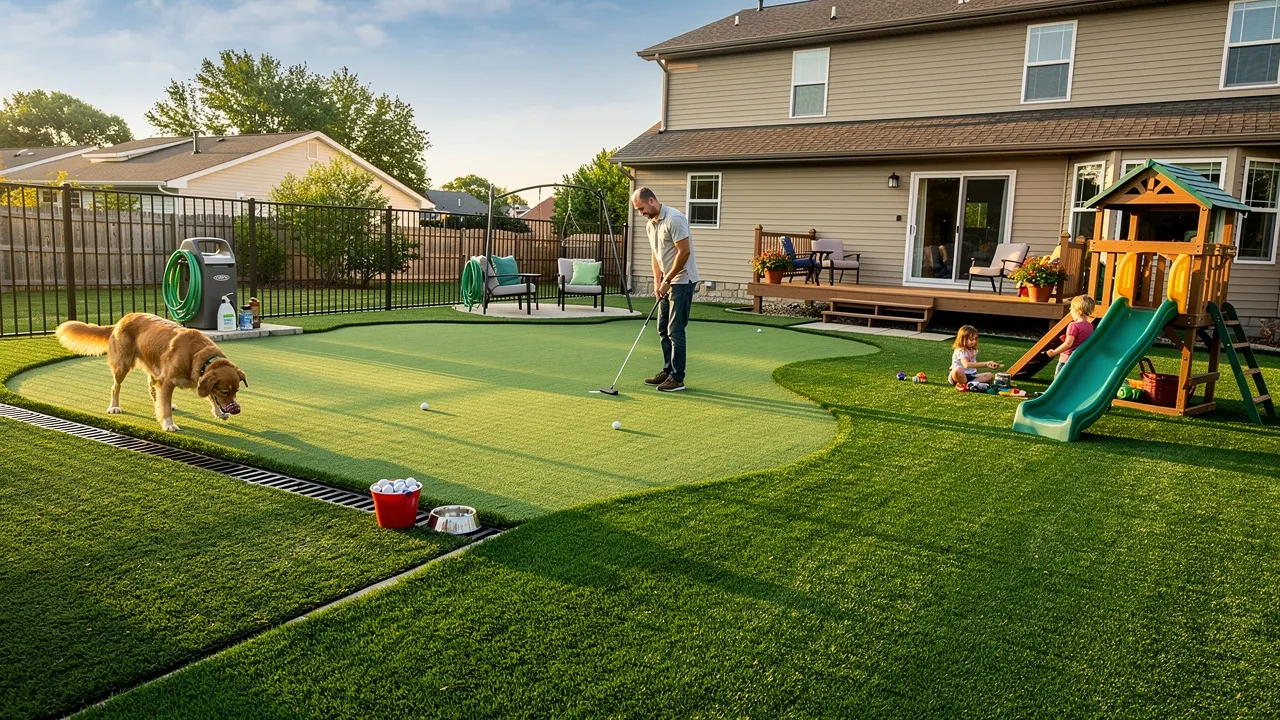
For a Kansas City-area home, this comparison can produce more than one answer without making the whole yard one project. A dog run beside a lawn and a putting area near a patio can be assessed as separate zones. When activities share the same footprint, record the competing demands instead of assuming that one category or general lawn specification covers them all.
A practical starting record should name the zone, its approximate size, its users, expected traffic, and the surface conditions already present. Include drainage observations and any history of pooling. Those details turn a broad question—“Which artificial turf should I buy?”—into a narrower question about whether a particular system fits a particular part of your property.
The choice is therefore a use-and-site decision, not a universal product decision. Start with the activity, then test drainage, heat, maintenance, and installation scope before treating any option as suitable.
Use pet turf when dog activity drives the specification
Pet turf fits a residential zone when dog activity is the main reason you are changing the surface. The relevant questions are how often dogs use the area, how vigorously they move, how large the designated zone is, and how you will handle cleaning. Active dogs may need more resilient artificial grass for vigorous movement, but the appropriate system still depends on the activity pattern and site conditions.
That distinction matters in a Kansas City-area yard because the same dog activity can occur on a zone with different exposure, access, or water behavior. The activity profile is not a product specification by itself. It makes the next questions concrete: where repeated movement occurs, where waste is handled, how water behaves after rain, and which neighboring uses must remain available. If the area is expected to support ordinary lawn traffic as well as dogs, record that mixed use instead of assuming a pet-focused description covers it. A proposal can then be compared with the actual zone, its users, and the conditions that still need evaluation.
A quiet side yard used for short bathroom breaks does not present the same use pattern as a narrow run used for daily sprinting, turning, and play. Describe that difference before discussing materials. Your activity profile should include:
- The number and size of dogs using the area.
- Whether the dogs run, dig, turn sharply, or stay mainly in one relief zone.
- Whether the zone is used during wet weather or after storms.
- Where waste is collected and how the surface will be cleaned.
- Whether direct sun, shade, or nearby hard surfaces affect the area.
They identify the performance questions that a proposed system needs to answer.
We design pet-friendly areas for safe play. For your Kansas City-area home, that means the pet zone should be discussed as a complete use area rather than as grass alone. Bring the dog activity pattern, approximate measurements, drainage observations, and cleaning expectations into the conversation so the proposed surface can be evaluated against the way you will use it.
Pet turf is a reasonable direction when dog use dominates the zone. If the same area must also function as a putting green or children’s play space, identify those competing uses before selecting a pet-focused specification.
Treat drainage, infill, and cleaning as one pet-area question
A pet-area drainage plan connects urine management, stormwater, surface condition, and cleaning expectations. A drainage system beneath pet turf can help water and pet urine move through the surface, which can make the yard drier and odor control easier; site-specific results still require evaluation.
Drainage should not be treated as a promise attached to the grass layer. A controlled comparison summarized by Hall Turf found more runoff from the tested artificial lawns than from living grass, so the surrounding site and its drainage design still need attention. A low area, compacted base, slope, or history of pooling can change the practical result.
Record what you observe before the consultation:
- Where water collects after heavy rain.
- Whether the proposed zone sits below nearby paving or planting beds.
- Whether the soil appears compacted or slow to accept water.
- Where downspouts and other runoff routes discharge.
- Whether the area has an existing surface that must be removed or modified.
Infill is a performance layer, not decorative grit. Its effects on look, feel, drainage, durability, heat, and odor depend on the product type and quantity. Ask which infill is proposed, what function it serves in the system, and how it affects the care routine.
Synthetic grass can reduce routine mowing, watering, and fertilizing, but it still requires cleaning, inspection, and occasional minor repairs. Set that routine before approval rather than assuming the surface eliminates all yard work. Your pet-area plan should state how waste will be removed, how the surface will be cleaned, what inspection involves, and who handles minor repairs if they become necessary.
Drainage, infill, and cleaning should therefore be evaluated together. A strong answer to one question does not settle the other two.
Use putting-green turf when ball performance is the priority
Putting-green turf is the appropriate category when the surface’s main job is golf practice or play. It should be treated as a specialized playing surface rather than as an ordinary lawn, because the application determines the material, installation method, and maintenance questions.
First define the golf use. A backyard putting green is different from simulator turf, an indoor green, or another golf-related surface, and the requirements vary by application. Your intended use should state whether you want short putting practice, a larger practice area, a green connected to other landscaping, or a space that will also handle ordinary foot traffic.
For a residential Kansas City project, separate the putting zone from adjacent lawn or pet uses whenever the layout allows. A surface that must accommodate dogs, children, patio traffic, and golf practice may require compromises that are not visible in a product sample.
We offer putting greens among our residential artificial-turf options and tailor options to homeowner needs. Your part of that process is to describe the playing purpose rather than asking for a generic green. State how you expect to practice, who will use the surface, how often it will be used, and whether the surrounding landscape or pool affects the layout.
A putting-green decision is a performance decision. Appearance can be considered after the intended play, ball behavior, and site conditions are clear.
Define the putting experience before selecting materials
A putting experience depends on how the ball interacts with the surface, so define the performance you want before choosing materials. Pile height, ball speed, and roll are core variables for putting-green turf. When evaluating speed, ask how the intended stimp rating fits the way you plan to practice or play.
Translate that into questions you can answer:
- Do you want a practice surface that emphasizes a particular speed?
- How much variation in slope or break should the green include?
- Will the green be used for putting only, or will other golf activities occur nearby?
- How much surrounding foot traffic should the system tolerate?
- Does the green need to fit an existing patio, pool, planting bed, or lawn?
A speed preference without a use context is incomplete. A green used for occasional family practice may be evaluated differently from one intended to replicate a particular practice experience.
Putting-green turf should be matched to performance and environmental requirements by reviewing pile height, fiber type, density, infill, technical specifications, and recommended installation and maintenance protocols. Ask how the proposed choices relate to the ball behavior you described, rather than treating any single feature as the full specification.
Base preparation deserves its own question. Ask how the putting-green base will be prepared, compacted, and graded, because those steps affect the installation and playing experience. The question matters in a Kansas City yard where the proposed green may meet existing soil, paving, planting areas, or drainage routes.
Before approval, your written project brief should contain the intended golf use, desired surface behavior, approximate dimensions, surrounding uses, base-preparation questions, and maintenance expectations. That record gives you a way to compare the proposed system with the experience you actually want.
Use playground turf as a use-specific play-surface project
Playground turf should be planned around children’s activity, expected foot traffic, surrounding drainage, and existing surface conditions rather than selected as a general lawn substitute. A play area is a use-specific project, so record where it sits, how it will be used, and what happens around it before comparing turf products.
Your play-space record should include:
- The location and approximate dimensions.
- Expected users and the type of activity you anticipate.
- Foot-traffic patterns and access routes.
- Existing soil, paving, landscaping, or other surfaces.
- Drainage observations, low areas, and any pooling history.
- Shade, direct-sun exposure, and nearby features that may affect surface temperature.
Those details help separate a play-surface question from a lawn question. They also make it easier to identify which project conditions still need evaluation.
Artificial grass can become hot in direct sunlight. Surface-temperature planning should account for product design, shade, sprinklers, climate, and possible cooling infill rather than assuming every product behaves the same.
Treat heat as a planning question, not as a universal product verdict. Note which parts of the play area receive direct sun, when that exposure occurs, whether shade is available, and what cooling measures are being considered. A product or feature that addresses one condition does not resolve every site question.
A playground-turf decision is a fit decision for the whole play zone. If the proposed space will also serve as a dog area or ordinary lawn, identify those competing uses before selecting the system.
Compare the three options by mismatch risk
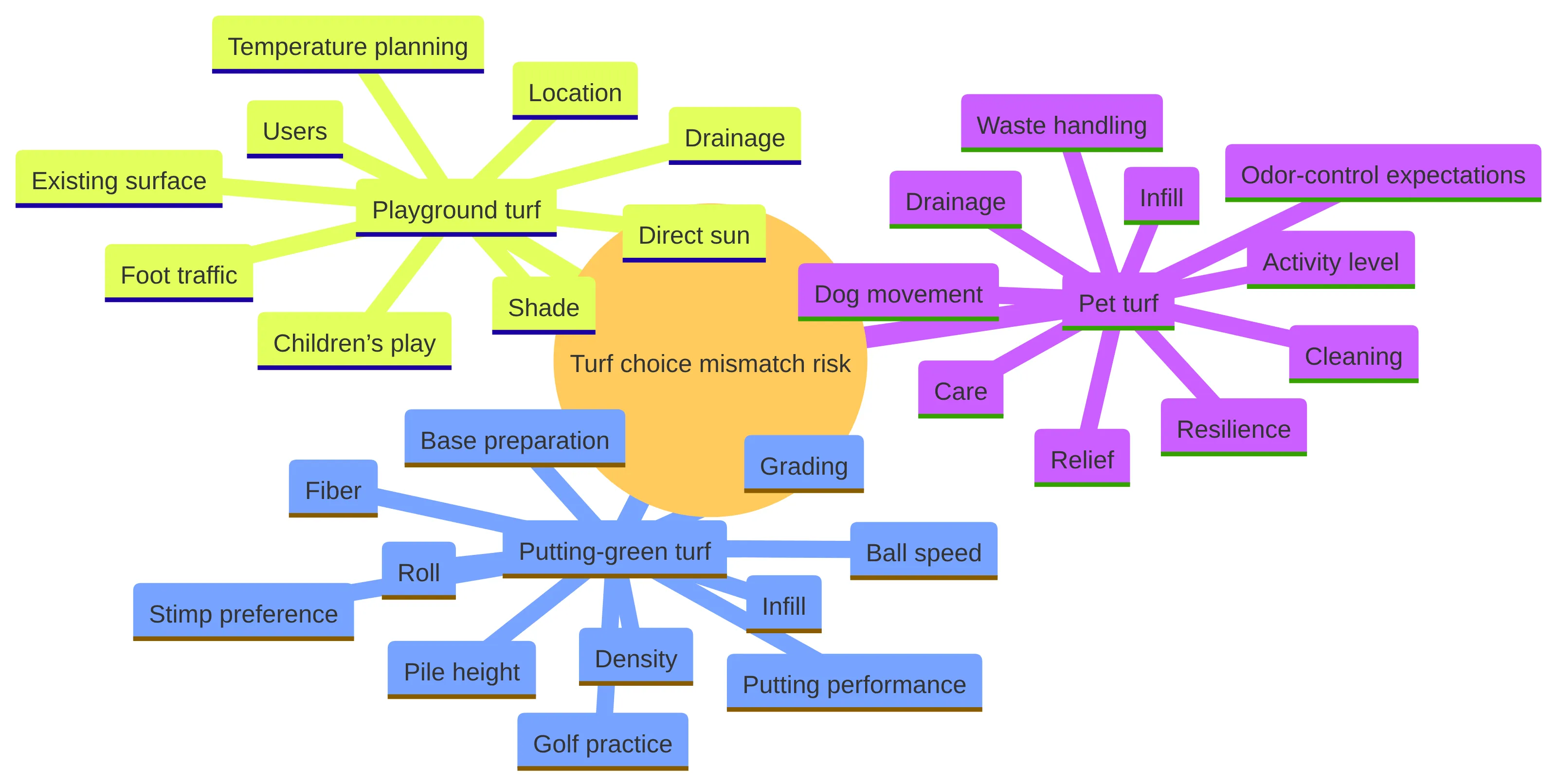
The three residential turf choices differ most in what they must support. Use the comparison below to identify the question that should govern your next step, not to rank one category above the others.
| Turf direction | Primary use to define | Main fit questions | Mismatch signal |
|---|---|---|---|
| Pet turf | Dog movement, relief, waste handling, and cleaning | Activity level, resilience, drainage, infill, odor-control expectations, and care | The zone is expected to perform as a specialized golf surface or a play area without those uses being addressed separately |
| Putting-green turf | Golf practice or putting performance | Pile height, ball speed, roll, stimp preference, fiber, density, infill, base preparation, and grading | The surface is being chosen mainly for lawn appearance while ball behavior remains undefined |
| Playground turf | Children’s play and associated foot traffic | Location, users, traffic, drainage, existing surface, direct sun, shade, and temperature planning | The project treats a play space like a general lawn and leaves site conditions unrecorded |
A mismatch appears when the chosen category answers the visible appearance question but not the activity question. A dog area still needs a plan for movement, waste, drainage, and cleaning. A putting green still needs a defined playing experience. A play space still needs a use-specific site record.
If two uses are equally important, divide the yard into zones where practical and describe each zone separately. If a single zone must serve several uses, make the trade-offs explicit before you request a proposal. Do not treat a general-purpose description as proof that one system will meet every demand.
Screen the property before treating any option as suitable
A Kansas City residential site should be screened for use, water behavior, access, and existing construction before any turf category is treated as suitable. The property record should cover intended activity, measurements, access, existing surface, drainage observations, low areas, slope, compaction, and any history of pooling.
Walk the proposed zone and record what you can observe:
- Map the use. Mark where dogs run or relieve themselves, where children play, or where a putting green would sit.
- Measure the area. Record approximate length, width, irregular edges, and the relationship to patios, fences, pools, planting beds, and gates.
- Trace water. Note low points, downspouts, slopes, wet areas, and places where water has pooled after rain.
- Describe the existing surface. Identify grass, soil, paving, compacted areas, or other materials that may affect preparation.
- Record access. Note gates, narrow passages, steps, utility features, and other conditions that may affect installation work.
- Mark exposure. Identify direct sun, shade, nearby walls, and hard surfaces that may affect comfort or temperature planning.
A site record does not predict the final drainage, temperature, durability, or performance result. It gives the project discussion the conditions needed for evaluation. Artificial lawns in a controlled rainfall comparison produced more runoff than living grass, and the accompanying guidance states that site drainage design remains necessary. That finding should prompt questions about your property, not a prediction about your yard.
Heat also requires site-specific attention. Direct sunlight, shade, product design, sprinklers, climate, and possible cooling infill can all affect surface-temperature planning. Do not treat a general statement about artificial grass as an assessment of your particular play area, dog run, or putting green.
The boundary is straightforward: if you have not recorded how the zone handles water, how it will be used, and what surrounds it, the turf choice is not ready for final approval.
Set cost expectations around the complete project scope
Artificial turf cost should be treated as a complete-project scope question rather than a universal price question. Initial installation can be significant, while maintenance and water-related costs may change. Product composition, heat behavior, durability, end-of-life handling, site access, and installation conditions also deserve product- and project-specific discussion.
Do not rely on a fixed price before the project is defined. Ask the proposal to identify the parts that make up the work:
- The area, shape, and measured scope.
- Removal or treatment of the existing surface.
- Base preparation, grading, and compaction.
- Drainage work or related site changes.
- Turf, infill, edging, seams, and other specified materials.
- Labor, access conditions, and any location-specific work.
- Cleaning, inspection, and minor-repair expectations after installation.
Synthetic grass can reduce routine mowing, watering, and fertilizing compared with the recurring work associated with natural grass, but it still requires cleaning, inspection, and occasional minor repairs. That is a workload trade-off, not a claim that the surface has no continuing obligations.
For a pet area, include drainage, infill, waste handling, odor-control expectations, and cleaning in the scope. For a putting green, include performance targets, base preparation, grading, and maintenance protocols. For a playground area, include traffic, existing surface, drainage, direct sun, shade, and temperature planning. A comparable quote must describe the same use and the same scope; otherwise, different totals may reflect different projects rather than different turf value.
Use the estimate as a scope record, not only as a total. For each line item, identify whether the work is included, excluded, or dependent on conditions discovered during evaluation. Then connect that item to the observations in your site record. For example, a drainage allowance should be considered alongside the locations where water collects, while base preparation should be considered alongside the existing surface, slope, and compaction observations. This makes it easier to see which parts of the proposal are based on known measurements and which remain open until the site is reviewed.
A useful comparison should answer five questions:
- What is being measured? Check that the area, shape, boundaries, and access assumptions describe the same zone you asked to evaluate.
- What preparation is included? Look for removal or treatment of the existing surface, grading, compaction, and any stated drainage work.
- What system is being priced? Review the turf, infill, edging, seams, and other specified materials rather than comparing a generic turf label.
- What continuing care is assumed? Confirm the cleaning, inspection, waste-handling, and minor-repair expectations that apply to the intended use.
- What is still unresolved? Keep site findings, local requirements, or material selections that need confirmation visibly separate from included work.
This review helps prevent a narrow price comparison from hiding a difference in preparation or performance priorities. It also gives you a focused list of questions for the consultation. If an item affects drainage, heat planning, putting behavior, play use, or pet-area care, ask how the proposed scope addresses that item and what evidence or site information supports the answer.
Prepare a consultation brief for Hall Turf
A consultation brief for Hall Turf should summarize the use, users, area, traffic, site conditions, and expectations you want evaluated. Preparing that information before contact makes the conversation about your property rather than about a generic turf category.
Include these items:
- Intended use: pet area, putting green, playground, or more than one zone.
- Expected users: dogs, children, household members, guests, or golfers.
- Approximate area: measurements, shape, boundaries, and nearby features.
- Activity pattern: running, turning, relief, play, putting, or ordinary foot traffic.
- Site conditions: existing surface, access, slope, compaction, low areas, and pooling history.
- Water observations: downspouts, runoff routes, wet areas, and drainage concerns.
- Exposure: direct sun, shade, hard surfaces, and any temperature concerns.
- Care expectations: cleaning, waste handling, inspection, and minor repairs.
- Performance expectations: desired putting behavior, resilience, or play-surface requirements.
The consultation recommendation is to prepare those facts, not to decide the final suitability yourself.
The intended use, approximate area, traffic, pet activity, drainage or pooling observations, cleaning expectations, desired putting performance, and existing surface conditions are all useful inputs for a consultation. If you are considering a Kansas City-area project, add the property location and any access limitations that could affect the work.
Send photographs only as supporting context; they do not replace measurements or an evaluation of the base and drainage conditions. Keep unresolved questions visible. For example, write down whether the proposed pet zone connects to a downspout, whether the putting area must share space with children, or whether a playground zone receives direct afternoon sun.
A concise brief should help you receive a project-specific response. It should not be used to treat a general product description as a guarantee for your property.
Verify the proposed system before approval
A proposed turf system should be checked against the use and site record before approval. Request a written description of the materials, preparation work, drainage approach, installation sequence, and maintenance expectations so you can compare the proposal with the questions that governed your decision.
For a pet area, the written scope should address drainage, infill, cleaning, waste handling, and the activity level you described. For a putting green, it should address pile height, fiber type, density, infill, desired ball behavior, base preparation, compaction, and grading. For a playground area, it should address the intended play use, traffic, existing surface, drainage observations, direct sun, shade, and temperature planning.
Ask which technical specifications and recommended installation and maintenance protocols apply to the selected materials. A sample can show appearance, but it cannot by itself establish how the complete installed system will behave on your property.
Use the document review to connect each proposed benefit to a defined part of the system. Ask Hall Turf to identify the product certifications, CAD files, technical specifications, and testing documentation that apply to the proposed materials and installation approach. The documents should be considered in relation to the use you described: pet-area questions may concern drainage, infill, cleaning, and odor-control expectations; putting-green questions may concern ball behavior, base preparation, compaction, and grading; play-area questions may concern the selected product, site conditions, installation, foot traffic, and applicable requirements.
Hall Turf is described as a licensed contractor. Confirm the current licensed-contractor status and any location-specific requirements that apply to your address rather than treating a general description as a substitute for project review. For work in Kansas City, Missouri, keep the licensing and permit questions tied to the city-specific requirements already noted in this guide.
A practical document check can use three labels: identified, applicable, and unresolved. Mark a document or specification as identified when the proposal names it, as applicable when it clearly relates to the selected use and site, and as unresolved when the proposal leaves its relevance or limitations unclear. This prevents a list of documents from being mistaken for proof that the entire installed system is suitable. It also gives you a precise follow-up question: which stated property, use, installation condition, or maintenance expectation does the document address?
CAD files can help clarify the proposed layout and relationship to surrounding features, while technical specifications and product certifications can help you understand what is being proposed. Testing documentation should likewise be reviewed for the product or system and use to which it applies. None of these references removes the need to evaluate drainage, heat, access, preparation, maintenance, or local requirements. Their value is that they make the proposal more specific and give you a record against which the completed scope can be discussed.
Kansas City, Missouri, requires contractors performing regulated work within the city to obtain appropriate licenses before pulling permits or performing the work. If your property is within Kansas City, Missouri, include the applicable licensing and permit questions in your project review before work begins.
That city-specific requirement should not be generalized to every address in Kansas or Missouri. State, county, and municipal conditions can differ, so keep the project location in the written scope and ask which local requirements apply. The same location detail also helps keep access, drainage, and installation conditions tied to the correct property.
Prepare a mixed-use zone record for project-specific evaluation
A clear decision starts with the activity, then moves through drainage, heat, maintenance, site conditions, and complete project scope. Separate activities where the layout allows; if one zone must serve more than one activity, record the competing demands before selecting materials. If the use remains mixed or the property record is incomplete, continue evaluating the zone before selecting materials.
Bring your measurements, use profile, traffic pattern, drainage observations, existing-surface notes, exposure information, and questions about the proposed system to the next conversation. A qualified professional should determine individual suitability for your property after reviewing those conditions. At Hall Turf, we can then evaluate the residential project in its Kansas City-area context rather than applying a general promise to every site.
What should homeowners confirm before choosing residential artificial turf?
What factors should I consider when choosing pet turf for my Kansas City home?
When selecting pet turf, consider the activity level of your dogs, the size of the area, how you will handle cleaning, and whether the turf can withstand vigorous movement without showing wear. It’s important to evaluate drainage, odor control, and maintenance expectations as well.
How do I determine the right turf for a backyard putting green?
For a putting green, focus on performance variables such as pile height, ball speed, and roll. Define how you plan to use the green, including the desired speed and slope, and ensure the turf matches these requirements.
What should I include in my consultation brief for Hall Turf?
Prepare a brief that includes the intended use of the turf (pet area, putting green, playground), expected users, approximate area, activity patterns, site conditions, water observations, exposure to sun or shade, and care expectations.
What are the maintenance requirements for artificial turf compared to natural grass?
Artificial turf generally requires less routine maintenance than natural grass, such as mowing and watering, but it still needs cleaning, inspection, and occasional minor repairs. It’s important to set a care routine before installation.
How can I assess drainage needs for my artificial turf installation?
Evaluate the site for existing drainage issues, such as pooling or slow water absorption. Record where water collects after rain and consider how the proposed turf will manage drainage to ensure it remains functional.
What should I know about the heat retention of artificial turf?
Artificial turf can become hot in direct sunlight, so it’s important to consider product design, shade, and cooling measures when planning your installation. Not all turf behaves the same, so evaluate how these factors will affect your specific area.