
Start with the problem your outdoor space must solve
Artificial grass deserves a site-fit decision, not a blanket yes or no. If your Kansas or Missouri yard is difficult to maintain, start by naming the recurring problem: frequent mowing, watering, mud after rain, worn areas from pets or children, or an outdoor space that needs a more consistent surface. Then test whether grama artificial—the Spanish term for artificial grass—addresses that problem without creating a larger concern involving heat, drainage, upkeep, or end-of-life handling.
A suitable decision connects four parts of your property: the job you need the surface to perform, the condition of the existing ground, the weather and water conditions around the site, and the maintenance you are willing to keep doing. We present artificial turf as a water-saving option for homeowners in areas such as Kansas City, and our artificial turf has lower maintenance requirements than natural grass, which requires frequent mowing, watering, and fertilizing. Those advantages do not settle every project question. Use them as reasons to investigate fit, not as a promise that every yard will perform the same way.
This opening screen gives you a practical starting point before you compare colors, blade heights, or product names:
- Name the area: front lawn, backyard, dog run, play space, walkway edge, or another defined zone.
- Name the repeated problem: labor, water use, mud, wear, appearance, or a combination.
- Record the site condition: existing grass or concrete, slope, drainage pattern, sun exposure, access, and areas that collect water.
- State the boundary: lower routine maintenance does not remove the need for cleaning, minor repairs, site preparation, or project-specific planning.
If the problem and the intended use are still unclear, pause the product search and define the space first.
Define grama artificial by the residential job it must perform
Artificial grass is a synthetic grass surface selected and installed for a defined outdoor use. A residential lawn may need to present a consistent landscape surface, while a pet area may need to handle repeated activity and cleaning. A play space, walkway edge, or landscaped section may call for a different balance of surface feel, traffic tolerance, drainage planning, and appearance. The useful question is not whether artificial grass is generally attractive; it is whether the installed surface matches the job you need it to perform.
Residential artificial turf can be considered for several defined uses:
- Lawns and landscaping: Choose this path when your main concern is the routine work associated with natural grass and you want to assess a lower-maintenance landscape surface.
- Pet areas: Consider the animal activity, the size of the designated area, cleaning needs, and whether vigorous movement calls for a more resilient grass. Active dogs may require more resilient artificial grass that can withstand vigorous activity without showing visible wear.
- Play spaces: Treat the area as a use-specific project. Record the location, expected foot traffic, surrounding drainage, and surface conditions instead of assuming a general lawn specification will fit.
- Putting greens: Treat a putting green as a specialized playing surface rather than as an ordinary lawn. We offer putting greens among our residential artificial-turf options and tailor options to homeowner needs.
Your first selection record should contain one sentence: “This area must perform as a ___ for ___ use.” Fill in the space with a lawn, pet area, play space, landscape feature, or putting green, then add the people, pets, traffic, and weather exposure the surface will face. That sentence gives you a basis for discussing turf selection and preparation. Without it, a comparison can drift toward appearance while leaving the actual use unresolved.
Run a quote-readiness audit for each outdoor area
Treat each proposed turf area as a separate site-fit audit rather than folding the whole property into one verdict. Record the area’s residential job, existing surface and condition, drainage or pooling concerns, access, sun exposure, expected activity, and the maintenance problem prompting the project. Mark each item as known or needing confirmation. The audit produces a focused set of project questions instead of assuming that every area has the same fit.
Use the audit to keep physical readiness separate from use and exposure. For a concrete area, assess its condition because the surface should provide a solid foundation before artificial grass is installed over it. Record heat exposure and water movement as separate questions, then note whether pets, children, or everyday traffic create a specific use demand. If an important condition is unknown, leave it open for project-specific review rather than treating the area as automatically suitable.
The result you want from this guide is a clearer next step, not a universal verdict. Artificial grass may fit a defined area when its intended use, site condition, water movement, heat exposure, and maintenance plan align. If those conditions remain uncertain, document the open questions and seek a project-specific assessment before choosing a product or committing to installation.
Use the recurring yard problem as the first screening test
The recurring yard problem should determine whether artificial grass deserves further review. If your main burden is the repeated mowing, watering, and fertilizing associated with natural grass, lower-maintenance artificial turf may address part of that burden. Our artificial turf can save homeowners time, water, and maintenance costs. Those savings are a stated benefit, not a property-specific calculation, so keep your actual area and current routine visible.
Your screening questions should cover four points for each outdoor area:
- What keeps failing or consuming time? Write down mowing, irrigation, reseeding, mud, worn spots, uneven ground, or another recurring issue.
- How often does the area receive activity? Separate occasional use from daily foot traffic, pet activity, children’s play, or a dedicated practice function.
- What change would count as useful? You may be seeking less routine mowing, a more consistent appearance, a defined pet zone, or a surface that supports a particular activity.
- What trade-off would be unacceptable? Examples include a hot exposed surface, unresolved pooling, ongoing cleaning, visible seams, or unclear disposal planning.
Continue only when you can answer all four questions in concrete terms.
Lower routine maintenance does not mean maintenance-free ownership. Budget for cleaning and minor repairs, and plan seasonal maintenance routines across spring, summer, fall, and winter. A realistic screening test therefore compares your current lawn routine with the routine you are willing to perform after installation. If you expect to eliminate every maintenance task, revise that expectation before requesting a project estimate.
Artificial grass is a stronger candidate for further review when the defined area has a clear use, the existing surface can be prepared, and the main problem is one that a consistent synthetic surface could address. Artificial grass needs a more cautious review when the area has unresolved water movement, intense sun exposure with no heat-management plan, uncertain access, or a use that has not been defined. In the first case, prepare a site record; in the second, resolve the boundary questions before comparing products.
Screen the site before comparing turf products
Site condition should come before product comparison because the same turf surface can face different preparation demands from one property to another. Kansas and Missouri project records should account for hot summer exposure, heavy rain, hail, seasonal drought, existing grass, concrete, grade, drainage, access, pets, children, and everyday foot traffic. These conditions do not predict a particular installation result; they identify the questions that need answers.
The existing surface is the first physical checkpoint. Existing grass may need to be removed before the base is leveled and compacted. Concrete should be assessed to determine whether it provides a solid foundation before artificial grass is installed over it. Record cracks, uneven areas, low spots, edges, steps, gates, and any location where water already gathers. A product choice cannot correct an unexamined foundation.
Drainage deserves its own site discussion. The environmental comparison reports that natural grass released infiltrated water more slowly and stored more water than the short and long artificial-turf surfaces tested. A separate report states that artificial turf may hinder groundwater recharge and may require watering for cooling on hot days. These findings do not determine what will happen in your yard, but they do justify asking how water will move through the proposed system, where runoff will go, and how heavy rain will affect the area.
Your site record should include the following before a site assessment:
- Approximate dimensions and the shape of the area.
- Current surface type and visible condition.
- Low points, slopes, drains, downspouts, and places where water pools.
- Sun and shade patterns during the parts of the day when the area is used.
- Gate width, side-yard access, steps, fences, landscaping, and other access limits.
- Expected pet, child, furniture, walking, or recreational traffic.
- Any concrete, retaining edge, irrigation line, utility feature, or transition to another surface.
Send the record with photographs if you have them, but treat photographs as preparation material rather than a substitute for a site-specific assessment.
Treat heat and water movement as design constraints
Heat exposure is a design constraint for an exposed Kansas or Missouri outdoor area. In the systematic review’s reported test conditions, maximum surface temperature reached 74.3°C for 13-millimetre green synthetic grass in sun versus 55.1°C for natural grass in sun. Those are reported test results, not a prediction for your property. They show why sun exposure, time of use, surface temperature, nearby shade, and a plan for hot-day use belong in the project discussion.
Water movement is a second constraint rather than a minor installation detail. The cited report states that artificial turf may require watering for cooling on hot days and may hinder groundwater recharge. The environmental comparison also reports that natural grass can store and release infiltrated water more slowly than the artificial-turf surfaces tested. Ask how the proposed base, surface, surrounding grades, and discharge path relate to heavy rain at your property. Do not treat a water-saving claim as proof that drainage questions disappear.
Your heat-and-water discussion should cover these questions:
- Which parts of the area receive direct afternoon sun?
- When will you, your children, guests, or pets use the space most often?
- Where does water currently collect after heavy rain?
- Does a downspout, slope, paved area, or neighboring grade direct water toward the proposed turf?
- What surface and base approach is being considered for the existing ground?
- How would the area be used during very hot weather?
- What maintenance or cleaning is expected after rain, dust, pet use, or seasonal debris?
A site that has an unresolved heat or water boundary needs a documented answer before product selection.
We offer artificial turf as a water-saving and lower-maintenance option for homeowners in areas such as Kansas City, but those benefits should be weighed against the conditions of your specific area. A lower routine watering requirement does not establish a universal water result, and a cleaner-looking surface does not establish a particular temperature or drainage result. Keep the benefit and the boundary together when you decide whether to request a project review.
Compare environmental trade-offs without declaring a universal winner
Environmental trade-offs should be compared by the outcome that matters to your property rather than reduced to a single label such as sustainable or unsustainable. Natural grass and artificial turf affect water use, surface temperature, water movement, maintenance inputs, and end-of-life planning in different ways. The table below keeps those factors separate so you can identify which questions matter most for your yard.
The following comparison separates the main environmental factors you need to weigh:
| Decision factor | Natural grass | Artificial turf | Question for your property |
|---|---|---|---|
| Routine water demand | The environmental case study reports that natural grass can require up to 1 million gallons of water per year in the United States. | We present artificial turf as a water-saving option, while another report states that artificial turf may require watering for cooling on hot days. | What water use is part of your current routine, and how would hot-day cooling be handled? |
| Surface temperature | The systematic review reported a maximum of 55.1°C for natural grass in sun under its test conditions. | The same review reported 74.3°C for 13-millimetre green synthetic grass in sun under its test conditions. | How much direct sun does the area receive, and when will the surface be used? |
| Water movement | The case study reports that natural grass released infiltrated water more slowly and stored more water than the artificial-turf surfaces tested. | The report states that artificial turf may hinder groundwater recharge. | Where will water go during heavy rain at your property? |
| Ecological functions | The case study reports that natural grass can reduce surface temperatures, support biodiversity, reduce soil erosion, and act as a carbon sink. | Which ecological functions matter in this part of your yard? | |
| Lifecycle planning | Natural grass has recurring maintenance inputs that vary with the selected grass and site. | A report estimates artificial-turf athletic-field lifecycle costs by including installation, maintenance, disposal, and replacement. | How will you account for installation now and removal or replacement later? |
The comparison does not produce one winner for every Kansas or Missouri property. Natural grass may support cooling, biodiversity, soil erosion control, and water storage, while its water and maintenance demands may conflict with your priorities. Artificial turf may reduce routine watering and maintenance, while heat, water movement, and lifecycle handling need explicit attention. Choose the option that fits the defined area and the trade-offs you are prepared to manage.
Waste management belongs in the initial conversation, not after installation. The cited report includes disposal and replacement in its artificial-turf lifecycle assessment and estimates that artificial-turf athletic fields can cost two to ten times more than organically managed natural-grass fields over their life cycles when installation, maintenance, disposal, and replacement are included. That estimate concerns athletic fields, not your residential yard, so do not transfer the range to a home project. Use it as a reason to ask how the proposed system will be maintained, replaced, and handled at the end of its service life.
Match the surface to pets, children, and everyday traffic
Your use record should identify the demands for each area:
- Pet use: Identify the number and activity level of pets, whether the area is a dedicated run, and the cleaning routine you can maintain.
- Child use: Record the type of play, hours of direct sun, surrounding hardscape, access points, and whether use continues during hot weather.
- Everyday traffic: Note paths between doors, gates, patios, driveways, and outdoor seating.
- Mixed use: Separate the zones if one part needs frequent activity and another part is mainly visual landscaping.
A use record gives you a basis for asking about resilience, surface temperature, water movement, cleaning, edges, seams, and repairs.
Pet and family use does not remove ongoing care. Artificial-turf maintenance can include cleaning and minor repairs, and seasonal routines can organize care in spring, summer, fall, and winter. Plan for leaves, dirt, pet waste, furniture movement, and visible wear as part of ownership. The practical question is whether the required routine is manageable for your household, not whether the surface can be installed and then ignored.
Heat deserves a direct conversation wherever children or pets will use an exposed area. The reported test conditions found a higher maximum surface temperature for the tested green synthetic grass than for the tested natural grass in sun. That result does not establish a temperature for your lawn, but it does establish a reason to record sun exposure and use times. Ask how the area should be approached during hot weather, and keep that answer separate from claims about appearance, maintenance, or water use.
Understand the professional installation path
Professional installation turns the site record into a prepared surface and a defined scope of work. We consider professional installation important for artificial turf. The exact work depends on the existing surface, layout, access, drainage, and intended use.
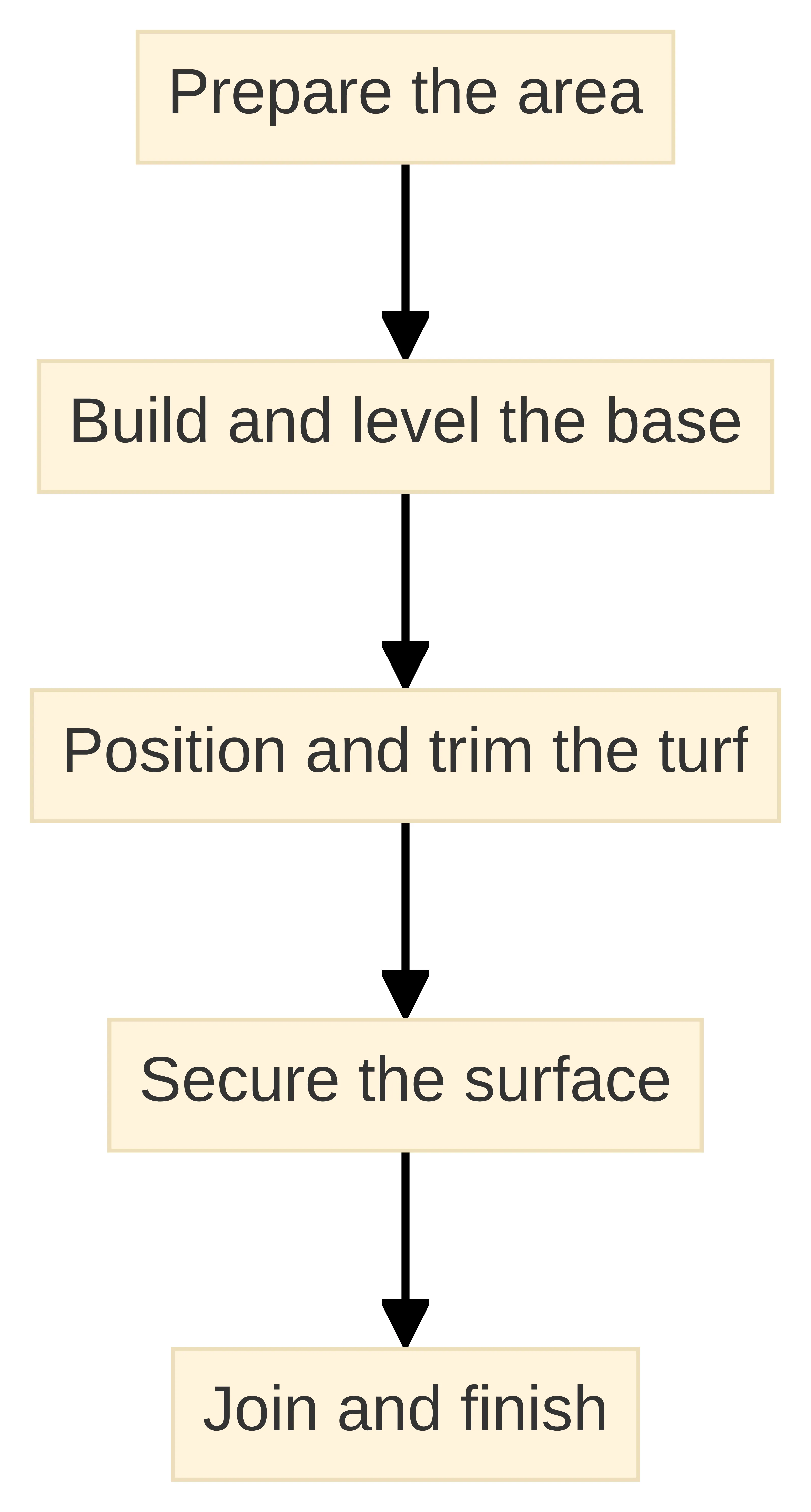
The high-level sequence can be understood as five connected stages:
- Prepare the area: Remove the existing surface where required and expose the area that will receive the installation.
- Build and level the base: Rake, level, and compact the base material so the prepared area can support the turf system.
- Position and trim the turf: Lay out the rolls, align the installation, and trim around boundaries, features, and transitions.
- Secure the surface: Use the specified nails, staples, or other securing method for the installation.
- Join and finish: Where multiple rolls meet, use seam tape and adhesive as part of the joining process, then finish edges and transitions.
Treat this as an orientation to the work, not as a complete installation specification.
Concrete requires a separate condition check before artificial grass is installed over it. Assess whether the concrete provides a solid foundation, and record cracks, uneven sections, drainage points, edges, and transitions. Do not assume that a visible slab is ready simply because it is hard. Ask how its condition affects preparation, water movement, finished height, and the connection to surrounding surfaces.
A site assessment or quote becomes appropriate when you have identified the area, intended use, approximate dimensions, existing surface, and major site constraints. We provide artificial-turf installation in Kansas City and offer options tailored to homeowner needs. The cited Lowe’s installation guide also describes artificial-grass installation as work that can be handled by a professional independent installer. For your project, use the assessment to resolve preparation, drainage, access, use, and scope questions rather than treating it as a formality.
Prepare the information needed for a quote
Your project brief should include these details:
- Location: City and state, plus the part of the property where the area is located.
- Use: Lawn, landscape section, pet area, children’s play space, walkway, putting green, or mixed use.
- Measurements: Approximate length, width, irregular corners, and any separate zones.
- Existing surface: Grass, soil, concrete, pavers, mulch, or another surface, along with visible cracks, low spots, uneven areas, or damaged sections.
- Water conditions: Downspouts, drains, slopes, pooling after heavy rain, and any known route for runoff.
- Exposure: Sun and shade patterns, especially during the hours when pets, children, or guests will use the area.
- Access: Gate width, side-yard route, steps, fences, landscaping, and obstacles that may affect material movement or preparation.
- Activity: Pet size and activity level, child use, furniture, foot traffic, or specialized practice requirements.
- Desired change: Less mowing, less routine watering, fewer muddy areas, a designated pet surface, a play area, or another clearly stated objective.
Photographs can make the initial discussion more useful when they show the full area, property edges, access route, downspouts, drains, slopes, concrete condition, and nearby transitions. Add a simple sketch with measurements if the shape is irregular. Label each photograph with the direction or feature it shows. These materials help organize the conversation, but an image does not settle foundation, drainage, heat, or installation conditions on its own.
Your project discussion should resolve the questions that affect your decision:
- What preparation is proposed for the existing surface?
- How will the installation address the current drainage pattern?
- Which parts of the area are exposed to direct sun during use?
- What maintenance, cleaning, and minor repairs should you plan for?
- How does the proposed turf match the intended pet, child, traffic, or landscape use?
- What work is included for edges, transitions, seams, access, and removal of the existing surface?
- What assumptions affect the installation scope, and which conditions require an on-site decision?
- How should future replacement or removal be considered in the project plan?
These questions keep a quote connected to the site rather than reducing it to a product name or surface area.
When your brief is ready, contact Hall Turf with the area, intended use, site conditions, photographs, and the questions that remain open. A project discussion can then focus on whether the defined area and its conditions support the type of installation you are considering.
Key Highlights
Your decision should keep these points in view as you decide whether to continue:
- Start with a defined problem. Artificial grass is easier to evaluate when you can name the recurring labor, water, mud, wear, or use issue it should address.
- Match the surface to the job. A lawn, pet area, play space, landscape feature, and putting green should not be treated as interchangeable uses.
- Check the site before the product. Existing grass, concrete, grade, drainage, sun exposure, access, and traffic can change the installation discussion.
- Treat lower maintenance as a trade-off, not an elimination of care. Cleaning, minor repairs, and seasonal routines remain part of the ownership plan.
- Keep heat visible. The reported test conditions showed higher maximum surface temperature for the tested synthetic grass than for natural grass in sun; your use times and sun exposure need separate attention.
- Keep water movement visible. Water-saving potential does not answer how heavy rain, cooling water, runoff, or groundwater recharge will relate to your site.
- Keep lifecycle handling visible. Ask how installation, maintenance, replacement, and eventual removal fit into the project scope.
- Prepare a documented brief. Measurements, photographs, use, site condition, access, and open questions give a quote discussion a usable starting point.
A practical decision rule is simple: proceed to a project discussion when the area has a defined job, the main site conditions are recorded, and the trade-offs are acceptable to you. Pause when the intended use, water movement, heat exposure, foundation, access, or future maintenance remains unclear. That boundary protects the decision from being driven by appearance alone.
Use heat and water movement as the first project screen
Start with two site questions: how much direct sun reaches the area and how rainwater moves through it. In the reported test conditions, 13-millimetre green synthetic grass reached 74.3°C in sun versus 55.1°C for natural grass; a comparison also found that natural grass released infiltrated water more slowly and stored more water than the tested artificial-turf surfaces. We offer artificial turf as a water-saving, lower-maintenance option for homeowners in areas such as Kansas City, while the project-specific trade-offs still need to be examined.
Before moving forward, assemble the area measurements, intended use, existing-surface notes, drainage observations, sun exposure, access details, photographs, and questions about preparation and future care. A qualified professional must determine whether a particular installation is suitable for your property and intended use. Use the completed record to request a project-specific discussion rather than relying on a general product description.
What should a homeowner confirm before requesting an artificial turf quote?
What is grama artificial used for in a home?
Grama artificial is artificial grass for residential outdoor spaces such as lawns, pet areas, play spaces, and landscaping.
What should I consider when choosing artificial turf for pets?
For active dogs, it’s advisable to select more resilient artificial grass that can withstand vigorous activity without showing visible wear.
What steps are involved in the installation of artificial turf?
The installation process typically includes removing existing grass, leveling and compacting the base, trimming and securing the turf, and joining rolls with seam tape and adhesive.
What information should I prepare when requesting a quote for artificial turf installation?
Prepare details such as the location, intended use of the area, approximate measurements, existing surface conditions, drainage observations, sun exposure, access details, and any specific questions about the installation.
How does artificial turf compare to natural grass in terms of environmental impact?
While artificial turf can reduce water usage and maintenance needs, it may hinder groundwater recharge and require cooling on hot days. Natural grass supports biodiversity and can store more water, but it demands significant water resources and maintenance.
What maintenance is required for artificial turf after installation?
Maintenance for artificial turf includes regular cleaning, seasonal upkeep, and minor repairs to extend its lifespan. Homeowners should budget for these tasks to ensure the turf remains in good condition.