
Start with the site-readiness decision
Artificial turf is worth exploring when lower routine maintenance fits your priorities and the property can support a properly assessed installation. That is a more useful starting point than asking whether turf is universally good or bad for Kansas and Missouri homes.
Your decision has two parts. First, decide whether replacing living grass addresses a real problem in your yard, such as time spent mowing, watering, fertilizing, or repairing worn areas. Second, determine whether the proposed surface, base, drainage approach, access, and intended use fit the property. Hall Turf’s homeowner guidance says its artificial turf can save homeowners time, water, and maintenance costs, but that statement does not establish the result for every site or project.
A site-readiness decision should answer these questions before you commit:
- What part of the property will receive turf, and what will you do there?
- What problem should the replacement solve: routine mowing, mud, worn grass, pet use, or a defined play area?
- How does water leave the area after heavy rain?
- Is the existing surface soil, concrete, or another foundation that needs assessment?
- What preparation, materials, access work, and finishing tasks belong in the proposed scope?
- What care will remain after installation?
If you cannot answer those questions yet, you are still in the evaluation stage. That is not a reason to reject turf; it is a reason to gather the property information that makes a quote meaningful.
Overview
Artificial turf is a manufactured grass-like surface used in place of living grass for defined outdoor areas. Residential uses can include a main lawn, a smaller backyard, a pet area, a play space, or a specialized feature such as a putting green. The right evaluation starts with use and site conditions rather than appearance alone.
The potential appeal is straightforward: Hall Turf’s homeowner guidance describes artificial turf as an option that can save time, water, and maintenance costs, and its pet-turf guidance describes lower maintenance requirements than natural grass, which requires frequent mowing, watering, and fertilizing. Those are first-party statements about the stated offering, not a guarantee of a particular household result.
The evaluation becomes clearer when you work through the project in this order:
- Define the surface and the activities it must support.
- Compare lower routine maintenance with the cleaning and minor repairs that remain.
- Examine rain, grade, existing surfaces, access, and other site questions.
- Separate potential water-use savings from broader environmental trade-offs.
- Turn pet or child use into specific questions for the proposed system.
- Follow the installation from removal and base preparation through seams and securement.
- Treat cost as a record of scope, not as an isolated number.
- Assemble a property record before asking for a site-specific discussion.
Professional installation is recommended in Hall Turf’s homeowner guidance, while its installation material identifies concrete assessment, base preparation, trimming, weed control, securement, and joining rolls as distinct parts of the work. A decision guide should therefore help you inspect the project, not simply choose a grass color.
Define the residential surface and intended use
The intended use should determine which part of your property you evaluate and which questions you ask. A front lawn used mainly for appearance has a different brief from a backyard that receives daily foot traffic, a designated dog run, or children’s play.
Write down the primary use before you compare products. Then record secondary uses that could change the scope, such as entertaining, moving outdoor furniture, access to a gate, or a connection to a patio or pool. The purpose is not to predict performance from a product name. The purpose is to make the proposed surface answerable to the way you will use it.
A practical use record can include:
- Area: front lawn, side yard, backyard, pet zone, play space, or another defined section.
- Activity: walking, sitting, playing, pet use, entertaining, or visual landscaping.
- Traffic pattern: regular paths, concentrated wear points, furniture locations, and gates.
- Existing features: trees, planting beds, edging, steps, drains, irrigation components, patios, and concrete.
- Surface boundaries: straight edges, curves, narrow passages, slopes, and transitions to other materials.
- Seasonal concerns: areas that become muddy, shaded, hot, flooded, or difficult to maintain.
This record helps separate a whole-yard replacement from a smaller targeted installation. It also gives you a basis for asking whether one surface and one preparation approach fit every area. If the answer is no, keep the areas separate in the project discussion.
A product category does not decide individual suitability. Your property, intended use, and planned maintenance must be considered together. If a space will serve children, pets, or frequent gatherings, describe that use plainly rather than assuming a general lawn specification covers it. Ask for the proposed system and its limits in writing before you treat the area as ready for installation.
Balance lower routine maintenance with ongoing care
Artificial turf can reduce the routine work associated with living grass, but artificial turf is not maintenance-free. Hall Turf’s guidance describes its artificial turf as having lower maintenance requirements than natural grass, while also recommending that homeowners budget for cleaning and minor repairs. The useful comparison is therefore lower routine maintenance versus a different care schedule, not no maintenance versus frequent maintenance.
Your care plan should identify what you will do after installation. Hall Turf’s homeowner guidance recommends budgeting for cleaning and minor repairs to help extend artificial turf’s lifespan. Use that guidance as a planning prompt, then ask what care the proposed system requires in your intended area.
A care discussion can cover:
- Routine removal of leaves, dirt, and other debris.
- Cleaning needs for the type of use you described.
- How you should report or handle a damaged section.
- Which minor repairs are ordinary owner responsibilities.
- What maintenance materials, tools, or labor the proposed system may require.
These questions do not establish a lifespan, repair frequency, or maintenance cost for your property. They make the ongoing responsibility visible before you compare installation with living grass.
Natural grass may be a better fit for your priorities if you prefer a living surface and are prepared for frequent mowing, watering, and fertilizing. Artificial turf may be worth further investigation if reducing those recurring tasks matters more to you than preserving living grass and you accept the cleaning and minor-repair obligations that remain. Choose the option whose routine matches the way you actually manage your yard.
Evaluate weather, drainage, and existing surfaces before choosing
Kansas and Missouri weather makes the site record more useful than a general promise about year-round performance. Hot summer sun, heavy rain, seasonal drought, and winter conditions can change the questions you need to ask about a particular area. Do not assume that a surface that looks suitable in dry weather will manage water, heat, or traffic in every season.
A water-conservation report discussing playing fields states that cooling artificial turf requires substantial water and that the cooling effect lasts only minutes before temperatures rebound. That evidence concerns playing fields, not every residential lawn. Use it as a reason to ask how heat should be considered for your intended use, not as a prediction of your home’s surface temperature.
Drainage should be treated as a design and site-assessment question. A water-conservation report states that artificial turf can increase stormwater runoff and prevent groundwater recharge in some locations, while a Utah water-quality report states that artificial turf may conserve water but can also have higher runoff potential and lower rainfall capture and infiltration. Those findings come from locations and conditions outside Kansas and Missouri, so they do not establish a local result for your property.
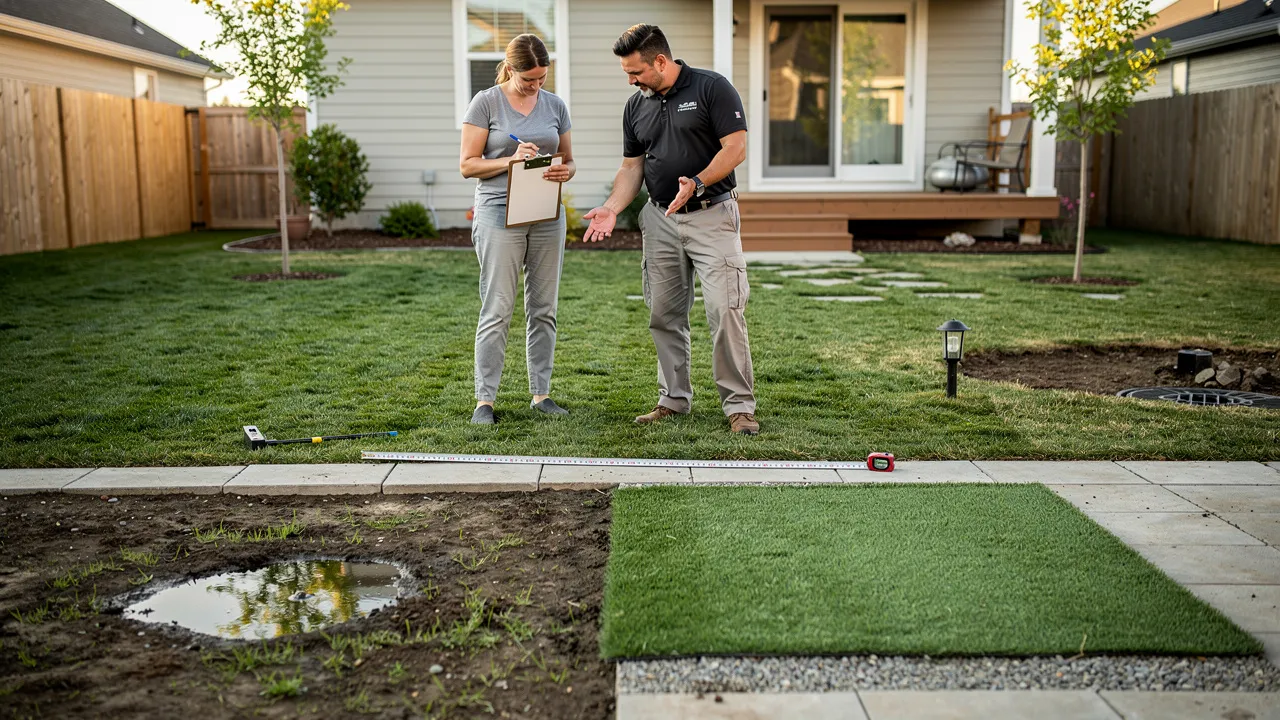
Before installation, describe where water currently goes after a storm. Note pooling, soggy areas, downspouts, slopes, retaining edges, nearby structures, and any route toward a driveway or public drainage feature. Ask how the proposed installation is expected to handle that site condition and what work is included. A quote should not turn a drainage question into an unstated assumption.
The existing surface changes the preparation conversation. Hall Turf’s guidance says concrete condition must be assessed before artificial grass is installed over concrete to help ensure a solid foundation.
Record whether the proposed area is soil, concrete, or a mixture of surfaces. Mark cracks, uneven transitions, damaged edges, and places where access is restricted. If the surface is concrete, ask what condition assessment is required. If the surface is living grass, ask what removal and base preparation are included. The correct boundary is simple: do not treat the surface as ready until its condition and preparation have been addressed.
Compare water and environmental trade-offs without assuming local results
A comparison of artificial turf and natural grass needs more than a water-use claim because the options affect maintenance, runoff, infiltration, heat, and ecological functions differently.
| Question | Artificial turf | Natural grass |
|---|---|---|
| Routine maintenance | Hall Turf states that its artificial turf can save time, water, and maintenance costs, while its guidance still includes cleaning and minor repairs. | Hall Turf describes natural grass as requiring frequent mowing, watering, and fertilizing. |
| Water use | Hall Turf states that its artificial turf can save homeowners water; the result is not a property-specific water-use estimate. | A cited case study states that natural grass can require up to 1 million gallons per year in the United States; that figure is not a Kansas or Missouri household estimate. |
| Rainfall and infiltration | Reports from Utah and locations discussed in California describe higher runoff potential, lower rainfall capture or infiltration, or increased runoff in some settings. | One case-study comparison found natural grass more effective than short and long artificial turf at slowly releasing infiltrated water and storing water. |
| Heat | A water-conservation report about playing fields says cooling artificial turf requires substantial water and lasts only minutes before temperatures rebound. | A case study reports that natural grass fields can reduce surface temperatures, but that field finding does not determine your residential result. |
| Environmental functions | A Utah report states that artificial turf can contribute microplastics to waterways and leach chemicals, metals, and organic micropollutants. The finding is tied to that report’s setting and should prompt material and runoff questions. | A case study reports that natural grass fields can support biodiversity, reduce soil erosion, and act as carbon sinks. |
The table is a decision aid, not a local impact assessment. It keeps potential water savings separate from questions about runoff, rainfall capture, heat, and materials.
Hall Turf states that its artificial turf can save homeowners water, while a cited case study reports that natural grass can require up to 1 million gallons per year in the United States. The case-study figure is a broad reported maximum, not an estimate for your lawn, and neither source predicts the utility bill or local water balance for a particular home.
Ask what watering you would stop, what cleaning or cooling might still require water, and how rain would move through the completed area. Keep those answers separate. A reduction in routine irrigation does not by itself resolve every water or environmental question.
Environmental and health-related questions need careful boundaries. The Utah report connects artificial turf with microplastics, chemicals, metals, organic micropollutants, runoff, and lower rainfall capture or infiltration in its studied context.
Those sources do not establish that a residential installation in Kansas or Missouri will produce the same result, and they do not establish that a particular product or installation is safe. If children or athletic activity are part of your plan, ask for product-specific testing and use guidance, discuss surface conditions, and have a qualified professional address individual suitability. Do not use a general environmental label as a substitute for project-specific questions.
Match pet and child use to the questions a quote must answer
Pet use should be described as a distinct project requirement rather than folded into a general lawn request. Hall Turf’s guidance discusses artificial turf for a dog run and identifies lower maintenance requirements compared with natural grass, which requires frequent mowing, watering, and fertilizing. That guidance does not establish a universal result for odor, drainage, cleaning, durability, or pet safety.
For a pet area, record the number and size of animals, the location of the intended run, access for cleaning, nearby doors, and any existing mud or drainage problem. Ask how the proposed system is intended to handle the use you described, what cleaning is expected, and what repairs or maintenance remain your responsibility. Keep those answers tied to the proposed product and installation rather than assuming every pet-turf system is equivalent.
Child use should also be stated plainly before a product or installation is selected.
Describe whether children will crawl, run, fall, play games, or use equipment in the area. Ask about surface specifications, edge transitions, heat considerations, cleaning, and the limits of the proposed installation. Do not treat a general statement about a lawn as an individual safety conclusion for a play space.
A use-specific quote discussion can cover these points:
- What surface and base are proposed for the stated use?
- Which areas are included, and which areas are excluded?
- How will water and cleaning access be handled?
- What maintenance remains after installation?
- What product documentation applies to the surface?
- Which site conditions could change the scope?
The more clearly you describe pets or children, the less likely the project will be evaluated as an undefined general lawn. Ask for a written scope that names the intended use and its boundaries.
Follow the installation from site preparation to finishing
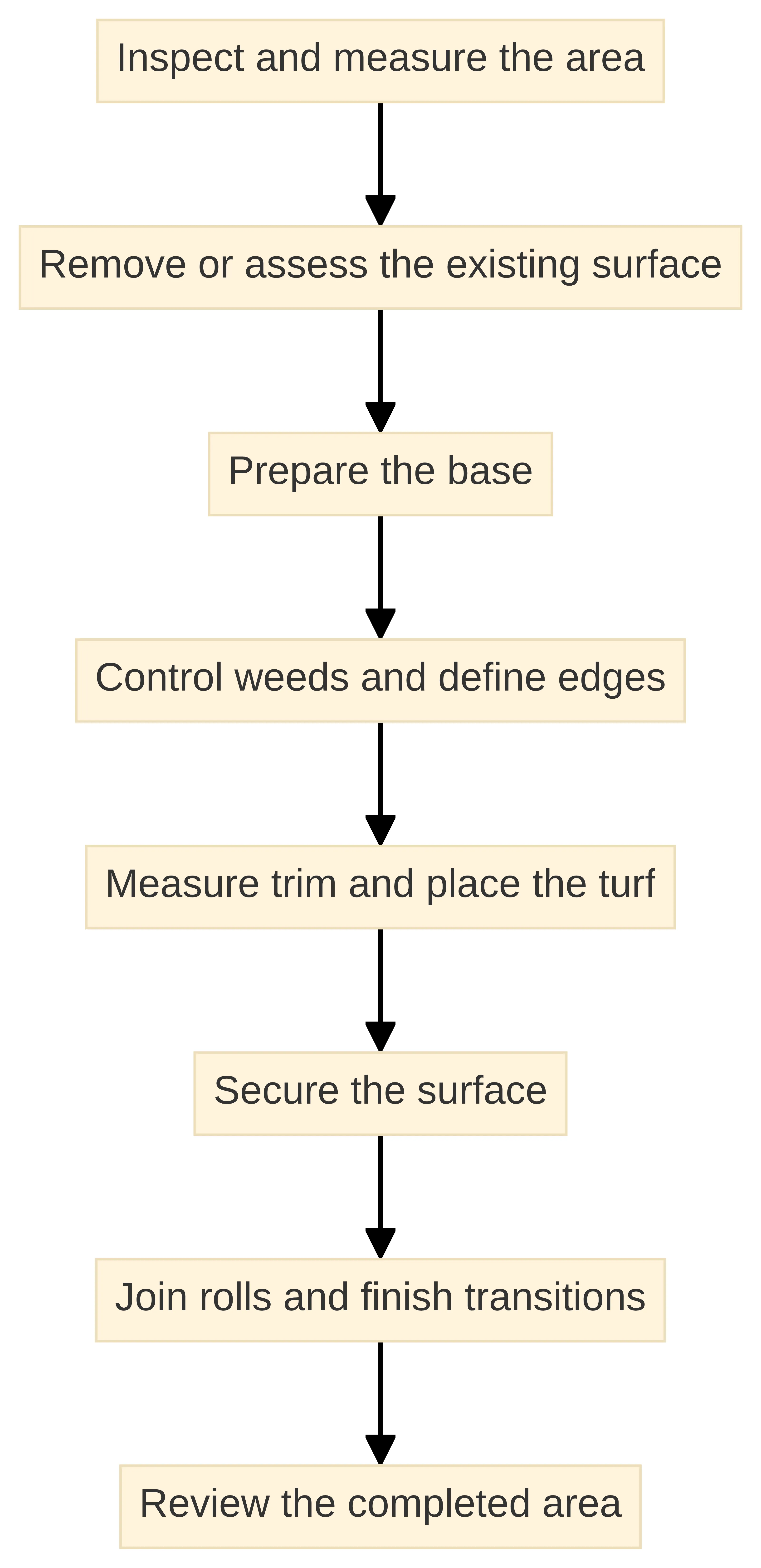
Artificial turf installation is a sequence of site and finishing tasks, not simply the placement of a roll over existing grass. Hall Turf’s guidance identifies professional installation as important.
A practical sequence looks like this:
- Inspect and measure the area. Record dimensions, boundaries, obstacles, slopes, existing surfaces, and access limitations.
- Remove or assess the existing surface.
- Prepare the base.
- Control weeds and define edges. Landscape fabric, edging, or another proposed treatment should be identified in the scope rather than assumed.
- Measure, trim, and place the turf. Curves, obstacles, transitions, and multiple rolls affect the finishing work.
- Secure the surface. The guidance identifies grass nails or staples as securement materials.
- Join rolls and finish transitions. Seam tape and adhesive are identified for joining multiple rolls.
- Review the completed area. Confirm that the finished scope matches the intended use, boundaries, and agreed site work. The written scope should state whether infill applies to the proposed system, what purpose it would serve if included, how it would be handled, whether it is included in the quote, and which product- and use-specific details need confirmation.
Existing conditions should remain visible throughout the installation discussion. A concrete slab may need condition assessment, while soil may require removal, leveling, base preparation, and compaction. Trees, irrigation components, drains, steps, fences, narrow gates, and changes in elevation can affect how the work is planned.
Ask which preparation tasks and materials are included, whether infill is part of the proposed system, which product- and use-specific infill details need confirmation, and which conditions would require a change to the proposed scope. Ask how seams, edges, and transitions will be handled where the turf meets concrete, planting beds, paths, or structures. These questions do not predict an outcome; they prevent the installation plan from hiding the work needed to reach the finished surface.
Professional installation is the stated Hall Turf recommendation, but professional installation does not remove the need for a property-specific assessment. A qualified installer still needs to understand the site, the intended use, the existing surface, and the work included in the scope. Treat the installation sequence as a checklist for the discussion, not as a guarantee that every listed task applies to every property.
Turn project cost into a scope question
Artificial turf cost should be discussed as the cost of a defined project scope, not as a price for grass alone. Hall Turf’s homeowner cost guidance addresses time, water, maintenance costs, cleaning, and minor repairs, while its installation guidance identifies removal, base preparation, measuring, trimming, weed control, securement, and seams as project tasks. A total that leaves those tasks unclear is difficult to compare with another total.
Build the scope around observable details:
- Measured area and the dimensions behind the total.
- Existing surface and any removal or condition assessment.
- Base preparation, leveling, and compaction.
- Edges, transitions, obstacles, and seams.
- Access for people, materials, and equipment.
- Drainage questions and any included site work.
- Product specification and the use assigned to each area.
- Cleanup, finishing, and owner maintenance responsibilities.
This list does not produce an exact price. It identifies the subjects that should be visible before you judge whether an estimate is complete.
Add an infill checkpoint to the scope record rather than treating infill as an automatic part of every project. Ask:
- Does the proposed system use infill for this intended use and surface?
- If so, what product- and use-specific information explains its purpose and handling?
- What installation tasks, cleanup, and owner-care expectations belong in the scope?
- Is the material, related labor, and any follow-up work included, excluded, or conditional?
- What site or use detail would change that answer?
The point is not to choose an infill type from a general article. It is to ensure the written estimate connects any infill decision to the selected system, the area’s use, and the work being priced. If the answer is still open, mark it as an unresolved scope question rather than comparing totals as though the item were identical. Record any product- or use-specific documentation requested, and note whether the response is expected before installation or at the quote stage. This checkpoint keeps a product question from being mistaken for a site conclusion, and makes exclusions visible during quote review.
A useful estimate comparison keeps like scopes together. Compare the measured area with the area being priced, then check whether both estimates address the same removal, preparation, materials, securement, seams, access, and finishing tasks. If one estimate leaves a task as an allowance or excludes it, record that difference instead of treating the totals as equivalent.
The maintenance side also belongs in the decision. Hall Turf’s guidance says homeowners should budget for cleaning and minor repairs to help extend artificial turf’s lifespan. Include that ongoing responsibility in your household comparison, even though a written installation estimate may not include future care.
Do not use a low or high total as a suitability conclusion by itself. A lower figure may reflect a smaller area, fewer preparation tasks, a different product, or an unresolved site condition; a higher figure may include work that another estimate leaves open. Ask what each line means, what is excluded, and what property condition would change the scope. The price becomes useful only after the project being priced is clear.
Prepare a property record before requesting a quote
A property record gives a site-specific discussion something concrete to address. Hall Turf’s installation guidance identifies measuring the area, preparing the base, trimming turf, controlling weeds, securing the surface, and joining rolls as installation tasks. Its concrete guidance says the condition of concrete must be assessed before artificial grass is installed over it.
Prepare the record in sections:
- Location: city and state, plus the part of the property under consideration.
- Use: lawn, landscaping, pet area, play space, entertaining area, or another purpose.
- Measurements: length, width, separate sections, narrow passages, curves, and obstacles.
- Existing surface: soil, living grass, concrete, paving, or mixed conditions.
- Water observations: pooling, runoff direction, downspouts, low areas, and nearby drains.
- Access: gate width, side-yard route, stairs, fences, structures, and equipment limitations.
- Photos: wide views, boundaries, transitions, damaged areas, slopes, and drainage concerns.
- Questions: product, preparation, whether infill is part of the proposed system, seams, edges, maintenance, documentation, and exclusions.
The record does not replace an on-site assessment. It helps you describe the project accurately and makes it easier to identify what still needs professional judgment.
Measurements should preserve the shape of the project instead of recording only one guessed total. Divide an irregular yard into manageable sections, write down each section’s dimensions, and mark areas that require separate treatment. Note curves, trees, posts, beds, steps, drains, and transitions to other surfaces.
Photographs should support the written record. Take views from each boundary, close images of surface damage or cracks, and images that show how materials could reach the work area. Label the photos by location. If you are uncertain about a slope, drainage path, or foundation condition, mark it as an open question rather than calculating a conclusion from a photograph.
Your record is ready for a quote discussion when it names the intended use, shows the area under consideration, identifies the existing surface, records access and water observations, and lists the questions that remain open. Keep estimates, measurements, and assumptions together so you can see when a proposed scope changes. That simple record protects the decision from being based on appearance alone.
Confirm the installer’s documentation and project boundaries
Project documentation should make the proposed artificial turf system and its boundaries understandable. Ask for the product name, technical specifications, intended use, applicable certifications, and testing documentation. If the project involves design coordination or unusual geometry, ask whether CAD files or other drawings are available for the proposed scope.
These documents should answer practical questions such as:
- Which product is assigned to each area?
- What use is the product being considered for?
- Which base, edge, seam, and securement details are proposed?
- What site preparation is included?
- Which drainage or water-management questions remain open?
- What care and minor repairs will belong to you?
- Which tasks or conditions are excluded from the proposed scope?
Requesting documentation is not the same as treating a certification or test result as proof that the entire project is suitable. The document must apply to the product, use, and installation conditions under discussion.
Hall Turf’s accepted installation guidance identifies professional installation, base preparation, weed control, trimming, securement, and seams as relevant parts of an artificial turf project. When you discuss your property with us, ask us to connect those tasks to the areas and uses in your record. Ask which items are included, which are conditional, and which require a separate decision.
A clear boundary protects both sides of the project discussion. You should know what the proposed work addresses, what you must maintain afterward, and what requires an additional site assessment before a conclusion can be reached.
Do not treat a generic product description, a photograph, or a broad performance phrase as a complete project specification. Match every meaningful statement to the area, use, surface, and conditions you have described. If a question affects drainage, children, pets, heat, or the foundation, leave it open until the applicable documentation and professional assessment address it.
Build a site-readiness worksheet before requesting a quote
Use a site-readiness worksheet to organize a quote request, not to assign a general yes-or-no verdict. Artificial turf may fit your project when you want to reduce the routine work associated with natural grass, understand that cleaning and minor repairs remain, and have a site whose surface, use, access, and water questions can be addressed. Hall Turf states that its artificial turf can save homeowners time, water, and maintenance costs, and its guidance recommends professional installation; neither statement removes the need to assess your property.
Use these decision branches:
- If maintenance reduction is your main reason: compare the mowing, watering, and fertilizing you want to reduce with the cleaning and minor repairs that remain. Proceed to a scope discussion only if that exchange fits your priorities.
- If drainage is your main concern: document pooling and runoff, then ask how the proposed installation addresses the observed site. Do not treat potential water savings as proof that drainage will improve.
- If the area is concrete: have the concrete condition assessed before treating it as a suitable foundation. Proceed only after the foundation question is addressed.
- If pets or children will use the area: name the use, ask for applicable product and testing documentation, and discuss maintenance and surface limits. Do not infer individual safety from a general lawn description.
- If cost is the deciding factor: compare complete scopes, measured areas, preparation, access, finishing, and ongoing care. Do not choose from an unexplained total.
Each branch ends with a supported action: document the condition, ask the specific question, or pause until the unresolved issue is addressed.
The decision is ready for the next stage when your property record is complete, the intended use is explicit, the existing surface and drainage questions are visible, and the proposed scope can be compared line by line. If those conditions are not met, keep gathering information. A pause at this point is more useful than treating an uncertain site as ready.
Request a free quote for the property-specific next step
Your next step is to bring together the intended use, measurements, photos, existing-surface notes, drainage observations, access limits, maintenance expectations, and open documentation questions. That record gives us a clearer basis for discussing the proposed scope with you. A qualified professional should decide individual suitability after assessing the property and the conditions that affect the work.
What should a homeowner confirm before requesting an artificial turf quote?
What are the benefits of installing artificial turf in Kansas or Missouri?
Artificial turf can save homeowners time, water, and maintenance costs.
What maintenance is required for artificial turf after installation?
While artificial turf has lower maintenance requirements than natural grass, it still requires some upkeep, including routine cleaning and minor repairs to extend its lifespan.
What factors should be considered before installing artificial turf?
Homeowners should evaluate the intended use of the area, existing surface conditions, drainage patterns, and maintenance requirements.
How can I prepare for a quote for artificial turf installation?
Before requesting a quote, prepare a property record that includes the intended use, measurements, existing surface conditions, drainage observations, and any specific questions about the installation.
What should I ask about the installation process for artificial turf?
Inquire about the specific tasks involved in the installation, such as site preparation, base compaction, securing the turf, and how seams will be handled. Understanding these details will help clarify the scope of work.