
Use the urine-path test before comparing turf
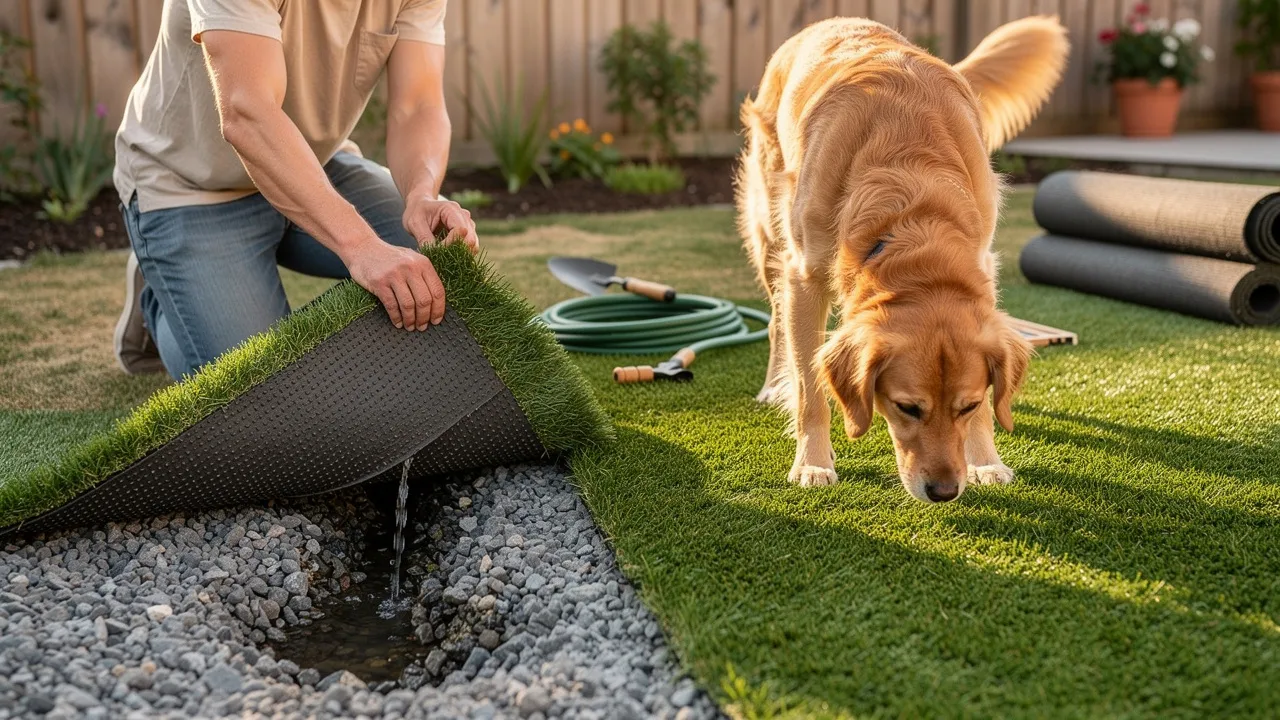
Outdoor fake grass can handle dogs peeing and pooping on it without the surface being damaged, but the visible blades are only the top of the system. Dog-specific artificial turf is often described as clean, consistent, and durable when engineered correctly; it also carries a higher upfront cost, needs drainage planning, and requires periodic sanitization. The useful question is not simply whether a turf sample looks realistic. It is whether urine, rain, and rinse water can move from the fibers through the backing, infill, base, and soil without becoming trapped.
Drainage controls how quickly urine and rinse water leave the surface, which affects odor, hygiene, and how stable the turf feels underfoot. Artificial turf products do not all perform the same, particularly in drainage. A proper base and permeable turf are important for a pet-friendly system; without them, pungent problems can result.
Use this path to screen any system:
- Surface and backing: Confirm that the turf is intended for outdoor use and has drainage openings or another documented path for liquids to pass through.
- Infill: Ask how the proposed infill affects flow and whether the planned amount suits the dogs’ workload.
- Base: Identify what supports the turf and how that layer will be compacted and graded.
- Soil and runoff: Determine whether the ground beneath the base can accept water and where water goes during heavy rain.
- Care: Plan for solid-waste removal, rinsing, odor management, and brushing after installation.
Water-saving estimates do not answer the dog-drainage question. The Synthetic Turf Council estimates that a turf lawn measuring 1,800 square feet can save 99,000 gallons of water per year, or about 70% of a homeowner’s water bill; that estimate is presented for a Western United States context, not as a Kearney or Kansas City forecast. The same report describes an estimate of 500,000 to 1 million gallons saved per year for an artificial-turf athletic field the same size as a 1.32-acre natural-grass sports field, equal to 8.7 to 17.4 gallons per square foot in that athletic-field comparison. Those figures describe water use, not urine handling in a residential dog area. For your yard, follow the liquid path first.
A dog-used lawn needs a system that connects drainage with daily care. Pet turf still leaves you responsible for picking up waste. Use the urine-path test before comparing color, blade shape, or softness: if the proposed system cannot explain how liquid travels below the turf and away from the use area, the product description is incomplete.
Match the surface to the dogs and the workload
Turf selection should follow the number and size of your dogs, their preferred bathroom spots, activity level, digging or chewing behavior, and any known allergies or sensitivities. A single small dog using a broad yard creates a different workload from several large dogs using a compact side yard. An active dog that runs, jumps, or digs also places different demands on the edges and surface than a dog that mainly walks to one bathroom area.
For a residential project, compare the system against these questions:
- How many dogs use the area? A higher dog load means more urine, more solid waste, and more frequent cleaning in the same space.
- Where do they urinate? Dogs may return to the same locations, so a small preferred zone can receive much more liquid than the rest of the lawn.
- How do they move? Active dogs may need more resilient grass when the area must withstand vigorous activity without showing signs of wear.
- Do they dig or chew? Those behaviors make secure edges and perimeter details more significant than a sample’s appearance.
- Are sensitivities a concern? Ask which turf and infill materials are appropriate when a dog has a known contact sensitivity; do not assume every material has the same properties.
Selected pet-turf guidance distinguishes landscape turf for one to three pets, pet turf for multiple-pet use, and 100% permeable pet turf for high pet use or small, concentrated areas such as kennels, commercial facilities, and dog parks. That categorization can help you describe workload, but it does not select a product for every Kearney or Kansas City yard. Match the category to the actual use area and site drainage.
Drainage openings deserve a direct product question. Most synthetic turf products are described as hole-punched to allow drainage, but drainage-hole spacing varies by product; examples range from 2, 3, and 4 inches up to 8 inches on center. For pet use, selected guidance recommends landscape turf with drainage holes. Ask for the proposed product’s drainage construction rather than treating the word “permeable” as a complete system description.
Infill also changes how liquid moves. Overfilling with standard infill can restrict water flow and trap urine near the top, while installers often use less infill and may choose zeolite-based options in heavy-use zones. More material is not automatically a better answer. Request the planned infill type, intended amount, and reason for using it in the dog’s preferred bathroom area.

Build the drainage path below the turf
A typical soil-based installation involves excavating existing grass and plants, grading for drainage, and compacting the exposed soil. The base supports the turf and creates a shaped path for water; it is not decorative material placed beneath the visible grass.
A typical soil-area sequence is:
- Remove organic material. Excavate existing grass, roots, debris, and loose topsoil. Organic material left beneath the lawn can retain moisture and produce bacteria and unpleasant odors.
- Compact the native soil. Compact the exposed subgrade before adding base material to help limit future settling and uneven areas caused by digging or repeated traffic.
- Place separation fabric where appropriate. A permeable, non-plastic geotextile fabric can separate soil from the base, block weeds, and still allow liquids to drain. In a pet area, place it below the base rather than directly under the turf, because fabric directly beneath artificial grass can contribute to urine and odor buildup.
- Add the aggregate base. Crushed rock, class II road base, decomposed granite, or a similar material can provide a firm support layer that can be shaped for drainage. Spread crushed stone or decomposed granite evenly and compact it in layers.
- Grade the finished base. Proper compaction helps prevent low spots and establishes a drainage pathway so water can permeate through the turf and move away rather than pool on the surface.
An installation guide describes soil-based excavation as usually 3-4 inches deep. Treat that as a source-specific planning figure, not a universal excavation requirement: the existing surface, edge conditions, drainage design, and property may change the work required.
The prepared base matters for dog use because urine and rinse water must pass through more than the turf backing. For context, one study found that full-sized, 1.32-acre natural-grass sports fields can use up to 1.5 million gallons of irrigation water per year, depending on geographic location. That athletic-field figure does not predict the water needs or drainage behavior of a residential yard, but it illustrates why surface area and system design should be kept separate from the pet-turf question.
For a soil lawn in Kearney or the Kansas City area, ask what material will be removed, what aggregate will be installed, how it will be compacted, and how the completed grade directs water. A turf sample cannot answer those construction questions.

Test the site before trusting the product rating
A turf product’s advertised drainage rate does not establish that the sub-base will drain at the same rate. A product rated at 30+ inches per hour may still be installed over a base or soil layer that slows water movement. Poor sub-base materials and underlying clay-rich or conglomerate soils can reject excess water and cause flooding.
The soil beneath a pet-turf installation should drain well and have good permeating qualities. If the soil does not drain or permeate, it may need to be removed and replaced with a drainage material that retains compaction. For a poor-quality sub-base, over-excavation and replacement with imported drainage materials may be recommended. In an area known to flood excessively, clean crushed aggregates may be used to help prevent erosion of subgrade and sub-base materials.
A drainage concern needs a property-specific answer. Do not assume that the same arrangement fits every yard, including two properties in the same Kansas City suburb. For a Kansas or Missouri property, include heat, heavy rain, freezing weather, ultraviolet exposure, and winter conditions when evaluating the turf and maintenance plan.
Use the existing yard as a test before you approve a turf system. Look for conditions that change the drainage path or the installation method:
- Standing water after rain or after rinsing the existing surface.
- Soil that stays compacted, wet, or slow to absorb water.
- A slope that sends runoff toward a building, fence, walkway, or neighboring area.
- A low spot where dogs repeatedly urinate or where water collects.
- Difficult access for excavation equipment, aggregate delivery, or removal of organic soil.
- A history of flooding, erosion, or water moving across the proposed dog area.
Pet turf needs a surface that lets fluids flow through; otherwise bacteria, trapped contaminants, and lingering odors may develop. Flooding in pet areas can cause excessive bacteria to build up. Existing drainage issues should be addressed before installation, and turf alone should not be assumed to solve them.
A selected 100% permeable pet-turf product is described as capable of draining over 400 inches per hour. That product-specific figure still does not establish how quickly the prepared base or native soil will drain. If a proposal relies on a product rating without describing the site layers, ask for the missing drainage path.
Choose the right layers for the property surface
The property surface determines which layers belong below artificial grass. Soil, concrete, pavers, balconies, and some decking do not present the same support or drainage conditions, so a soil-based installation sequence should not be copied onto a hard surface.
For soil: Plan around excavation, compacted native soil, a suitable separation layer where needed, an aggregate base, grading, turf, infill, and secure edges. The base replaces soft soil as the support layer and provides the structure that helps water move below the surface.
For concrete, pavers, balconies, or some decking: Artificial turf can be installed without placing a crushed-stone base on top of the hard surface. The design shifts toward drainage, cushioning, and secure attachment. The hard surface may already be stable, but it still needs a way for urine, rinse water, and rain to leave the area rather than collect beneath the turf.
Ask how the proposed system handles the existing surface, where liquid goes, and how the edges will be held in place. A hard surface may simplify support while creating a different drainage detail; it does not eliminate the need to plan for dog waste and rinsing.
A shock pad can be installed above the base layer where dogs frequently run, jump, or rest. Whether that layer belongs in your project depends on the use of the area and the selected installation design; it should not be added without considering drainage and finished height.
Secure turf edges to prevent lifting or movement, especially when active dogs use the area. Edge security matters around gates, fences, planting beds, steps, and transitions to concrete or pavers. Include those transitions in the installation discussion instead of evaluating only the open lawn.
Treat infill and odor control as part of the system
Odor control begins below the visible turf. Artificial grass installed over bare ground can allow urine to seep into unstable soil, become trapped, and create conditions for odor-causing bacteria to build up over time. In a pet area, the drainage path, base, infill, and cleaning routine work together.
Zeolite or similar minerals can be placed beneath the turf as part of the base layer to help neutralize pet-waste odors. Pet-friendly antimicrobial infills can also help neutralize bacteria. These options are not substitutes for drainage or waste removal. If liquid remains trapped, adding an odor-control material does not repair the underlying flow problem.
For persistent odor or slow drainage, selected guidance recommends checking whether the turf backing has a high drainage rate, ideally 250 to 400 inches per hour. Treat that range as a product-screening reference, not a promise that any installation will perform at that rate. Ask how the backing, infill, base, and soil work together at the specific property.
Infill influences how water and urine move through the system and how long moisture remains near the surface. Overfilling with standard material can restrict flow and trap urine at the top, while less infill or a zeolite-based option may be considered in heavy-use zones. Have the installer explain the planned amount instead of assuming that a deeper layer improves odor control.
A well-constructed gravel foundation is reported to last between 10 and 15 years without requiring replacement. That reported range applies to the foundation described in the source, not to every dog-turf installation or to the turf surface above it. Foundation condition still depends on the soil, drainage, use, construction, and maintenance at your property.
Plan the care the turf still requires
Pet turf still requires a waste and rinsing routine. Odor can build up without frequent cleaning. Routine rinsing is usually enough for most residential installations.
Use this maintenance sequence:
- Remove solids first. Scoop solid waste right away using gloves and a bag.
- Rinse the surface. Hose urine spots weekly and rinse the whole area so water can carry urine and debris toward the base.
- Deep-clean heavy-use areas. Perform an enzyme deep clean once a month, or use a turf-specific enzyme cleaner in areas with heavier pet use where odor-causing bacteria need additional attention.
- Brush traffic lanes. Brush high-traffic lanes every few months with a stiff push broom against the grain to lift matting and spread infill evenly.
- Watch the drainage path. Persistent odor, puddling, or a soggy surface calls for an assessment of the surface, infill, base, and soil rather than repeated surface cleaning alone.
The exact cleaning frequency may need to follow the dog load and use pattern. A compact area used by several dogs will place a larger maintenance demand on the same square footage than a broad yard used occasionally.
Cleaning products matter because the surface is used by your dogs. For problem areas, selected guidance describes an enzyme cleaner or a 1:1 white vinegar and water mix; it also says to skip bleach and ammonia because they can damage fibers and irritate paws. Rinse away any cleaner after treatment so residue does not remain on the walking surface.
Maintenance cannot correct every installation problem. If odor returns quickly after rinsing and turf-safe cleaning, or if water remains on the surface, investigate drainage and trapped contaminants below the blades.

Compare DIY planning with a documented installation scope
DIY planning can help you measure the area and define the intended dog use, but base preparation requires accurate excavation, grading, drainage planning, and compaction. Small mistakes can create larger problems after the turf is installed, while professional installation costs more upfront.
Published pricing guidance gives separate planning figures that should not be merged into a local quote. One installation guide states that complete professional installation with high-quality materials costs $13-17 per square foot. A Kansas City pricing guide lists nylon at $5 - $8 per square foot and local polypropylene at $5 - $10 per square foot; that guide describes nylon as the most durable option and polypropylene as medium durability. The first range refers to complete professional installation, while the Kansas City figures refer to turf material categories, so they measure different scopes.
Use these figures only to frame questions. Your total can depend on excavation, soil removal, base depth, drainage work, access, edges, seams, infill, and the size and shape of the dog area. A material price is not an installed-system price.
A professional proposal becomes easier to compare when it explains the work beneath the visible turf. Request a written scope that answers:
- What existing grass, roots, loose soil, or other material will be removed?
- What base material will be used, and what base depth is planned?
- How will the base be compacted and graded?
- Where will urine, rinse water, and rainwater go?
- How will the installation address standing water or odor after rain?
- How will seams, borders, gates, transitions, and turf edges be secured?
- What infill and odor-management approach is included for the dog workload?
- Which costs are included for access, haul-off, drainage work, or difficult soil?
- What coverage applies separately to materials and workmanship?
Compare warranty length and terms for materials and workmanship. A warranty does not explain where water goes; the written drainage method should do that.
Seek qualified evaluation when the site signals risk
Professional evaluation makes more sense when several dogs or large breeds require a high-durability setup, or when dogs repeatedly dig, chew, run, or jump along the same perimeter. These use patterns affect the base, drainage route, edge security, and maintenance workload, so a product sample cannot resolve them by itself.
Persistent unevenness, compaction, inconsistent performance, or a localized problem in existing turf should also be assessed before replacement.
We recommend assessing your specific needs and consulting with professionals to explore artificial-grass installation options. Bring the facts that change the design: the number and size of dogs, preferred bathroom spots, activity and digging behavior, the surface beneath the proposed area, drainage history, slope, access, and your expected cleaning routine.
When requesting a site-specific evaluation or quote from Hall Turf, ask Hall Turf, a licensed contractor, to connect each recommendation to the property and identify applicable product certifications, CAD files, and testing documentation for the proposed system. The explanation should cover the turf backing, infill, base, soil, drainage route, edge details, and maintenance plan. Request the written scope before comparing totals so you can compare the same work rather than comparing a turf-only number with a complete installation.
Request a property-specific Hall Turf quote
A property-specific quote should begin with the way your dogs and yard actually use the space. Before you request one, record the approximate area, current surface, number and size of dogs, preferred bathroom locations, activity level, digging or chewing behavior, drainage history, slope, access, and the maintenance routine you can sustain. Note whether the project is in Kearney or another Kansas or Missouri location and whether the area is soil, concrete, pavers, a balcony, or decking.
The decision is straightforward: choose a system only after its urine path, base, soil conditions, infill, edge security, cleaning needs, and total installation scope are clear. If drainage or site conditions remain uncertain, use professional evaluation rather than treating the visible turf rating as the answer. A qualified professional decides what is suitable for your individual property and use conditions.
What should homeowners confirm before choosing outdoor fake grass for dogs?
Can dogs use fake grass for dogs to pee on outside?
Yes. Dogs can pee and poop on artificial grass without damaging the surface, but the system must provide a reliable path through the turf backing, infill, prepared base, and soil. Drainage, dog workload, site conditions, and continuing waste removal determine whether the area remains usable and manageable.
What should go under artificial grass for dog urine and rinse water?
For a soil yard, the usual foundation includes excavated organic material, compacted native soil, a permeable geotextile below the base where appropriate, and a compacted crushed-rock or decomposed-granite base shaped for drainage. Do not install over bare ground without evaluating it, because trapped urine can contribute to odor. If the soil does not drain, it may need replacement with suitable drainage material.
How can homeowners prevent odor in outdoor dog turf?
Start with permeable turf, a properly prepared base, and soil that accepts water; odor-control infill cannot correct a blocked drainage path. Remove solid waste promptly, rinse urine areas regularly, and use a turf-specific enzyme cleaner for heavy-use or persistent-odor areas. Skip bleach and ammonia because they can damage fibers and irritate paws.
When should a Kansas or Missouri homeowner have the yard evaluated before installing dog turf?
A site-specific evaluation is appropriate when the yard has standing water, compacted or clay-rich soil, a slope, unusual runoff, flooding history, difficult access, or several dogs using a concentrated area. Ask how rain, urine, and rinse water will move through the proposed layers. Turf alone should not be assumed to solve an existing drainage problem.
How often does dog-used artificial grass need maintenance?
Remove solid waste right away or daily, rinse urine spots weekly, and perform an enzyme deep clean monthly as a planning routine. Brush high-traffic lanes every few months to lift matting and distribute infill. The workload may increase when several dogs use a small area, and recurring odor or puddling warrants checking the drainage system rather than only cleaning the surface.