
Start with a Kansas City weather-and-site readiness check
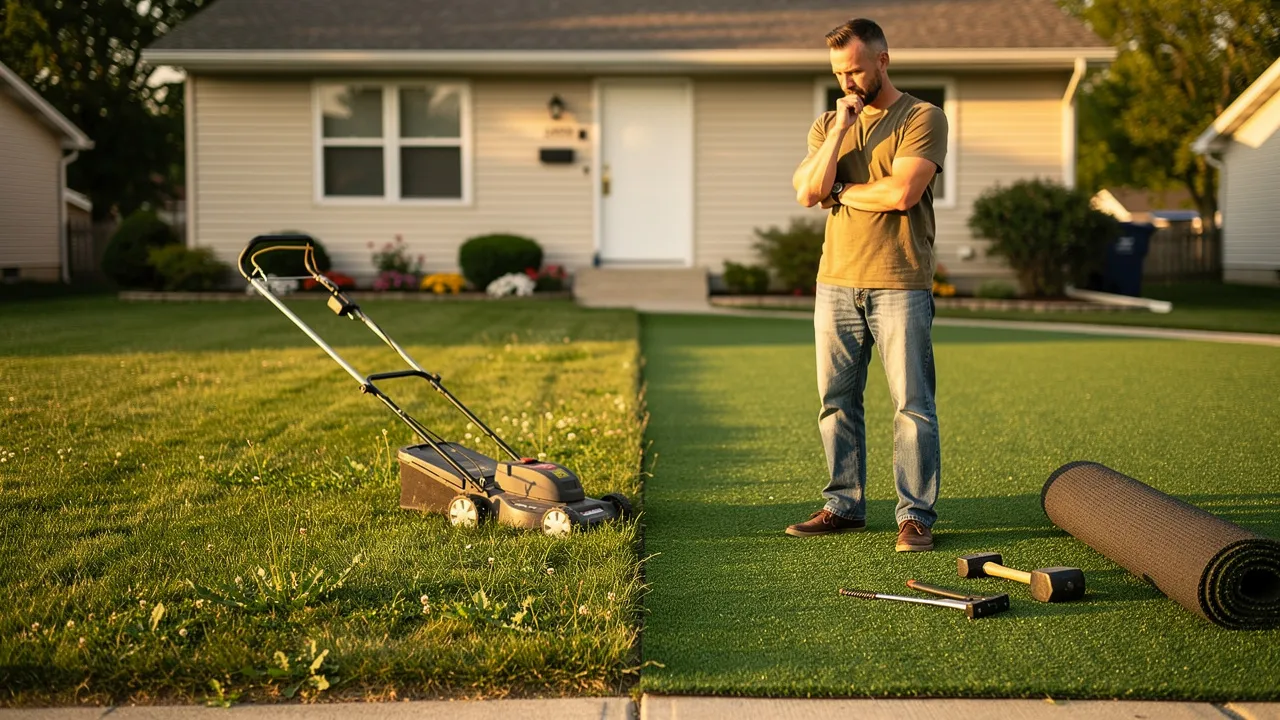
Artificial turf is a synthetic lawn surface that can reduce the recurring mowing, watering, and fertilizing associated with natural grass. U.S. residential adoption is rising as homeowners look for low-maintenance, long-lasting, and attractive outdoor surfaces. Artificial turf is increasingly used in gardens, terraces, balconies, pet zones, and children’s play areas because it does not require regular watering and lawn care in the same way natural grass does. For a Kansas City or Missouri yard, start with a weather-and-site readiness check: note heat exposure, water movement, seasonal-care expectations, and surface condition before weighing a quote. This keeps the decision tied to the property rather than to a universal claim about synthetic grass.
The residential segment accounts for approximately 31% of the artificial turf market, meaning the figure measures residential market share rather than the percentage of homes in Kansas City or Missouri with turf. The 31% figure is a market-share measure, not a count of Kansas City or Missouri households or a demographic profile. You can still use the broader pattern as context: residential applications commonly include ordinary lawns, pet areas, and children’s play spaces, but your household’s use and the condition of your property should control the decision.
Kansas-and-Missouri installation estimates provide planning context, not a guaranteed price for your yard. In Kansas and Missouri, synthetic turf installation, including materials and labor, typically ranges from $12 to $22 per square foot; for a typical residential yard of about 1,000 square feet, the corresponding range is approximately $12,000 to $22,000. The range describes an installed project that includes materials and labor. Access, removal, grading, drainage, base work, turf selection, and site dimensions can change the scope, so use the range to understand why a property-specific evaluation matters rather than treating it as an offer.
Use the weather-and-site readiness check for daily trade-offs
The weather-and-site readiness check separates the conditions that shape use from the care routine itself. Use each row to identify what belongs in a household comparison and what needs site-specific attention.
| Check | What to keep in mind | What to examine on your property |
|---|---|---|
| Heat exposure | Synthetic grass can reach 150-180°F on hot days, while natural grass typically remains at 80-90°F. | Note sun exposure and whether children or pets use the area. |
| Water and routine care | Artificial turf generally needs less routine maintenance and no regular watering, although brushing, debris removal, and occasional rinsing may still be needed. Natural grass requires mowing, watering, and fertilizing. | Compare the current irrigation and lawn-care routine with the upkeep you expect. |
| Cold-season appearance | Natural grass can go dormant during colder months, leading to brown patches and an uneven appearance. | Decide how seasonal appearance affects the household’s use of the yard. |
| Water movement and upkeep | Deep cleaning can help protect drainage; standing water can invite algae, odor, and matting that shorten turf life. | Record puddles, runoff paths, low spots, or saturated soil for site assessment. |
| Environmental trade-off | Artificial turf uses synthetic materials and can raise concerns about plastic pollution and the loss of ecological benefits from living plants. | Weigh that material trade-off alongside the desired lawn routine. |
Water-use estimates need to stay attached to the source and lawn size that produced them. One homeowner guide states that switching from natural grass to artificial turf can save 22,000 gallons of water each year. A typical 1,000-square-foot natural-grass lawn uses around 35,000 gallons of water every year, while artificial turf does not need regular watering but still uses some water for occasional cleaning. These figures describe different lawn sizes and conditions, so do not combine them into a promised saving for your yard. Your actual water use depends on the size, irrigation routine, cleaning needs, and existing lawn conditions.
Heat and long-term considerations should stay separate from the daily-care comparison. Synthetic grass can reach temperatures of 150-180°F on hot days, while natural grass typically remains at 80-90°F; treat those figures as context for sun exposure and intended use, not as a Kansas City prediction. In the Greenville, South Carolina, example, artificial grass can last between 15 and 25 years, and installation runs from $6 to $20 per square foot; those figures are not a Kansas City price or a site-specific lifespan. Hall Turf reports that synthetic grass may decrease property value by around 5%, which measures a possible change in property value rather than a prediction for every Kansas or Missouri home. These are separate questions to consider during a property-specific evaluation: surface temperature, the local relevance of any lifespan or price estimate, and how future buyers may view the installation.
Match turf materials and performance to household use
Turf selection should follow the way you will use the yard, not a universal ranking of materials. Compare intended use, foot traffic, pets, children, appearance, maintenance expectations, surface condition, drainage, budget, and exposure. A front lawn in Overland Park may have different demands from a backyard in Kearney, a pet area in Independence, or a play space in Olathe. High-traffic projects may require stronger backing, deeper bases, and higher-quality synthetic grass, so the visible blade is only one part of the system.
The main material differences give you a starting point for questions about feel, appearance, and traffic. Polyethylene offers softness and realistic texture. Polypropylene has a lower grass cost but a shorter lifespan. Nylon provides strength for high-traffic areas. These descriptions do not identify one material as suitable for every home; they show why your intended use, budget, and expected traffic need to be discussed together. Ask which material, backing, pile height, and infill match the use you described.
Drainage belongs in the product comparison before appearance and feel. Most synthetic turf products on the market today are hole punched to allow drainage, but hole spacing varies by manufacturer and product; products with holes farther apart can have slower permeability rates. Perforated backing can allow liquid to pass through, while crushed stone or gravel can serve as a permeable base beneath the turf. A drainage guide states that runoff systems can manage up to 1,200 inches of liquid per hour with contemporary synthetic grass that has perforated backing. That figure describes the cited system and does not establish the drainage performance of every product or the soil beneath it. Ask how the selected turf, base, grade, and existing soil work together.
Exposure and product pricing add two more selection checks. Synthetic grass can reach 150-180°F on hot days, while natural grass typically remains cooler at 80-90°F. Those temperature ranges measure the surfaces described in that passage and should prompt you to consider sun exposure, barefoot use, pets, and children when planning the area. A cited Ohio guide lists turf product prices - not complete installation prices - at around $1.50 to $2.50 per square foot for entry-level turf, $2.50 to $3.50 for mid-range turf, and $3.50 to $5 or more for premium products. The same guide links price differences to fiber density, pile height, and backing technology. Use those product figures only as general context.
Read the existing yard before choosing the surface
Existing lawn conditions determine whether turf preparation can address a surface problem or whether the problem needs investigation first. Stable, dry surface irregularities may need only base preparation and finish grading. Persistent puddles, soft or spongy ground, runoff moving toward a house or patio, or recurring settlement calls for investigation of drainage, compaction, moisture, or subgrade conditions. Do not use turf to hide those conditions. Do not assume that turf should be installed directly over loose soil; site conditions and manufacturer requirements should determine the foundation system.
Walk the yard after ordinary rain and record what the water does before you discuss a final layout. Note low spots that puddle, areas that stay soft, water moving toward structures or a neighboring property, and slopes that send stormwater across the proposed lawn. Assess whether existing soil remains saturated and whether regrading or another drainage measure may be needed. A turf surface does not create an outlet for water that already lacks a workable path.
Conventional lawn damage can also point to a condition beneath the visible grass. Damage that resembles disease may result from incorrect watering, fertilizing, or mowing; chemicals; poor drainage; compaction; temperature extremes; competing vegetation; or thatch more than 1/2 inch thick, where the figure measures thatch depth. Identify the cause of severe or recurring damage before removing the lawn. The observation helps define the preparation scope, but it does not replace a qualified assessment when the ground is unstable, wet, or affected by runoff.
Understand the professional installation sequence
Professional artificial-turf installation begins with site preparation rather than turf placement. Hall Turf’s published guidance states that we prepare the site before installing artificial grass. A typical preparation sequence can include these stages:
- Clear existing grass, debris, and rocks.
- Excavate to create room for the foundation and drainage layers.
- Place and compact crushed stone or gravel.
- Add geotextile fabric where the system calls for separation between soil and base material.
- Grade the base for drainage and the intended finished level.
- Lay the turf against the prepared edges and complete the finishing work.
The precise sequence and materials depend on the existing surface, drainage, grade, access, intended use, and manufacturer requirements.
One cited installation guide describes excavation typically 3-4 inches deep and a 2-3 inch layer of crushed stone or gravel. The same guide recommends creating a 1-2% slope toward drainage points to avoid pooling. These figures measure the example preparation sequence in that guide; they are not an automatic specification for every Kansas City, Missouri, or Kansas yard. The base still needs to be graded for drainage, and its thickness may change when the existing soil, final elevation, expected load, or water path changes.
Site-specific drainage work may sit below or beside the standard sequence. Depending on site conditions and regional rainfall, an installation may require a French drain, additional drain pipes, or catch basins. Poor sub-base material may call for over-excavation and replacement with imported drainage material. Discuss these possibilities before the turf is ordered, because the visible lawn surface cannot correct saturated soil, an unsuitable base, or a runoff path that has not been addressed.
Compare the complete installation scope behind the quote
Artificial-turf installation cost varies with square footage, site access, existing-lawn removal, soil preparation, labor, infill type, pile height, and material quality. A small lawn can still carry meaningful preparation and access work, while a larger lawn can increase the total even if some per-square-foot costs change. A turf-only number therefore does not describe the complete build. Compare the work included beneath and around the visible grass.
A comparable quote should identify the parts of the installation that apply to your yard:
- Measured square footage, layout, seams, and custom cuts.
- Existing grass or surface removal and disposal.
- Soil preparation, excavation, base material, and compaction.
- Grading, drainage additions, edging, and weed barrier.
- Turf material, pile height, backing, infill, labor, and finishing.
- Access conditions that may affect movement of materials and equipment.
A quote comparison should cover base material, labor, infill, disposal, edging, and weed barrier - not just the turf price.
A property-specific quote needs the property’s square footage, site access, and the amount of existing lawn that must be removed. Add your observations about slopes, puddles, soft areas, shade, sun, pets, children, and expected traffic so the proposed system answers the actual use. Two prices are not comparable when one includes removal, base work, drainage, edging, and disposal while the other covers only turf and basic labor. Ask for the scope in writing before comparing totals.
Plan for upkeep, drainage, and surface trade-offs
Artificial turf is not maintenance-free. Artificial turf still needs light, regular upkeep such as brushing, rinsing, debris removal, and occasional infill top-offs. Another maintenance guide describes sweeping, spraying, and sanitizing as part of care. Plan for the routine before you choose the surface: remove leaves and other debris, rinse when dust or residue collects, brush when fibers need attention, and ask what care the selected infill and system require.
Artificial-turf drainage also depends on keeping the surface and base functioning together. Deep cleaning can help protect drainage by clearing the base layer beneath synthetic fibers. Standing water can invite algae, odor, and matting that shorten turf life. If your yard already holds water, solve the drainage condition through the project scope rather than expecting routine cleaning to correct it. The maintenance plan should explain how surface care and drainage inspection fit together.
Synthetic materials create a separate trade-off from routine labor. Artificial turf can reduce water and chemical inputs, but its production and disposal can contribute to pollution, and synthetic grass does not provide the same ecological benefits as living plants. Artificial grass can also become hot in direct sunlight, and installation typically costs more than natural grass. Compare those conditions with the maintenance pattern you want, the amount of lawn you plan to replace, and how you intend to use the surface in Missouri and Kansas weather.
Seek qualified evaluation when the yard signals risk
A qualified site assessment belongs before the final turf scope when your yard has persistent puddles, soft or unstable ground, runoff toward a structure or neighboring property, recurring settlement, saturated soil, loose soil, or an uncertain foundation. Do not cover those conditions with turf and hope the finished surface resolves them. Assess the cause first, then determine whether the project needs grading, drainage, base preparation, or a combination. Professional consultation is also appropriate when the proposed area has utility conflicts or another condition that makes excavation or the foundation uncertain.
Pet areas and concrete surfaces need their own checks. In a pet turf area, the underlying soil must drain well; if it does not, remove and replace it with proper drainage material because inadequate permeability can leave bacteria and contaminants between drainage holes and create lingering odors. When concrete is the existing surface, Hall Turf assesses concrete condition to ensure a solid foundation before installing artificial grass on concrete. Tell the installer about pet use, existing slabs, cracks, low spots, and any areas that stay wet.
Compaction figures should be treated as project guidance, not a universal Kansas City specification. A ground-preparation guide tied to a Southwest desert-region installation describes crushed fines installed to 3 inches to near finish grade, grading for drainage, and a compaction goal of 90-95%, typically taking 2-3 passes. The figures measure that guide’s preparation example. Your installer should determine the appropriate base, depth, grading, and compaction approach from your soil, drainage, final elevation, expected load, and manufacturer requirements.
Prepare a property note for a Hall Turf quote
Turn the weather-and-site readiness check into a short property note before a quote discussion. Record:
- Approximate lawn dimensions and area to replace, plus the access route.
- Sun and shade exposure and whether the space is used by adults, children, or pets.
- Current surface, including grass, soil, concrete, low spots, soft areas, and recurring settlement.
- Water movement: puddles, runoff paths, slopes, saturated soil, and any recurring drainage concern.
- Current lawn-care routine, desired maintenance level, appearance expectations, and budget range.
- Existing hardscape and the amount of lawn that may need removal.
A quote should identify more than the turf itself. Ask how base material, labor, infill, disposal, edging, and weed barrier contribute to the total, and remember that square footage, site access, lawn removal, soil preparation, pile height, and material quality can change the scope. The note makes those property conditions visible without turning a general range into a promised price.
At Hall Turf, we prepare the site before installing artificial grass. When concrete is part of the proposed area, we assess its condition to ensure a solid foundation before installation. Bring your measurements and observations to that discussion, especially if water, unstable soil, pets, children, or an existing slab will affect the design. The right decision is the one that matches the way you use the yard and the work the property actually requires.
If the ground is uncertain, resolve that condition before finalizing the surface.
Questions to resolve before requesting a residential turf quote
Can residential turf grass be installed directly over dirt?
Do not assume so. Loose soil generally does not provide the stable, properly graded foundation expected for a professional installation. The site may require excavation, a compacted base, grading, and drainage work, with the final system determined by soil conditions and manufacturer requirements.
What lawn conditions should be fixed before installing artificial turf?
Persistent puddles, soft or spongy ground, runoff toward a structure or neighboring property, saturated soil, or recurring settlement should be assessed before the turf scope is finalized. Depending on the cause, the project may need regrading, drainage work, base preparation, or a combination rather than simply covering the surface.
How should homeowners choose between polyethylene, polypropylene, and nylon turf?
Use the yard’s intended purpose, traffic, appearance, budget, and maintenance expectations as the starting point. Polyethylene offers softness and realistic texture, polypropylene has a lower grass cost but a shorter lifespan, and nylon provides strength for high-traffic areas. Drainage, backing, pile height, and the base also affect suitability.
What should a Kansas City homeowner check before adding turf to a pet area?
Confirm that both the turf and the underlying soil can drain well. Inadequate permeability can leave bacteria and contaminants between drainage holes and create lingering odors. If the soil does not drain properly, the installation may require removing and replacing it with suitable drainage material.
Does artificial turf need maintenance after installation?
Yes. It generally needs less routine care than natural grass, but homeowners should still remove debris, brush the fibers, rinse away dust or residue, and inspect for damage. Depending on the system, occasional infill maintenance or deeper cleaning may also help protect drainage and reduce odor or matting.