
Start with a post-installation care baseline
Post-installation pet-turf care starts with a baseline, not another turf sample. Record where your dogs use the area most, where seams and edges are located, and whether you already notice low spots, odor, shifting, or heat concerns. For a Kearney, Kansas City, Overland Park, Olathe, or nearby Missouri property, keep the product label and available installation information with those notes so later changes can be compared with the installed conditions.
Use the baseline to separate routine care from a problem that needs assessment. Pick up solid waste promptly, rinse high-use areas regularly, clear pet hair and debris, gently brush the blades, and address spots with mild soap and water.
During each review, note whether odor returns after cleaning, whether water or urine pools, and whether the surface has shifted, lifted, or become unusually hot. Routine care addresses residue and debris. A recurring or uncertain condition is a reason to pause the affected use area and request qualified assessment instead of adding stronger products or attempting an unassessed repair.
This care record gives you a practical way to explain what changed, where it changed, and which part of the dog area needs attention.
Match the surface to your dogs and daily use
Your dogs’ size, movement, habits, and waste volume should determine the turf specifications you compare. A surface that looks good in a small sample may still flatten along a running path or struggle with concentrated urine if the system does not match the workload.
Large dogs can be harder on artificial grass because their weight, urine volume, and habits test the turf system. A 70-pound dog can press fibers flat with each step and turn, while one visit from a large dog can put far more urine in one spot than a small breed does. Turf without enough density or resilience can begin to look worn along repeated paths.
Translate daily use into specifications:
- Pile height: About 25mm is described as a suitable short pile height for high-frequency use. Another product guide lists around 1 to 1.25 inches as a pet-area pile-height option and says shorter pile can rinse clean and resist matting from paws. These are reference points, not a guarantee for every dog or property.
- Weight and density: A comparison describes 70-90 ounces as an ideal turf weight for resisting flattening. Another guide says a heavier build may hold up to traffic and digging and that a dense face may spring back. Ask whether total weight and face weight are both published.
- Yarn: Monofilament polyethylene with a thatch layer is described as a yarn option that is soft on paws but durable. Treat that description as a specification to compare, not an assurance that every dog will prefer it.
- Use pattern: Mark the places where your dogs run, turn, dig, rest, and urinate. Concentrated use should shape the proposal more than total square footage alone.
A 2026 cost estimate reports that large open yards price 10-20% lower per square foot at scale. That figure measures a reported per-foot difference for large open-yard projects; it does not establish a discount for a particular Kansas City property.
Your first action is to describe the workload in concrete terms: the number and size of dogs, daily activity, digging behavior, dominant potty areas, and whether people will also use the space. Give that description to the installer before choosing the visible turf. If one area will receive most of the running or waste, ask how the proposed system addresses that concentrated load rather than averaging the entire yard.

Design the water and waste path before choosing products
Drainage is the route that carries urine and rinse water through the turf, infill, base, and surrounding site. Artificial grass systems are designed to let liquids move through the turf into an underlying drainage system, but drainage behavior varies by product. A high published drainage rate cannot compensate for a poorly prepared or unsuitable base.
Good pet turf can drain dog urine through fully permeable backing, and drainage rate is a key odor-control specification. Well-designed pet turf often lists a published drainage rate of 250 to 400 inches per hour or higher, while some landscape products list 30 to 60 inches per hour. These figures measure water throughput listed for the products described; they do not predict the performance of a specific Kansas City installation.
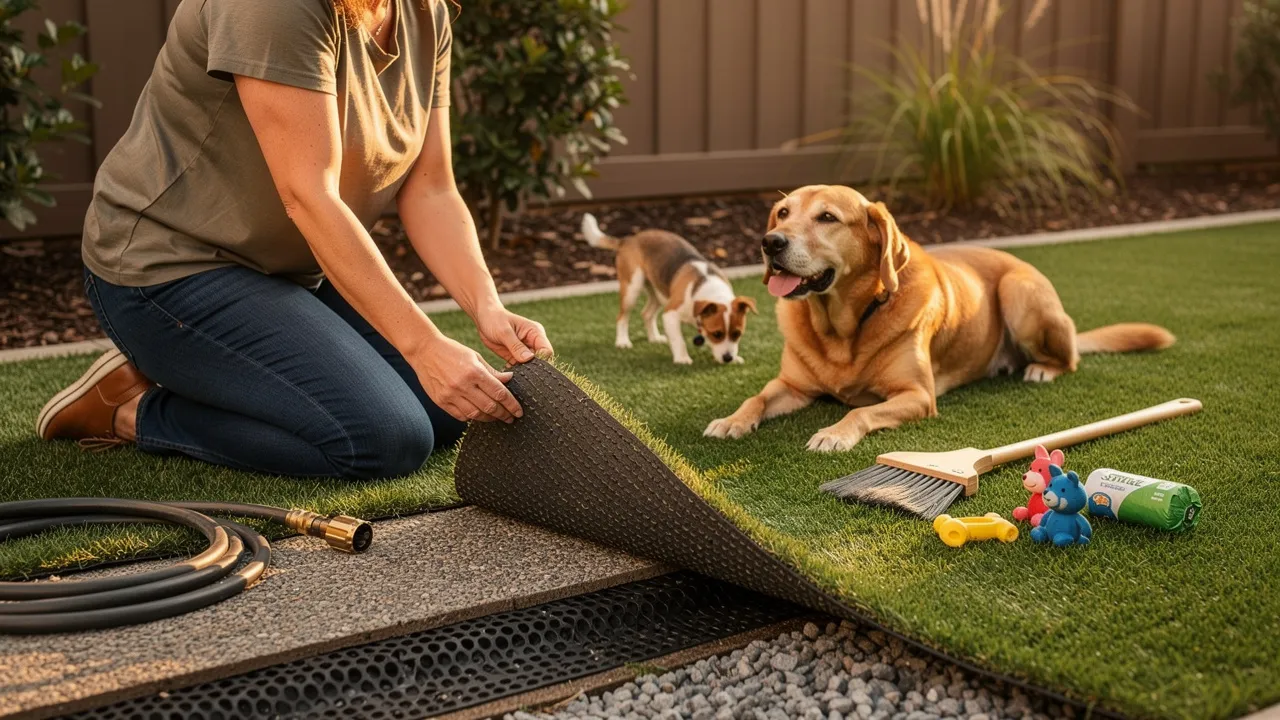
The base and slope determine whether that advertised pathway remains useful on your property. An installation guide recommends sloping the base at least 1% away from structures so water and urine can drain freely instead of pooling beneath the turf. The same guidance says high-traffic pet zones may benefit from 3 to 4 inches of crushed stone for structural integrity and odor prevention.
Ask for a plain explanation of these parts:
- Backing: Is the backing fully permeable, and what drainage rate is published for the specific product?
- Base: What material will be used beneath the turf, how deep will it be, and how will each layer be compacted?
- Slope: Where will rinse water go, and how will the plan keep it away from the foundation or other structures?
- Existing conditions: Does the property have clay soil, a low spot, standing water, a downspout discharge, or another condition that changes the drainage plan?
- Infill: Could the selected amount or type restrict water movement if it becomes compacted or overfilled?
The ground beneath the turf is part of the decision. A permeable surface cannot correct a base that shifts, a low area that holds water, or a drainage route that has nowhere to discharge. Choose the drainage plan before treating a turf sample as the main product.
Choose odor-control materials with their trade-offs in view
Infill affects odor control, moisture behavior, blade support, and cleaning, so compare it as part of the drainage system rather than as a decorative add-on. Overfilling with standard materials can restrict water flow and trap urine near the surface, which can worsen odor. Odor control also requires a high-drain-rate backing and a rinse-down routine you can maintain.
The main trade-offs are easier to see side by side:
| Infill option | Odor and moisture considerations | Cost and care considerations |
|---|---|---|
| Zeolite | Zeolite is described as a usual choice for dogs because it traps ammonia. Its performance still depends on drainage, correct installation, and regular rinsing. | Compare the amount, placement, replenishment plan, and compatibility with the selected turf system rather than assuming the label settles the decision. |
| Silica sand | Silica sand can trap pet odors, may harbor moisture, and may contribute to bacteria, mold, or mildew. It may also lose permeability if it hardens. | Silica sand is generally the least expensive infill material, but its lower initial material cost does not resolve moisture, odor, or cleaning concerns. |
Some pet-turf products may include antimicrobial protection designed to help guard against bacteria, mold, mildew, and the odors they can cause. That feature is a product characteristic, not a promise that an area will stay odor-free without waste removal, rinsing, and suitable drainage.
Ask which material is being proposed, what function it serves, how much will be installed, and how it will be inspected or replenished. The right choice depends on your dogs, the site, and the care routine you can sustain. Do not treat a single infill type as universally correct.

Build the care routine into the decision
Artificial turf care begins with waste removal, rinsing, debris control, and inspection. Pet-friendly artificial turf can handle heavy paw traffic and resist digging, but uncleaned pet waste can still cause odor, bacteria growth, and hygiene issues. Most dogs can be trained to urinate and defecate on artificial grass, and its consistent surface can make waste easier to spot and remove.
A workable routine includes:
- Pick up solid waste promptly.
- Rinse high-use areas regularly, giving urine and residue a route through the system.
- Remove leaves, fur, and other debris that could interfere with drainage.
- Gently brush the blades to address matting and keep the surface groomed.
- Treat spots with mild soap and water when appropriate for the turf system.
- Inspect infill in high-use areas and top it up if coverage becomes thin.
One care guide recommends weekly rinsing, monthly deep cleaning with an enzymatic pet-odor cleaner, and infill replenishment every 1-2 years depending on foot traffic and pet activity. Those intervals are guidance, not a substitute for inspecting the actual surface and infill.
An artificial-grass enzyme treatment can help break down organic residue that contributes to pet odors, but it does not replace solid-waste removal, thorough rinsing, or attention to contaminated infill or backing.
If the routine feels unrealistic for your household, include that fact in the decision. A surface that reduces mowing still needs a repeatable plan for dog waste, rinsing, debris, and occasional deeper care. Agree on who will handle those tasks and how recurring odor or thin infill will be identified before you commit to the system.
Use a written care schedule so a missed task does not become an odor investigation. Pet owners can record solid-waste removal as it occurs, rinse high-use areas weekly, deep-clean monthly with an enzymatic pet-odor cleaner, and inspect infill during those checks. A care log should identify the date, area, visible debris, pooling, odor after cleaning, thin infill, and any lifted or shifting surface. A care guide says infill may need replenishment every 1-2 years depending on foot traffic and pet activity; an inspection should determine whether coverage has become thin rather than treating the 1-2-year interval as automatic. Leaves, fur, and debris should be removed before they interfere with drainage. A recurring odor after label-directed cleaning is not a reason to increase product strength or frequency without assessment. Surface residue can be treated with label-directed products, but contaminated infill or backing may require a different response. If a care log shows odor returning in the same location, the location should be reported with the products used, rinsing performed, and timing of the return. If a care log shows pooling after rinsing, the drainage path and base should be evaluated instead of being masked with additional infill. This schedule gives dog owners a way to distinguish an ordinary maintenance task from a repeated condition that warrants qualified help.

Keep pet-turf and natural-grass maintenance practical
The maintenance choice is different for each surface. Artificial grass can provide a cleaner, low-maintenance area for everyday dog activity, but it is not maintenance-free. Natural grass can feel cooler underfoot and supports biodiversity, air quality, and local wildlife, but it changes with weather and use and needs ongoing care.
| Maintenance question | Pet-friendly artificial turf | Natural grass |
|---|---|---|
| What happens after pet use? | Pick up solid waste promptly, rinse urine and high-use areas, clear debris, brush the blades, and clean spots as needed. | Remove waste and manage the lawn as weather, traffic, and digging affect the surface. |
| What routine lawn work remains? | No mowing or routine irrigation is needed to keep the surface green, but cleaning and periodic care remain necessary. | Regular mowing and usually routine irrigation are needed. |
| How does the surface handle activity? | It can help reduce muddy paws, withstand frequent activity, and make waste easier to manage. | Running, digging, weather, and repeated traffic can change the lawn surface and create worn areas. |
| What practical trade-off matters? | Higher upfront cost, surface-heat checks, drainage considerations, and cleaning remain part of ownership. | Lower initial cost may come with continuing mowing, watering, repair, and other care. |
| What broader yard role matters? | Provides a consistent synthetic appearance, subject to use and maintenance. | Supports biodiversity, improves air quality, and supports local wildlife while requiring ongoing investment. |
Use the surface that fits the work you are prepared to do. Artificial turf may reduce mud and routine lawn work, but it requires a waste-removal and cleaning routine plus attention to heat and drainage. Natural grass may suit a household that values a living, cooler-feeling surface and accepts seasonal maintenance, watering, and repair.
Check summer surface heat before use
Heat checking belongs in recurring care for any sunny dog area.
Before warm-weather use:
- Place the back of your hand on the turf.
- Keep it there for five seconds.
Check sunny paths, potty zones, and areas near reflective walls separately. Shade, time of day, surface color, infill, and airflow can make one part of the yard feel different from another. Include heat observations in your care record, especially for a south-facing Kansas City yard with little shade.
If you cannot assess the surface confidently, pause pet access and contact a qualified professional promptly rather than guessing.
Use maintenance history to interpret project cost
A care history can show when a recurring problem may require more than routine cleaning. Note the affected area, how often the problem appears, what cleaning product was used, whether odor or pooling returns, and whether the surface has shifted or been damaged. That information helps separate a maintenance question from a possible base, drainage, or replacement project.
If a new pet-turf area or larger corrective project is being considered, a 2026 cost estimate places installed pet-friendly turf at about $10 - $18 per square foot. A separate U.S. estimate gives a broader range of about $10 - $20 per square foot, depending on the product and site conditions. For one 500-square-foot example, an estimate places pet-friendly turf at about $5,000 - $9,000. These are broad planning references, not Kansas City pricing or a price for correcting an existing problem.
The factors that can change a project total include area, turf tier, removal and hauling, base preparation, slope correction, drainage complexity, access, perimeter work, labor, and infill. One 2026 estimate assigns $1 - $3 per square foot to removing and hauling away an old lawn and $2 - $5 per square foot to a crushed-rock sub-base. Significant slope correction or advanced drainage can raise the total even when turf material costs remain the same.
Use the record to explain the condition before discussing scope or cost. Do not treat a planning range as evidence that a particular cleaning, drainage correction, or replacement is needed.
Turn the site into a quote-ready question set
A quote-ready site brief turns your dog’s workload and property conditions into specific questions. Installation typically includes measuring, excavation, a compacted sloped aggregate base, turf installation and seaming, edge securing, any required infill, and final grooming. Base preparation is the installation step most likely to make or break the result.
Give the installer this information and ask for a direct answer to each point:
- Use: How many dogs will use the area, what are their sizes, and where do they run, dig, rest, and urinate?
- Area: What square footage is included, and how do the shape, curves, seams, and access route affect the material and labor scope?
- Existing ground: Will the project remove the existing lawn and soil? One installation guide recommends removing 2 to 4 inches of soil across the installation area.
- Base and slope: What aggregate will be used, how deep will it be, and how will it be compacted? The guide recommends sloping the base at least 1% away from structures and compacting aggregate in 2-inch lifts.
- Drainage: Where will urine and rinse water go, and what site condition could interrupt that route?
- Backing and infill: What drainage rate, infill type, quantity, and replenishment plan apply to the selected system?
- Edges and seams: How will the perimeter and joins be secured, and how will the finished surface be groomed?
- Durability: Are total weight, face weight, pile height, yarn type, and resilience documented for the proposed product?
- Warranty: Is the written warranty term stated plainly, including what the maker will back?
- Expected performance: Some UV-stabilized turf materials are rated to perform for roughly 12 to 20 years depending on the product and conditions. That rating is not a promise for an individual yard.
- Cost scope: Does the proposal separate turf, infill, excavation, old-lawn removal, sub-base, drainage work, seams, edges, labor, and ongoing care?
Take photographs of the existing area, note standing water or low spots after rain, measure the planned dog zone, and record the questions you cannot answer yourself. A complete brief makes proposals easier to compare without pretending that two different sites have the same scope. If the area connects to a foundation, retaining wall, downspout, or shared drainage route, mark that relationship on the site notes so it is addressed before work begins.
Compare proposals by matching scope before comparing totals. A proposal with a lower total may cover less excavation, base preparation, drainage work, infill, perimeter work, or removal than another proposal, so a total alone cannot show which option costs less for the same work. Ask each installer to state exclusions, allowances, and conditions that could change the price after site inspection. Ask Hall Turf, a licensed contractor, which product certifications, CAD files, and testing documentation apply to the proposed system and where those materials can be reviewed. Use product certifications, CAD files, and testing documentation to check that the proposed product and planned installation details match the written scope. The documents do not replace a site-specific assessment of drainage, base conditions, slope, or access. Record each installer’s answer to the drainage, base, product, documentation, and cost-scope questions in the same order for every proposal. A written comparison should distinguish product specifications from installation assumptions and should show whether ongoing infill replenishment and cleaning are included or left to the homeowner. Choose the proposal you can evaluate clearly against your dogs, property, use pattern, and care capacity, not simply the proposal with the smallest headline number.
Escalate persistent odor, drainage, and damage
Persistent odor, uncertain drainage, a shifting base, damaged turf, or an unsafe surface condition should change the next step from routine care to assessment. Start with prompt solid-waste removal, system-appropriate rinsing, and the cleaning product’s label directions.
If odor keeps returning, stop adding stronger products and request an assessment because waste may have accumulated in the infill or backing. Repeated surface applications may not reach the contaminated layer. Enzyme formulas have different dilution, contact-time, rinsing, and pet re-entry directions, so do not guess at a universal recipe.
Ask for qualified site evaluation when:
- water or urine appears to pool beneath or around the turf;
- the drainage route, base material, slope, or compaction cannot be identified;
- the surface has low spots, shifting areas, lifted seams, or persistent odor;
- turf or backing is damaged and the extent of the problem is unclear;
- a weed-barrier approach may have trapped urine-related moisture and bacteria below the turf; or
- the surface is too hot to assess confidently before pet use.
A loose base can shift and create uneven surfaces over time. Installation guidance recommends compacting 2-inch lifts of crushed stone or decomposed granite. The same guidance says weed-barrier fabric can trap urine-related moisture and bacteria below the turf and create odor problems that are very difficult to fix after installation.
If you are in doubt about drainage, persistent odor, damaged turf, unsafe surface heat, or another pet- or property-safety concern, keep people and pets off the affected area as appropriate and contact a qualified professional promptly. Avoid concealing the symptom with more infill, stronger products, or an unexamined repair.
Bring a care record to a local consultation
Bring the care record to a local consultation: identify the dogs’ use pattern, affected locations, drainage observations, cleaning products used, heat checks, photographs, and any changes in seams, edges, infill, or the base. Ask whether the next step is routine cleaning, professional cleaning, a drainage or base assessment, or repair of damaged turf.
For a Kearney or Kansas City-area property, make any unresolved odor, pooling, shifting, damage, or heat concern the first topic. If the condition cannot be assessed confidently, keep the affected area out of use as appropriate and contact a qualified professional promptly. Once the site condition is understood, request a free quote for any pet-turf work that fits the property and the care requirements.
What should dog owners verify before choosing pet-friendly turf?
What should I do if pet-turf odor keeps returning?
Stop adding stronger products and request an assessment. Persistent odor can indicate waste has accumulated in the infill or backing, where repeated surface treatments may not reach. Until the cause is assessed, limit use of the affected area and continue only with appropriate waste removal and rinsing.
How can I tell whether artificial turf is too hot for my dog?
Place the back of your hand on the surface for five seconds. If it is too hot for you, keep your dog off it until conditions change. Check sunny potty areas and running paths separately, because shade, time of day, surface color, infill, and ambient conditions can affect heat.
When does a drainage concern require a site assessment?
Request qualified evaluation when water or urine pools, the drainage route or base cannot be identified, or the surface develops low spots, shifting areas, lifted seams, or persistent odor. A permeable turf product cannot correct an unsuitable or poorly prepared base, so avoid guessing at repairs or masking the problem with additional chemicals or infill.