
Build a Pet-Turf Installation Brief for Quote Comparison
Build a written installation brief before comparing pet-turf proposals for a Kearney or Kansas City property. Record the dogs’ activity and waste pattern, then connect those conditions to the proposed drainage approach, infill role, cleaning and deodorizing routine, available safety testing for the materials, and replacement planning for a dog run or pet-relief area. The brief makes the proposed installation the unit you compare.
Give the brief one entry for each question that still needs a property-specific answer. Note how the proposed system will handle water and waste, what care the household will perform, which material specifications and safety-testing information are available, and what would need planning if a heavily used area requires replacement. This keeps the quote discussion focused on details that can be checked.
Pet-turf suitability is a system question. Materials, product quality, installation, maintenance, surface temperature, drainage, and cleanliness all affect whether an artificial-grass area fits regular dog use. A surface sample can help you compare appearance, but it cannot answer every question about the completed installation.
Use the rest of this guide to build a property brief before you compare products. Your brief should connect the dogs’ workload to the waste pathway, infill, cleaning routine, site conditions, and project budget. That sequence keeps a product label from making the decision for you.
Match Durability to the Dogs’ Workload
Dog activity determines the durability question you need to answer. Occasional household use may place less concentrated pressure on a surface than daily running, repeated turns, vigorous play, or a dedicated dog run. Active dogs may require more resilient grass that can withstand vigorous activity without showing signs of wear. Treat that point as a workload requirement, not as a promise that any particular product will remain unchanged.
Describe the use in practical terms before requesting a quote:
- Routine relief use: Identify where urine and solid waste occur and how often the area will be cleaned.
- Daily play: Record the paths, turning points, and zones that receive repeated traffic.
- Vigorous activity: Note running, chasing, digging attempts, and concentrated use in a dog run or pet-relief area.
- Multiple-dog use: Account for the combined waste volume and traffic rather than evaluating the habits of only one dog.
The purpose of this list is to give the installation discussion a clear workload. It does not assign a universal product grade.
Artificial-turf durability should be assessed with the rest of the system. Ask which materials and installation choices are intended for the activity level you described, how the proposed area will handle concentrated use, and what maintenance the surface requires after installation. Product quality and installation are part of suitability, alongside the material itself.
A durable-looking sample is not enough to settle the decision. Keep the questions tied to your dogs’ workload and the area’s waste routine. If the proposed surface is intended for a high-use dog run, make sure the written plan addresses cleanable components, sanitation, drainage, odor management, water access, and replacement planning rather than discussing appearance alone.
Design the Waste Pathway Before Choosing the Surface
Pet-area drainage should be planned before you judge the surface layer. Dog-frequented turf needs effective drainage, and periodic washing and rinsing with water and an enzyme cleaner support cleanliness. Where excessive rainfall or dog use is expected, ask whether a drainage panel is appropriate for the proposed system.
A dog run or pet-relief area also needs a practical waste pathway. Assess rapid drainage, cleanable components, sanitation, odor management, water access, and replacement planning. These checks connect the dogs’ daily use to the installation rather than treating drainage as a feature that can be assumed from the turf alone.
Ask the installer to explain how the proposed system handles cleaning water and where that water goes. Ask what part of the system is intended to drain, what part can be cleaned, and whether a drainage panel belongs in the plan. A clear answer should relate to your site and expected use.
Those factors affect whether a pet-turf plan fits your property and your household routine.
Use this short pre-quote screen:
- Intended use: Mark relief, play, running, or mixed use.
- Drainage conditions: Record any area where water management is a concern and ask how the proposed system addresses it.
- Weather exposure: Note how much direct exposure the pet area receives and include surface temperature in the discussion.
- Existing surface: Describe what is already in the installation area and ask how it affects preparation.
- Maintenance commitment: Decide who will rinse, clean, deodorize, remove waste, and arrange repairs when needed.
A quote that begins with these facts can address the waste pathway more directly than a quote based only on square footage.
Keep the screen factual rather than predictive. Record the condition you can observe, the question it creates, and the answer the proposal must provide. For example, a drainage concern should lead to a description of the proposed drainage approach and cleaning-water path; an existing-surface concern should lead to a description of preparation; and a maintenance concern should lead to a clear account of rinsing, cleaning, deodorizing, waste removal, and repairs. In a Kearney or Kansas City project, this same record keeps local site details attached to the quote without assuming that every property has the same conditions. It also gives you a way to identify unresolved points before comparing infill or surface options.
Treat Odor Control as Ongoing System Management
Odor control requires both drainage and active cleaning. Effective drainage and periodic washing with water and an enzyme cleaner support cleanliness. Rain alone does not eliminate dog-urine odors, so plan for active cleaning, deodorizing, and regular maintenance instead of treating rainfall as the complete solution.
This distinction resolves a common planning error. Drainage helps move cleaning water through the system; it does not remove the need to manage urine buildup. Cleaning and deodorizing remain part of the operating routine, especially where dogs return to the same relief area frequently.
A pet-turf cleaning brief should state what you will do after solid waste, routine urine use, heavy rain, and visible soil. Include water access and the cleanable components that must be reached during maintenance. For a concentrated dog area, ask how sanitation and odor management fit the proposed system.
Do not describe the surface as odor-free or maintenance-free. Instead, set a clear operating expectation: remove waste, use the planned rinse and cleaning approach, apply deodorizing treatment when needed, and maintain the area regularly. The exact routine depends on the installation and product instructions, so include it in the written project discussion rather than assuming every system has the same requirements.
Evaluate Infill by Function, Not by a Generic Pet-Turf Label
Infill should be evaluated by the job it performs in the turf system. The available descriptions assign different roles to silica sand, EPDM rubber, organic infill, and envirofill. Infill can affect resilience, cooling properties, safety, drainage, and odor management, so a generic pet-turf label does not answer every selection question.
| Infill option | Stated role to compare | Pet-use check | Budget point |
|---|---|---|---|
| Silica sand | Drainage and stability | Confirm that the selected material is identified as suitable for pet areas and intended for odor control | Tends to be more affordable and widely available |
| EPDM rubber | Cushioning | Check the material information and available safety testing before selecting it for dogs | Compare its project cost separately |
| Organic infill | An available option where appropriate | Confirm dog suitability and odor-control purpose before use | Cork or coconut-fiber options may require a larger investment |
| Envirofill | An available option where appropriate | Confirm the stated pet-use and odor-control suitability | Request the installed cost rather than assuming equivalence with sand |
The table gives you comparison categories, not a ranking. Select the infill only after the intended role, pet-use suitability, and project budget are clear.
Pet-turf infill should be identified as safe for dogs and intended for odor control. Do not use random sand without checking whether it is suitable for pet areas. Before selecting any material, check the product specifications and available safety testing for the materials used.
Ask these questions in writing:
- What role does the proposed infill serve in this installation?
- Is the material identified as suitable for dogs and intended for odor control?
- What safety testing is available for the materials used?
- How does the infill affect the planned cleaning and drainage routine?
- What cost difference results from choosing another supported infill option?
These questions keep cost, system function, and pet use connected. They also prevent a low initial material cost from becoming the only selection criterion.
Check Materials, Surface Temperature, and Evidence Limits
Pet-turf safety depends on the complete system rather than a single surface characteristic. Review the materials, product quality, installation, maintenance, surface temperature, drainage, and cleanliness. Check the product specifications and available safety testing for the materials used before selecting turf for dogs.
You can turn that guidance into a document request. Ask for the specifications for the proposed materials, the available safety testing, the maintenance requirements, and the drainage approach. Keep the documents tied to the actual system under consideration rather than using a general product description as proof that every installation will perform the same way.
Surface temperature belongs in the suitability discussion, but available studies do not support a universal heat advantage for artificial turf. The cited research notes limited understanding of differences among artificial turf, unirrigated natural turf, and irrigated natural turf because many studies did not report whether the natural turf was irrigated.
For your Kearney or Kansas City property, describe the area’s heat exposure and the times your dogs use it. Ask how surface temperature is addressed in the proposed material and maintenance plan. Do not treat a general comparison between artificial and natural turf as a property-specific result, and do not promise that one surface will remain cooler in every condition.
Inspect the Kearney or Kansas City Site Before Comparing Products
Your Kearney or Kansas City site should be screened before you compare turf products. The walk-through should show how the area will function and what the installation must accommodate.
Walk the proposed area and record:
- Where the dogs enter, run, turn, rest, and relieve themselves.
- Which areas receive concentrated use or repeated traffic.
- How the existing surface relates to the proposed pet area.
- Where water access is available for rinsing and cleaning.
- How much direct heat exposure the area receives during normal use.
- Who will handle routine maintenance after installation.
The purpose of the walk-through is to create a site record. It is not a product score.
A property brief should connect site conditions to the dog-use plan. For a relief area, emphasize drainage, sanitation, odor management, water access, and cleanable components. For a larger play area, add traffic patterns, activity level, and the maintenance tasks that will follow daily use.
Weather exposure belongs in the same record as existing-surface conditions. A quote can then address the actual installation scope instead of treating every Kansas or Missouri yard as interchangeable. If the intended use, drainage, existing surface, or maintenance routine is uncertain, request a site assessment before choosing among materials.
Compare the Project Cost With the Work It Replaces
Your written comparison should separate the costs and obligations that apply to your property:
- Installation: Record the proposed area, materials, labor, and any site work included in the scope.
- Infill: Compare the cost of silica sand with other proposed options; silica sand tends to be more affordable and widely available, while cork or coconut-fiber options may require a larger investment.
- Routine care: Include rinsing, cleaning, deodorizing, and any minor repairs described for the system.
- Replacement planning: Ask how concentrated pet use affects the long-term plan for the area.
- Natural-grass comparison: List the mowing, watering, fertilizing, labor, and other recurring work you currently perform or would otherwise budget.
A cited case study reports that natural grass can require up to 1 million gallons per year in the United States, but that is not a Kansas or Missouri household estimate. Do not use it as a local water-use promise or as your project budget. Keep local decisions tied to your own property, maintenance routine, and written installation scope.
Use one worksheet for the project and another view for recurring work. The project side can hold area, site work, materials, labor, infill, and any drainage-related scope identified in the proposal. The recurring side can hold rinsing, cleaning, deodorizing, waste removal, minor repairs, and replacement planning. This separation prevents a lower initial material line from being treated as the entire financial comparison. It also keeps national or nonlocal figures in their proper place: they may illustrate a category of cost or water use, but they do not replace property-specific scope for a Kearney or Kansas City decision. Compare the obligations you can identify, and mark any amount that still requires a quote.
To compare two proposals, first align their scope lines rather than comparing headline totals. Put site preparation, base work, drainage provisions, turf, infill, labor, cleanup, and replacement planning into separate rows when the proposal identifies them. Mark each row as included, optional, excluded, or unanswered. This does not create a local price estimate; it shows whether the proposals describe the same work. It also makes it easier to ask why a drainage provision or different infill changes the scope. Keep recurring cleaning, deodorizing, waste removal, and minor repairs outside the installed total so the comparison reflects both the initial project and the work the household will perform afterward. When a proposal leaves a line unanswered, carry that question into the quote discussion instead of filling the gap with an assumption. Keep the status visible in the worksheet so unresolved scope questions are not mistaken for excluded work.
Turn the Decision Into a Written Installation Brief
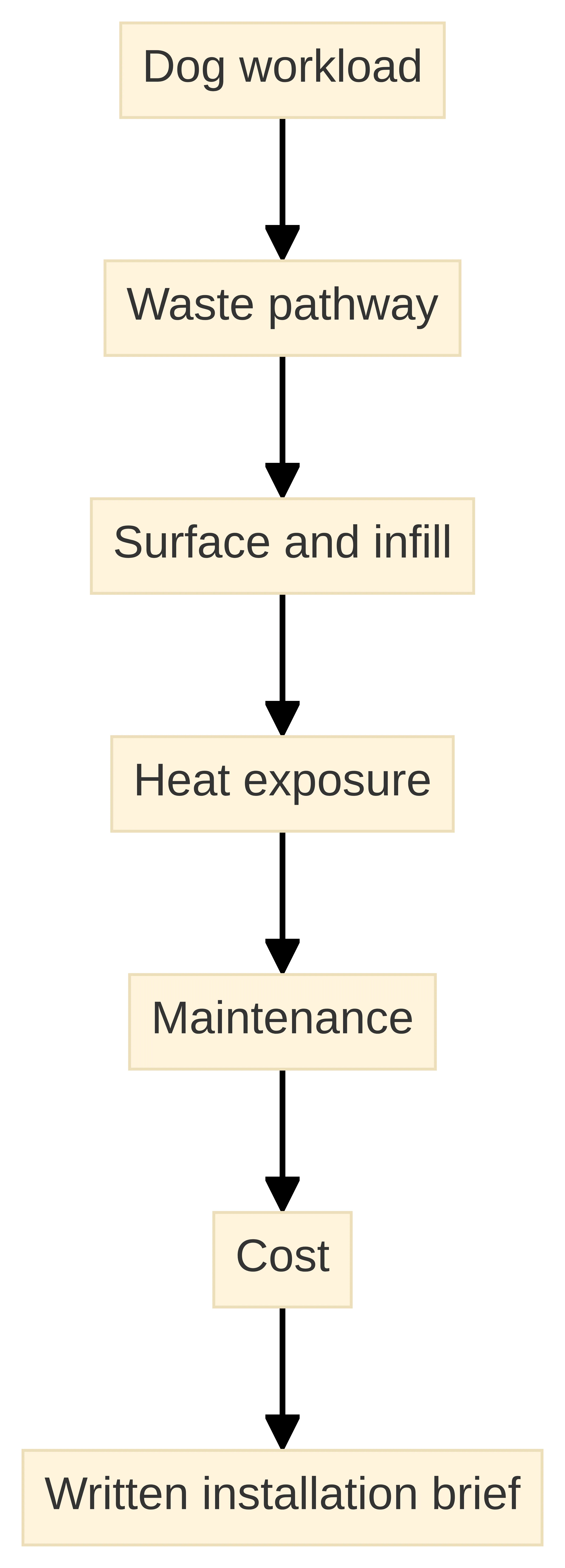
A written installation brief turns your dog-use observations into questions that a quote can answer.
Include these sections:
- Dog workload: Number of dogs, frequency of use, activity level, concentrated traffic, and waste locations.
- Waste pathway: Drainage conditions, water access, cleanable components, sanitation, odor management, and whether a drainage panel should be considered.
- Surface and infill: Proposed materials, the stated role of the infill, pet-use suitability, odor-control purpose, and available safety testing.
- Heat exposure: Areas of direct exposure and the times when the dogs normally use the space.
- Maintenance: Rinsing, cleaning, deodorizing, solid-waste removal, and repair expectations.
- Cost: Installation scope, infill cost, recurring care, and replacement planning.
This format gives you a practical record to use during the quote discussion. It also keeps the product choice subordinate to the conditions the installation must address.
Add a document-verification row to the brief. Hall Turf is identified as a licensed contractor in the business information. Ask Hall Turf to identify the proposed system’s product certifications, CAD files, and testing documentation, and record which turf, infill, base, or drainage component each document addresses. The request does not mean that one document proves the performance of the whole installation. It shows which parts of the proposal have supporting documentation and which questions remain open.
For each document, note the product or material name, the component covered, the purpose of the document, and any limits stated in it. Compare that record with the actual proposal. If a certification or test applies only to a material, keep it separate from installation details such as drainage, cleaning access, or replacement planning. This gives the quote discussion a traceable evidence record without treating a general product label as proof of site-specific suitability.
Use a separate status for “document provided,” “document requested,” and “not established.” If a proposal says an infill is safe for dogs, intended for odor control, or suited to the planned use, record whether that statement is supported by a product specification, safety test, or installer explanation. Keeping those statuses separate prevents an absent document from being treated as a favorable result and makes follow-up questions specific before installation is scheduled.
Ask for the written maintenance instructions that correspond to the proposed materials and infill. Keep those instructions next to the cleaning and odor-management plan, because a document about material composition does not answer how the completed area is to be maintained. If a quote uses a broad term such as pet-safe or odor-control, ask which component and document support that description. This turns a marketing label into a question that can be checked without declaring the system suitable in advance.
A professional site assessment is appropriate when drainage, existing-surface conditions, weather exposure, dog workload, or cleaning requirements remain uncertain. Request a written explanation of the proposed drainage approach, infill, cleanable components, sanitation and odor-management plan, water access, and replacement planning.
Use the assessment to resolve material questions, not to obtain a generic product recommendation. The completed brief should make clear what the dogs will do in the area, what the site must accommodate, what maintenance you will perform, and which product specifications or safety testing still need to be reviewed. If those points remain undefined, the decision is not ready for a product comparison.
Compare Pet-Turf Proposals Field by Field
A property-specific quote should follow your dog-use and site brief, not replace it. Compare proposals field by field: record the proposed drainage approach, infill, cleaning expectations, product specifications and available safety testing, and unresolved site questions before choosing. A qualified turf professional should decide individual installation suitability after reviewing those property conditions.
For a Kearney or Kansas City project, bring the written workload, waste pathway, infill questions, surface-temperature concerns, cleaning plan, and cost comparison to the quote discussion. That process will help you compare an installation scope with the work it replaces without treating one product as a universal answer.
Questions to Resolve Before Choosing Pet Turf
What factors should I consider when choosing artificial turf for my dogs?
Evaluate the intended use of the area, drainage conditions, heat exposure, existing surface conditions, and the maintenance tasks you are willing to perform after installation.
How can I manage odors from dog urine on artificial grass?
Active cleaning and deodorizing treatments are necessary, as rain alone does not eliminate odors. Regular maintenance helps prevent urine buildup.
What type of infill is best for pet turf?
Choose infill that is safe for dogs and designed for odor control. Silica sand is often more affordable, while organic options may require a larger investment.
How does drainage affect the suitability of artificial turf for dogs?
Effective drainage is crucial for cleanliness and odor management. Consider installing a drainage panel if the area experiences heavy rainfall or frequent dog use.
What maintenance is required for artificial turf used by dogs?
Routine maintenance includes rinsing, cleaning, deodorizing, and removing solid waste. Establish a clear cleaning plan based on the specific installation.
When should I request a professional site assessment for artificial turf installation?
A site assessment is appropriate when drainage, existing surface conditions, weather exposure, or cleaning requirements are uncertain.