
Start with the suitability question
Artificial turf can suit a residential lawn, pet area, or backyard play space, but the right decision depends on more than whether the finished surface looks green. You need to match the surface system to the way you will use the area, the condition of the site, the movement of water, and the amount of care you are willing to provide after installation.
That sequence shows why the visible turf is only one part of the decision.
Artificial turf may deserve closer evaluation when you want a more consistent outdoor surface and lower-maintenance convenience, or when natural grass has become difficult to manage. It may deserve more caution when cooling, water storage, biodiversity, soil function, or end-of-life waste carries greater weight for your property. Hall Turf states that synthetic turf offers low-maintenance convenience while presenting ecological challenges that include heat retention and waste management.
Use the rest of this guide to make the choice in this order:
- Define whether the space is mainly for a lawn, pets, children, or several uses.
- Test the existing surface, slopes, drainage path, and access conditions.
- Compare artificial turf with natural grass by the trade-offs that matter to you.
- Review the turf, infill, base, drainage work, installation, care, and price as one system.
- Prepare a clear property brief before requesting a project-specific estimate.
Match the surface to how the space will be used
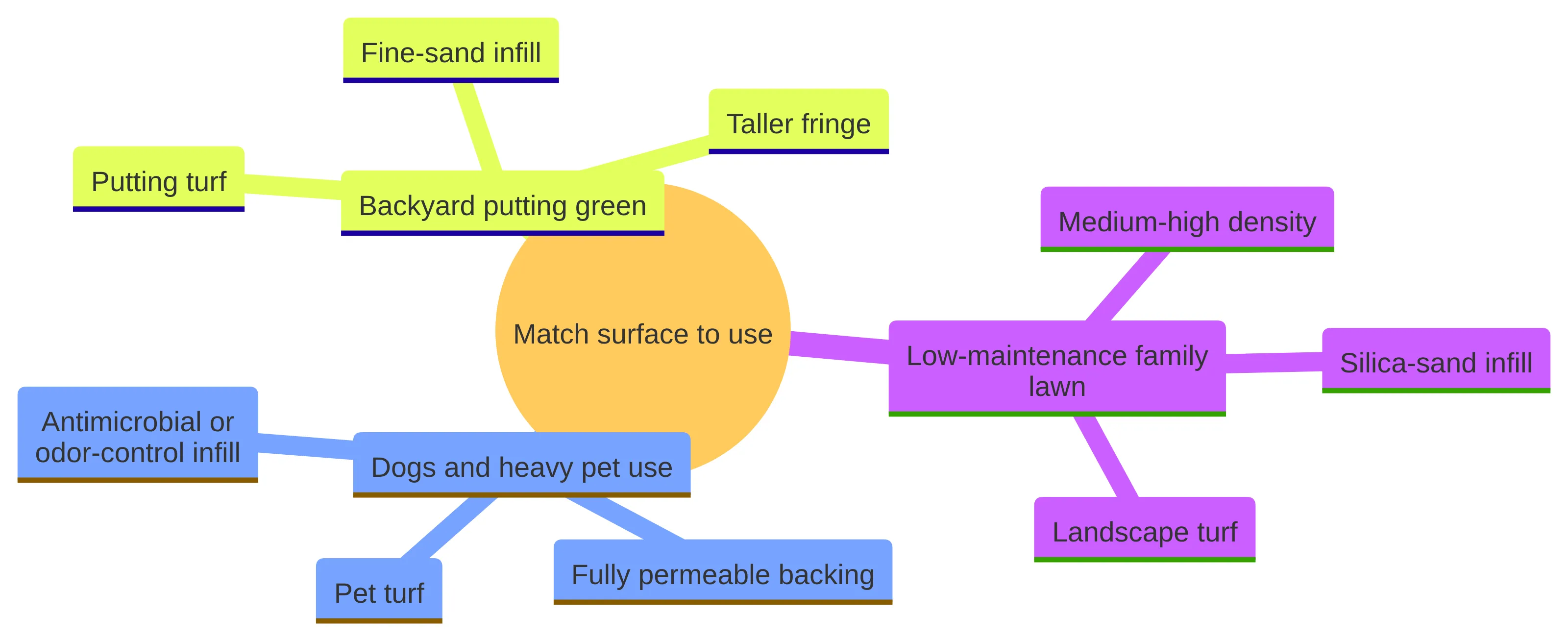
Residential artificial turf should be selected around the main activity in the space, not around a generic product label. A lawn that receives light family use has different selection priorities from a narrow dog run, and both differ from a backyard putting green. If several activities share one area, identify the activity that creates the greatest demand on the surface and discuss that use rather than selecting for the easiest use.
A selection guide offers these starting points:
- For a low-maintenance family lawn, it suggests 1.5- to 1.75-inch landscape turf with medium-high density and silica-sand infill.
- For dogs and heavy pet use, it suggests 1.0- to 1.25-inch pet turf with fully permeable backing and antimicrobial or odor-control infill. Verify the actual product specifications before choosing.
- For a backyard putting green, it suggests 0.375- to 0.75-inch putting turf with fine-sand infill and taller fringe around the perimeter.
These are selection-guide suggestions, not a project specification or a promise about performance on your property.
For a family lawn, focus your questions on appearance, foot traffic, the desired surface feel, and the care instructions. For a pet area, focus on the animal’s activity level, the backing, the infill, the way water will leave the area, and the cleaning requirements. Hall Turf recommends considering more resilient turf for active dogs that may subject the surface to vigorous activity. That recommendation applies to the use pattern, not to every pet project.
For a play space, define where children will run, sit, or move between equipment and ask how the proposed system addresses the existing surface and drainage. Do not assume that a lawn product is automatically appropriate for play. For a mixed-use backyard, mark the zones separately so the installer can explain whether one turf choice is suitable throughout or whether different surfaces are more appropriate.
Write down the primary use before you request an estimate. A clear use statement—such as “dog run with frequent activity,” “family lawn with regular foot traffic,” or “small putting area”—gives the project discussion a practical starting point.
Test the property before choosing turf
The property itself may determine whether an artificial turf plan is straightforward or requires more preparation. The relevant conditions include whether the area is soil, existing grass, concrete, paving, or a mixture; whether the ground is level or sloped; where water travels after rain; and whether gates, steps, narrow side yards, or other access limits affect the work area.
Those stages give you a useful checklist for asking what the proposed estimate includes.
Concrete needs its own review. Hall Turf states that it assesses concrete condition before installing artificial grass over it to help ensure a solid foundation. A concrete surface should therefore be discussed as a specific installation condition, not treated as interchangeable with prepared soil.
Before choosing a turf system, inspect the property with these questions:
- Where does stormwater collect, slow down, or leave the area?
- Does the proposed surface connect to a patio, driveway, foundation, fence, or planting bed?
- Will the area need demolition, removal of existing grass, or correction of an uneven base?
- Can materials and equipment reach the work area without unusual handling?
- Does the site include concrete, compacted soil, slopes, low spots, or transitions between surfaces?
- Will pets, children, furniture, or frequent foot traffic use the same zone?
Do not treat a sample, a square-foot figure, or a product height as a site assessment. A surface can look suitable in a sample while the property still requires decisions about preparation, drainage, access, or transitions. Ask for those conditions to be identified before you judge the system or compare estimates.
Compare artificial turf and natural grass by the actual trade-offs
Artificial turf and natural grass solve different problems, so compare them by the conditions you care about rather than by a single benefit. The following table keeps the comparison practical:
| Criterion | Artificial turf | Natural grass |
|---|---|---|
| Routine care | Hall Turf describes synthetic turf as offering low-maintenance convenience. | Natural grass requires decisions about species, climate fit, irrigation, and maintenance needs. |
| Water | Do not assume the surface alone determines your water use; ask how your present irrigation and care pattern would change. | A review states that natural grass can require up to 1 million gallons of water per year in the United States, but that figure is not a Kansas- or Missouri-specific residential estimate. |
| Heavy rain and water movement | The installed system requires site-specific drainage planning; permeable backing is a product specification to verify, not a performance guarantee. | A review says natural grass can reduce runoff and mitigate flooding, while also noting that natural-grass areas can flood during heavy rainfall. |
| Heat | Hall Turf identifies heat retention as an ecological challenge associated with synthetic turf. | A review identifies lower surface temperatures as one benefit of natural grass. |
| Ecology | Hall Turf identifies waste management as an ecological challenge for synthetic turf. | A review identifies biodiversity support, reduced soil erosion, and carbon storage among natural-grass benefits. |
| Long-term choice | Plan for cleaning, minor repairs, maintenance, and eventual waste questions. | Plan for water, maintenance, soil, and the effects of the chosen grass and local conditions. |
The comparison does not produce a universal winner. It shows which questions need a property-specific answer.
Natural grass has functions that artificial turf does not automatically reproduce. The review identifies lower surface temperatures, biodiversity support, reduced soil erosion, carbon storage, runoff reduction, and flood mitigation as natural-grass benefits. It also cites a study finding that natural grass released infiltrated water more slowly and stored more water than the short and long artificial-turf types examined.
That does not make natural grass the right fit for every Kansas or Missouri property. It means you should state the trade-off plainly. If your primary concern is reducing routine lawn work, compare that benefit with heat, drainage, ecological, and waste considerations. If your primary concern is water movement or a cooler surface, give those criteria equal weight instead of treating low maintenance as the only measure.
Write down the two or three outcomes that matter most to your household. Then ask whether the proposed system addresses those outcomes directly and what trade-off remains.
Resolve the questions about heat, drainage, waste, and environmental impact
Heat deserves a direct question because surface temperature affects how you plan to use an outdoor area. Hall Turf states that synthetic turf can present heat retention as an ecological challenge, while the review identifies lower surface temperatures as a benefit of natural grass. Neither point tells you the temperature of a particular yard at a particular time. Ask how shade, orientation, surrounding hardscape, intended activity, and the selected system affect your use of the space.
Drainage also needs a property-specific discussion. A professional installation process may include drainage planning, and the selection guide identifies fully permeable backing as a feature suggested for pet turf. Those points support asking about the proposed path for water; they do not establish that every turf system will drain every site in the same way.
Environmental questions should include both the material and the surface it replaces. The review states that natural grass can support biodiversity, reduce erosion, store carbon, reduce runoff, and ease urban heat. It also states that natural grass emits far fewer greenhouse gases than artificial turf, without providing a quantified comparison in the selected passage.
Hall Turf states that synthetic turf can create waste-management challenges. Ask what happens to removed grass, existing base material, damaged turf, and the system at the end of its useful service period. Avoid replacing these questions with a broad claim that either option is simply “green.” The more useful comparison is specific:
- What material will be installed?
- What existing material will be removed?
- How will water move through or around the finished area?
- How will heat affect the way you use the space?
- What maintenance, repair, and disposal decisions will arise later?
Those answers help you compare the complete property change rather than the surface appearance alone.
Evaluate the complete installed system
A turf project should be evaluated as a connected system rather than as an isolated product. A lower product price may not represent a lower project cost if preparation, drainage, access, removal, or other work is handled differently between estimates.
Use those stages as a scope checklist, while recognizing that the source describes general guidance for projects outside Kansas and Missouri.
Product selection should follow the intended use. The selection guide suggests different turf heights, densities, backing, and infill for a family lawn, heavy pet use, and a backyard putting green. Treat those values as starting points for discussion rather than a universal specification.
Ask the installer to explain these items in plain language:
- What existing material will be removed, and what preparation will follow?
- What base is proposed, and how will the site condition affect that work?
- Where is water expected to go after installation?
- Which turf category, height, backing, density, and infill match the intended use?
- How will seams, boundaries, transitions, and fixed features be handled?
- What work is included in the written scope, and what conditions could change it?
- What final walkthrough or care instructions will you receive?
At Hall Turf, we consider professional installation important for artificial-turf projects. Hall Turf also recognizes both DIY and professional installation options, with resources available for each. That distinction lets you make a practical choice about the work itself without confusing a product purchase with a complete installed system.
If the surface is concrete, include its condition in the scope. Hall Turf assesses concrete condition before installing artificial grass over it to help ensure a solid foundation.
Plan for care after installation
Artificial turf is not a no-responsibility surface. Hall Turf recommends budgeting for maintenance that includes cleaning and minor repairs to help extend the turf’s lifespan. Hall Turf also states that lifespan can vary according to maintenance and environmental factors. Plan for those future tasks before you decide whether the initial installation fits your household budget.
Your care plan should identify:
- Which cleaning methods and products are appropriate for the selected turf and infill.
- How pet use will affect the care routine.
- How you will notice and address minor damage or loose areas.
- Which maintenance tasks you can handle and which require installation support.
- How the surface will be used during periods of heat, heavy rain, or unusually high traffic.
For active dogs, Hall Turf recommends considering more resilient turf that can withstand vigorous activity without showing signs of wear. That recommendation makes the use pattern part of both the initial selection and the later care discussion.
Request written care instructions for the specific system proposed. General maintenance language cannot answer product-specific questions about cleaning, infill, repairs, or replacement.
Use cost as a scope question, not a decision shortcut
A published price can help you understand scale, but it cannot tell you what your property will cost. A ProMatcher report listed an average Kansas City, Kansas, artificial-grass installation cost of $10.08 per square foot for mid-grade lawn turf, with a reported range of $7.93 to $12.22 per square foot. The report’s underlying individual entry was dated September 17, 2019, so this is historical market information rather than a current Kansas or Missouri project quote.
The cited Kansas City cost entry said its figure included labor and listed basic site preparation, a crushed-rock base, infill, turf laying, and mid-grade synthetic turf. The report also indicates that inclusions can vary by estimate. That distinction matters: two totals can look different because they describe different quantities, materials, preparation conditions, or included work.
Use the figure as a scale anchor only. Do not multiply it by an approximate area and treat the result as a budget promise, especially for a Missouri property or a project with unusual access, drainage, removal, concrete, slopes, or mixed uses.
When comparing estimates, compare the scope line by line:
- Area measured and area priced.
- Existing grass, concrete, or other material to be removed.
- Base preparation and the condition it assumes.
- Drainage planning or drainage work.
- Turf category, height, density, backing, and infill.
- Seaming, boundaries, transitions, and access conditions.
- Labor, cleanup, care instructions, and any stated follow-up work.
The installation process described by Magnolia Turf includes several stages beyond laying turf, including assessment, demolition, base preparation, drainage planning, seaming, infill, and a final walkthrough. Use that sequence to identify missing scope items, not to assume that every installer or project includes identical work.
A quote becomes more useful when it explains its assumptions. Ask what would cause the scope to change and which conditions were observed or left unresolved. Judge the estimate by how clearly it describes the complete proposed system, not by the total alone.
Prepare a property-specific evaluation
Before contacting an installer, prepare a short project brief. It should give the discussion enough context to address your property rather than only a product category. Include:
- Your city and state, such as Kearney, another Kansas City-area community, or a location elsewhere in Kansas or Missouri.
- The intended use: lawn, pets, children, everyday foot traffic, putting, or a combination.
- Approximate dimensions, along with a sketch or notes about curves, obstacles, slopes, gates, steps, and fixed features.
- The current surface and its condition, including soil, grass, concrete, low spots, uneven areas, or areas where water collects.
- How the space is used now and what problem you want the project to address.
- Whether active dogs, frequent foot traffic, furniture, or play equipment will create additional demands.
- Your preferred timing, access limitations, and the questions you have about future care.
This information does not determine the design or price by itself. It gives the installer a clearer starting point for site assessment, preparation, drainage planning, and system selection.
Take these questions into the evaluation:
- Which turf type and infill match my stated use, and what product specifications support that choice?
- What preparation does this site require before turf placement?
- How will water move through, around, or away from the finished area?
- Which parts of the proposed scope are allowances, and which conditions could change them?
- What does the estimate include for demolition, base, drainage planning, seams, infill, cleanup, and the final walkthrough?
- What care, cleaning, and minor-repair work should I plan for?
- If the area is concrete, how will its condition affect the installation?
- What trade-off should I consider if heat, water movement, biodiversity, or waste matters as much as low maintenance?
It should not require you to decide from a product name or a single per-square-foot figure.
Add a documentation and accountability check to the evaluation. Hall Turf is a licensed contractor. If you are considering Hall Turf, ask which proposed products have relevant certifications, what testing documentation is available, and whether CAD files or detailed technical specifications can be provided for the selected system. These materials do not replace a site review, drainage discussion, or product-specific care instructions. They help connect the recommendation to the intended use and distinguish documented product information from a general sales description.
Also ask what warranty applies to the complete installed system, which components and workmanship it covers, how long coverage lasts, and what maintenance or installation conditions affect it. Do not assume that a product warranty covers site preparation or every part of the installation. Request the answers in writing with the estimate, along with any exclusions or owner responsibilities. This gives you a clearer record for comparing proposals and knowing whom to contact if a question arises after installation.
Choose the next step only after the fit is clear
Artificial turf is worth considering when its use, site conditions, drainage approach, system choices, care requirements, and trade-offs fit your property. Natural grass may remain the better fit when cooling, water storage, biodiversity, soil function, or broader environmental considerations carry more weight. The decision should follow the conditions of your space, not the appearance of a sample or the attraction of a generic price.
At Hall Turf, we provide artificial turf installation services for residential projects in Kansas and Missouri, and we recognize both DIY and professional installation paths. We consider professional installation important for artificial-turf projects. A qualified installer should determine individual suitability from the property conditions and intended use.
If you have defined the area, its use, the site questions, and the scope items you want explained, you are ready to move from general guidance to a property-specific assessment.
What should a homeowner confirm before requesting an artificial turf quote?
What are the main applications for residential artificial turf?
Residential artificial turf can be used for various applications, including lawns, pet areas, playgrounds, and putting greens. The choice of turf should match the primary activity in the space.
How should I assess my property before installing artificial turf?
Begin by evaluating the existing surface, drainage patterns, and site conditions. Consider factors like slopes, access limitations, and whether the area is soil, grass, or concrete.
What factors should I consider when comparing artificial turf and natural grass?
Compare them based on maintenance requirements, water usage, heat retention, drainage capabilities, and ecological impacts. Each option has different benefits and trade-offs.
What maintenance is required for artificial turf after installation?
Maintenance includes regular cleaning and minor repairs to extend the turf’s lifespan. It’s important to plan for these tasks before installation.
How can I prepare for a project-specific quote for artificial turf installation?
Prepare a project brief that includes your location, intended use, dimensions, current surface condition, and any specific questions or concerns you have about the installation.
What should I know about the lifespan of artificial turf?
The lifespan of artificial turf can vary based on maintenance and environmental factors. Regular care can help extend its durability.