
Start the installation record with water and dog use
A Kansas City pet-turf decision should begin with the water path below the surface and the way your dog will use the area, not with a turf sample. A site assessment should consider drainage, grade, soil, pets, children, foot traffic, sun exposure, and low spots that collect water before installation begins. Those details shape the base work, turf selection, cleaning routine, and the amount of preparation your project may require.
For a dog run, the relevant questions are practical: Where does urine go? Where does stormwater go after a heavy rain? Will the dog use one small relief area or the whole lawn? Will children cross the space? Does direct sun cover the area for much of the day? Record the answers before you compare systems.
Record site conditions before excavation
Irrigation lines deserve attention before excavation. If irrigation lines run through the turf area, the cited Kansas City guidance recommends capping them because leaving them active can cause pooling beneath the base and unnecessary watering. Do not cut or cap a line you cannot identify safely; pause and arrange site-specific help when the utility layout is uncertain.
Sun exposure also belongs in the material and use decision. Artificial turf can become warmer than natural grass in direct sunlight, so shade and cooling measures may help in hot weather. Artificial grass can be suitable for dogs when appropriate materials are properly installed, but comfort also depends on surface temperature, pile structure, and base stability. Plan the dog’s access around those conditions rather than treating one turf specification as a complete answer.

Release the drainage path before covering it
Do not approve the drainage portion of an installation from the turf specification alone. A turf product’s stated drainage capacity does not establish that the sub-base will drain adequately. Review the compacted base, underlying soil, grade, runoff route, and any fabric layer as separate parts of the path.
Check whether the soil drains or permeates, whether clay-heavy or conglomerate soil may reject excess water, and whether runoff could threaten the base. If the sub-base is poor, over-excavate and replace it with quality imported drainage materials.
A product description reports over 400 inches per hour for its 100% Permeable Pet Turf, while also stating that the underlying soil must drain well. Keep that product figure separate from the site finding; it does not establish the site’s drainage performance.
Most synthetic turf products are hole punched for drainage, but drainage-hole spacing varies by manufacturer and product. Closer-spaced drainage holes generally allow better drainage, while farther-spaced holes have slower permeability rates. Ask for the selected product’s drainage-hole pattern and evaluate that pattern together with the base, soil, grade, and runoff route rather than using the product rating as a site diagnosis.
Drainage review should also check whether the proposed surface sits above the building foundation or stucco weep screed, whether large stormwater volumes cross the area, and whether any weed suppressor is permeable. A site with saturated soil, a nonpermeable weed suppressor, or an unresolved stormwater route needs a defined drainage plan before turf is covered.
Envirofill is another system choice tied to drainage and odor control. The cited passage says Envirofill can reduce up to 99% of ammonia-related urine odors and inhibit up to 99.99% of bacterial growth. The same passage describes Envirofill as having a soft texture that is gentle on paws and costing more than traditional sand infill. The reported percentages are product-passage claims, not a guarantee for every Kansas City dog yard, so compatibility, site drainage, and maintenance still require review.
Runoff deserves a separate question when roofs, slopes, or hard surfaces direct water toward the proposed installation. A 10,000-square-foot rooftop receiving 1 inch of rain produces approximately 6.2 thousand gallons of water flowing onto the turf. That example describes a large contributing surface; your site still needs its own path for water to exit.
Where flooding may occur, consider exit drains, French drains, or catch basins because excessive runoff can cause sub-base failure. Do not bury a known drainage problem under turf. Resolve the water route first, then choose the surface system.

Verify the installation stage by stage
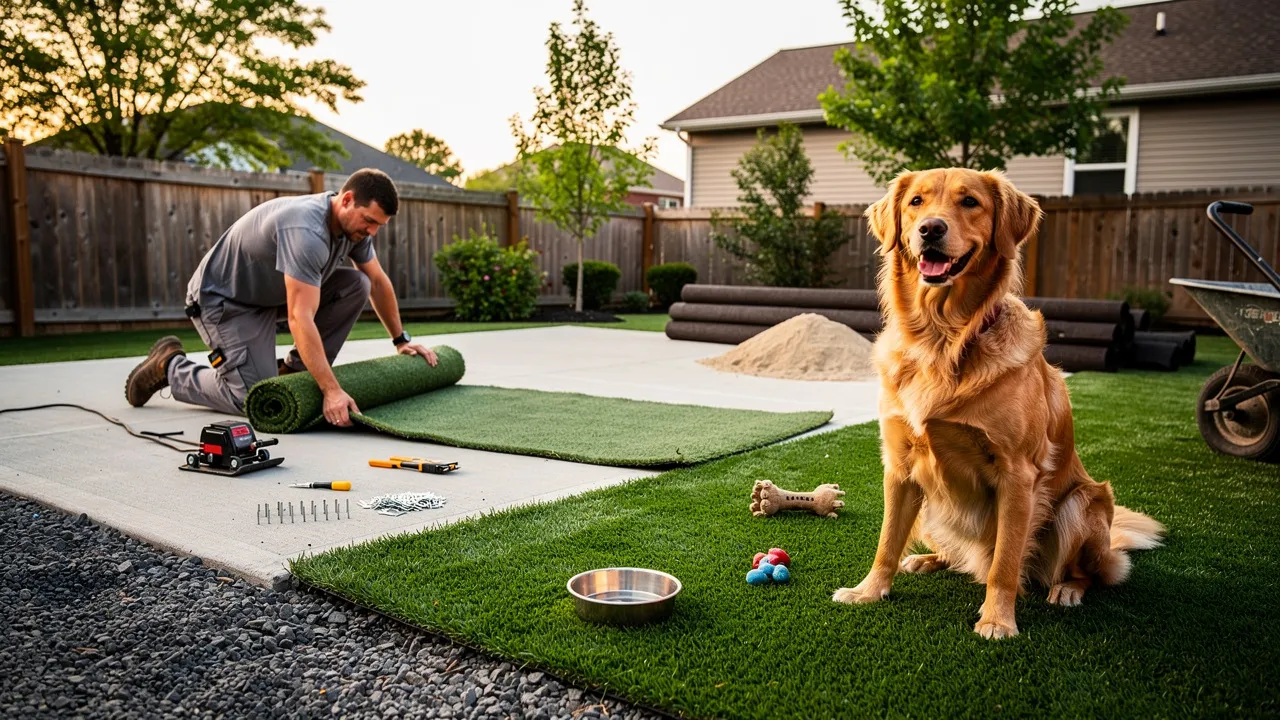
Use the installation sequence as a stage-by-stage inspection record:
- Measure the area and plan the layout and grain direction.
- Remove vegetation and other obstacles; excavate existing soil up to 2-1/2 inches where the surface is dirt or soil.
- Build, grade, and compact the crushed-stone or aggregate base.
- Place and cut the turf, keeping adjoining pieces aligned.
- Join multiple rolls with seaming cloth or artificial grass tape and secure the edges.
- Add infill only when the selected product calls for it.
- Brush and groom the fibers, then review seams, edges, and transitions.
Record each stage before it is covered by the next. The sequence does not make a site-specific assessment unnecessary; it makes omissions visible before finishing.
The base is the hidden part of the installation. A compacted crushed-stone or aggregate base helps turf drain and stay flat, and the grade should direct water away instead of allowing it to pool. In the Kansas City installation guidance cited here, the area is excavated and a compacted crushed-stone or decomposed-granite base is used to support water movement through the soil profile.
Check compaction and grade before covering the foundation. A thin, loose, or uneven base can leave you with dips, movement, or drainage trouble that becomes harder to correct after the turf is down.
Seams and edges need deliberate workmanship. For multiple turf rolls, align the edges, use seaming cloth or artificial grass tape, and secure it with landscape anchors or 6-inch galvanized nails. Keep the grain direction consistent so adjoining pieces do not appear to have different colors or textures.
The final stage includes brushing the fibers upright, checking seams and edges, and reviewing the finished space. Freshly installed turf often looks flatter or more matted until it is brushed against the grain. Product instructions control the infill amount: AQUAMAXX 50 and PETMAXX 50 are listed with approximately 1 pound per square foot of infill, while AQUAMAXX and PETMAXX 75 and 90 are listed with approximately 3 pounds per square foot, with EnviroFill 12-20 recommended for both groups.

Match infill to the turf record
Use the product record to link the infill choice to the turf, not to a universal pet-turf rule. Infill helps fibers stand upright after pressure and helps shield the backing from UV damage. Common types include silica sand, crumb rubber, zeolite, and acrylic-coated sand with antimicrobial protection.
For a pet area, the comparison points are explicit: zeolite traps ammonia through adsorption; silica sand is generally the least expensive infill but may harbor moisture, reduce permeability if it hardens, and trap pet odors; crumb rubber adds bounce but can trap odors and heat. Write down the selected material’s intended use and trade-offs before installation. Pet-friendly options include zeolite, coated antimicrobial sand, and specialty blends; verify the infill’s EPA heavy-metal standards and pet-safety certification before purchase. A practical infill comparison should first confirm turf compatibility, then weigh odor, moisture, heat, cushioning, and fiber-support trade-offs, and finally verify pet-safety documentation.
Pet-friendly options include zeolite, coated antimicrobial sand, and specialty blends. Verify the infill’s EPA heavy-metal standards and pet-safety certification before purchase. Not all artificial turf requires infill; check the manufacturer’s recommendations and product compatibility before choosing materials.
Some product tables list no required infill for HEATMAXX SOFT 47 and HEATMAXX SOFT 65. SPORTMAXX 36 2CN and SPORTMAXX 36 3CN are also listed as not requiring infill, although compatible putting-green infill may be used if preferred. These examples show why you should match the material to the selected turf rather than assume that every dog area needs the same amount or type of infill.
Hand off a care and drainage record
Make the handoff after installation a care record rather than a general promise about odour. Daily solid-waste removal, weekly urine-area rinsing, monthly enzyme deep cleaning, brushing every 2-3 months, and seasonal drainage and infill checks form the maintenance schedule.
Rinse urine spots regularly with water and use a turf-compatible enzymatic cleaner if odors persist. If drainage is missing, fabric traps liquid, or waste sits on the surface, odor can develop; no installation is odor-proof. Persistent odor or surface water belongs in the site-assessment notes rather than being treated as a routine cleaning variation.
Odor can develop when drainage is missing, fabric traps liquid, or waste sits on the surface. A weed-barrier fabric layer under a dog yard can trap urine against the turf instead of letting it drain into the base. Any dog yard needs regular upkeep to stay fresh, and no installation is odor-proof.
The response to a persistent smell depends on where the liquid is being held. Start with the routine cleaning steps and inspect the drainage path. If odor continues after cleaning, or if water remains on the surface, stop treating the symptom as a cleaning problem and arrange a site assessment. The same boundary applies when seasonal checks reveal blocked drainage or displaced infill.
Audit the quote by included scope
Maintenance comparisons also vary. One comparison reports artificial-grass maintenance at $400 - $1,000 every few years and natural-grass upkeep at $500 - $1,500 annually. Another comparison reports annual synthetic-turf maintenance costs of $250 - $350, versus $1,500 - $6,000 each year for natural-grass maintenance. The different time periods and task assumptions prevent either range from establishing a universal local cost.
Compare what each estimate includes: mowing, irrigation, fertilization, waste-related cleaning, brushing, rinsing, repairs, and any future replacement work. A lower recurring estimate is not meaningful if it leaves out tasks you will actually pay for.
One published comparison estimates the longer-term totals below:
| Period | Natural grass | Artificial grass |
|---|---|---|
| 10-year total | $11,700 - $38,700 | $4,600 - $12,300 |
| 15-year total | $17,500 - $58,000 | $6,350 - $17,000 |
Those are comparison estimates, not a promise about your property. Use them to identify the categories that need clarification, then request a scope-specific quote that separates turf, removal, base work, drainage, labor, infill, edging, and ongoing care assumptions.
Test DIY against the installation checks
DIY suitability turns on whether the project can pass the same installation checks as a professional job. You may be able to install artificial turf yourself with planning and the right tools, but check whether your property manager or HOA allows synthetic grass before ordering materials.
Our installation tool list includes a shovel, rake, plate compactor, level, rubber mallet, utility knife, sharp scissors, measuring tape, and string line.
Choose the DIY route only if you can document base compaction and grade, aligned seams, secure edges, and product-specific infill. If those checks cannot be performed, arrange qualified help before excavation.
The DIY decision should include a written product record, not only a tool list. Record the selected turf’s drainage pattern, backing requirements, infill requirement, and manufacturer instructions before materials arrive. A DIY route is a poor fit when the homeowner cannot verify product compatibility, base compaction, grade, seam alignment, edge restraint, and finishing requirements.
DIY planning should assign responsibility for excavation, compaction, cutting, seaming, edge securing, infill, and grooming before work starts. The installation sequence contains several dependent stages, so completing turf placement without completing the base and edge checks does not establish a finished system.
The time commitment includes preparation, not only the day the turf is laid. One selected schedule estimates 1-2 days on site for a professional crew of 3-4 people and 5-8 working days for a DIY team of 2 people. In that schedule, a DIY team of 2 people may need 2-3 days to remove grass and excavate, 1-2 days to spread and compact the base, and 1 day to roll out, cut, and seam turf.
Treat those durations as planning estimates. Weather, access, material delivery, site size, and corrections can change the workload.
Workmanship shortcuts create avoidable decision points. Avoid a thin or uneven base, poor slope, mismatched grain direction, rushed seams, unsecured edges, incorrect infill application, face-side cutting, and work in extreme heat. If you cannot check compaction, grade, seam alignment, edge restraint, and product-specific infill requirements, the DIY route may not give you enough control over the finished system.
Do not begin excavation when flooding, saturated soil, unstable ground, or an unresolved irrigation or utility conflict is already apparent. Record the condition and arrange site-specific help before continuing.
Seek professional evaluation when site risks appear
A turf sample cannot resolve a drainage or construction conflict. Do not proceed by adding turf over a known problem, installing a fabric layer that traps liquid, or assuming a product drainage rating will overcome poor sub-base conditions. Keep the project paused until the water route, base condition, and utility questions have a documented answer.
For a straightforward, accessible area with a suitable water path, you can continue comparing the installation route, infill, care schedule, and budget. For a site with the conditions above, use the assessment to define the work before choosing materials.
Convert the screen into a quote-ready next step
A quote-ready project brief should include the measured area, dog-use pattern, photos of low spots and drainage routes, irrigation information, sun exposure, access limits, preferred maintenance routine, and the questions raised by your site screen. Ask for the scope of excavation, base preparation, grading, drainage work, seams, edge restraint, infill, cleanup, and ongoing care so you can compare the complete project rather than a turf-only figure. Also ask Hall Turf to confirm its licensed-contractor status and provide relevant product certifications, CAD files, and testing documentation for the proposed system, where applicable.
We install artificial turf in the Kansas City area. A qualified professional should decide individual suitability when flooding, non-draining soil, unstable ground, utility conflicts, or major grading make the site uncertain. Bring your site record and system questions to the assessment, then use the written scope to decide whether professional installation or a controlled DIY project fits your property.
The next step is to turn your notes into a site-specific conversation about the dog area, drainage path, system materials, preparation work, and total project scope.