
Start with the whole-system drainage decision
Pet turf with drainage should be judged as a site-specific water-management and care system, not as a surface selected by appearance alone. Drainage depends on the turf system as a whole, including the backing, sub-base, soil, grading, and downstream drainage. A turf product’s stated drainage rate does not show that the sub-base will drain at the same rate. The best drainage system depends on your soil, climate, and expected pet traffic.
For a Kearney, Kansas City, Overland Park, or other Kansas City-area property, begin with the route that water and pet waste must take after it passes through the turf. Ask what happens at the backing, where the water enters the base, whether the soil can accept it, and where runoff leaves the area. A system that drains through the turf can still develop standing water if the base, native soil, grade, or outlet restricts the flow.
The number and size of your dogs matter because they affect how often the area receives urine, solid waste, foot traffic, and rinsing. A small potty zone beside a house raises different questions from a large enclosed dog run that receives stormwater from a roof or paved surface. Describe the intended use before comparing turf samples.
Use this order before requesting a quote:
- Inspect the existing surface, grade, soil condition, and any areas that already hold water.
- Describe how many dogs will use the area, their sizes, and whether the space will function as a yard, potty area, or enclosed dog run.
- Compare the turf backing, drainage openings, infill, base, edging, and downstream drainage as connected parts.
- Ask for a quote that separates preparation, drainage work, materials, labor, cleanup, and warranty terms.
That sequence gives you a way to decide whether the proposed system fits your property before you compare product names or prices. If the existing water path is unresolved, a different-looking turf product will not by itself answer the drainage question.
Trace where water and runoff will go
A Kansas City pet-turf site needs a water-path assessment before installation. Poor sub-base materials and clay-rich or conglomerate underlying soils can restrict drainage and contribute to flooding. Underlying soils high in clay and/or conglomerates can reject excess water intrusion after becoming fully absorbent, and flooding can result.
Look beyond the area that will receive turf. Roofs, patios, driveways, neighboring grades, downspouts, and stormwater routes can send additional water toward the dog area. Before installation, assess flooding risk, stormwater flows, the need for regrading, where added water will travel, and whether existing soils remain saturated.
A large upstream surface can change the design, so the installer needs to account for water entering the area from somewhere else rather than looking only at the turf’s square footage.
Walk the property during or after rain if conditions allow, and note where water first collects, where it moves, and how long low spots remain wet. Photograph downspouts, foundation edges, retaining walls, hardscape transitions, and any route that could direct runoff into the proposed pet area. These observations do not replace a site assessment, but they give the installer a more useful starting point.
Ask these questions during the site visit:
- Where does water currently collect after heavy rain?
- Does the proposed grade direct water toward a functioning outlet or toward a foundation, walkway, or neighboring property?
- Will the design need regrading, an exit drain, a French drain, or a catch basin?
- Are the native soil and sub-base expected to accept the flow, or will water need another route?
- What happens when the ground is already wet and the dog area receives additional runoff?
- How will water from downspouts, roofs, patios, or driveways be kept from overwhelming the pet area?
Where flooding may occur, consider exit drains, French drains, or catch basins as part of the drainage design. Do not treat turf replacement as a correction for an unresolved water-path problem. The quote should identify where water is expected to travel after it leaves the turf and what work creates that route.

Check the existing surface before choosing a system
The existing surface determines how much preparation a synthetic-turf system needs. A typical installation includes site preparation and grading, a drainage base, secured turf, infill, and final grooming and inspection. A well-built synthetic-turf system depends on excavation, stable grading, and consistent compaction adapted to the site’s soil, moisture, and drainage conditions.
The inspection should cover:
- Organic material, roots, sod, rocks, debris, and any material that could decompose beneath the finished surface.
- The firmness, smoothness, and uniformity of the exposed ground.
- Excavation depth, finished height, transitions to patios or walkways, and the available space for a drainage base.
- Existing slopes, low spots, saturated areas, and the direction of surface water.
- The condition of concrete if the proposed area is a slab or includes a hard-surface transition.
- The location of irrigation lines, utilities, drains, downspouts, and other features that may affect excavation or runoff.
The ground should first be cleared of organic material and debris because organic material can decompose over time. Before synthetic grass is installed, the surface should be relatively smooth and the appropriate sub-floor, typically gravel, should allow for drainage. Sub-base materials should be dampened and compacted during installation to help prevent shifting or sinking over time.
We prepare the installation site for artificial grass, and we assess concrete condition to ensure a solid foundation before installing artificial grass. Those are site-preparation steps, not a promise that every existing surface is ready for turf. Have the installer explain what will be removed, what will remain, how the grade will change, and how the finished surface will connect to the surrounding property.
The selected installation guide sets a compaction goal of 90-95%, typically reached in 2-3 passes. Treat that figure as guidance from the cited installation source rather than a universal specification for every Kansas City site. Ask which compaction standard and testing method apply to your soil and planned use.
The finished height also deserves attention. A pet area that meets a patio, sidewalk, threshold, gate, or drainage inlet must transition without creating a trip point or blocking the intended water route. Ask the installer to show the proposed finish elevation and explain how the base depth, turf thickness, edging, and surrounding surfaces will meet. A smooth-looking sample cannot reveal whether the completed installation will fit those existing elevations.

Compare backing, drainage openings, base, and edging for dog use
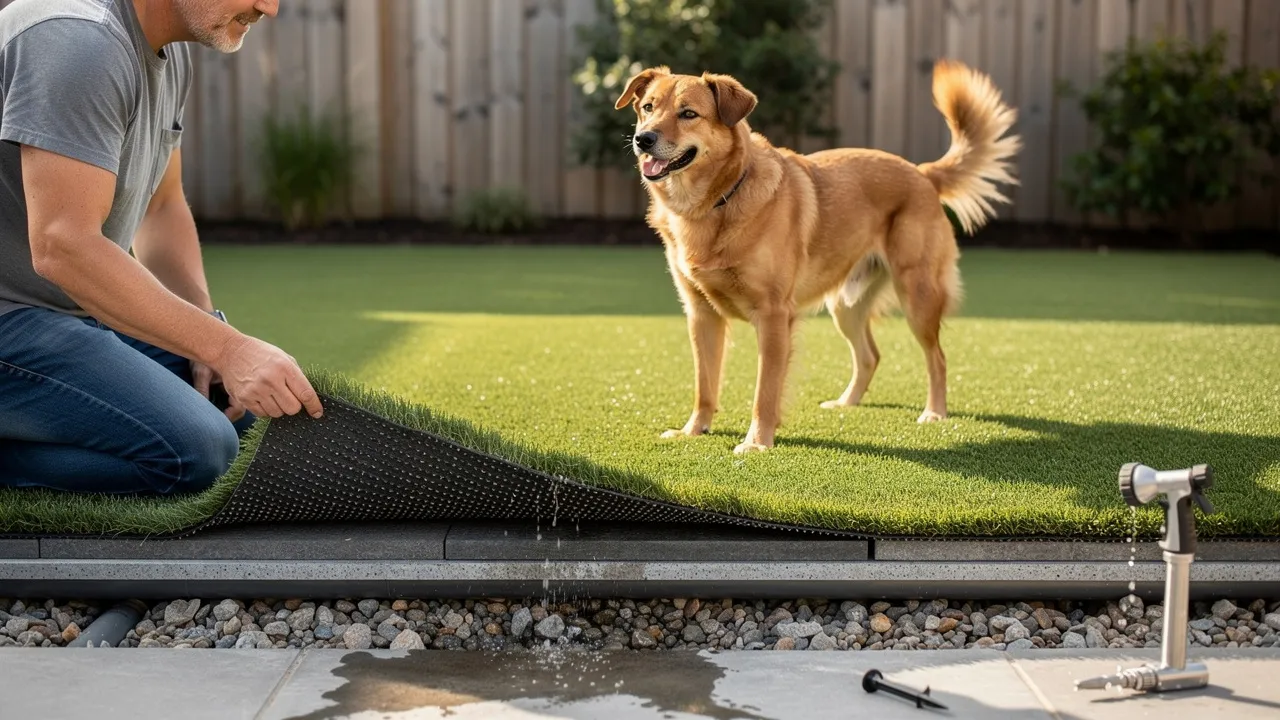
The turf system should match your dogs’ use, rainfall exposure, soil, grade, and drainage route. Most synthetic turf products are hole-punched for drainage, with spacing that can range from 2, 3, 4 and up to 8 inches on center. The cited guidance says closer-spaced drainage holes generally allow better drainage, while wider spacing can slow permeability. Ask for the product’s backing type, opening pattern, and applicable drainage documentation rather than relying on a sample’s appearance alone.
A full-surface, edge-to-edge permeable backing has less risk of infill clogging; perforated backing has a higher risk that infill or debris will block holes. That comparison does not make one backing suitable for every site. The installer still needs to match the backing and base to soil permeability, expected pet traffic, runoff, and maintenance access.
Use the shared criteria below to frame the backing discussion:
| Backing question | Full-surface, edge-to-edge permeable backing | Perforated backing |
|---|---|---|
| How does liquid move? | The cited comparison describes flow across the full surface. | Liquid moves through openings spaced at intervals. |
| What can restrict flow? | The comparison describes less risk of infill clogging. | Infill particles or debris can block openings. |
| What must the site still provide? | Adequate soil, base, grading, and downstream drainage remain necessary. | The site design still needs suitable soil, base, grading, and downstream drainage. |
| What should you request? | Product-specific drainage and maintenance information. | Opening spacing, drainage information, and cleaning instructions. |
Base depth also belongs in the site discussion. The selected installation guide says a base may be as little as 3 inches over stable, well-draining soil, while some projects call for 4 or more inches depending on drainage, stability, height, and load requirements. These figures describe guidance from the cited installation source, not a fixed Kansas City specification.
Artificial turf can drain vertically through drainage holes, but a slight base slope can help avoid water buildup or improper drainage. A crushed-fines base can be graded to create the crowns and slopes needed for drainage. Use a consistent slope toward drains and keep inlets clear so water can move freely.
Ask the installer to identify these items in writing:
- Backing construction and drainage-opening pattern.
- Base material, proposed depth, grading method, and compaction approach.
- The direction of the finished slope and the destination of surface water.
- Edging material, attachment method, and how the edge will resist movement near dog paths or digging zones.
- How the selected turf and base accommodate the number and size of your dogs.
We offer pet-specific turf with advanced drainage systems, but the drainage system still needs to be evaluated against your property and use. Treat the backing, base, and edge as connected design choices rather than selecting each item separately.
Choose infill for drainage, odor, cushioning, and safety questions
Pet-turf infill anchors the fibers, provides cushioning, and helps manage drainage; it can also affect odor control, durability, and dog safety. Treat infill as part of the system rather than as a finishing material added without regard to the backing or maintenance plan.
Named pet-friendly infill options include zeolite, coated antimicrobial sand, and specialty blends. Zeolite is a porous mineral that can trap ammonia molecules through adsorption and is used as an odor-control infill option. Pet-friendly infill can help reduce heat and minimize odors, but those functions do not remove the need for drainage and cleaning.
The choice should follow the job the infill must perform. If odor control is the priority, ask how the proposed material interacts with urine, rinsing, and the backing. If cushioning or active play is the priority, ask how the quantity and material affect the finished surface. If safety documentation is the priority, ask for the applicable heavy-metal and pet-safety information before approving the product.
Use these comparison questions:
- What is the infill made of, and what function is it intended to serve in this system?
- How does the infill interact with the backing openings or permeable backing?
- What quantity will be installed, and how will the quantity be measured?
- How will the infill be replenished or redistributed after heavy use?
- Does the selected infill meet EPA heavy-metal standards and carry certification that it is safe for pets?
- What care instructions apply if a dog eats, digs into, or displaces the material?
The selected quote example shows why quantity and type belong in the written scope: Quote A uses 1 pound per square foot of plain sand for $150 in infill, while Quote B uses 2 pounds per square foot of antimicrobial infill for $600. Those are figures from an example comparison, not a price or quantity recommendation for your project.
If your priority is odor control, ask whether zeolite or another named infill is compatible with the proposed turf, drainage path, and dog use. If your priority is cushioning or active play, ask how the infill choice affects the finished surface. Choose only after the installer explains the material, quantity, safety documentation, and care requirements. The written quote should name the infill instead of leaving you to infer its contents from a general label such as pet-friendly.

Plan for urine, solid waste, and odor control
Dog urine and solid waste require different care in an artificial-turf dog area. Dogs can urinate on artificial grass, and quality turf with a porous backing can let urine pass into the drainage system underneath. Solid dog waste must be removed or scooped manually; rinsing can then clear residual waste or smell.
Dog urine releases ammonia and can contribute to odors over time, especially with frequent use. Adequate drainage helps prevent urine from accumulating beneath the turf. A membrane under artificial grass can trap urine and contribute to odor problems, so ask what layers are proposed beneath the turf and how liquids will move through them.
Odor control depends on more than a deodorizing product. Most smell problems on artificial grass are drainage problems first and cleaning problems second. Remove solid waste promptly, rinse the area with a hose, and optionally use a turf enzyme cleaner. Enzyme turf cleaner breaks down pet urine salts and odor molecules, while zeolite infill can help absorb odors long-term.
A practical waste and odor plan includes:
- Removing solid waste as soon as reasonably possible rather than allowing it to be pressed into the fibers or infill.
- Rinsing the used area so residual urine and waste move through the drainage path.
- Using a pet-safe enzyme product according to its label when the maintenance plan calls for it.
- Checking whether the backing, infill, base, and outlet can carry liquids away from the surface.
- Increasing attention during warm weather or when several dogs use the same potty area.
Do not treat a cleaner as a substitute for a functioning drainage path. If a proposed system relies on odor-control infill, ask what happens when the underlying base is saturated or the drainage outlet is restricted.
Your dogs’ habits should be part of the design conversation. A single preferred potty location may receive concentrated liquid and require a different rinsing routine from a larger area used throughout the day. Dogs that run, dig, or repeatedly follow the same paths may also place more demand on the infill, edges, and surface fibers. Give the installer that use pattern before the turf and infill are selected.
Use a maintenance routine matched to the dogs
Artificial turf is not maintenance-free, and pet areas may need more frequent rinsing and cleaning depending on the number of dogs and how often the area is used. A low-maintenance surface still requires a routine that matches waste volume, traffic, weather, and the condition of the infill and drainage path.
A maintenance schedule can include:
- Daily: remove solid waste and inspect the main potty or traffic areas for residue, displaced infill, or visible drainage problems.
- Weekly: rinse the pet area. One maintenance guide recommends rinsing at least 1-2 times per week, and more often during warm weather or with multiple pets.
- Monthly: apply enzyme cleaner to high-use spots and brush fibers that have begun to lean. Another schedule recommends enzyme cleaner 2-4x per month depending on heat and the number of pets.
- Every 3 to 6 months: check infill, seams, edges, and drains.
- Seasonally: groom the fibers, inspect the installation, and look for changes after heavy rain or periods of heavy use.
The enzyme-cleaner frequencies differ across the cited maintenance guidance. A schedule may call for monthly treatment of high-use spots, while another recommends 2-4 treatments per month. Use a pet-safe product according to its label and the instructions for the specific turf and infill system.
Homes with large dogs or several dogs may need to rinse more often, sometimes every day in summer. Urine salts can accumulate in warm weather; regular rinsing and periodic enzyme treatment can reduce related odor buildup. Additional odor-control infill may be added every 6-18 months depending on use.
Turf blades may lean and mat downward over time; brushing against the grain helps keep them upright. Include maintenance access in the design. A narrow side yard, enclosed dog run, or area blocked by landscaping may be harder to rinse, brush, inspect, or service than an open lawn.
Before accepting the care routine, identify who will perform each task and what equipment the area allows you to use. A hose connection, clear access to drains, and room to brush the fibers affect how practical the routine will be. Ask where infill may be added, how seams and edges should be inspected, and which signs require an installer to assess the system rather than simply increasing cleaning.
Handle accidents and cleaning products carefully
A fresh pet accident needs surface cleanup followed by a controlled rinse and product application. For a fresh accident, remove solids, rinse from the outside edge toward the center, use a pet-safe enzymatic cleaner as labeled, allow a typical dwell time of 10 to 20 minutes, and rinse until runoff is clear.
Use this sequence for a fresh accident:
- Remove solids without grinding them into the blades.
- Rinse from the outside edge toward the center.
- Apply a pet-safe enzymatic cleaner according to the product label.
- Allow 10 to 20 minutes of dwell time when the product instructions call for it.
- Lightly agitate with a suitable soft brush if needed.
- Rinse until runoff is clear and allow the area to dry.
Spot-clean accidents, rinse traffic lanes and pet zones weekly, deep-clean high-use areas monthly with an enzymatic wash, and groom and inspect the turf seasonally. Avoid bleach, pressure washers, wire brushes, harsh pet repellents, paint thinners, solvents, and gasoline on pet turf.
Cleaning guidance differs on pressure washing. Some maintenance instructions recommend avoiding pressure washers, while other guidance permits pressure washing with a spray of 40 degrees or wider held 12 inches above the surface. A narrow pressure-washer jet can blow out infill. Follow the turf and infill manufacturer’s instructions first, and ask the installer whether pressure washing is suitable for the specific system.
A regular garden hose and appropriate pet-turf cleaner may be enough for routine care, but the correct method depends on the installed materials.
Keep the cleaning plan with the product and infill information after installation. If the surface develops an odor, puddles, displaced infill, lifted edges, or persistent residue despite the stated routine, describe the symptom and the cleaning steps already taken when you request an assessment. Increasing chemical strength or water pressure without knowing the system can create a different maintenance problem.
Compare the trade-off with natural grass
Artificial turf and natural grass place different demands on your yard, budget, and maintenance routine. Artificial turf generally costs more upfront than keeping a natural lawn. A natural lawn has recurring costs for water, fertilizer, weed control, seed, mower and equipment upkeep, and often a lawn service. Artificial turf still needs periodic rinsing, brushing, and infill checks.
The practical comparison is not simply less mowing versus more installation cost. Consider these shared criteria:
| Consideration | Artificial turf | Natural grass |
|---|---|---|
| Initial financial burden | Generally higher upfront installation cost | Does not carry the same artificial-turf installation scope at the start |
| Ongoing work | Waste removal, rinsing, brushing, enzyme treatment, and infill checks remain | Mowing, watering, fertilizing, weed control, reseeding, and equipment upkeep may remain |
| Dog-use routine | Urine can pass through suitable porous backing; solid waste still requires manual removal | Solid waste still requires removal, while the lawn also requires its own growing-season care |
| Water path | Requires a functioning backing, base, soil, grade, and outlet | Depends on soil, grading, and the natural lawn’s ability to absorb and shed water |
| Longer-term value | Depends on current lawn spending, climate, and how long you will keep the yard | Depends on recurring care costs, climate, use, and how long you will keep the yard |
Whether turf pays off depends on your current lawn spending, your climate, and how long you will keep the yard. Add your actual mowing, watering, fertilizer, treatment, equipment, and service expenses to the comparison instead of assuming that every avoided lawn task becomes a direct saving.
For a Kansas City-area dog owner, also consider shade, direct sun, summer rinsing, winter access, muddy periods, and the dogs’ preferred potty routes. Natural grass may require more growing-season work, while artificial turf shifts the work toward waste removal, rinsing, brushing, infill care, and drainage inspection. The right choice is the one whose installation scope and continuing care fit the property you actually have.
If you are comparing a full-yard replacement with a smaller pet area, price and maintenance should be considered for the same area and use. A targeted dog run may have different edging, access, drainage, and cleaning needs from a whole-lawn project. Keep that scope distinction clear when you compare alternatives.
Build a drainage-focused quote request
A drainage-focused quote should describe the complete project rather than list only a turf product. Some quotes cover only the artificial grass, while others include ground preparation, drainage, materials, and labor. The turf itself varies in price depending on its quality, density, backing, and drainage performance.
Ask the installer to document these items:
- Existing grass, roots, debris, concrete, or other material to be removed.
- Excavation depth, haul-off, finished grade, and the route for surface water.
- Sub-base material, proposed depth, spreading method, and compaction method.
- Turf name or specification, backing type, drainage openings, pile characteristics, seams, and cutting waste.
- Infill type, safety documentation, quantity, and pounds per square foot.
- Edging type, linear footage, attachment method, and transitions to hardscape.
- Irrigation changes, utility protection, drains, catch basins, French drains, or other drainage work.
- Labor, cleanup, access assumptions, maintenance instructions, and product or workmanship warranty terms.
Compare quotes for grass removal, excavation and haul-off, sub-base material, weed barrier, turf material, infill, edging, irrigation changes, labor, cleanup, and product or workmanship warranty terms. A quote checklist can identify the infill type and pounds per square foot, include removal of existing grass, roots, and debris, include excavation and haul-off, and include product and workmanship warranty terms.
The example quote comparison shows why two totals can describe different projects. Quote A does not list grass removal, while Quote B charges $750; Quote B removes sod and roots at $1.50 per square foot, whereas Quote A leaves removal to the customer or a later change order. Quote A charges $350 for excavation and haul-off and digs 3 inches, about 4.6 cubic yards, while Quote B charges $775, digs 4 inches, about 6.2 cubic yards, and uses a higher rate. Only Quote B includes a weed barrier, priced at $300.
Use those figures as an illustration of scope differences, not as a local price schedule. A quote that leaves out drainage work, base preparation, removal, or edging may look lower because part of the work has been excluded or deferred.
Give the installer a short property brief before the visit. Include the project location, approximate area, existing surface, access limitations, number and size of dogs, preferred potty locations, known low spots, recent drainage problems, downspout routes, and whether you want a dog run or a broader lawn replacement. Ask the installer to return that information in the written scope rather than relying on a verbal assumption.
Use cost as a scope comparison, not a product promise
Pet-turf cost is a project-scope question, not a single product number. In the United States, professionally installed pet turf commonly costs approximately 10-20 per square foot, although difficult site conditions can push prices higher. That range is broad guidance for professionally installed pet turf in the United States, not a quote for a Kansas City property.
Hall Turf gives artificial turf material at $2 to $12.55 per square foot and professional installation labor at $2,725 to $10,000 for a standard project. The material figures measure the turf itself, while the labor figures measure professional installation labor for a standard project; neither figure by itself describes your complete drainage, preparation, or pet-area scope.
Preparation can change the total. Removing old turf or natural grass, clearing rubbish, or removing concrete can increase costs per square foot, and preparation may be quoted separately or included in the square-foot cost. The turf specification can also change the material line through quality, density, backing, drainage performance, pile, infill, or edge requirements.
The example comparison adds more context. Quote A uses $3 per square foot budget turf costing $1,500, while Quote B uses a $5.50 UV-stabilized product with a taller pile costing $2,750. Quote A lists $2,250 for labor and Quote B lists $2,465; the crew rates are described as similar, with a few more hours for Quote B’s extra preparation. Quote B adds 90 linear feet of edging for $360, while Quote A does not list edging.
Use a cost worksheet with separate lines for:
- Removal and haul-off.
- Excavation, base material, grading, and compaction.
- Drainage outlets or regrading.
- Turf, seams, cutting waste, and infill.
- Edging, irrigation changes, labor, and cleanup.
- Product and workmanship warranty terms.
Compare what each price measures, what condition it assumes, and what work remains outside the total. Do not use a published range to promise savings or to decide that a lower quote contains the same drainage system.
Access can also change the work included in a local quote. A narrow side yard, a long haul route, limited equipment access, existing concrete, or a need to protect nearby surfaces can affect preparation and labor. Ask the installer to identify those assumptions instead of comparing only the final square-foot number. A useful comparison keeps the area, preparation, drainage work, turf specification, infill, edging, labor, and cleanup visible in separate lines.
Verify the installer’s technical documentation
The installer’s technical documentation should connect the proposed turf and infill to your property, dogs, water path, and maintenance plan. Ask for plain-language answers supported by the documents that apply to the selected system.
Bring this checklist to a Kansas City-area site assessment:
- Is the installer a licensed contractor for the work and location, and what licensing information applies to the project?
- What product certifications, pet-safety documentation, drainage testing, and maintenance instructions apply to the exact turf and infill being proposed?
- Can the installer provide CAD files or detailed drawings showing grades, edges, drains, transitions, and the downstream water route when the project requires them?
- What testing documentation supports the stated drainage or compaction specifications?
- What are the backing, drainage openings, infill type, infill quantity, base materials, base depth, and edging details?
- What product and workmanship warranty terms apply, and what maintenance conditions or exclusions affect them?
- How will the design change for an energetic dog, several dogs, a narrow dog run, or an area with heavy runoff?
We offer pet-friendly artificial turf designed as dog-run turf. We provide tailored turf solutions for residential lawns, playgrounds, and pet areas. Those offerings still need to be matched to the actual site, dog use, drainage route, and installation scope.
Ask the installer to connect that recommendation to the turf specification rather than leaving it as a general description. A complete technical package should let you understand what will be installed, how water will move, how the area will be maintained, and which terms apply after installation.
For a larger project or a design involving several drainage elements, ask how the drawings identify finished grades, inlets, outlets, transitions, and maintenance access. For a simple dog area, the documentation may be shorter, but it should still identify the turf, backing, infill, base, drainage path, preparation work, and applicable care instructions. The level of detail should match the decisions you are being asked to approve.
Seek professional evaluation for warning signs
Standing water, poor grading, saturated soil, utility conflicts, contaminated material, or an unsafe surface should stop an installation plan until the condition has been assessed. A turf product’s stated drainage rate does not mean the sub-base will drain at that rate. If the sub-base is poor quality, over-excavation and replacement with imported drainage materials may be needed.
Get qualified turf or drainage help promptly when you find:
- Water that remains on the surface after ordinary rainfall or collects against a building.
- A grade that directs runoff toward the proposed dog area, foundation, walkway, or neighboring property.
- Soil that remains saturated, unstable, or unable to accept water.
- Existing drains, utility lines, irrigation, or other buried features that could conflict with excavation.
- Unknown, contaminated, decomposing, or otherwise unsuitable material beneath the proposed surface.
- Concrete or another hard surface whose condition has not been assessed.
- A proposed design that gives a turf drainage number but does not explain the base, soil, slope, or outlet.
Do not install over an unsuitable or unassessed base, and do not assume turf alone will correct a drainage problem. Ask for the water path, preparation method, and unresolved conditions to be documented before approving the scope.
The point of a site assessment is not to force every yard into the same system. It is to identify whether the property can support the proposed base, grade, drainage route, pet use, and maintenance routine, or whether additional work is needed first.
Pause the quote process when the proposed solution depends on covering a problem that has not been measured or explained. Standing water, saturated soil, and unsafe surfaces call for an assessment of the underlying condition before you select turf, infill, or a cleaning routine. Resume product and price comparisons only after the site-work decision is clear.
Request a site-specific quote
A site-specific pet-turf decision is ready for the next step when you have recorded the yard or dog-run location, approximate dimensions, existing surface, drainage concerns, number and size of dogs, expected traffic, and maintenance priorities. Bring your questions about backing, infill, base, grading, runoff, edging, cleaning, documentation, warranty terms, and the complete project scope.
For a Kearney or Kansas City-area property, use the assessment to determine whether the proposed system gives water a workable path from the turf surface through the backing, base, soil, grade, and outlet. A qualified professional must decide individual suitability after assessing the property and proposed system. We offer pet-friendly dog-run turf and tailored solutions for pet areas, but the final design and scope depend on your site conditions and use.
Prepare your measurements, photographs of low spots or existing drainage, dog-use details, and maintenance concerns before the appointment. That information helps the installer address the property you have rather than a generic lawn.
Your quote request is ready to send when it includes the intended pet use, the known water path, the existing surface, the work that may be required below the turf, the selected system details, and the ongoing care expectations. Use the response to compare complete scopes, not just product labels or a single square-foot figure.