
Start with the dog-use decision
A dog-use decision starts with the job your yard must perform, not with a surface sample. A whole lawn, a dedicated potty area, and a high-traffic dog run place different demands on drainage, wear, cleanup, appearance, and upkeep. The right shortlist for a Kearney or Kansas City-area property may therefore contain more than one material.
Use these questions to define the job:
- What will the area do? A lawn for shared family use needs a different balance from a narrow potty zone or a run used every day.
- How does your dog use the space? Running, digging, resting, and repeated elimination expose different weaknesses.
- What maintenance can you accept? Living covers may need establishment care, while loose-fill surfaces can shift and require smoothing or replenishment.
- What must the surface look like? A green planted area, natural mulch, stone, and a unitary surface create different visual expectations.
Loose-fill surfaces such as gravel, wood chips, and sand can move as dogs run. They may need replenishing, smoothing, and leveling. Unitary surfaces stay in place more easily, but they require cleaning and sanitizing. That distinction is useful before you compare individual materials.
A practical first pass is to separate candidates into three groups: living covers, loose-fill materials, and hardscape or unitary surfaces. Then compare each group against your dog’s activity, the available sun and shade, drainage, odor concerns, desired appearance, and budget. Match the alternative to the property’s climate and usage patterns, including foot traffic. General information can narrow the field; it cannot tell you whether a particular subgrade or slope will support the finished surface.
Use artificial turf as the comparison baseline
Artificial turf provides the baseline because it changes the kind of work your dog area requires. Artificial grass typically needs minimal upkeep, such as occasional rinsing, and eliminates mowing, watering, and fertilizing. That can suit you if your main priority is avoiding routine lawn work.
Pet use still creates a cleaning obligation. Regular cleaning is essential for preventing odors and maintaining hygiene, especially in high-use areas. A surface that does not need mowing is not a surface that can be ignored after installation. Professional deep cleaning for pet areas typically costs between $150 and $300 per visit, according to the cited Hall Turf comparison; the amount applies to each visit and can vary with the service and area being cleaned.
Artificial turf also gives you a useful contrast for living and loose-fill options. A planted surface may need establishment care, mowing, watering, or seasonal acceptance. Gravel can allow liquid drainage and visible solid-waste pickup, but it can shift. Mulch can feel softer and look natural, but it breaks down. Artificial turf reduces some recurring lawn tasks while retaining its own cleaning routine.
Maintenance cost comparisons need the same caution as material comparisons. One prairie-management source averages around $0.06 per square foot for maintaining a natural area versus $0.20 per square foot for a green, weed-free turf lawn and reports 73.5% in annual cost savings. The figures describe that source’s residential natural-area and turf-lawn experience, not a guaranteed cost for your property or for every living alternative. Use them as a prompt to ask what work a proposed surface includes rather than as a local quote.
The baseline is therefore mixed: artificial turf can reduce mowing and watering, while cleaning, heat exposure, material choices, and installation conditions still matter. Compare alternatives against those specific trade-offs rather than treating artificial turf as maintenance-free.

Living covers for planted, lower-intensity areas
Living covers suit you when a planted appearance, habitat, and a less formal lawn matter more than a uniformly hard-wearing dog run. Groundcovers spread without growing tall, so they can need little maintenance and no mowing, but they may require weeding and mulching while becoming established. An edge barrier can help contain spreading plants, although the effort required will depend on the planting and site.
Moss and clover lawns can be low-maintenance and drought-resistant, but they may be less durable in high-foot-traffic areas and may take time to establish. That makes them candidates for a lower-intensity lawn, a planted border, or a zone where your dog rests more often than it runs. A concentrated route from a back door to a favorite potty spot deserves a separate wear assessment.
A natural lawn gives you a familiar surface and a living system. A natural lawn can provide habitat for insects, worms, and birds and can help improve water quality and prevent soil erosion. Those benefits may matter if your priorities include a planted yard and ecological function, but they do not remove the need to match the planting to traffic, shade, soil, and seasonal expectations.
Natural areas still need planned care. A prairie-management source says a natural area in a residential setting may need just 3-6 maintenance visits throughout the season. That figure describes the cited source’s managed natural areas; it does not promise the same schedule for a newly planted yard, a heavily used dog area, or a property with difficult drainage.
Use living covers as a shortlist when you can accept establishment time and some variation in density or seasonal appearance. Keep heavily used paths, elimination zones, and play lanes separate until you know how the planting performs under your dog’s actual routine.
Clover for urine tolerance and lighter use
Clover is a candidate when urine spotting and a living surface matter more to you than a uniform year-round green. Clover is non-toxic to dogs, relatively resilient to playful-pet wear, and can resist the brown spots that pet urine can cause in typical lawns. Those descriptions support a shortlist, not a guarantee that clover will remain intact under concentrated running, digging, or repeated elimination.
Clover’s growing conditions also narrow its fit. Clover can grow in hardiness zones 4 through 9 and needs four to eight hours of sunlight each day, about 1 inch of water per week, and well-draining soil with a pH between 6.0 and 7.0. Treat those measurements as planting conditions to check, not as a substitute for examining your soil and exposure. A shaded side yard and a sunny, compacted dog run should not be evaluated as the same site.
Seasonal appearance is another trade-off. Clover can go dormant and brown off in winter across most U.S. climates, so it may not stay green year-round like cool-season grass. If a consistently green appearance is a firm requirement, record that preference before you select a living cover. If seasonal change is acceptable, winter dormancy may be less significant than urine tolerance and a planted look.
Clover fits more naturally in a lower-intensity lawn or a zone with distributed use. For a large dog that charges along one route or repeatedly turns in the same place, compare a clover stand with a grass blend or a nonliving surface rather than assuming the plant will handle concentrated wear. Your shortlist should record sunlight, soil drainage, expected traffic, winter appearance, and the maintenance you are willing to provide.
Clover blends for active dogs
Clover blends deserve consideration when your dog needs more traffic structure than a pure clover stand can provide. For a high-traffic dog area, a clover-fescue or clover-ryegrass mix may provide more traffic structure than a pure clover stand while retaining clover’s urine tolerance. The blend balances two functions: clover addresses urine-spot concerns, while the grass component contributes traffic structure.
A blend still needs a site screen. Record the route your dog runs, the places where your dog turns or digs, the hours of sun, and the areas that stay damp. A mix that fits a broad lawn may not perform the same way in a narrow run where every step lands in the same corridor. Soil preparation and establishment also affect whether the planted surface fills in evenly.
Use a blend as a practical middle option when you want a living lawn but expect more activity than a pure clover stand can reasonably absorb. Keep a hard-wearing path or dedicated potty area in the comparison if traffic is concentrated. A blend may offer more traffic structure, but performance can vary with the dog, soil, and use pattern.
Your decision record can be simple: note whether urine spotting or traffic is the larger problem, then identify whether the space receives distributed use or repeated movement along one line. Choose a living blend for further evaluation when it addresses both concerns; reserve a different surface for the places where the planting would face concentrated wear.
Low-growing planted accents around paths
Creeping thyme and creeping phlox work better as carefully placed planted accents than as automatic substitutes for a heavily used dog run. Creeping thyme can tolerate pet and pedestrian foot traffic, requires minimal care, and can work around stepping stones. Creeping thyme is non-toxic to dogs, drought-tolerant, under two inches tall, and suited to full sun, well-drained soil, and light to moderate paw traffic.
That traffic qualification matters. For planted areas that receive foot traffic, favor low-growing, spreading plants that can recover quickly. Creeping thyme may handle light traffic, while vinca minor may break down under constant pressure. Place delicate groundcovers such as lungwort or wild ginger in low-traffic areas rather than dog play zones. A path edge, sunny gap between stepping stones, or quiet border can be a more realistic role than the center of an active run.
Creeping phlox offers a different appearance. Creeping phlox is listed as non-toxic to dogs by the ASPCA and can form a low flowering mat in sunny, well-drained spots in USDA zones 3 through 9. Flowering habit, sun exposure, drainage, and the amount of paw traffic should all appear in your planting brief.
Plant toxicity requires a species-level check. Check each proposed groundcover by its botanical name on the ASPCA list before planting. Do not treat a common name, a neighboring plant, or a general pet-friendly label as enough to approve every cultivar or substitute.
Shortlist these plants when you want living detail around a path or in a lower-traffic zone. Do not use light-to-moderate traffic tolerance to justify a heavily used dog run without a separate assessment of wear, drainage, and recovery.
Pea gravel for drainage and waste pickup
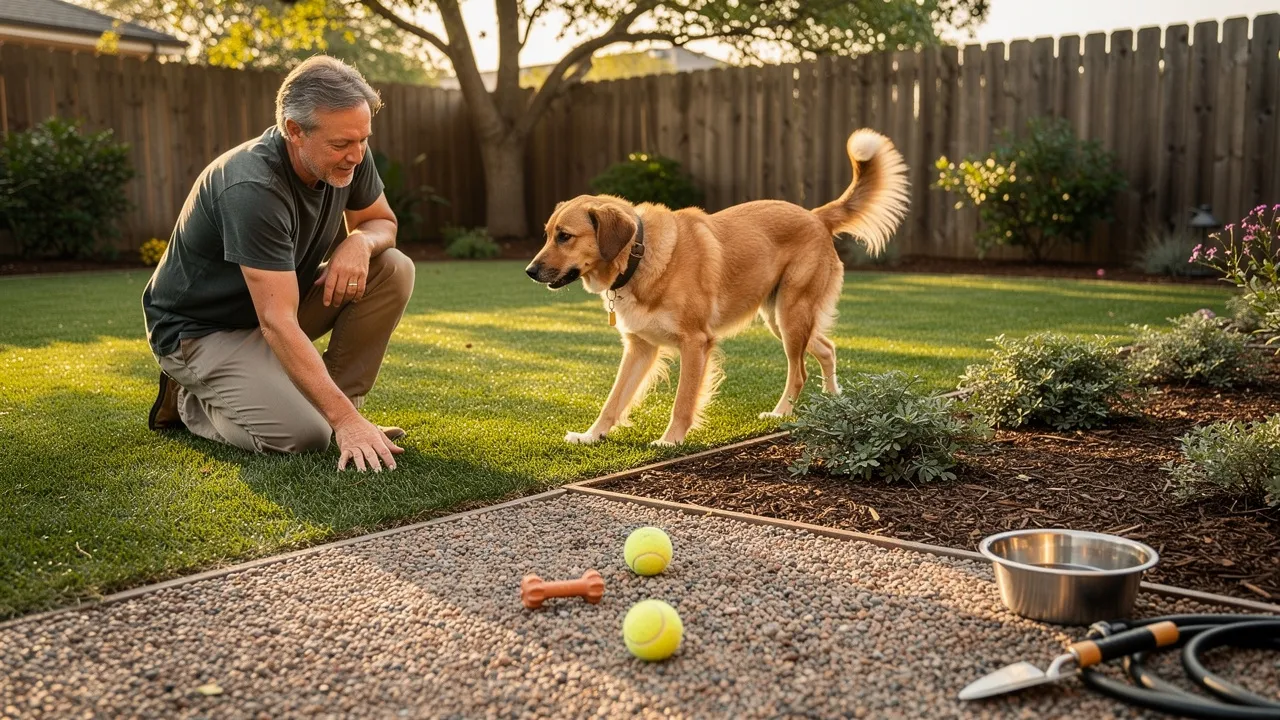
Pea gravel is a strong candidate for a dedicated potty area or dog run when liquid drainage and visible solid-waste pickup are central priorities. Pea gravel is usually around 3/8 to 1/2 inch in diameter, and its gaps allow liquids to drain while solid waste remains on the surface for pickup. The rounded pieces create a different underfoot experience from turf, mulch, or bare soil, so paw comfort and your dog’s willingness to use the area still belong in the evaluation.
With a compacted base and proper edging, pea gravel is less likely than bare dirt to become a mud pit. Pea gravel may be comfortable for pets, may help limit mud and weeds, and may stay cool in hot weather; digging can still displace it. Rounded pea gravel can be gentle on paw pads while allowing liquid waste to drain rather than pool.
Installation depth and the base affect the drainage expectation. A 3-4 inch layer of pea gravel over a compacted base can let urine pass down to the soil, while solid waste can be spotted and scooped from the surface. Urine can enter the soil, where it dilutes and disperses. Those statements assume the prepared base and surrounding soil can receive the liquid; a gravel layer cannot correct a slow-draining subgrade by itself.
Routine cleanup remains part of the choice. Solid waste is easy to spot and scoop from pea gravel; occasional hose-downs or diluted enzymatic-cleaner sprays can help control odor. For planning, allow roughly $30-50 per cubic yard delivered, with replenishment potentially needed every 1-2 years. The cost and interval are source-specific planning figures, not a local quote or fixed replacement schedule.
Shortlist pea gravel when you want a nonliving surface with visible waste pickup and a drainage-focused design. Keep digging, edging, base preparation, and the receiving soil in the decision.
Manage loose-fill movement and odor
Loose-fill maintenance determines whether gravel or another granular surface remains practical after installation. For a small, dedicated dog run, gravel or crusher dust may be simpler to keep fresh than artificial turf. That comparison concerns small, dedicated dog runs; it does not establish that every gravel surface will require less work than every turf system.
Urine management is a recurring task because liquid waste cannot be picked up. Hose favorite pee spots on stone regularly so liquids drain and dilute; if odors linger, a pet-safe enzymatic cleaner or outdoor odor neutralizer can help. The action is most useful when the surface, base, and subgrade allow water to move away rather than remain trapped beneath the visible stone.
Loose-fill surfaces can shift and need replenishing, smoothing, and leveling, while unitary surfaces stay in place more easily but require cleaning and sanitizing. Dogs that dig can move stones even when routine use does not. Plan to inspect edges, low points, gates, and favorite digging areas instead of assuming that a single installation check will settle the material permanently.
Replenishment depends on use and displacement, so include leveling and top-up work in your maintenance comparison.
A workable care routine is straightforward:
- Remove solid waste promptly so the surface remains usable.
- Hose concentrated urine areas on a regular schedule.
- Check whether odor persists after drainage and rinsing.
- Rake or level displaced material and inspect the edges.
- Plan for replenishment when stones settle, migrate, or leave thin spots.
Choose loose fill when you can accept this recurring physical maintenance. Choose a different candidate when loose material would conflict with your dog’s habits, access needs, or tolerance for periodic leveling.
Mulch and bark for a softer natural surface
Mulch and bark offer a soft, natural-looking surface when paw feel and appearance matter more than resistance to repeated digging. Cedar or pine bark mulch can be soft and gentle on paws, but it may break down and need replacing every 6-12 months in a high-traffic potty area. Mulch can provide some odor masking, yet it can harbor more bacteria and odor than gravel or turf when it is not raked and refreshed regularly.
Moisture and material quality create practical limits. Mulch and bark chips can be soft and natural-looking, but rough pieces may splinter, damp organic material can encourage mould, fungi, and fleas, and the material needs regular top-ups. Locally sourced mulch may contain sharp pieces that can injure a dog’s paw; finer-chipped commercial mulch is less likely to contain them. Inspect the material before placing it where your dog will run, rest, or eliminate.
Do not use cocoa bean mulch around dogs because it is toxic if ingested. The warning applies even when the product looks like an ordinary landscape mulch. Rubber mulch requires a separate exclusion: rubber mulch does not break down in a dog’s digestive tract and can cause a digestive blockage requiring emergency veterinary intervention if swallowed. Rubber mulch can also become extremely hot in the sun and costs approximately $3.50 per square foot.
Mulch therefore fits a specific use case: a planted border, a lower-intensity area, or a surface where you can rake, refresh, and replace material. It is a weaker candidate for a dog that repeatedly digs, chews loose material, or uses one small area as a high-traffic potty zone. If you still shortlist it, specify cedar or pine rather than cocoa bean mulch, inspect for sharp pieces, and record the replacement work in your maintenance plan.
Hardscape and specialty surfaces for different priorities
Hardscape and specialty surfaces can suit you when watering, digging resistance, drainage, or a defined route matters more than a living lawn. Gravel and permeable pavers can eliminate watering needs. Tumbled recycled glass gravel is non-porous and typically costs $60-90 per cubic yard; it does not need replacing because of material breakdown. The price is a source-specific planning range, while the surface still requires evaluation for installation, edge control, cleaning, and paw comfort.
The comparison rates several surfaces against shared criteria:
| Surface | Drainage | Digging resistance | Paw comfort |
|---|---|---|---|
| Pea gravel | Excellent | Moderate | Good |
| Decomposed granite | Good | High | Good |
| Washed sand | Excellent | Low | Excellent |
| Pavers with gravel joints | Good | Very high | Good |
| Bark mulch | Good | Low | Excellent |
These ratings help you organize a shortlist; they do not replace a site assessment. Decomposed granite may appeal when digging resistance has more weight, while washed sand has a low digging-resistance rating despite its excellent drainage and paw-comfort ratings. Pavers with gravel joints have very high digging resistance in the cited comparison, but their jointed construction still needs a plan for drainage and cleaning.
Pea gravel remains a useful reference because the same comparison rates it as having Excellent drainage, Moderate digging resistance, and Good paw comfort. Those ratings should be read with the separate guidance on displacement, edging, and replenishment. A rating is not a promise that your dog’s behavior or your subgrade will match the source’s conditions.
Use hardscape or specialty materials when you can state the priority clearly: no watering, a defined walkway, reduced digging, or a drainage-focused run. Then check how the proposed surface, base, slope, and surrounding soil work together before treating the material choice as final.
Screen shade, soil, slope, and drainage first
A site screen should come before a final surface choice because a visible material cannot solve every subgrade problem. Record the areas of full sun, partial shade, and deep shade; mark the route your dog uses most; identify standing water or mud; and note whether the proposed surface must support a lawn, a potty area, or a run. Match a living alternative to climate, foot traffic, and usage patterns rather than using appearance as the only filter.
You can perform a preliminary drainage screen for a proposed dog run by digging a hole a foot deep, filling it with water, and checking whether it empties overnight. Slow infiltration may leave water beneath the surface. The test is a screen, not a complete drainage design, and it should not be treated as proof that a finished surface will drain properly.
Slope and soil affect the same outcome. The cited guidance uses an approximate finished slope of 1.5% to 4.5%; excessive slope and clay soils can increase standing water, mud, and surface deterioration. Those conditions are construction questions, not details that a layer of gravel, mulch, or turf can simply hide.
Use this sequence before you narrow the shortlist:
- Mark sun, shade, gates, downspouts, and the dog’s regular route.
- Identify low spots, existing mud, compacted areas, and signs of clay.
- Screen subgrade drainage with the one-foot hole test.
- Consider the finished slope and where water should move.
- Remove options that conflict with the site’s light, traffic, drainage, or maintenance limits.
If the screen reveals slow infiltration, clay, uncertain slope, or recurring standing water, pause the material comparison and arrange a site-specific assessment. The visible surface is only one layer of the system.

Shortlist one surface or zone the yard
A practical shortlist can contain one surface for the whole yard or several surfaces assigned to different zones. Use a living cover where traffic is distributed and a planted appearance matters; use pea gravel or another loose-fill material where drainage and visible waste pickup lead the decision; use hardscape where a defined route or higher digging resistance matters. A mixed layout is a reasonable conclusion when the lawn, path, and dog run do not have the same job.
Use these branches to narrow the choice:
- Living cover: Shortlist clover, a clover-grass blend, or another suitable groundcover when you accept establishment time and seasonal variation. Favor low-growing, spreading plants that can recover quickly in planted areas with foot traffic.
- Drainage-focused run: Shortlist pea gravel when liquid drainage, solid-waste pickup, and a nonliving surface are more important than a continuous lawn appearance. Keep base preparation, edging, odor control, and loose-fill movement in the plan.
- Defined or high-resistance route: Shortlist pavers with gravel joints or another hardscape when digging resistance and a stable route carry more weight than a planted surface. Check the drainage path and underfoot experience before committing.
- Zoned yard: Combine candidates only when each zone has a distinct job. A planted area can serve lower-intensity use while a separate run handles concentrated elimination or repeated traffic.
Test a 100-square-foot section before converting the entire lawn, then scale up based on what you observe. Use the test to observe whether your dog chooses the surface, whether waste cleanup is practical, whether material shifts, and whether the appearance matches your expectations.
Living alternatives may provide 20-70% water savings; clover may use 50% less water and meadow lawns may use 70% less once established. These figures are not guaranteed results for your yard. Keep them separate from your decision about drainage and dog traffic.
The shortlist is ready for a site-specific review when you can name the surface or zone, the reason it fits, the unresolved risk, and the maintenance you accept.
Weigh heat and environmental trade-offs
Heat and material impacts can change the comparison when your dog uses the yard in direct sun. In one study, artificial turf reached temperatures as high as 63.8 °C, while natural turfgrass never exceeded 40 °C under the reported conditions. The study also found that dogs spent more time on natural turfgrass than on artificial turf, while natural turfgrass had lower temperatures and less compaction. Artificial turf was visually more durable in that study but harder and hotter.
The study gives a direct use boundary: when environmental temperature exceeds 25 °C, use caution with artificial turf because its surface temperature could cause injury to dogs. The finding comes from the cited study and its reported conditions; it is not a universal temperature prediction for every turf system, shade pattern, or property. Shade, access to another surface, and the time of day should be part of your dog-use plan.
Natural turfgrass has its own trade-offs, but it can provide a living surface and habitat. Those functions may matter if your priorities include a living landscape. They do not establish that natural grass is suitable for every traffic pattern, drainage condition, or maintenance preference.
Material lifecycle also belongs in the comparison. Artificial grass can release material fragments that contribute to microplastic pollution, has an estimated shelf life of 10-20 years, and is difficult to reuse. Treat those points as reasons to ask about the complete material and disposal plan, not as proof that one option has no environmental cost.
Use heat, habitat, and material reuse as explicit decision criteria. If direct sun and dog comfort dominate, give natural or shaded areas serious consideration. If a surface remains under consideration, document how you will provide shade or an alternate route and how you will manage cleaning, replacement, and end-of-use material.

Seek professional evaluation for unresolved site risks
A site-specific evaluation becomes necessary when drainage, soil, slope, or concentrated traffic could change the construction plan. Use the preliminary screen to identify risk, then pause the material decision when the result is not straightforward.
Seek an evaluation when any of these conditions applies:
- The proposed finished slope is uncertain, or the area already shows standing water, mud, or surface deterioration.
- Your dog will use a narrow run heavily, especially where digging, repeated turning, or concentrated elimination can move or contaminate the surface.
- The planned material depends on a compacted, permeable base, but the existing subgrade and water path have not been examined.
The cited guidance uses an approximate finished slope of 1.5% to 4.5% and warns that excessive slope and clay soils can increase standing water, mud, and surface deterioration. That range is a planning reference from the cited guidance, not a universal design instruction for every residential yard. Site conditions determine how the finished surface should be built and where water should go.
General comparison can help you decide which questions to ask. It cannot determine whether your soil, slope, base, edging, and drainage will support a particular construction plan. When those factors remain unresolved, carry the uncertainty into the site assessment instead of choosing a material solely because it appears easy to maintain.
Move from a shortlist to a site-specific quote
A site-specific quote should begin with a clear property brief, not a single preferred material. Record the approximate area, whether you need a whole lawn or a dedicated dog run, your dog’s activity and digging habits, sun and shade, current drainage, soil and slope concerns, cleanup expectations, desired appearance, and the maintenance you are willing to provide.
Bring these decisions forward:
- Which zones need a living cover, loose fill, hardscape, or a combination?
- Where must liquid waste drain, and where will solid waste be picked up?
- What happens to the surface in direct sun, winter dormancy, heavy traffic, and wet conditions?
- Which unresolved questions require inspection of the subgrade, base, slope, or edging?
- What ongoing work and replacement intervals are acceptable to you?
A 100-square-foot test can help you evaluate maintenance and appearance before full conversion, while a drainage screen can show whether water may remain beneath the visible surface. Those steps help you bring useful observations into the site-specific discussion. A qualified professional should decide individual suitability where construction conditions, drainage, or other property-specific risks affect the result.
Use the comparison to identify a defensible shortlist, not to force every yard into one material. The final choice may be a living cover, a drainage-focused run, a hardscape route, or a zoned combination after the site conditions are understood.