
Start with the walking requirement, not the material
Walkability is the first filter for any Kansas City lawn replacement. Before you compare artificial grass, natural grass, clover, native planting, or hardscape, define how you expect to use the space: occasional crossing, daily trips between the house and driveway, children’s play, entertaining, pet activity, or a combination of these uses.
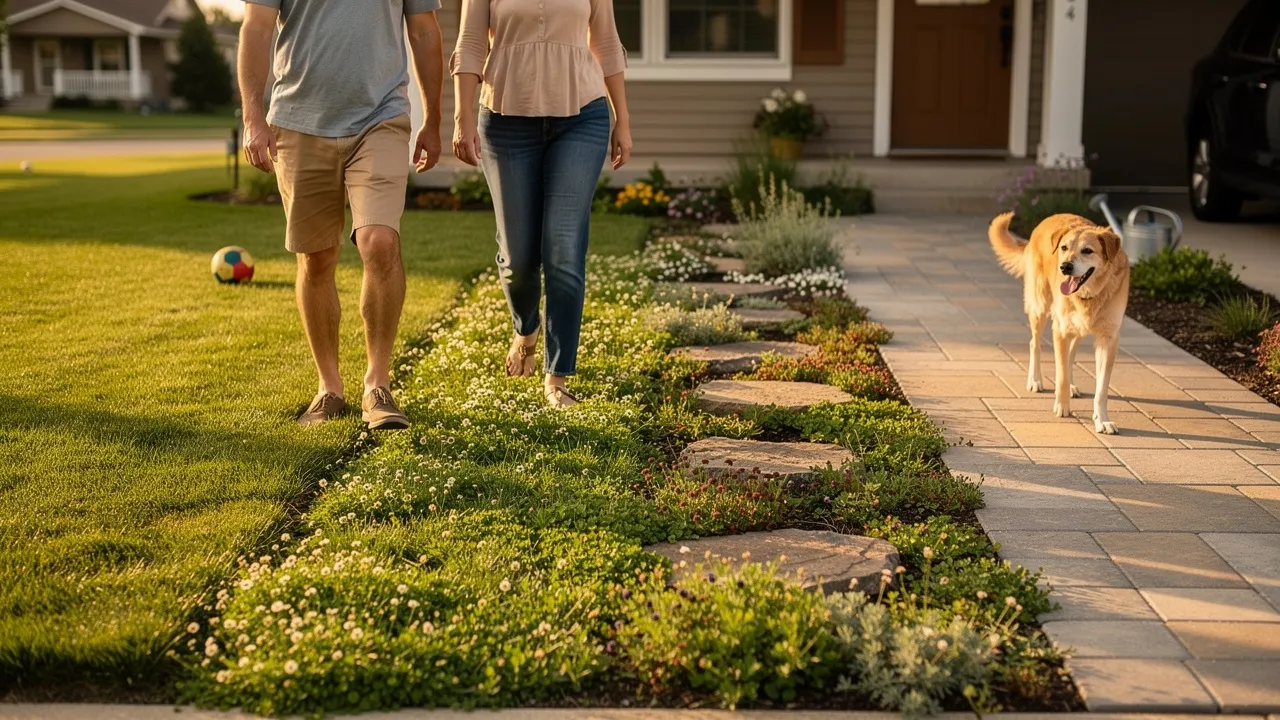
A surface that looks attractive from the window may not fit the way you move through the yard. A planted area can work beside a defined path but become frustrating if you expect it to function as a uniform lawn. A hardscape route can solve circulation without replacing every square foot. Artificial grass can preserve a lawn-like surface, but it still requires site preparation, cleaning, minor repairs, and a property-specific review.
Your first decision is therefore not “Which material is best?” Your first decision is “What must this area let me do?” Use that answer to narrow the alternatives.
Use three walking questions before you look at samples:
- How often will you cross the area? Occasional foot traffic creates a different requirement from a route used several times a day.
- Where will people actually step? A front approach, side passage, play area, and backyard gathering space may need different surfaces.
We also recommend matching any alternative to your climate, usage patterns, and expected foot traffic.
A 100-square-foot test area can help you evaluate an alternative before converting the full lawn. Expand only after you have considered how that trial fits your property; the recommendation is general guidance, not a Kansas City performance guarantee.
The main categories of walkable lawn alternatives
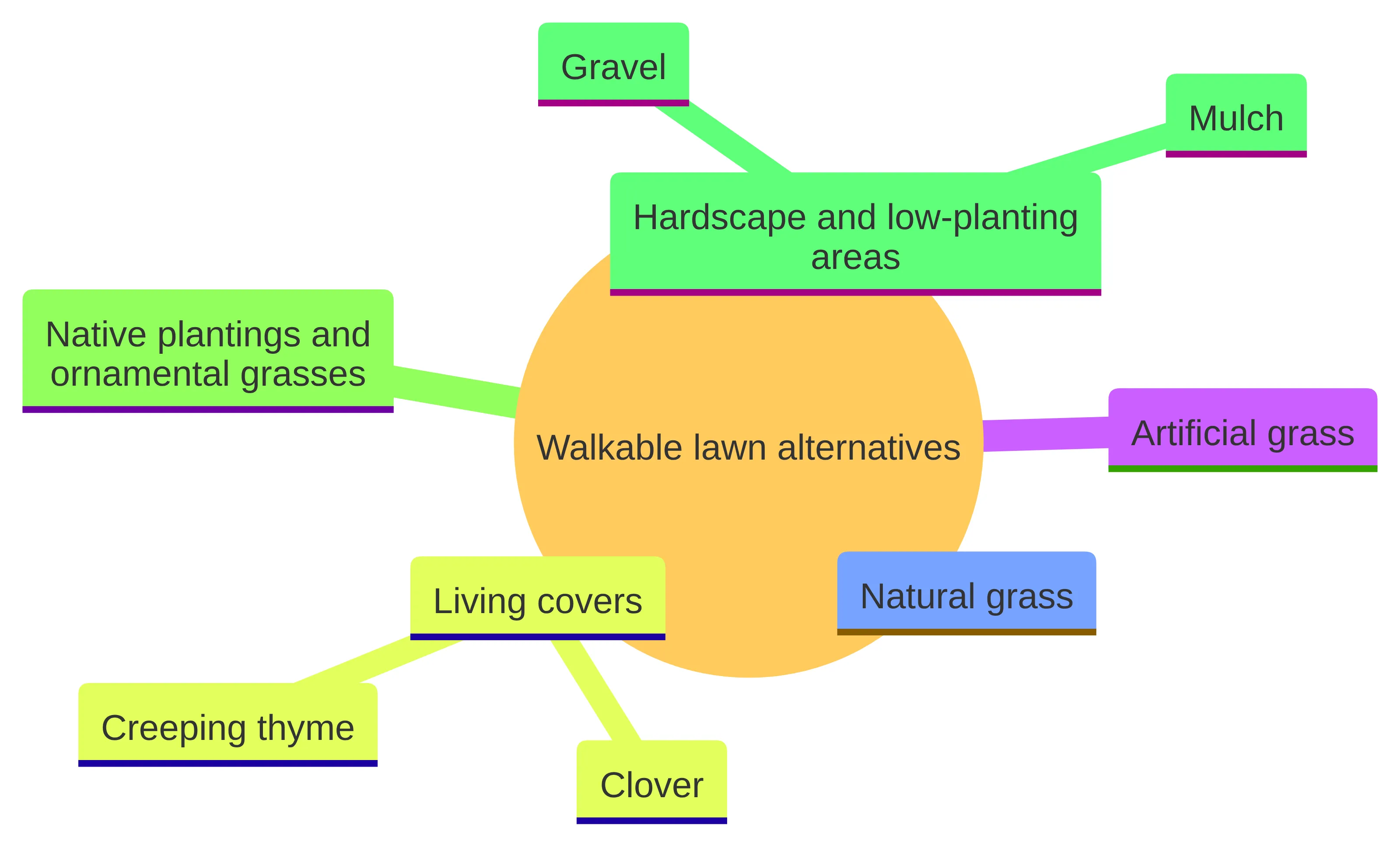
Grass alternatives include artificial turf, clover, creeping thyme, gravel, mulch, and native ground covers. For a residential lawn in Kearney, Kansas City, Overland Park, Lee’s Summit, Olathe, Shawnee, Lenexa, Liberty, or another nearby community, group those choices into five practical categories:
- Hall Turf’s guidance also notes that artificial grass requires cleaning and minor repairs.
- Natural grass: A living lawn that can provide a familiar walking surface, but whose upkeep includes frequent mowing, watering, and fertilizing.
- Living covers: Options such as clover and creeping thyme that replace a conventional turf lawn with lower-growing plants. Their suitability depends on how the area is used and how the planting establishes.
- Native plantings and ornamental grasses: Planting-led alternatives that can add texture, blooms, height, and habitat value. These are usually evaluated as landscape zones rather than assumed to be one uniform walking carpet.
- Hardscape and low-planting areas: Materials such as gravel or mulch, often planned around paths, gathering areas, borders, or reduced-lawn designs rather than treated as a complete lawn substitute.
These categories can also be combined. A yard might use a walkable central surface, a planted edge, and a defined path through a higher planting area. That approach lets you assign each part of the property a job instead of asking one material to solve every use.
Ornamental grasses illustrate why category names are not enough. Ornamental grasses are not a uniform walking surface; evaluate their role alongside the route through the yard.
Native plantings create a different kind of value. The National Wildlife Federation describes native plant beds as a way to add blooms, visual interest, and wildlife benefits when reducing turf. Those benefits may make a planted zone attractive beside a route, but they do not answer whether the zone should carry daily foot traffic. Select the plant area and the walking route together.
Use a walkability-first comparison
Walkability alone is not enough: consider expected wear alongside upkeep, site conditions, and intended traffic before selecting an option.
| Alternative | Walkability question | Maintenance and appearance question | Water and site question | Budget question |
|---|---|---|---|---|
| Artificial grass | Can the proposed installed system support your intended traffic and lawn-like use? | Can you accept cleaning and minor repairs while seeking a consistent appearance? | How will site preparation and drainage be addressed? | What work is included in the property-specific proposal? |
| Natural grass | Can the selected grass and lawn layout support the way you use the area? | Can you commit to frequent mowing, watering, and fertilizing? | What irrigation, soil, climate, and rainfall conditions affect the choice? | What recurring upkeep fits your budget? |
| Clover or another living cover | Can the planting tolerate the actual traffic while it establishes? | What establishment and seasonal care will the area require? | Does the general water-saving information apply to your site and climate? | Can you test a small area before converting the lawn? |
| Native planting or ornamental grass | Which areas can remain planted, and where must you provide a clear route? | Do the height, texture, blooms, and annual cutback fit your intended appearance? | Which species and layout suit the particular site? | Would a partial conversion meet the goal without changing the entire yard? |
| Gravel, mulch, or another hardscape approach | Is the surface intended for a defined route or gathering area rather than a continuous lawn? | How will edges, transitions, appearance, and routine care be handled? | How will rain move across and away from the surface? | What area can be converted while preserving access and function? |
The table keeps walkability ahead of appearance. It also separates a general category from a finished installation: the material name alone cannot answer whether the planned system fits your yard.
Read each row as a decision branch:
- Choose a living option for further investigation when you can accommodate its establishment and ongoing care, and when the walking pattern does not require every square foot to act as a uniform surface.
- Choose a planted-and-path layout when you want planting value but need predictable circulation through the yard.
- Investigate artificial grass when a consistent lawn-like surface is a priority and you are prepared to examine site preparation, care, drainage, environmental trade-offs, and project scope.
- Keep natural grass in the comparison when living vegetation, water movement, and the upkeep routine fit your priorities.
No branch wins automatically. The correct next step is to test the unresolved condition rather than allowing a material label to make the decision for you.
Living options: natural grass, clover, covers, and native plantings
Natural grass remains a serious option when you want living vegetation and can maintain it. Hall Turf describes natural grass as requiring frequent mowing, watering, and fertilizing. A case study reports that natural grass can reduce surface temperatures, support biodiversity, reduce erosion, store carbon, and emit fewer greenhouse gases than artificial turf. Those findings come from the study context; they do not establish the result for every Kansas City residential lawn.
That figure is not a Kansas City household estimate, so do not use it to predict your water bill or irrigation demand. The study also found natural grass more effective than short and long artificial-turf treatments at slowly releasing infiltrated water and storing water in its comparison.
Natural grass therefore presents a genuine exchange: living environmental functions and a familiar lawn form on one side, with a recurring upkeep commitment on the other. Keep it on your shortlist if that exchange fits your priorities and property.
Clover and other living covers may reduce the intensity of a conventional lawn routine, but the result depends on establishment and use. One 2026 comparison reports 20%–70% water savings for most living alternatives, with clover at 50% and meadow lawns at 70% once established. Those figures are general comparison results, not Kansas City household estimates, and they do not establish how a particular cover will handle your foot traffic.
Use a small trial before a full conversion. A 100-square-foot test area gives you a defined place to observe appearance, establishment, and the maintenance routine before you extend the choice across the yard. Treat the trial as a decision aid, not as proof that the same result will occur everywhere.
Creeping thyme and similar low-growing covers belong in the same screening conversation. Ask whether your actual route crosses the planting, whether the area has time to establish, and whether the appearance you want is a continuous lawn or a more varied planting surface.
Native plantings and ornamental grasses make sense when reducing lawn area is part of the goal. The National Wildlife Federation describes replacing turf with native species as a way to create garden beds with varied blooms, visual interest, and wildlife benefits.
Those descriptions support a landscape-zone decision, not a universal Kansas City species list. Local exposure, soil, shade, drainage, and winter conditions still affect which plants belong on a particular property. Plan a clear path through or around the planted areas if you need dependable daily circulation. Keep planting-led areas separate from the parts of the lawn that must handle repeated walking.
Hardscape and low-planting options
Hardscape changes the question from “Which grass replacement covers the yard?” to “Which parts of the yard need a planted surface at all?” Gravel and mulch are among the grass-alternative categories discussed in a comparison focused on Texas and Florida, rather than Kansas or Missouri. Use the categories as ideas, not as local performance guidance.
A hardscape plan can be appropriate for a defined walkway, seating area, service route, or border. The walking requirement should determine the layout, width, transitions, and connection to doors, gates, driveways, and existing paths. Do not assume that a material suitable for a low-traffic border will suit a route used every day.
Before selecting a low-planting or hardscape area, ask:
- Will you walk across it in ordinary shoes, barefoot, or while carrying equipment?
- Will children, pets, visitors, or delivery access change the traffic pattern?
- How will the surface meet the lawn, planting beds, steps, and doors?
- Where will rainwater move after it reaches the new surface?
- Can you maintain the edges and keep the intended route clear?
These questions do not produce a universal material recommendation. They help you assign hardscape to the parts of the property where its function is clear.
A mixed design can reduce the amount of surface that must perform as a lawn. Keep a defined walking route, use planting areas where you want visual variety, and reserve a continuous surface for the activities that truly need it. That arrangement may be more useful than converting the entire yard to one alternative.
Rainfall deserves a separate check. A Utah water-quality report found higher runoff potential, lower rainfall capture or infiltration, and pollutant concerns for artificial turf and xeriscaping, including microplastics and leached contaminants from artificial turf. Utah conditions do not establish Kansas or Missouri performance, but the report supports asking how the proposed layout will handle runoff rather than treating water conservation as the only environmental criterion.
Where artificial grass fits—and where its trade-offs matter
Artificial grass fits the comparison when you want a lawn-like surface and want to reduce the routine demands associated with natural grass. We describe artificial grass as a durable, low-maintenance, visually appealing alternative to natural lawns. Hall Turf’s guidance also says that artificial grass can save time, water, and maintenance costs, while making clear that the surface still needs cleaning and minor repairs.
Artificial grass should remain a candidate rather than an automatic answer. A front lawn used mainly for appearance raises different questions from a backyard used for daily circulation, play, entertaining, or pets.
Artificial grass also has trade-offs that belong in the decision before installation. A case study reports environmental benefits for natural grass, including lower surface temperatures, biodiversity support, erosion reduction, carbon storage, and lower greenhouse-gas emissions than artificial turf. A Utah report raises runoff, infiltration, microplastic, and leached-contaminant concerns about artificial turf, but its findings are not established for Kansas or Missouri properties.
Water savings require similar restraint. Hall Turf’s general statement that artificial turf can save water is not a property-specific water-use estimate.
Use those limitations as decision prompts. Ask how the proposal handles rainfall, what care remains after installation, and what assumptions support any water or maintenance discussion. Keep natural grass, living covers, native plantings, and partial hardscape in the comparison if their environmental or landscape functions matter to you.
Artificial grass installation begins with the site, not the visible grass layer. We prepare the site before installing artificial grass. That preparation should be discussed alongside the property’s intended use and drainage questions.
Artificial turf lifespan varies with maintenance and environmental factors. Do not turn a general lifespan statement into a fixed service-life promise for a Kansas City yard. Ask what maintenance the proposed system requires, which environmental exposures matter, and how repairs would be handled.
If those answers are not clear, pause the material comparison and request a site-specific assessment before selecting artificial grass.
Do not use broad cost figures as a local answer
Cost per square foot is useful only when you know what the number includes. Published field-installation figures of $4.50–$10.25 per square foot for artificial turf and $0.60–$5.00 for natural grass are not Kansas or Missouri residential quotes. Field projects and residential lawn replacements can differ in size, preparation, access, drainage work, materials, and scope, so those figures should not become a budget promise for your property.
A more reliable budget screen asks for comparable scope. Have the proposal identify the property conditions and work included, then compare like with like. Ask whether the quoted area, preparation, installation, finishing work, and any ongoing care assumptions are stated clearly. Do not compare a broad field benchmark with a residential proposal as though both describe the same job.
Your budget decision should include two kinds of cost:
- Project cost: The work required to change the existing lawn into the selected surface.
- Ongoing commitment: The mowing, watering, fertilizing, cleaning, repairs, planting care, or edge maintenance associated with the option.
Apply the same discipline to every alternative, and request a property-specific quote when artificial grass remains under consideration.
Screen the property before choosing
A property screen turns a broad lawn question into a decision you can act on. Write down the following before selecting a material:
- Use: Record who will walk there, how often, and whether the space supports circulation, play, entertaining, pets, or appearance.
- Traffic pattern: Mark the routes that receive daily use and the areas that can remain planted or lightly used.
- Existing conditions: Note the current lawn, bare areas, slope, shade, sun exposure, access points, and any place where water collects or moves quickly.
- Maintenance tolerance: State which recurring tasks you will perform and which tasks you want to reduce.
- Appearance: Decide whether you want a consistent lawn field, a mixed lawn-and-bed design, a native planting area, or a defined path with reduced turf.
- Budget: Set a project range and identify whether ongoing upkeep is part of the comparison.
- Trial opportunity: If a living alternative remains in contention, identify a 100-square-foot area that could serve as a test before full conversion.
The list does not determine suitability by itself. It gives you a shared record for comparing options and exposes the questions that need a property-specific answer.
Drainage deserves its own line in the record. A Utah report found higher runoff potential and lower rainfall capture or infiltration for artificial turf and xeriscaping, while another comparison found natural grass more effective than the artificial-turf treatments at slowly releasing infiltrated water and storing water. These findings come from specific study settings and do not predict what will happen on your Kansas or Missouri property.
Use them to form questions rather than conclusions. Ask where rainwater will go, whether the planned surface changes an existing flow path, and what site preparation is required. Artificial grass still needs site preparation before installation; a surface sample cannot answer the drainage question.
A professional assessment becomes appropriate when the traffic pattern is complicated, the property has unclear water movement, the surface must serve several uses, or the project scope cannot be compared on equal terms. At Hall Turf, we recommend assessing your specific needs and consulting professionals when exploring artificial-grass installation options.
Use the completed screen to choose your next branch:
- Continue researching living options if you can accept establishment and recurring care, and your traffic pattern leaves room for a nonuniform lawn design.
- Plan a mixed surface if your actual need is a reliable route through a larger planted or reduced-lawn yard.
- Investigate artificial grass further if a consistent lawn-like surface fits the intended use, the maintenance trade-off fits your budget, and you are ready to discuss preparation, drainage, care, and project scope.
- Seek a site-specific assessment if you cannot explain how the proposed surface will handle your use or rainfall conditions.
Choose the branch that resolves the largest unanswered property question. Do not let a general product description substitute for that answer.
Make the next decision site-specific
Your shortlist should begin with the way you walk through and use the yard. Compare artificial grass, natural grass, living covers, native plantings, ornamental grasses, and hardscape by traffic, upkeep, appearance, water questions, drainage, climate fit, and budget. Keep general study findings separate from predictions about your Kansas City property, and treat broad cost figures as background rather than a residential quote.
Artificial grass merits further investigation when a consistent lawn-like surface fits your use and you accept the remaining care and site questions. Natural grass or a living alternative may fit when you value living vegetation and can support its upkeep. A mixed design may fit when only certain routes need a dependable walking surface. A qualified landscaping professional should determine individual suitability from property-specific information.
Prepare your use pattern, site notes, maintenance expectations, and budget questions before requesting project guidance.