
Start with the budget decision
Backyard putting green installation cost is best treated as a scope-based planning range, not a single price for every property. Professional backyard putting green installation generally costs $15 to $40 per square foot, depending on the project. One U.S. cost guide dated September 3, 2026, reported a normal project range of $3,500 to $9,000, with an average around $4,300. These figures are broad planning references, not a current Kearney or Kansas City quote.
A useful preliminary budget separates the project into five questions:
- How much putting surface do you need?
- What shape, holes, breaks, fringe, or chipping areas do you want?
- What earthwork, base, drainage, and edging will the yard require?
- How difficult will it be to move material into the work area?
- Which turf, infill, maintenance, and installation approach fits the intended use?
Putting green size also needs context. Most Tour Greens installations are over 1,000 square feet, and Tour Greens has built greens of all sizes. PGA Tour putting greens measure about 5,000 to 6,000 square feet. Those professional-course comparisons can help you picture scale, but they do not establish the size or price your backyard needs.
For a Kearney or Kansas City property, use published figures to organize questions and compare scopes. Treat the final amount as site-specific because soil, slope, drainage, access, irrigation, design, and included work can change the result.
Create a size-based planning range
A size-based planning range gives you a starting point without turning a published example into a promise. A guide dated September 3, 2026, reported that a 300-square-foot green often costs $4,500 to $12,000, while a 500-square-foot project can cost $7,500 to $20,000 when site preparation and contour work are included. The ranges are broad because the word “green” can describe very different scopes.
Another useful benchmark is the per-square-foot range. Smaller greens under 400 square feet tend toward the higher end of the $15 to $40 per-square-foot range, while greens of 2,000 square feet or more can have a lower per-square-foot rate. One industry pricing guide places projects under 400 square feet around $30 to $35 per square foot, projects from 400 to 2,000 square feet around $25 to $30, and projects at 2,000 square feet or more around $20 to $25. Those figures describe general planning conditions rather than Kansas or Missouri pricing.
Use the figures as a worksheet rather than as a final calculation:
- Choose a tentative surface area in square feet.
- Multiply that area by a published planning range.
- List site preparation, drainage, access, features, and landscape integration as separate lines.
- Mark every line as included, excluded, or undecided.
- Record the date, geography, project size, and included work for every price reference.
- Replace the planning range with a current written quote after the property is assessed.
Keep the worksheet organized by scope. A bare per-square-foot number is difficult to compare with a total that includes excavation, drainage, edging, cups, infill, or landscape restoration. Write the included work beside every figure, then place separate allowances below it for items that are unknown.
A compact green can cost less overall but carry a higher unit price because excavation, delivery, grading, and crew setup still cost nearly the same. An 800-square-foot entertainment green may have a higher total price but a lower unit price because mobilization and foundation work are spread over more surface area. Total project cost and cost per square foot answer different questions, so record both.
Choose the playing surface before pricing features
Putting green design determines more than appearance; it defines the work that must be priced. A simple, flat layout costs less than a green with multiple holes, contours, fringe cuts, or integrated chipping areas. Larger spaces typically cost more because they require more material and labor, even though a larger project may sometimes have a lower unit price.
Write the playing purpose before selecting features. A practice surface for short putts has a different scope from an entertainment green with several cup positions, approach shots, a fringe, or a chipping area. Your worksheet should record:
- Intended users and type of practice
- Approximate surface area and outside dimensions
- Number of cups or flag positions
- Desired breaks, tiers, contours, or elevation changes
- Fringe, rough, chipping areas, bunkers, or surrounding landscape
- Whether the green must fit around a patio, pool, trees, fence, or other fixed feature
Feature allowances need their own lines. One installer’s pricing guidance says adding a fringe typically adds about $1,500 to $3,000, while adding a real sand or padded white turf bunker adds an extra $1,500 to $3,000, depending on the project. Those amounts are an installer’s planning examples, not local Hall Turf pricing.
Artificial grass and putting turf come in 15-foot-wide rolls, and each additional piece adds a seam to the green and increases cost. A pricing guide describes installation within multiples of 15 feet as most cost-effective. The same contractor says its average backyard putting green is around 15 by 20 feet and is large enough for four cups or flags. That example can help you think about layout, but it does not determine the right dimensions for your yard.
Choose the footprint and playing features first. Price each feature separately so removing a bunker or reducing the number of contours produces a visible scope change rather than an unexplained total.
Separate earthwork, base, and drainage
Earthwork, base construction, and drainage should appear as separate budget lines because the surface turf is only one layer of the installation. Extensive grading or drainage work can raise site-preparation expenses by $1,000 or more, while excavation generally costs $50 to $200 per cubic yard depending on site conditions. A different planning guide reports that base preparation typically ranges from $1 to $5 per square foot, influenced by site complexity and material choices.
One cost model attributes 40-55% of cost to base construction and 30-40% to turf material; it says larger greens can have a lower per-square-foot cost because of material efficiency. That model is a general planning reference, not a breakdown for a particular Kearney property. Ask each installer to show whether excavation, aggregate, grading, compaction, drainage, edging, and hauling are included.
Drainage belongs beneath the visible playing surface. A well-built putting green needs a drainage layer beneath the base to move water away efficiently. Poor drainage can create water-management problems that later affect the surface, so do not treat drainage as an optional cosmetic upgrade when the site needs it. Soil also expands and contracts with climate conditions; one guide explains that this movement can cause artificial grass to buckle, wrinkle, or become uneven when a sub-base is not properly addressed.
Sub-base material is another specification to record. One guide describes decomposed granite as the best choice for a putting-green sub-base because it yields a smoother finish; the guide says crushed miscellaneous base is easier to compact but does not drain quite as well. Preserve that comparison as a design question rather than assuming one material fits every property.
A published cost table lists a 150-300-square-foot basic practice green at $2,200 - $4,800 installed, or $14 - $22 per square foot. The table is a broad U.S. planning reference. Its inclusion does not remove the need to price the Kearney or Kansas City site work separately.
To make this section useful during quoting, leave a line for each physical layer: excavation and removal, aggregate or sub-base, compaction, drainage path, edging, and surface installation. If a line is not yet known, label it undecided instead of silently folding it into a general allowance. That keeps a low preliminary budget from hiding the work required to prepare the site.

Record access, slope, irrigation, and landscape constraints
Property constraints can change the installation approach before turf is selected. Construction access can materially affect a project because equipment, soil or base material, and other supplies must reach the green site. A California-based project account notes that a crane is not uncommon for lifting putting-green materials into a backyard; the practical planning point is to document how material will reach your proposed green.
Record these conditions before requesting comparable estimates:
- Gate width, stairs, fences, retaining walls, and the distance from delivery access to the work area
- Existing slope, low spots, standing water, and the direction of surface runoff
- Irrigation heads, lateral lines, valves, controllers, and nearby utilities
- Trees, roots, patios, pools, structures, and landscape features that limit the footprint
- Space needed around the green for edging, maintenance, and material handling
Existing irrigation may require capping sprinkler heads, pulling risers, adjusting controller zones, and coordinating with an irrigation contractor on larger commercial or HOA jobs. Slope can also complicate design and construction; grading, retaining walls, and maintenance space around the green can significantly increase the price. Poor drainage can cause water to pool, create soft uneven spots that affect ball roll, wear out turf faster, and lead to mold and odors over time.
Published size examples show how scope expands. A U.S. cost table lists an 800-1,200-square-foot Par-5 training layout at $10,000 - $18,000 installed, or $12 - $18 per square foot. The same table lists a 1,500-3,000-square-foot large pro-style green with fringe at $18,000 - $36,000 or more installed, or $10 - $16 per square foot. These are tabled planning examples, not Kansas City-area prices.
Photograph access, slope, irrigation, and drainage conditions before the site visit. Include a tape-measured gate width and a simple route from the delivery point to the proposed green when possible. A clear record helps each estimate address the same property instead of pricing an idealized version of it.
Add turf, maintenance, and performance choices
Turf selection and maintenance allowances complete the budget because the surface system affects both the initial scope and the ongoing work. Premium synthetic turf and advanced synthetic putting greens designed to replicate real golf greens tend to cost more but deliver better ball roll, durability, and realism; cheaper options may lower upfront cost but often sacrifice performance and longevity. Treat those as trade-offs to discuss, not as a universal promise about any product.
Your worksheet should separate these lines:
- Putting turf and any surrounding turf types
- Underpad, edging, cups, infill, and drainage components
- Fringe, rough, chipping zones, bunkers, or landscape integration
- Cleaning supplies and replacement or top-up infill
- Routine maintenance labor, if you plan to hire it
- Product documentation and the conditions attached to any workmanship coverage
Maintenance materials may cost $100 to $500 each year, and infill material may cost $1 to $2 per square foot, according to one general cost guide. Ask what maintenance the quoted system expects and which materials are included at installation.
Professional installation expenses can vary significantly and are reported as averaging between $15 and $40 per square foot. Larger and more intricate designs can escalate to $18,000 or more. Magnolia Turf says most full-feature builds land between $18 and $25 per square foot installed, including turf, underpad, edging, cups, drain core, and an optional bunker. Magnolia Turf’s Texas pricing should be used to compare included scope rather than to predict a Missouri or Kansas price.
A lower initial number may exclude the parts that determine how the green plays. Compare the turf specification, base, drainage, cups, edging, infill, features, and maintenance assumptions together. If two options use different turf systems or include different preparation work, keep them as separate scope choices rather than averaging their prices into one figure. Brushing every 1-2 weeks is recommended to maintain an even surface and prevent matting. Rinsing is necessary after heavy rain or pet waste, ideally monthly during heavy-use seasons. Depending on usage, infill replacement may be needed annually or biannually.
Compare DIY with professional installation
DIY installation can reduce labor expenses, but the project still requires time, tools, material handling, grading, compaction, drainage planning, turf selection, seam work, and cup installation. A guide says DIY installations can save between 40-60% on labor costs compared with hiring professionals, whose installation fees in that guide range from $27 to $30 per square foot.
A stable installation sequence includes:
- Remove grass, roots, and debris and shape the excavation.
- Build the sub-base with crushed stone in thin lifts of 2 inches at a time, compacting each lift with a plate compactor.
- Fine-grade the surface and maintain a steady 1-2% fall for water while checking for dips and humps.
- Set the putting cups, lay and seam the turf, secure the edges, add infill, and brush the surface to fine-tune ball-roll speed.
Properly compacted aggregate helps prevent settling and ripples, while tight seams, secure perimeters, and cup installations keep the system locked in under play and temperature swings. DIY installations often fail because of poor drainage, inadequate base preparation, wrong turf selection, improper infill, or misaligned seams; each mistake affects playability and longevity. Professional installers bring experience in grading, compaction, and seam work that can mitigate costly errors and improve long-term performance.
| Decision area | DIY installation | Professional installation |
|---|---|---|
| Labor budget | May reduce labor expense, but requires your time and tools | Adds installation expense and brings a crew for the construction work |
| Base and drainage | You must control excavation, grading, compaction, and water movement | The installer handles these construction tasks within the quoted scope |
| Seams and cups | You must align seams, secure edges, and set cups correctly | The installer brings experience with seam work, edges, and cup placement |
| Site complexity | More difficult when access, slope, irrigation, or drainage is uncertain | A qualified installer can assess those conditions before digging |
A putting green kit may have a lower upfront cost but often lacks the customization, durability, and performance of a professionally installed green. Choose DIY only when the site, tools, materials, and construction tasks are genuinely controllable. Get qualified installation help before work begins when the base, drainage, slope, access, or seams are outside your experience.
The labor figure should not be the only DIY comparison. Add tool rental, aggregate delivery, disposal, time away from other work, and the cost of correcting a failed base or seam if the project does not proceed as planned. Keep those items visible in the worksheet, even when you do not yet have a dollar amount.

Plan for work duration and scheduling
Installation duration and turf lifespan are separate planning questions. A standard 200-400-square-foot backyard putting green takes 2-5 days from start to finish, according to BackyardPutter.com. Larger or more complex installations with retaining walls or significant landscaping can take 1-2 weeks, and weather delays are common because base compaction requires dry conditions.
Broader project timing can be longer than on-site construction. Southwest Greens Florida says most backyard projects run about one to three weeks from the first site visit to the final walkthrough; smaller, flatter yards can take under ten days, while larger designs with more contouring or drainage work can take closer to a month. That account includes the wider project sequence rather than only the days a crew is physically installing materials. A separate scheduling guide says lead time to start is typically 1-3 weeks, with longer timing possible during spring and early summer.
Use the following distinctions when comparing schedules:
- A site visit and design typically takes 30-60 minutes.
- On-site work typically takes 6-9 hours, depending on light and weather.
- Smaller projects may combine steps and finish in 1-3 days.
- More square footage requires more excavation, base, edging, turf, and finishing.
- Narrow gates or stairs may require moving dirt and stone by wheelbarrow and add hours or days.
- Breaks, fringe, chipping zones, and multiple seams require additional precision and can add labor.
- Rain can pause base work and infill, while frozen ground can slow excavation.
Artificial turf lifespan varies with maintenance and environmental factors. Ask how care, exposure, drainage, and the selected system affect the maintenance plan, then record the answer with the quote.
When comparing schedules, ask which date starts the clock. A two-to-five-day installation estimate may describe construction from preparation through completion, while a one-to-three-week project estimate may include the initial visit, scheduling, weather interruptions, and final walkthrough. Keep lead time, active workdays, and weather contingency as separate notes.

Turn the worksheet into comparable estimates
Comparable estimates require a consistent project brief. Some published pricing examples price site preparation, sand traps, shade structures, and landscape integration separately. A lower total may therefore reflect fewer included items rather than a lower cost for the same finished scope.
Send the same information to each installer:
- Approximate dimensions, square footage, intended use, and number of cups
- Shape, breaks, contours, fringe, chipping areas, bunkers, and landscape features
- Photos and measurements showing access, slope, irrigation, drainage, gates, stairs, and nearby structures
- Requested turf, base, drainage, edging, infill, cup, and maintenance specifications
- Desired schedule and any HOA, utility, or landscape coordination questions
Use that sketch to compare the shape, cup positions, contours, and included work rather than comparing totals alone. Ask each estimate to identify excavation depth, base material, compaction, drainage, hauling, seams, edging, infill, cleanup, landscape restoration, taxes, and exclusions.
One Arizona contractor lists a base specification at $16 - $22 per square foot, including turf, base, drainage, cups, edge restraint, infill tuning, and a 2-year workmanship warranty. The same contractor lists $3,200 - $4,400 for a 200-square-foot putting-only green with 2 cups, $4,800 - $6,600 for a 300-square-foot green with 3 cups and a subtle break, and $8,000 - $11,000 for a 500-square-foot green with chipping fringe and 4 cups. Site preparation and some features are priced separately in those examples, and the figures come from Arizona.
Use outside examples to identify questions about inclusions. Do not copy an Arizona total into a Kearney or Kansas City budget. Ask for a current written scope tied to your property.
Before comparing totals, place each estimate into the same worksheet columns:
- Base project scope
- Site preparation and removal
- Drainage and irrigation work
- Turf, cups, edging, and infill
- Fringe, contours, chipping areas, or bunkers
- Access, hauling, cleanup, and landscape restoration
- Taxes, exclusions, allowances, and possible change conditions
- Expected lead time, active workdays, and weather assumptions
A quote that leaves a line blank is not automatically lower. Mark the line as excluded, included, or unanswered and resolve the difference before using the total for a decision.
Seek a site assessment when conditions are uncertain
A site assessment is the right next step when soil, drainage, slope, access, irrigation, or local requirements are uncertain. Before digging, a qualified installer should assess soil type, drainage patterns, existing vegetation, slope, and integration with the surrounding landscaping. A site-specific price also depends on seeing the conditions that a general worksheet cannot measure.
Request an assessment before committing to a design when:
- Water pools, runs toward the proposed green, or has caused soft ground.
- The yard slopes sharply or may require grading, retaining walls, or extra maintenance space.
- Equipment and base material must pass through a narrow gate, over stairs, or around structures.
- Existing irrigation, utilities, roots, patios, pools, or other landscape features cross the proposed footprint.
- You are considering multiple contours, fringe, chipping zones, bunkers, or a green above 1,000 square feet.
- A quote does not clearly identify its base, drainage, site-preparation, feature, or access assumptions.
The site visit and design confirm size, shape, breaks, cup count, and fringe; this step typically takes 30-60 minutes. Above 1,000 square feet, a backyard green is described as a serious practice facility, so document the intended use and scope carefully at that scale.
Call 811 where required. An HOA may require plan sign-off even when formal landscaping permits are uncommon, so check the applicable local and HOA requirements. Do not rely on an unverified estimate or skip evaluation of drainage, soil, slope, access, and irrigation. If any of those conditions are unclear, pause the excavation decision and obtain qualified installation help.
Seek that help before digging rather than after the base has been placed. The assessment should resolve the proposed footprint, water path, access route, major site constraints, and items included in the written scope. Those decisions give you a defensible comparison between preliminary planning and the price for the actual Kearney or Kansas City property.
Request the next local quote
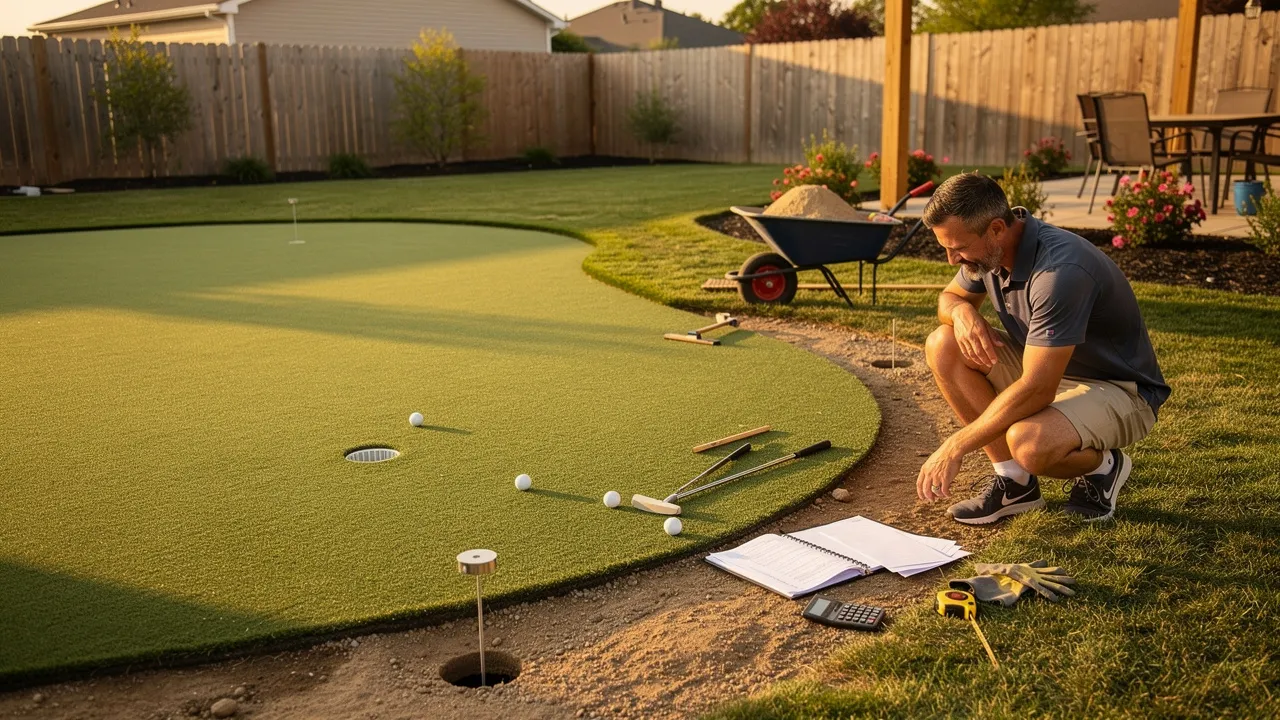
A quote-ready backyard putting green brief should contain your approximate dimensions, intended use, number of cups, desired contours, fringe or chipping features, access route, slope, drainage history, irrigation, surrounding landscape, and preferred timing. Add photographs and mark any condition that could affect excavation or material delivery.
Use the worksheet to request a current Kearney or Kansas City-area scope and price, then compare what each estimate includes before you decide. A clear site-specific assessment can replace broad planning references with a project definition tied to your yard. Individual suitability, design decisions, and final scope should be determined with a qualified installation or contracting professional.
Keep the completed brief, photographs, and marked-up site notes together so the project scope can be discussed against the actual property.