
Start with the practice result and usable space
A backyard putting green can give you a place to practice golf, enjoy friendly competition, and spend time outside. The shape should follow what you want to do on the surface and what your property can support - not the other way around.
Start by weighing five conditions: usable space, intended use, surface contours, drainage, and the maintenance you can reasonably manage. A compact practice area may need a different footprint from a family feature or a shared commercial installation. Existing patios, walkways, planting beds, fences, and gathering areas also affect how comfortably you can move around the green.
Cost belongs in the shape decision from the beginning. A published U.S. estimate places backyard putting greens at $15 to $40 per square foot in 2026, with size identified as the single biggest driver of total project cost. The same planning material places a 300-square-foot green at about $4,500 to $12,000 and describes an 800-square-foot entertainment green as potentially including multiple holes, fringe, and shaped contours; the larger project has a higher total price but may have a lower price per square foot.
A separate estimate reports that most Prescott-area projects fall between $4,500 and $20,000 depending on size, site work, and features. That is a different local market, so use it as context rather than as a Kansas City budget. Your useful starting point is a shortlist of shapes whose space and construction scope you can explain.
Map the footprint before choosing a shape
The intended installation area is the first design input. Measure the usable space before you choose a footprint, and mark the edges that a green cannot cross. Include the locations of:
- Property boundaries, fences, trees, and garden beds
- Patios, decks, walkways, doors, and seating areas
- Utility features or other objects that will remain in place
- Routes people use to reach the house, yard, or other outdoor areas
Available property size influences the green’s shape, number of holes, and the length of putts it can accommodate. A drawing that shows only the open lawn can make a shape look workable until circulation and fixed features are added.
Size also sets a practical ceiling on practice variety. A design guide says 100-square-foot layouts can accommodate basic putting, a 500-square-foot green can balance practice variety with manageable upkeep, and a 2,000-square-foot layout can allow longer putts or additional features. Another design guide places a small green that provides a meaningful challenge at roughly 100 to 200 square feet. These are planning references, not promises that every site will produce the same experience.
For a small yard, begin by deciding whether you need one or two cups, subtle contours, or compact fringe. For a larger area, decide whether longer putts, more target locations, or additional features justify the extra footprint.
Treat the playable footprint and the supporting base as separate decisions. The described artificial outdoor putting-green specification uses a 3/8-inch to 1/2-inch pile, moderate to heavy face weight, texturized blades, and silica sand infill. The same source says contours should go into the base rather than the turf, with a compacted 3- to 4-inch crushed or decomposed granite sub-base determining how the green plays.
You do not need to finalize those materials before comparing shapes. You do need to leave enough room for the base, drainage work, movement around the green, and the features that make the layout usable.

Compare seven putting green shape options
Each footprint trades usable area, approach angles, cup placement, and construction complexity differently. Shortlist shapes by the constraint you actually have.
-
Oval. An oval surface is described as suitable for a smaller yard.
-
Circular. A circular surface is also described as suitable for smaller yards. Its consistent curved boundary can work where you want to avoid corners, but you still need to check how the circle meets patios, fences, and paths. Choose it only after marking the usable area rather than assuming a round shape will fit every open patch.
-
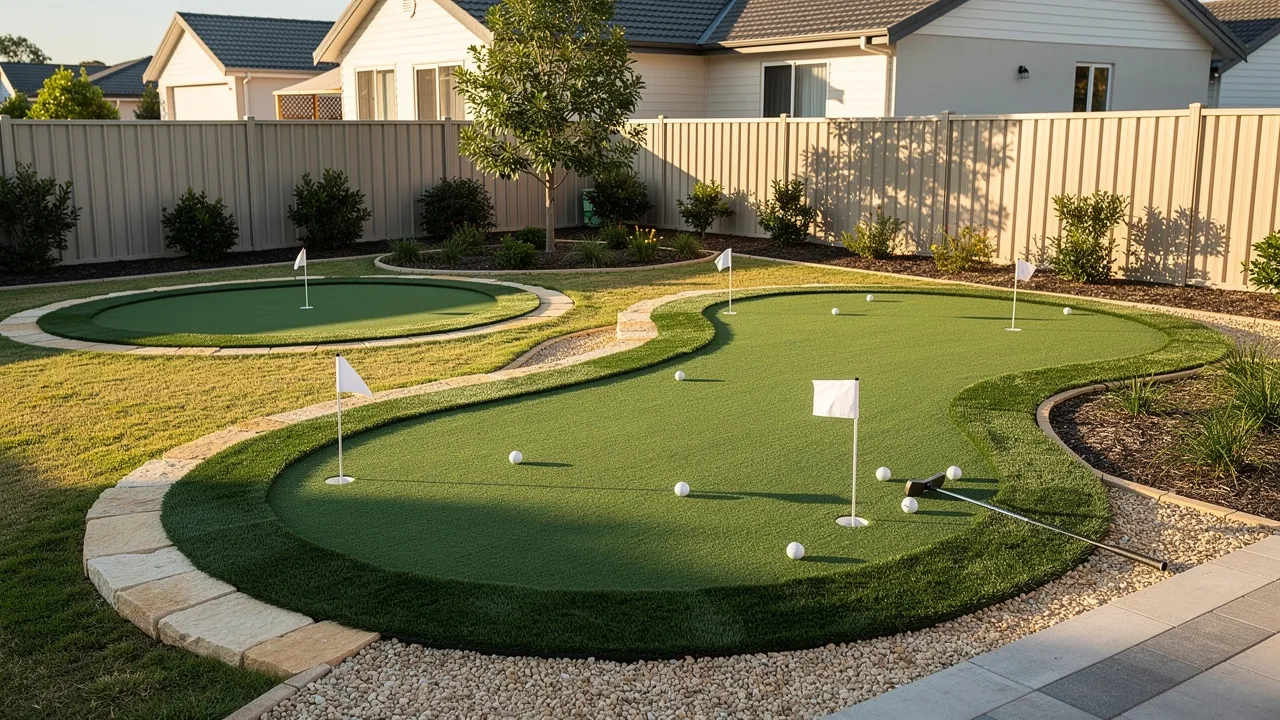
Kidney. A kidney shape can suit a squarish back corner and create two approach angles from one footprint. Its concave edge uses surface area, however, so it requires more total square footage than a rectangle for the same puttable ground. Consider it where the curved indentation adds useful approaches and the site has enough room to absorb the lost area.
-
L-shaped or wraparound. An L-shaped green can fit around a patio, deck, or house corner. The inside corner is difficult to grade cleanly and compact to the edge, so keep that construction boundary in your shortlist notes. Use this form when wrapping around an existing corner solves a real space problem, not merely as decoration.
-
Freeform ribbon. A freeform ribbon can suit a long, narrow side yard and use its length for distance-control and lag putting. It offers almost no break variety across its width, so the contour carries much of the challenge. Shortlist it when length is available and distance practice matters more than varied lateral approaches.
-
Peanut or hourglass. A peanut or hourglass shape can suit a footprint with an immovable object in the middle. The two lobes create the usable areas, but cups are confined to those lobes and the narrow pinch point is difficult to compact well. Use this option only when the central obstacle is fixed and the narrow connection can be built properly.
-
Irregular outline. An irregular outline can absorb leftover space around fence curves, tree wells, and patio corners that a rectangle would leave unused. It can make an awkward boundary part of the plan instead of leaving a strip of lawn outside the green. Select it when the property’s existing lines provide a clear reason for the irregular edge.
The outline is only half of the design. Design guidance describes a 1 to 3 percent grade, calm ground around each cup, and one diagonal ridge as features that can produce six meaningfully different putts from three cups.

Judge each shape by playability and circulation
A shape earns its place on your shortlist when it leaves enough usable surface for varied practice and comfortable movement. Hole placement determines practice variety; a thoughtful layout provides different distances and angles rather than putting every cup in a straight line.
Use these checks while sketching each candidate:
- Reserve short-putt areas for accuracy practice.
- Use medium-length attempts for speed control.
- Add longer putts only where the available space permits them.
- Keep cups away from crowded edges and narrow areas.
- Account for slopes, because severe breaks can make some holes frustrating or difficult to use consistently.
- Leave a practical route for standing, addressing the ball, retrieving it, and moving to another target.
A narrow ribbon may support distance control but limit lateral variety. An L-shape may solve a corner problem while making the inside edge harder to construct. Compare those consequences directly.
Surface selection also affects the scope you compare. Professional backyard putting green installation generally falls between $15 and $40 per square foot in the United States in 2026, That broad range is not a like-for-like comparison unless the proposals cover the same base, drainage, contours, fringe, and labor.
Match the shape to residential or commercial use
Your intended users should determine which trade-offs matter most. A personal practice area can give priority to a compact footprint and the distances you use most. A family-oriented residential feature may need clearer circulation around the green, a visible relationship to patios or seating, and enough separation between putting areas and other outdoor activities. A commercial installation may need a more deliberate route for multiple users, clearer boundaries, and a shape that works with the property’s landscape and access points.
For a small backyard, a green can incorporate one or two cups, subtle contours, and compact fringe areas. A professional designer can help maximize usable putting space without overwhelming the yard. You can also integrate a putting green into existing landscaping so it complements the surrounding outdoor space.
Use the footprint to support the way you expect the area to function:
- Choose a compact rounded shape when the available area is limited and basic practice is the priority.
- Consider a kidney or irregular outline when the site has usable width and you want more approach options.
- Consider a wraparound when a patio, deck, or house corner controls the boundary.
- Consider a ribbon when the property offers length but little width.
For a business or shared property, mark where people will stand, wait, walk, and gather before you treat a shape as workable. The most attractive outline still needs usable circulation.
Check site conditions before committing to the concept
A shape that looks good on a sketch can change when you account for the ground beneath it. Slopes can complicate design and construction, while grading the yard, adding retaining walls, and providing maintenance space can significantly increase the price. Construction access matters too because equipment, soil or base material, and other supplies must reach the installation area.
Before committing to a concept, record:
- Where the ground slopes and where water collects
- Whether grading would affect a patio, retaining wall, fence, or foundation
- How equipment and base material would reach the work area
- Whether the proposed edge leaves enough room for maintenance
- Which drainage path can carry water away from the green
Proper base preparation, grading, and drainage are essential parts of putting green installation. A complex shape may use more of the available lawn while also adding more difficult edges, corners, or grading work.
If you are discussing a USGA putting green, the subgrade should match the general slope of the finished grade and be smooth and firm without water-holding depressions. In that construction system, the gravel layer moves excess water into drainage pipes and must be installed to a minimum depth of 4 inches; its depth can vary above that to create desired contours.
Those construction details do not automatically apply to every synthetic putting green system, so identify the system being discussed before comparing requirements. Site preparation and contour work can also move a 500-square-foot project into the $7,500 to $20,000 range in a published U.S. estimate. Treat the range as a planning reference, not a property-specific price.
Understand the cost differences between shape options
Published estimates use different scopes, so do not merge them into one universal rate. Professionally installed backyard putting greens in the United States typically cost $15 to $40 per square foot in 2026. A separate estimate for installed synthetic putting greens places the cost at $10 to $25 per square foot depending on turf quality and infill materials. The broader professional-installation range may include more site preparation and design work, while the synthetic estimate is tied to a narrower set of materials and conditions.
The estimate for a 300-square-foot green is about $4,500 to $12,000. A 500-square-foot project can cost $7,500 to $20,000 when site preparation and contour work are included. These figures describe project examples, not a quote for your property.
The cited pricing guides describe these approximate U.S. price bands by project size:
- Under 400 square feet: about $30 to $35 per square foot
- From 400 to 2,000 square feet: about $25 to $30 per square foot
- At 2,000 square feet or more: about $20 to $25 per square foot
Smaller greens can carry a higher price per square foot because excavation, delivery, grading, and crew setup can cost nearly the same as they do for larger greens. A smaller total project can therefore have a higher unit price even when its overall price is lower.
Shape affects price through the work required to build and finish it. A simple, flat layout costs less than a green with multiple holes, contours, fringe cuts, or integrated chipping areas. An L-shaped inside corner, a narrow peanut pinch point, a steep slope, or difficult access can also change the preparation scope.
When you compare concepts, ask what each price includes:
- Excavation, grading, and the compacted base
- Drainage work and the route for discharged water
- Putting turf, infill, cups, flags, and fringe
- The number and placement of holes
- Contours, chipping areas, retaining work, and access needs
This checklist lets you compare the shape itself separately from features that may be added to any shape.
Build a focused shortlist for design discussion
Turn your preferred concepts into a short site brief before discussing design or installation. Record the information that explains why each shape might work:
- Usable dimensions: Measure the length and width of the area, then mark the portions that are actually available for the green.
- Fixed obstacles: Note trees, fence curves, patios, decks, utility features, garden beds, and house corners that influence the boundary.
- Access and circulation: Mark equipment access, walking routes, seating, doors, and areas where people will stand or gather.
- Practice goals: Write down whether you want basic putting, accuracy work, speed control, lag putting, multiple targets, or a shared recreational feature.
- Surface conditions: Record visible slopes, low spots, water-holding areas, drainage paths, and any retaining or grading concerns.
- Maintenance expectations: Describe how much surrounding space and upkeep you are prepared to manage.
- Feature scope: List your preferred number of cups, fringe, contours, or other features separately from the footprint.
Then choose two or three candidate shapes. For each one, write one reason it fits and one boundary that needs to be resolved. For example, a ribbon may use a narrow side yard efficiently but offer little break variety across its width; a kidney may create two approach angles but use more total area than a rectangle. A shortlist with explicit trade-offs is more useful than a single attractive sketch.
Seek professional evaluation when site conditions are complex
Move from a general shortlist to professional evaluation when the property has meaningful slopes, uncertain drainage, water-holding areas, difficult subgrade conditions, retaining-wall or grading implications, or restricted access for equipment and base materials. Those conditions can change both the workable shape and the installation scope.
Bring your measurements, obstacle map, access notes, practice goals, and candidate shapes to the discussion. Ask the design conversation to address the ground beneath the turf as well as the visible outline. Published material estimates say that crushed stone, drainage layers, cups, flags, and fringe turf can add roughly $500 to $1,500 in total, although the amount depends on the scope being priced. Use that figure to remember these components when you compare proposals, not as a stand-alone allowance for your site.
Take your shortlist to a site-specific planning discussion
Your shortlist is ready when it connects the shape to usable space, fixed obstacles, circulation, practice goals, site conditions, and the scope behind the price. Bring those notes when you discuss a putting green for a home or business in Kearney or the Kansas City area. At Hall Turf, we offer backyard putting green installation for golf lovers, and we recommend a consultation on the options for installing a putting green. A qualified professional should decide whether a specific layout suits your property after the site conditions are assessed.
What should you prepare before discussing putting green shapes?
What should a putting green cost estimate include?
Ask whether the estimate covers excavation, grading, the compacted base, drainage, turf, infill, cups, flags, fringe, contours, chipping areas, labor, and construction access. In 2026, published U.S. estimates range from $15 to $40 per square foot for professional backyard installations and from $10 to $25 per square foot for some installed synthetic systems, so the scope must be clear before you compare prices.
What information should I provide for a putting green design discussion?
Provide measurements of the usable area, a sketch of trees and other fixed obstacles, access and walking routes, visible slopes or low spots, drainage concerns, maintenance expectations, and your intended practice goals. Also identify the preferred number of cups, fringe, contours, or other features so the proposed footprint and construction scope can be evaluated together.