
Choose turf by the performance job it must do
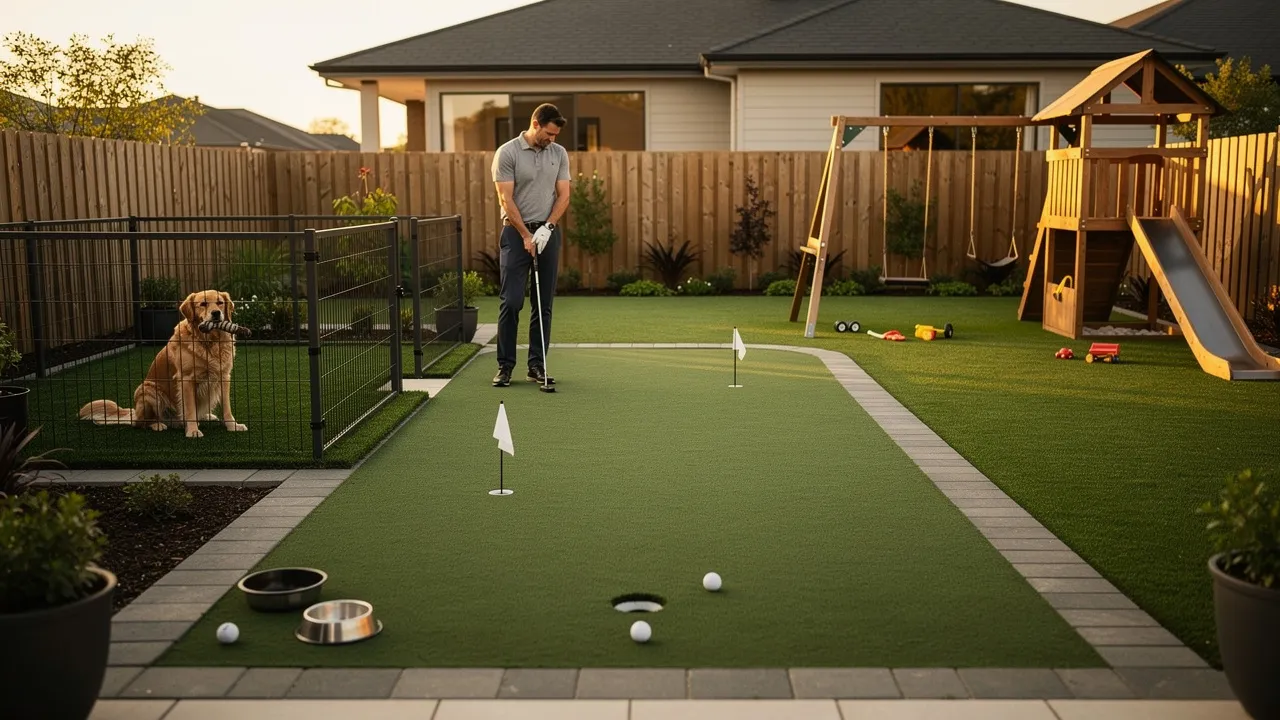
Pet turf, putting-green turf, and playground turf solve different performance jobs, so the intended use should lead your decision in Kearney, Kansas City, and the surrounding Kansas and Missouri area. Pet turf is designed for pet-waste handling, drainage, and odor control. Putting-green turf is engineered for golf-ball roll, ball speed, and short-game practice. Playground turf is designed for fall-height cushioning and impact attenuation beneath play equipment. A product that suits a dog run may be a poor fit for a putting surface, and installing the wrong turf in a high-traffic dog area or backyard golf setup can cause poor performance, drainage issues, and premature wear.
Use this first screen:
- Choose pet turf when liquid-waste drainage, odor control, active paws, and a repeatable cleaning routine are the main concerns.
- Choose putting-green turf when ball roll, speed control, practice features, and the shape of the green matter most.
- Choose playground turf when the project involves play equipment and requires a complete impact-protection system rather than soft-looking grass alone.
The property still has the final say. Layout, existing surface, slope, drainage, access, traffic, and maintenance expectations can change the appropriate system and the work required.
Project cost is a separate planning question, not a reason to choose a turf type without considering its job. Another cost guide says projects under 400 square feet may cost $17 - $25 per square foot, while larger installations may cost around $9 per square foot because labor is spread across more area. That same guide lists nylon at $5.05 - $5.83 per square yard and polyethylene at $2 - $4 per square yard.
A separate 2026 estimate places a typical 500-square-foot landscape-turf installation around $4,000 - $7,000. These figures describe different products, scopes, and pricing methods, so use them as planning points rather than a quote for your property. Measure the area and ask for an itemized scope before comparing totals.
Choose pet turf for drainage and odor control
Pet turf is designed for drainage and odor control, with backing that lets liquid pass through instead of pooling. The visible grass is only one part of the system; the backing, infill, base, slope, and drainage path all affect how urine moves away from the surface. Poor drainage can trap urine in the turf and base, while odor and bacteria problems may also result from inadequate system design or maintenance.
High-use pet-turf installations without proper drainage or infill often develop odor issues within months. Permeable bases, correct slope, and zeolite infill are described as supporting odor control and longer lifespan. Those features should be discussed as part of the system design rather than treated as optional add-ons after installation.
Active dogs can change the material and maintenance questions. We can recommend more resilient grass for active dogs that need to withstand vigorous activity without showing signs of wear. A small pet area used by one calm dog presents a different traffic pattern from a busy dog run used by several active dogs, so record the number of dogs, their activity level, the area they will use, and whether the surface will sit near a door, patio, or drainage-sensitive part of the yard.
Ask how the proposed system handles these conditions:
- Where urine will move after it passes through the turf.
- Whether the base needs added drainage measures or a defined outlet.
- Which infill is intended for the expected use and cleaning routine.
- How seams, edges, and transitions will be handled around patios, fences, planting beds, or concrete.
If water already pools in the planned pet area, resolve that condition before selecting a visible turf product.
Pet-turf maintenance includes rinsing urine spots, removing solid waste and debris, grooming the fibers, and occasionally using turf-safe enzyme cleaners. Remove solid pet waste promptly and rinse urine spots regularly; unaddressed waste can contribute to unpleasant odors and bacteria build-up. Regular debris removal and rinsing are also part of general artificial-grass care.
Artificial grass requires regular maintenance, and its longevity may range from 15 to 25 years. Treat that range as a maintenance-dependent planning statement, not an assurance for every installation. Before you request a quote, decide who will remove waste, rinse the area, groom the fibers, and handle occasional cleaning.
Choose putting-green turf for predictable ball roll
Putting-green turf is engineered for golf-ball roll, ball speed, and short-game practice; landscape turf should not be used for putting surfaces. Putting-green turf typically uses short, tightly packed fibers standing less than an inch high, with specialized silica-sand infill that helps stabilize the green and adjust firmness and stimp speed.
Pile height varies by product and fiber. One description places the fibers under one inch, while material-specific figures list approximately 1.125 inches for polypropylene and 0.5625 inches for nylon. Ask for the selected product’s specifications instead of treating a general pile-height description as a design requirement.
Putting-green drainage must address both the surface pitch and the sub-base. A putting green that holds water can grow moss, soften underfoot, and eventually heave. Ask whether the playing surface is designed with the recommended minimum 1-2% slope for drainage and how water will exit the base.
Clay-heavy soil can require additional planning. Ask whether a perforated drain pipe or dry well is needed, along with permeable backing and a drainage path around the perimeter. The correct answer depends on the soil and site conditions, so do not choose a drainage detail from a product sample alone.
Putting-green layout affects both play and construction. Slopes can complicate design and construction, while grading, retaining walls, and maintenance space can significantly increase the price. Construction access also matters because equipment, base material, and other supplies must reach the site; some backyard projects may require a crane.
Clarify these design choices before you compare proposals:
- The total area and the shape of the green.
- The number and placement of holes.
- Contours, fringe cuts, or an integrated chipping area.
- The intended ball speed and practice use.
- The route for bringing materials into the backyard.
- Space needed to maintain the green and reach its edges.
A simple, flat putting-green layout costs less than one with multiple holes, contours, fringe cuts, or integrated chipping areas. Silica sand and rubber granule infill can add $1 - $3 and help provide stability, prevent wear, and keep turf blades upright. A synthetic putting green’s long-term performance is directly related to build quality, so construction materials and methods belong in the comparison.

Choose playground turf as a complete impact-protection system
Playground turf is designed for fall-height cushioning and impact attenuation beneath play equipment, but turf alone does not establish playground safety. The full system, including the base and any required shock pad or infill, must be designed and assessed together. A soft-looking surface is not a substitute for documentation about the system used below swings, slides, climbing structures, or other equipment.
Ask which applicable impact-attenuation standard, such as ASTM F1292 or EN1177, applies to the playground system and request product-specific documentation. A playground shock pad typically provides impact attenuation and may be 25-50 mm thick; the turf, infill, pad, and base work together as a system.
Playground site preparation should address excavation, slope grading, a compacted crushed-stone base, and drainage testing before the turf is installed. A well-prepared playground subgrade helps reduce long-term settling that can affect surface evenness, drainage, and safety performance.
A base layer of concrete, asphalt, or properly compacted aggregate provides the structural stability of the system. Turf and infill work with the shock pad to maintain performance. The installation plan should identify how each layer will be prepared, tested, and documented before the visible turf covers it.
Playground pricing should be tied to the complete system and site work rather than a turf-only figure. A crushed-rock sub-base adds $2 - $5 per square foot, while stripping and hauling away an existing lawn adds $1 - $3. Ask for the base, shock pad, infill, drainage work, removal, labor, edging, and documentation as separate scope items so the total reflects the actual installation.
Screen the property before comparing turf systems
Your property screen should connect the planned use to the conditions below the turf. Before installation, measure the area, plan turf direction, review drainage and grading, and locate underground utilities. Record the existing surface, slopes, narrow access points, gates, steps, walls, trees, planting beds, fences, and structures that could affect excavation or material delivery.
Use a short site record:
- Measure length and width, then calculate the planned square footage.
- Mark curves, obstacles, borders, and areas that may need separate edging.
- Identify whether the existing surface is soil, lawn, concrete, gravel, or older turf.
- Note heavy traffic, pet routes, play equipment, golf features, and maintenance access.
- Photograph low spots, visible runoff paths, retaining walls, and difficult entrances.
- Check for utilities before digging.
This record gives an installer something more useful than a general request for turf. It also helps you distinguish a product question from a site-preparation question.
Site drainage should be evaluated before the base is installed. If water pools or drains slowly, ask for drainage measures before the base is installed and for grading that directs water toward a suitable drainage point. Evaluate slope and runoff early because water management is critical for long-term performance.
A well-designed artificial-turf system can achieve drainage rates of 500-1,000 mm per hour, preventing water accumulation and reducing slip risks. That figure describes a system capability, not a guarantee for every property. Ask how the proposed base, backing, slope, and outlet work together on your site.
A turf installation checklist should cover the ground beneath the finished surface. Excavate the area and remove organic material. Install base material in thin, even layers and compact each layer to a uniform density. Verify grade as each lift is completed, then test stability before continuing site preparation.
Edging can add $1 - $5 per linear foot, depending on the materials selected, and can improve appearance and prevent natural grass from encroaching. Include curves, transitions, and borders in your measured plan because a narrow or irregular site may require more cutting and edging than a simple rectangle.

Compare cost by turf use and site complexity
Artificial-turf pricing depends on the material, installation complexity, area size, existing surface, grading and drainage, turf purpose, edging, and local labor rates. In 2026, one cost guide places installed artificial turf at $8 - $18 per square foot overall: standard landscape grass at $8 - $14, pet-friendly turf at $10 - $18, sport and multi-use turf at $9 - $16, putting greens at $15 - $25, and budget or economy grass at $6 - $10.
The ranges describe different turf categories and scopes. A crushed-rock sub-base adds $2 - $5 per square foot, removing and hauling away an old lawn adds $1 - $3, and large open yards may price 10-20% lower per square foot at scale. Use the figures to identify questions, not to replace a property-specific scope.
The three turf paths differ in both performance job and cost drivers:
| Turf use | Primary job | Cost factors to clarify | Practical planning question |
|---|---|---|---|
| Pet turf | Move liquid waste through the system and address odor control | Pet-turf material, permeable backing, infill, drainage, traffic, and cleaning needs | How many dogs will use the area, and where will rinse water go? |
| Putting green | Support golf-ball roll, speed control, and short-game practice | Size, contours, holes, fringe, surface material, infill, grading, drainage, and access | What type of practice surface do you want, and can materials reach the site? |
| Playground turf | Provide fall-height cushioning and impact attenuation as part of a complete system | Base, shock pad, infill, equipment heights, drainage, testing, and documentation | Which applicable impact-attenuation requirements apply to the whole system? |
Pet-friendly artificial turf costs $10 - $18 per square foot installed and typically costs $2 - $4 more per foot than standard landscape turf because it uses heavier-duty fibers, a free-draining backing, and antimicrobial infill. For a 500-square-foot yard, pet-friendly turf costs about $5,000 - $9,000; standard landscape turf costs $8 - $14 per square foot and may still drain and wear well for lighter pet use.
Putting-green cost varies widely with scope and quality, and larger greens require more materials, labor, and preparation. A simple, flat layout costs less than one with multiple holes, contours, fringe cuts, or integrated chipping areas. Premium synthetic turf designed to replicate real golf greens tends to cost more but delivers better ball roll, durability, and realism; cheaper options may reduce upfront cost but often sacrifice performance and longevity.
Slopes, retaining walls, unusual shapes, drainage work, and restricted construction access can add work beyond the visible turf area. Ask each installer to separate those items from the turf and labor lines so you can see what is driving the total.
Prepare a quote brief for a Kansas City-area consultation
A Kansas City-area quote brief should give an installer enough information to assess the use and the property before discussing materials. Include the location, measured square footage, intended turf use, existing surface, access conditions, slope, visible drainage problems, expected traffic, maintenance expectations, and any features such as holes, play equipment, pet gates, edging, or drainage outlets.
Measure the planned area’s length and width, then multiply those measurements to calculate total square footage before budgeting. Professional installation can range from $8 to $20 per square meter in Kansas City, depending on project complexity and turf type. Installation costs can also vary from $3 to $9 per square foot depending on site complexity, while slopes, unusual shapes, leveling, or unique designs may increase costs. These figures use different units and scopes, so ask which measurement and work categories apply to your project.
A quote request should ask for clear answers rather than a single total. Request a quote that separately itemizes:
- Turf and the intended product type.
- Base materials and the planned base depth.
- Infill and its purpose in the system.
- Removal of the existing surface and haul-away work.
- Labor, edging, seams, and transitions.
- Drainage work, outlets, grading, or other site corrections.
- Warranty details, with materials and workmanship identified separately.
Effective drainage systems can raise costs by $2 - $8 per square unit when they are needed. Include drainage, infill, and edging in the budget rather than treating them as unexpected extras.
A written scope should state the base depth, drainage method, and seam placement, and it should explain how the installation is intended to prevent standing water or odor after rain. Compare each installer’s written warranty terms, including the separate coverage offered for materials and workmanship.
Putting-green projects should also identify the surface design, infill, slope, access plan, and practice features. Pet projects should identify the drainage path, infill, cleaning expectations, and traffic pattern. Playground projects should identify the base, shock pad, infill, applicable impact-attenuation requirements, and supporting documentation. A useful scope connects each component to the use it must support.
Pause when playground or site risks remain unresolved
Playground safety requires a complete system assessment, not a visual judgment about whether turf feels soft. If fall protection, the base, shock pad, infill, drainage, grading, subgrade stability, or applicable documentation remains uncertain, pause the project and seek qualified assessment and responsible-authority guidance before installation or use. Ask which applicable standard, such as ASTM F1292 or EN1177, applies to the complete system.
A playground-turf site typically needs excavation 80-100 mm, or about 4 inches, deep to provide room for drainage layers and padding. That typical depth does not determine the correct depth for every property or equipment layout. The installer and responsible authority need to address the actual site, equipment, and system requirements.
Unresolved utilities, drainage, grading, or unstable ground are reasons to stop and resolve the site condition before covering it. Always check for utilities before digging. Evaluate slope and runoff early, and do not continue excavation when the drainage path or subgrade condition is not understood.
A qualified site assessment should establish what preparation, testing, and documentation are needed. Do not treat a general turf description, a sample, or a quoted surface product as a property-specific safety determination.
Bring the project brief to the next local planning step
A completed project brief should name the turf use, describe the property, record drainage and access conditions, set out the maintenance routine, and list the scope questions that need written answers. Pet areas need a waste-handling and drainage plan. Putting greens need a ball-roll design, drainage plan, and access review. Playgrounds need complete-system impact protection, site preparation, and applicable documentation.
For a Kearney or Kansas City-area project, bring the measured area, photographs, existing-surface details, intended use, traffic expectations, drainage concerns, and requested features into the planning conversation. A qualified professional should decide individual suitability when site, drainage, fall-protection, or subgrade conditions are uncertain.
We deliver solutions tailored to the requirements of putting greens, playgrounds, and pet areas. We provide artificial grass lawns and landscaping, pet turf, playground turf, putting greens, and commercial projects. Share the use, site conditions, and scope questions so the next discussion can address the system rather than only the visible turf.
Questions to resolve before requesting a turf quote
What does pet turf, putting green, or playground turf near me typically cost?
In 2026, supplied estimates place installed pet turf around $10 - $18 per square foot and putting greens around $15 - $25 per square foot. For playground turf, request a local quote that accounts for the site, equipment, and complete impact-protection system. The final quote can change with area size, existing-surface removal, base preparation, grading, drainage, infill, edging, access, layout, and labor. Treat these figures as planning ranges rather than a property-specific price.
What should a playground turf quote document before installation?
It should identify the complete system: base, turf, infill, shock pad, drainage, grading, equipment-related fall-height requirements, testing, and applicable documentation. Ask which standard, such as ASTM F1292 or EN1177, applies. Turf that merely feels soft is not enough to establish safety, and uncertain fall protection or subgrade conditions require qualified assessment and responsible-authority guidance before installation or use.
How can I compare artificial-turf quotes fairly?
Request separate line items for turf, base materials and depth, infill, surface removal, labor, edging, seams, drainage work, grading, and warranty terms. Also ask for the drainage method and seam placement in writing. Comparing the scope - not just the total - helps show whether differences come from the turf type, site preparation, design features, or omitted system components.