
Start with the dog run’s actual demands
A dog run concentrates urine and repeated traffic in a smaller area than an ordinary lawn. That concentration changes the design problem: the base, drainage path, backing, infill, edging, and cleaning routine need to work together from the beginning rather than being added after odor or uneven areas appear. Proper drainage and a permeable base are especially important for reducing odor and turf-failure risk in larger or heavily used runs.
For a property in Kearney or the Kansas City area, start with the conditions your dogs will create every day. A single dog using a shaded potty zone has different demands from several dogs running through the same entry point, resting in full sun, and returning to one high-use spot. Treat the run as a complete surface system, not as a grass-colored covering.
Your first decision is whether the property can provide a dependable path for water and waste to move away from the surface. A turf product may have a published drainage rate, but that rating cannot compensate for an unsuitable or poorly prepared base. The practical question is not simply whether artificial turf looks cleaner than natural grass; it is whether the proposed site, materials, access, and maintenance habits fit your dogs’ use.
Use the rest of this guide to make that decision in order: map the site, compare the trade-offs, account for heat, specify each layer, test drainage, establish cleaning, and then choose between DIY and professional installation.
Map the run before selecting materials
The proposed run needs a site record before you choose turf. Measure the full length and width, note how sunlight moves across the area, identify the existing slope direction, and mark buried utilities or irrigation lines. Record where water currently collects after rain and where a dog is most likely to urinate, enter, turn, or rest.
Use this short checklist:
- Measure the complete run, including gates, corners, and narrow access points.
- Note morning, midday, and afternoon sun exposure rather than judging the site from one visit.
- Mark visible low spots, compacted areas, and the direction water already travels.
- Locate irrigation lines and other buried utilities before any excavation.
- Identify the hose bib and measure the distance to the area that will need rinsing.
The intended use determines where wear and waste will concentrate. Decide whether the space is for potty relief, active play, agility training, or a mixture of those activities, then sketch rough zones for each purpose. A designated potty area may need especially direct wash access, while an active entry zone may need stronger edge restraint and a surface transition that tolerates repeated foot and paw traffic.
Containment is part of the site plan. Plan a double-gate entry to reduce escape opportunities, select a suitable curb height and material, and use gate hardware rated for repeated daily use. High-wear entry points can also use gravel or paver thresholds, provided the transition does not create a place for water to pool.
Local requirements can affect the preparation plan in Kearney, Kansas City, and other Kansas and Missouri communities. Some municipalities require permits for grading or drainage work, and utility lines should be located before digging. Check the responsible local authority before excavation when the project changes grade, redirects water, or affects a drainage feature.
Water access deserves the same attention as the turf sample. Decide whether an existing hose bib reaches the run or whether a dedicated wash point is needed. If the site has no clear discharge route, unresolved low spots, or buried lines in the excavation area, pause the material selection and resolve that condition first.
The dog-run operating record should capture how the space will be used, not only its measurements. Write down the expected number of dogs, the locations where traffic will repeat, the areas that will receive concentrated waste, and whether the run will be used for short potty breaks, active play, or both. Note which parts receive direct sunlight and which parts can provide shade.
Use that record when you compare materials and installation routes. Concentrated urine and repeated traffic make the base, drainage, and infill design more consequential than they are on a lightly used lawn area. A clear hose route, secure entry, and accessible discharge point should appear on the sketch before you choose a turf sample.
Compare artificial turf with natural grass on the trade-offs
Artificial turf and natural grass solve different parts of the dog-run problem. The comparison below keeps the main trade-offs visible instead of treating either surface as maintenance-free.
| Criterion | Artificial turf | Natural grass |
|---|---|---|
| Urine and mud | One comparison says artificial grass avoids urine damage and mud. | The same comparison says real grass can be damaged by urine and can develop significant mud in wet weather. |
| Ongoing care | Artificial grass requires frequent rinsing and deep cleaning; drainage depends substantially on the base beneath it. | Urine damage and wet-weather mud remain concerns identified in the comparison. |
| Surface temperature | Artificial grass gets hot and needs management, particularly in direct sun. | The comparison describes natural grass as having a cooler surface. |
| Visual durability | A cited study found artificial turf remained visually more durable over time. | Natural surfaces were more favorable from a thermal and surface-hardness perspective in that study. |
| Installed cost reference | One broad comparison lists $5 - $20 per square foot installed for artificial grass. | The same comparison lists $1 - $5 per square foot installed for real grass. |
The installed-cost figures are reference ranges, not a price for your Kearney or Kansas City property. The $5 - $20 per square foot figure measures artificial grass installed, while the $1 - $5 per square foot figure measures real grass installed in the same broad comparison. Site preparation, access, drainage work, material selection, area size, and local labor can change the total, so keep the figures separate from a site-specific budget.
The lower initial cost of natural grass does not remove the need to manage muddy periods, worn areas, and urine-related damage. Artificial turf can reduce those particular lawn problems, but it replaces them with a need for deliberate drainage, rinsing, waste removal, heat management, and periodic inspection.
Your choice should follow the conditions you are willing to manage. Artificial turf may fit a property where a consistent surface and reduced mud matter more than the higher installation range and scheduled cleaning. Natural grass may fit a site where cooler surface conditions and living ground cover matter more than avoiding urine damage and wet-weather mud.
Neither option removes every maintenance task. If direct summer sun is unavoidable, include the heat check in the decision before committing to artificial turf rather than treating temperature as a minor finishing detail.

Treat summer heat as a design input
Artificial turf tends to reach higher temperatures than natural turfgrass, particularly in hot environments. In a study that tested one type of artificial turf, the artificial surface exceeded 60 °C during sessions with environmental temperatures of 25-28 °C, while the natural turfgrass treatments remained below 40 °C. The study also found that artificial turf could reach a surface temperature up to 30 °C higher than natural turfgrass.
Those measurements describe the tested conditions and one turf type, not every product or every Kansas City yard. The same study found artificial turf harder and less favorable from a thermal and surface-hardness perspective, even though it remained visually more durable over time.
Your summer-use plan should include a surface-temperature check before your dog uses the run, particularly when ambient air temperatures exceed 25 °C.
Build those features into the layout rather than relying on a later workaround. A shaded rest zone, reachable water source, and a way to cool the surface can change how the run functions during hot weather. The study tested only one artificial turf type, so use the result as a reason to check the installed surface rather than as a universal temperature prediction.

Specify the pet-turf system as connected parts
Pet-oriented turf should prioritize rapid drainage, odor control, and easy cleaning. Shorter pile and open tufting are listed pet-oriented features, while pet-specific products may use shorter fibers, flow-through backing, and antimicrobial treatments intended to handle waste and reduce odors.
Treat antimicrobial features as one part of the system. Antimicrobial features may help with odor, but they cannot replace waste removal, rinsing, and enzyme cleaning. Choose the turf around your dogs’ traffic, the site’s water path, and the cleaning routine you will actually follow.
The backing and infill determine how liquid moves after it passes through the blades. Fully permeable backing allows liquid to pass across the entire backing surface, while perforated backing drains through its holes. Permeable backing can provide faster and more uniform drainage for pet areas, but the base beneath it still needs a clear path.
Infill quantities vary by turf design, pile height, material, and the purpose of the system. One guide describes most systems as requiring 1.5-2 inches of infill to support fibers and manage moisture. Another describes most pet turf as requiring 1.5-2.5 pounds per square foot, depending on pile height and infill type. Shallow infill can contribute to matting and poor drainage, while excessive infill can create compaction issues.
Pet-friendly infill options include zeolite, coated antimicrobial sand, and specialty blends designed for pet areas. Verify that the selected infill meets EPA standards for heavy metals and is certified safe for pets before purchase. Use the selected turf and infill specifications together rather than applying one quantity to every installation.
Edges and entry points need their own design decisions. A perimeter made from bender board or treated lumber can provide an anchor point for turf edges. Gravel or paver thresholds can protect high-wear entries, and containment curbs should include drainage gaps to help avoid pooling water.
A pet run also needs an infill plan that accounts for concentrated traffic. Infill supports drainage and durability when it resists compaction and channels moisture through the backing into the subsurface drainage system. Keep the material, backing, base, edge restraint, and wash access in one specification so a strong component does not conceal a weak connection elsewhere.
Build the water path below the turf
Pet-turf drainage depends on a clear path through five layers. If one layer restricts movement, urine and organic material can remain in the system and contribute to persistent odor. Good drainage helps prevent surface pooling that can lead to odors, mildew, and an unhygienic environment in pet areas.
A high published drainage rate cannot compensate for a poorly prepared or unsuitable base. Permeable backing can move water across its full surface, but the liquid still needs to move through the base and away from the run. Inadequate drainage preparation can allow water to collect beneath the surface, while improperly prepared ground may produce uneven areas that require repairs.
One cited dog-run setup recommends excavating typically 3-4 inches below finish grade, removing organic material, creating a 1-2% slope toward a discharge point, installing 3-4 inches of clean open-graded aggregate, and compacting the aggregate in thin lifts. Another installation guide recommends a base slope of at least 1% away from structures because pooled water and urine beneath turf can create persistent odors.
Those dimensions describe cited preparation approaches, not a universal design for every property. High-traffic pet zones may benefit from 3-4 inches of crushed stone for structural integrity and odor prevention, while soil, grade, discharge location, access, and existing drainage can change the required work. Resolve the water path before covering it.
A pet-turf guide recommends at least 30 inches per hour of drainage, with 50 or more inches per hour for multiple dogs, and describes perforated backing as standard. Treat that number as a product specification to compare, not as proof that the complete installation will drain well.
Infill also affects the water path. One odor-control approach recommends roughly 0.5-0.75 pounds per square foot for a 1.0-1.25-inch pile because overfilling can slow drainage and trap urine near the top. That lower quantity differs from other guidance because the pile, product, and goal differ. Ask how the selected turf, backing, base, and infill are intended to work together before choosing the amount.
The drainage plan should answer five practical questions before excavation begins:
- Where will liquid enter the system after it passes through the turf and backing?
- What base material will carry that liquid away from the high-use area?
- Where will the water leave the run, and what prevents the discharge point from sending water toward a structure?
- How will edges, thresholds, and containment curbs avoid blocking movement or creating a low spot?
- How will you flush the finished surface and observe pooling, soft spots, or slow movement?
A product label can answer only part of that worksheet. The finished water path depends on the backing, infill, base, grade, edges, and discharge conditions working together, so resolve each connection before the turf conceals it.
Use a completion test, not a visual finish
An artificial turf dog run requires more than cutting turf to fit the outline. A practical installation sequence includes:
- Remove vegetation, roots, rocks, and debris that could interfere with the system.
- Check for underground irrigation lines, electrical features, and other buried elements before excavation.
- Build and compact a base suited to the site and its drainage requirements.
- Lay out the turf so blade direction is consistent and unnecessary seams are limited.
- Cut and secure the turf, join seams with suitable materials, and anchor the edges.
- Install the specified infill, then brush and inspect the finished surface.
Site conditions differ, so not every project follows exactly the same process. A narrow access route, slope, compacted soil, or existing drainage problem can change the preparation sequence.
The finished surface needs a functional check before you treat the work as complete. Perform a flush test to confirm drainage, paying attention to low spots, edges, seams, and the intended discharge point. Look for standing water or movement in the base rather than judging the result only by how upright the fibers appear.
Account for settling when ordering infill. One guide recommends allowing 10-15% extra infill for settling and compaction during the first few months. Use the selected product’s specification for the actual amount, distribute it as directed, and recheck the surface after the first period of concentrated use.
The pre-use check should cover the parts that a visual inspection can miss. Walk the entire perimeter to find loose edges, inspect seams for visible gaps, confirm that gates and thresholds are positioned as planned, and compare the finished grade with the planned discharge direction. Check the wash point and make sure the hose can reach the areas that will receive the most use.
Make cleaning part of the system specification
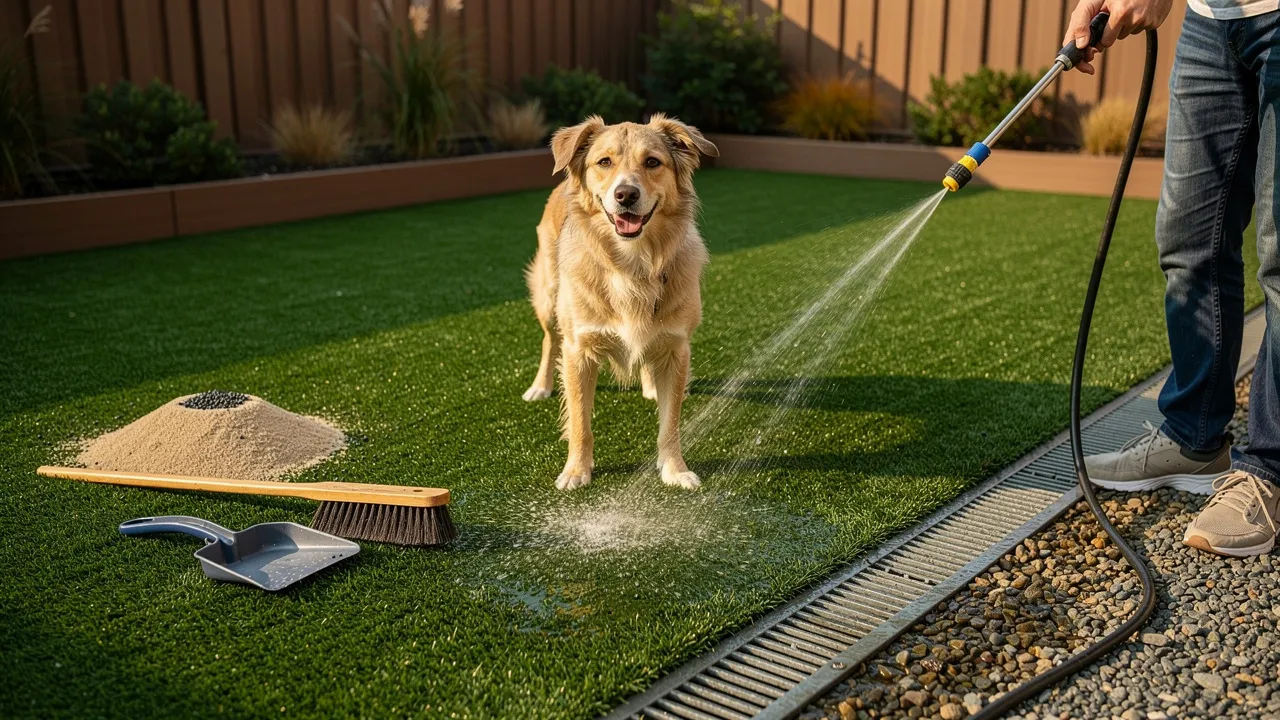
A pet-turf cleaning routine starts with waste removal rather than odor treatment. Remove solid pet waste frequently. If waste is messy, pick up what you can, rinse with a hose, and treat the area with a bacterial enzyme; do not rinse solid waste into the turf.
A practical schedule can look like this:
- Pick up solid waste daily and spray the main potty spot daily.
- Hose-rinse the whole pet area weekly; rinse between cleanings when the area does not receive regular rain.
- About once a month, apply enzyme cleaner to high-use spots, brush against the grain, and check edges and seams.
- Check infill depth and inspect seams, edges, and drains every 3-6 months.
- Walk the run for puddles or soft spots after heavy rain.
The schedule is a starting point, not a promise that one treatment will remove every odor. Several dogs, large dogs, limited rainfall, and concentrated potty zones can require more frequent care.
Loose debris, hair, and organic material can slow drainage and hold waste in the turf system. Remove debris and quickly groom traffic zones 1-2 times per week; the cited maintenance schedule gives a typical time of 5-15 minutes for that task. For installations under 1,500 square feet, one cleaning guide says a household vacuum can be used to remove hair and small debris from a dry surface.
Rinse artificial turf weekly; when the area does not receive regular rain, rinse between cleanings. Monthly, brush against the grain, check edges and seams, and rinse more deeply; the cited schedule gives a typical time of 20-60 minutes. Adjust the routine to the actual amount of use rather than waiting for odor or matting to become obvious.
Cleaning products need a narrow role in the plan. Avoid bleach, ammonia-based cleaners, and harsh degreasers because ammonia can encourage remarking, while strong chemicals can dull fibers and irritate paws. Follow the selected cleaner’s label and keep dogs away from treated areas as directed.
Artificial turf can change as it ages: fibers can flatten, infill can migrate, edges can loosen, seams can separate, and drainage can become less effective in high-use areas. Product quality, installation, traffic, sunlight, and care all affect turf lifespan. If repeated cleaning does not resolve a wet or odorous area, inspect the infill, edges, seams, and drainage path instead of adding more product.
Choose DIY only when the site is controllable
DIY installation may be feasible for a small, flat, accessible yard with a straightforward layout and a clear drainage path. The work still includes excavation, base preparation, compaction, cutting, seaming, edge restraint, infill, and inspection. A small footprint does not remove the need to locate utilities or check local requirements.
Professional installation becomes more appropriate when the site has drainage issues, compacted soil, slopes, difficult access, a complex layout, or a large zone. Professional crews can use equipment such as a plate compactor to compress base material evenly, and professional installation may take less time than working independently. Choose the route based on the site’s difficulty and the preparation you can complete accurately, not only on the visible turf area.
Professional installation costs more upfront, and the scope behind the number matters. One cited guide gives an expected complete-installation cost of $13 - $17 per square foot with high-quality materials; actual pricing may vary by property, materials, access, and work included.
The same guide says labor typically adds $5 - $8 per square foot to material costs, includes site preparation through cleanup, and may take two to four days depending on site conditions. Those figures describe a cited guide’s scope and timing, not a Kansas City-area commitment. Ask any installer to separate excavation, base, drainage, turf, seams, infill, edging, cleanup, and later care from the total.
Use this decision boundary:
- Choose DIY only if you can control the grade, reach the work area with materials and equipment, locate utilities, compact the base correctly, and complete a drainage flush test.
- Choose qualified installation help when unresolved drainage, substantial grading, compacted ground, difficult access, slopes, or a large or complex run make the base and water path uncertain.
A visually neat surface cannot correct a weak foundation. If the preparation work is the part you cannot evaluate or execute, that is the point at which professional expertise has practical value.
The DIY budget should include more than turf and infill. Account for excavation and removal, base material, compaction equipment, seam materials, edge restraint, delivery or access needs, and the time required to repeat physical preparation accurately. A relatively small installation can still involve substantial ground work, and working without the right equipment may extend the project over multiple weekends.
Compare a professional scope against the same line items. A lower visible material price is not directly comparable with a complete installation that includes site preparation, base work, turf placement, infill, and cleanup. Keep the published $13 - $17 per square foot complete-installation range and the $5 - $8 per square foot labor range as separate, scope-labeled references rather than combining them into a new estimate.
Seek qualified evaluation for unresolved site risks
Unresolved site conditions should stop preparation before materials are installed. Pause and seek qualified help when your yard has drainage problems, significant grading needs, compacted soil, a complex layout, or an access condition that prevents proper base preparation. A high drainage specification cannot make a blocked discharge route work.
Do not excavate until underground utilities and irrigation lines have been located. Some municipalities require permits for grading or drainage work, so check the responsible local authority before changing grade or redirecting water. These checks matter in Kearney as well as elsewhere in the Kansas City and Missouri service area because requirements and site conditions can differ by jurisdiction.
Stop the project and obtain qualified evaluation when you find standing water, a soft or shifting base, an unknown utility, a slope that sends water toward a structure, or a proposed discharge point that has not been resolved. Do not cover those conditions with turf or attempt to correct a drainage hazard by adding infill.
Return to the plan only after the water path, excavation limits, utility locations, and local requirements are clear. Then require a flush test before considering the installation complete.
Turn the assessment into a quote-ready next step
Your project brief should bring the site decision into one place. Record the run’s dimensions, intended uses, sun exposure, slope direction, existing drainage behavior, utility locations, gate and edge conditions, hose access, expected dog traffic, preferred cleaning routine, and any unresolved local requirement. Add questions about turf backing, infill quantity, base depth, discharge, heat management, seams, edging, and the drainage flush test.
That information lets you compare a controllable DIY project with a professional scope without treating a broad cost range as a quote. A qualified professional should decide whether the proposed preparation and materials fit your individual site conditions.
Use the completed brief to begin a site-specific discussion for your Kearney or Kansas City-area property. Keep the decision anchored to drainage, heat, daily dog traffic, cleaning, and the work required below the visible surface.
Practical questions before choosing an artificial turf dog run
How much does an artificial turf dog run cost to install?
Published guides give different scope-dependent reference points: one broad comparison lists artificial grass at $5 - $20 per square foot installed, while another lists $13 - $17 per square foot for complete professional installation with high-quality materials. Actual pricing in Kearney or the Kansas City area can vary with excavation, drainage, access, materials, and project size, so compare itemized site-specific quotes rather than relying on one range.
Is artificial turf safe for dogs during hot Kansas City weather?
It can become excessively hot in direct sun. A cited study found artificial turf exceeded 60 °C under environmental temperatures of 25-28 °C, while natural turfgrass remained below 40 °C, although only one artificial turf type was tested. Check the surface before use when ambient temperatures exceed 25 °C, and plan shade, irrigation, or another cooling method for warm conditions.
When should a dog owner avoid DIY installation?
DIY may suit a small, flat, accessible area with a clear discharge path. Seek qualified installation help when the site has unresolved drainage, significant grading, compacted soil, slopes, difficult access, buried utility uncertainty, or a large or complex layout. Do not excavate until utilities and applicable local requirements have been confirmed, and require a drainage flush test before routine use.
What should I do if artificial turf still smells after cleaning?
Persistent odor may indicate more than surface residue. Inspect for pooled urine, compacted or excessive infill, flattened fibers, loose edges, separated seams, blocked drainage, or a base that is holding moisture. Continue frequent waste removal, rinsing, brushing, and appropriate enzyme cleaning, but do not rely on antimicrobial infill alone; correct the underlying drainage or installation problem if odor continues.