
Begin with the residential lawn decision
Artificial grass is a manufactured lawn-replacement surface made from synthetic grass fibers that replicate the look and function of natural grass. Artificial turf, synthetic grass, and fake grass are commonly used names for the same type of product in a residential lawn context. The terminology matters less than the complete system you are considering: the visible fibers, backing, infill, prepared base, edges, and drainage path all contribute to the finished result.
For a front or back yard in Kearney, Kansas City, Overland Park, Olathe, Lee’s Summit, Shawnee, Lenexa, Liberty, Independence, or another nearby Kansas or Missouri community, the decision has two parts. First, determine what the lawn needs to look like and how you expect to use it. Second, determine whether the property can support the preparation and drainage work required beneath the turf. A surface that looks suitable in a sample may not be the right choice if the base, slope, access, or water path does not fit the site.
The soundest way to evaluate an artificial lawn is to separate product selection from installation scope. Product selection covers appearance, pile height, blade design, density, backing, infill, and expected use. Installation scope covers removal, excavation, base construction, compaction, grading, seams, edging, and cleanup. Those questions are related, but they are not interchangeable.
Use this guide to move through the decision in that order. You will first test whether the maintenance trade-off fits your household, then compare turf characteristics, then examine the ground beneath the surface. You will also build a property brief and a list of estimate questions so a quote reflects the actual project rather than only the square footage.
Decide whether the maintenance trade-off fits
Artificial turf changes the kind of lawn work you do; it does not remove every maintenance task. Artificial turf does not require regular watering, although you may still use some water for occasional cleaning. It also removes the recurring work associated with mowing, fertilizing, aeration, and reseeding described for natural grass. The remaining routine usually involves clearing debris, rinsing when needed, brushing areas where traffic has pressed the fibers down, and rinsing pet spots when applicable.
Natural grass and artificial turf therefore present different upkeep profiles:
| Consideration | Artificial turf | Natural grass |
|---|---|---|
| Regular water use | No regular watering is required, although occasional cleaning may use water. | Regular watering is part of natural-grass maintenance. |
| Recurring care | Rinsing, debris removal, and brushing may still be needed. | Mowing, watering, fertilizing, aeration, and reseeding are identified maintenance tasks. |
| Upfront decision | Installation can require a substantial initial investment. | Sod and natural-grass installation follow a different cost and care path. |
| Site conditions | Drainage and base preparation remain central to the installation. | The lawn remains dependent on the conditions required for natural grass. |
The practical question is not whether one surface is universally better. Ask whether you prefer the recurring work and seasonal variation of natural grass or the different preparation, cleaning, and replacement considerations associated with a synthetic surface.
Drainage is one of the boundaries of the low-maintenance promise. Without proper drainage, stagnant water can contribute to mold growth, unpleasant odors, and damage to the artificial grass surface. The turf itself cannot correct a site that sends water toward a structure, traps it in a low area, or lacks a suitable path through the base and surrounding ground.
Cost and replacement also belong in the decision. A general cost guide reports that most homeowners reach break-even in roughly 5-10 years through water and maintenance savings, but this is not a Kansas or Missouri project forecast. Artificial-turf trade-offs include upfront investment, limited lifespan, synthetic-material waste, potential microplastic runoff, and firmer surfaces from compacted infill. Treat those points as questions to investigate, not as reasons to assume that artificial turf will fit every property.
Choose this route when the change in upkeep, appearance, and use matches your priorities and you are prepared to evaluate the full installation system. If drainage, heat exposure, material disposal, or replacement planning is a deciding concern, put that concern into the estimate discussion before selecting a product.
Match the turf to how the yard will be used
Residential lawn turf should be selected around the way you use the yard, not around a blade sample alone. A front yard that is mainly viewed from the street has different priorities from a backyard used for daily walking, gatherings, children’s play, or access to a patio. Start by describing the use pattern, then compare the surface characteristics that support that pattern.
For residential lawns, typical pile height is about 1.25 to 2.0 inches. Multi-tone blades with thatch can support a natural look, while medium to high face weight, a soft feel, and rounded silica sand or coated sand infill are listed as common characteristics for landscape lawns. Taller turf piles can look plush but need more brushing. That creates a straightforward trade-off: a fuller visual profile may require more attention in traffic lanes.
Use this sequence before you compare product names:
- Identify the areas that will receive the most foot traffic.
- Decide whether your priority is a softer feel, a less formal appearance, easier brushing, or a denser visual profile.
- Note whether the lawn connects to a patio, pool area, walkway, gate, or driveway.
- Separate decorative areas from areas where people will regularly cross or gather.
- Ask how the selected pile height, blade profile, density, and infill fit those uses.
This process keeps appearance from becoming the only selection criterion. It also gives an installer a clearer starting point for discussing layout, seams, traffic lanes, and care.
Pet use changes the questions you should ask even when the project remains a residential lawn. Pet-zone turf is described for dog runs, side yards, kennels, and high-traffic pet areas, with a typical pile height of about 1.0 to 1.25 inches. Pet-zone turf options may include high drainage, durable yarns, antimicrobial or odor-adsorbing infill options, and fully permeable backing when fast drainage is a priority.
Those characteristics do not mean that every pet product belongs across an entire yard. Decide whether you need a dedicated pet area, a general landscape surface that will occasionally be used by a pet, or one system for both purposes. Tell the installer where pets relieve themselves, how often the area is used, and whether fast cleanup is a priority. Ask which backing and infill the proposed system uses and what maintenance that combination requires.
For a household without pets, do not pay attention only to pet-oriented labels. Compare the same underlying questions: how the surface will be used, how water will move through it, how much brushing you will accept, and whether the proposed construction matches the site.
Read the specifications as a complete system
Artificial turf specifications make sense only when you read them together. Pile height describes the length of the visible fibers, but it does not tell you how dense the surface feels, how the blades recover from traffic, or how water will move through the installation. Compare pile height with face weight, stitch density, blade shape, yarn, thatch, backing, drainage rate, infill, and UV stabilization.
A practical specification checklist includes:
- Pile height: Compare the visual profile and brushing expectations with the way you will use the yard.
- Face weight and stitch density: Use these as part of the density discussion rather than treating one number as a complete quality judgment.
- Blade shape and yarn: Ask how the profile affects appearance, feel, and recovery in traffic areas.
- Thatch: Consider whether the added layer supports the look you want.
- Backing: Ask how the backing is designed to move water and how it fits the base beneath it.
- Drainage rate: Request a tested value when drainage is a material concern.
- Infill: Ask what the selected system uses and what the infill is intended to do.
- UV stabilization: Ask how exposure and product documentation are addressed.
A specification sheet is most useful when each item is connected to your property and use pattern. A high drainage rate on the turf roll does not resolve an unsuitable grade or a poorly prepared base.
Pile height alone does not determine drainage. Water movement also depends on the turf backing, the base beneath it, site grading, and how the system is installed. For a Kansas City-area yard, ask where rainwater will go after it reaches the surface and whether the proposed base and slope support that path.
Artificial grass does not always require infill. The need depends on the selected turf, intended activity, and installation system, so follow the product and system instructions rather than adding or omitting infill based on a general rule. Infill should be discussed as part of the complete system, alongside blade support, traffic, drainage, cleaning, and future care.
If more than one roll is used, the installation instructions call for aligning pieces edge to edge, placing seaming cloth along the seam, and securing it with landscape anchors or 6-inch galvanized nails. Ask where seams will fall in relation to sightlines, walkways, doors, and high-traffic routes. A product comparison that ignores seams and the base leaves out two factors that affect the finished lawn.
Separate the turf from the ground beneath it
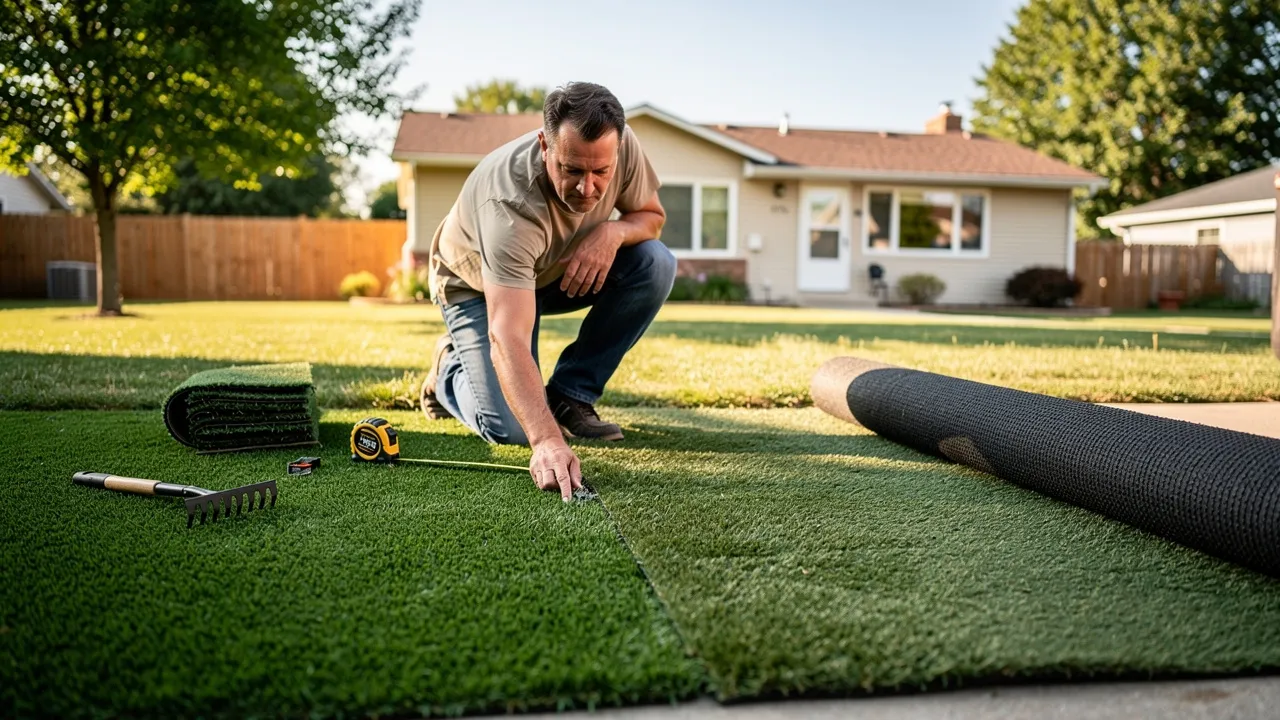
Artificial grass installation is a ground-preparation project before it becomes a surface-installation project. A typical sequence starts with clearing existing grass and debris, leveling the ground, positioning and cutting the rolls, securing the edges, and addressing drainage. Proper installation also requires removing existing vegetation, creating a compacted base layer, using appropriate anchoring, and addressing edge securing and infill application.
The major stages are:
- Clear the area. Remove existing grass, roots, mulch, pine needles, debris, and other material that could interfere with the system.
- Excavate as the selected system requires. One installation guide calls for removing 3-4 inches of soil for base materials and turf height. Another guide describes digging out existing soil up to 2-1/2 inches. Those figures are guide-specific, not a universal depth.
- Build the base. A Kansas City installation guide advises against placing artificial grass directly on existing soil; its approach excavates and compacts a base with crushed stone or decomposed granite.
- Grade and compact. The base needs a stable profile and a water path that does not send pooling toward structures.
- Place and cut the turf. Rolls are positioned, allowed to settle as required by the system, and cut to the planned layout.
- Seam and secure the installation. Edges, seams, and perimeter transitions are fastened using methods suited to the surface and application.
- Finish the system. Apply appropriate infill when specified, groom the fibers, and clean the work area.
The two different excavation examples show why you should not turn a generic measurement into a promise for your yard. The selected base, existing soil, drainage requirements, access, and finished elevations determine the actual preparation scope.
Kansas City installation guidance treats the existing ground as a central project question. A Kansas City installation guide describes excavating and compacting a base with crushed stone or decomposed granite instead of placing artificial grass directly on existing soil. A separate installation system describes a 2 to 4 inch layer of rock aggregate no larger than 3/4 inch and says unstable soil may require more than 4 inches of sub-base.
The same installation guidance recommends compacting the sub-base at 2-inch intervals and correcting hills or depressions over 1/4 inch. It also recommends giving the sub-base a very slight slope away from structures to help rainwater drain without pooling. These are examples from selected systems, not instructions that automatically determine the build for every Kansas or Missouri property.
If the soil does not compact, the cited guidance says washout can leave valleys and ruts under the turf. That is why a surface-level installation can produce a different project result from a prepared base. Ask the installer to explain the proposed excavation depth, aggregate, compaction method, finished grade, drainage path, and transition at buildings or hardscape before you compare the surface material alone.

Use installation quality to judge the project path
The difference between a DIY project and professional installation is concentrated in the preparation and finishing work. Professional installation evaluates site conditions and drainage, uses layout and seaming techniques, selects fastening methods for the surface and application, and manages labor, equipment, and cleanup. DIY installation may be limited by your experience and equipment; drainage may be overlooked or difficult to diagnose, and the final appearance depends on skill, planning, and execution.
| Project factor | DIY path | Professional path |
|---|---|---|
| Ground preparation | You assess the existing surface, remove material, and obtain the required equipment. | Site conditions and installation requirements are evaluated as part of the preparation plan. |
| Drainage | A drainage problem may be difficult to diagnose before the turf is installed. | Drainage is evaluated with the site and base rather than treated as a surface-only question. |
| Cutting and seams | Measuring, cutting, alignment, and seaming depend on your tools and practice. | Layout and seaming techniques are used as part of the installation work. |
| Fastening | You select methods and complete the perimeter and transitions yourself. | Fastening methods are selected for the surface, perimeter, and application. |
| Equipment and cleanup | You manage labor, tools, material handling, and removal. | Labor, equipment, and cleanup are managed within the installation work. |
Choose the DIY path only when you can account for the entire sequence, not merely the visible turf. If the property has uncertain drainage, significant excavation, multiple seams, difficult access, or transitions around structures, treat those conditions as reasons to obtain an installation assessment.
Ground preparation, precise measurements, drainage, seam placement, and finishing techniques all affect how artificial grass looks and performs over time. Expert installation techniques can reduce the risk of uneven surfaces, pooling water, visible seams, and shifting turf. That wording describes risk reduction, not a guarantee of a particular result.
Before choosing an installation path, write down which tasks you can perform accurately and which tasks require specialized equipment or judgment. Include excavation, base compaction, grading, roll handling, seam placement, perimeter fastening, and cleanup. A project that seems manageable when measured as square footage can become more demanding when you account for access, disposal, slopes, existing irrigation, and the finished grade at doors or walkways.
For a residential lawn in the Kansas City metropolitan area, a useful comparison is therefore not simply DIY versus professional. Compare who will evaluate the site, who will define the base, who will address water movement, who will place the seams, and who will be responsible for the final cleanup.
Compare cost signals without treating them as a quote
Artificial turf installation cost varies because lawn size, material quality, site preparation, and installation complexity influence the final number. National cost guides give different ranges: a national cost guide puts installed artificial grass at about $5 to $20 per square foot, while a 2026 cost guide reports installed artificial turf at $8 to $18 per square foot depending on turf type. Neither source establishes Kansas or Missouri pricing.
One 2026 guide also reports around $4,000 to $7,000 for a typical 500-square-foot backyard landscape installation. That figure describes the guide’s example, not your property. The same guide lists crushed-rock sub-base at $2 to $5 per square foot and old-lawn removal at $1 to $3 per square foot. Those components help show why two projects with the same surface area can produce different totals, but they are not a local estimate or a promise of the charges for a specific yard.
Use published ranges only to understand why an estimate may move. Do not multiply a national range by your yard size and treat the result as a project price. A small yard may carry preparation, delivery, access, or removal costs that do not scale neatly with area, while a larger or more complex site may require additional base or drainage work.
Site preparation can be a large share of the bill, and selected cost guidance says two quotes using the same turf can differ widely because of the base underneath. Compare the scope behind each number instead of comparing only the total or the price per square foot.
Ask each installer to separate these items:
- Turf material and selected product profile
- Base material and compaction work
- Removal and disposal of the old lawn or other surface
- Edging, transitions, and perimeter fastening
- Drainage or grading work
- Infill, if the selected system requires it
- Labor, equipment, and cleanup
The selected cost guide also reports artificial turf at $8 to $18 per square foot installed versus a few dollars per square foot for sod and describes turf as having almost no ongoing cost because it requires no mowing, watering, fertilizer, or reseeding. That comparison does not erase the higher initial investment or the continuing need for cleaning and brushing. Put the initial scope and the expected care routine side by side before deciding which lawn replacement fits your priorities.

Build an estimate-ready property brief
A property brief gives an installer the information needed to discuss scope rather than guessing from a single square-footage figure. Prepare the brief before you request an estimate, and include details that can change the product choice or preparation plan.
Record these details:
- Location and access: Note the city or suburb, gate widths, driveway access, stairs, narrow side yards, and the route for removing material and bringing in base aggregate.
- Approximate dimensions: Measure the front yard, back yard, side strips, curves, planting areas, and transitions separately when possible.
- Existing surface: Describe natural grass, bare soil, mulch, concrete, roots, low spots, slopes, edging, and any material that may need removal.
- Intended use: Identify walking routes, gathering areas, children’s play, decorative zones, patio connections, and pet traffic.
- Appearance preferences: Note your preferred color variation, blade profile, pile height, softness, density, and tolerance for brushing.
- Water concerns: Mark places where water currently collects, flows toward a structure, crosses a walkway, or leaves the yard slowly after rain.
- Irrigation: Identify sprinkler heads, valves, and irrigation lines that run through the proposed turf area.
- Complexity: List trees, roots, retaining walls, steps, fences, drain inlets, utility covers, and other obstacles.
The brief does not replace a site evaluation. It makes the first discussion more specific and gives you a record for comparing the scope of different estimates.
Existing irrigation deserves its own question because a converted lawn should not be treated as though the old watering layout disappears automatically. One Kansas City installation source says existing irrigation lines in the turf area are capped so water does not continue running to a lawn that no longer needs it.
Mark known irrigation lines on your property brief and ask what will happen to heads, valves, and lines inside the new turf area. Also identify irrigation that serves planting beds or neighboring zones and should remain active. This distinction matters: capping the lines in the converted area is different from removing or disabling an entire irrigation system.
Add these questions to your site discussion:
- Which irrigation components fall inside the proposed turf boundary?
- Which components serve planting areas that will remain?
- How will the proposed work affect access to valves or other service points?
- Does the planned grading or base alter the path of water around the existing system?
Give the installer the clearest map you can, then let the proposed installation plan address the actual site.
Require an itemized comparison
An itemized written estimate lets you compare the system beneath the turf as well as the turf itself. The estimate should separate turf, base, infill, removal of the old surface, edging, drainage, and labor. Request those categories in writing, even when an installer presents a single project total.
Use the estimate to check whether it answers these questions:
- What surface will be removed, and how will the material be disposed of?
- How much excavation is included, and what base material is proposed?
- How will the base be compacted and graded?
- Where will water move after rain?
- What edging, perimeter fastening, and transitions are included?
- How many seams are expected, and where will they be placed?
- Is infill included, excluded, or dependent on the selected turf system?
- Which labor, equipment, delivery, and cleanup tasks are included?
A detailed estimate does not guarantee that every site condition has been identified before work begins. It does give you a clearer basis for asking what changes if excavation reveals unstable soil, additional drainage work, or a different preparation requirement.
Product documentation should connect the proposed turf to the installation system. Ask which specifications are being used for the recommendation, including pile height, face weight, stitch density, blade design, backing, drainage rate, infill, and UV stabilization. If certifications, CAD files, or testing documentation matter to your project, ask which documents can be supplied for the selected product and what each document covers.
Ask for a tested drainage value when drainage is a deciding factor, and ask how that value relates to the backing, base, grading, and installation method. Also ask whether the proposed infill is required for that product and use. Artificial grass does not always require infill, so the answer should come from the selected product and system instructions rather than a blanket rule.
Keep the documents and the written estimate together. That record helps you distinguish a surface specification from a complete installation scope and gives you specific terms to discuss before approving the project.
Keep project duration and service life separate
Installation duration and turf service life are different questions. Project duration concerns how long the work takes, while service life concerns how long the installed system remains suitable for its use. Base preparation can significantly affect the installation schedule when existing soil requires additional excavation, grading, or drainage improvements.
Ask about schedule only after the installer has considered the property conditions that affect the work. Include removal, excavation, material delivery, access, base construction, weather-sensitive work, seams, edging, and cleanup in the discussion. A square-footage figure alone cannot establish a reliable schedule when the preparation scope is uncertain.
Use these schedule questions:
- What preparation work must happen before the turf is placed?
- Which site conditions could add excavation, grading, or drainage work?
- When will the base be compacted and checked?
- At what stage will seams, edges, and transitions be installed?
- What work remains after the surface is placed and groomed?
Schedule discussion should remain tied to the preparation scope and site conditions.
Artificial turf service life depends on product quality, installation quality, exposure, everyday use, and maintenance. Even high-quality turf will eventually need replacement because of natural wear and tear.
A lightly used decorative landscape could last past the 25-year mark, while a backyard with children, parties, and daily play may age faster in high-traffic paths.
Ask about the specific product, warranty terms, expected use, maintenance requirements, exposure, and conditions that may shorten the service period. Plan for eventual replacement rather than treating the initial installation as permanent.
Plan the ongoing care routine
Artificial turf is low maintenance, not maintenance-free. Artificial turf may need occasional rinsing, brushing high-traffic lanes, clearing leaves and debris, and rinsing pet spots. A routine inspection can include looking for debris, spills, or pet messes before they settle into the surface.
Use this simple care sequence:
- Inspect the lawn. Look for leaves, twigs, spills, pet messes, and areas where traffic has pressed the fibers down.
- Remove debris. Use a leaf blower or light rake to clear organic material from the surface.
- Cross-brush traffic areas. Use a stiff-bristled broom to brush against the grain where people walk most often.
- Rinse when needed. A hose rinse can clear dust and pollen, including during periods of high pollen, and can rinse pet spots.
- Watch the water path. Note areas that drain differently from the rest of the lawn or where debris collects.
This routine replaces some natural-lawn tasks with a smaller set of surface-care tasks. It does not replace the need for a properly prepared base and drainage system. If water remains on the surface or odors persist, record the location and discuss the installation system rather than simply adding more rinsing.
Set your maintenance expectations before you choose a turf profile. Taller piles can need more brushing, and high-traffic lanes may need attention more often than decorative edges. Infill requirements also depend on the selected product, intended activity, and installation system, so future care should follow the instructions for the system you approve.
Ask how often the proposed surface should be brushed, whether the infill may need attention over time, how pet areas should be rinsed, and which signs indicate a drainage concern. The answers should relate to the product and the way you will use the yard. Do not treat the phrase low maintenance as a reason to ignore routine inspection or site-specific water problems.
Weigh the benefits against the limitations
Artificial turf can reduce several recurring lawn tasks and can remain usable in wet conditions when the installed system drains effectively. Artificial turf can drain efficiently and reduce muddy patches, and it does not need regular watering. A typical 1,000-square-foot natural-grass lawn is estimated to use around 35,000 gallons of water every year.
The maintenance trade-off is concrete:
- You may remove regular mowing, watering, fertilizing, aeration, and reseeding from the natural-grass routine.
- You may still need occasional rinsing, debris removal, brushing, and pet-spot rinsing.
- You may gain a surface that does not become muddy in the same way when the drainage system is properly designed and installed.
- You still need to evaluate where water goes through the base and away from structures.
The result depends on what you value. Reduced routine work may matter more to you than the initial installation cost, or the material and replacement questions may matter more than reduced mowing. Write down your priorities before you compare products so the selection reflects your household rather than a generic promise.
Heat, drainage, initial cost, and replacement planning are material limitations to discuss in a Kansas or Missouri lawn project. A general turf comparison reports that plastic blades can reach surface temperatures up to 86.5° F higher than natural turf on sunny days. Artificial turf trade-offs include synthetic-material waste, potential microplastic runoff, firmer surfaces from compacted infill, upfront investment, and the need for eventual replacement.
Ask how the proposed system fits the location of your yard, the amount of direct sun, the way the space will be used, and the surfaces around it. If children or pets will use the area, include surface temperature and cleaning questions in the product discussion. If water collects on the property, make drainage and base preparation part of the scope rather than treating them as optional details.
Artificial turf may fit your lawn when the maintenance change is useful, the appearance and feel meet your priorities, and the site can support the required preparation. Natural grass may remain the better fit when you prefer its material profile, seasonal behavior, or care pattern. Make the decision from those conditions, not from a universal claim about either surface.

Seek professional evaluation when site conditions can change the build
Site conditions deserve a professional evaluation when they can change the base, drainage path, access, or installation sequence. Request that evaluation before approving the surface when your property includes any of these conditions:
- Low spots, standing water, or runoff toward a house, retaining wall, patio, or walkway
- Slopes, uneven grades, unstable soil, or uncertainty about how the base will compact
- Existing irrigation lines, valves, drains, utility covers, or other buried features
- Extensive grass, root, mulch, concrete, or old-surface removal
- Narrow access, multiple elevations, steps, gates, or difficult material handling
- Several rolls, visible sightlines, complex curves, or transitions around hardscape
- A yard that will receive frequent foot traffic, gatherings, or pet use
Professional installation guidance identifies drainage evaluation, layout, seaming, fastening, equipment, and cleanup as part of the work. Kansas City installation guidance also treats the excavated and compacted base as distinct from existing soil. Those points make a site review more useful than choosing by product sample alone.
Bring focused questions to the site discussion:
- Where will water travel during and after heavy rain?
- What excavation and base preparation does the selected system require here?
- How will the finished grade meet buildings, paving, planting beds, and gates?
- Which irrigation lines remain active, and which lines in the converted area are addressed?
- Where will seams fall, and how will the perimeter be secured?
- Which turf, backing, drainage value, infill, and maintenance instructions are being proposed?
- What conditions could change the scope after preparation begins?
The goal is not to predict every condition from a photograph. The goal is to make the conditions that could change the build visible before you compare estimates.
Turn the decision into a local quote request
Your next step is to combine the property brief, intended use, turf specifications, drainage questions, irrigation notes, and itemized-scope checklist into one conversation. Use that information to decide whether artificial grass fits the way you use your Kansas City-area lawn and whether the proposed installation addresses the ground beneath the surface. A qualified professional should determine individual suitability from the property conditions, selected system, and planned use.