
Start with the complete playground surface system
Playground turf installation is a surface-system decision, not a grass-selection decision. The surface beneath play equipment is part of the safety design and is intended to reduce the impact of falls. The U.S. Consumer Product Safety Commission handbook says falls from playground equipment have remained the largest single hazard pattern associated with playground use. Start with the fall zones, equipment layout, supporting layers, drainage, and maintenance plan before comparing turf appearance.
A playground turf system may include turf, infill, a shock pad or other underlayment, a compacted base, drainage layers, and edge containment. Impact performance is measured on the complete system of turf, infill, and shock pad, not on the turf alone. The turf, base, and padding or underlayment must be considered together; a grass-like appearance alone does not establish suitability beneath playground equipment. For a backyard in Kearney or a larger play area in the Kansas City region, ask whether the proposed components were evaluated as the system you will actually install.
Synthetic turf is already used across the United States: one cited review estimates approximately 1,500 new synthetic turf surfaces each year for sports fields, playgrounds, and other community recreation purposes, while also describing thousands of installations since 1966. Those figures describe broad U.S. use, not the number of playgrounds in Missouri or Kansas. They also do not remove the need for project-specific planning. The same planning discipline applies to a home playset, a school site, and a commercial installation, but the equipment, fall height, traffic, access, and documentation can differ.
Accessibility belongs in the first project conversation as well as impact attenuation. The 2010 ADA Standards for Accessible Design require playground surfaces to meet both impact-attenuation and accessibility requirements. Site preparation can add $3.00 to $8.00 per square foot to the overall artificial-turf price, according to one cited cost breakdown; that figure measures preparation work rather than the complete playground project. A go/no-go decision should therefore follow the system and site assessment, not a turf sample alone.
Map equipment, fall zones, and the existing surface
The existing playground surface determines what must be removed or replaced before turf work begins. The CPSC handbook says playgrounds should have protective surfacing and that concrete, asphalt, dirt, and grass are not protective surfacing. The CPSC also recommends not installing playgrounds over concrete, asphalt, or paved surfaces because falls from equipment can cause serious head injuries. Treat a hard or unprotected surface beneath equipment as a stop point rather than something to cover with turf.
For most home play equipment, extend protective surfacing at least 6 feet in all directions beyond the equipment. Swings require a different layout: extend surfacing in front of and behind a to-fro swing twice the height of the suspension bar. For a tire swing, extend surfacing in a circle whose radius equals the suspension chain or rope height plus 6 feet in all directions. Measure from the equipment and mark these areas before estimating turf, base, or edging.
Use this first-pass site checklist:
- Draw the equipment footprint and each required fall zone.
- Record the equipment height and the locations of swings, slides, and exits.
- Identify concrete, asphalt, pavement, dirt, grass, loose mulch, and areas that stay wet.
- Check whether access, gates, trees, drainage outlets, and existing edging affect the installation boundary.
The cited CPSC home-playground guidance calls for at least 9 inches of loose-fill material or an ASTM F1292-rated material at the depth required for the equipment height. The 9-inch figure applies to that loose-fill guidance; it is not a universal depth for every turf and shock-pad system. Ordinary carpeting and thin mats are not adequate protective surfacing; a carpet-like material would need documented ASTM F1292 testing and compliance before it could be considered protective surfacing.

Match the turf system to its test documentation
The applicable test method depends on the project jurisdiction and specification. In the United States, playground surfacing is commonly specified to ASTM F1292, while EN 1177 is used in Europe; the methods differ and one result does not substitute for the other. For a U.S. project, ask for data to the test method named in the specification. If the specification names ASTM F1292, an EN 1177 report is supporting information, not a substitute.
Critical fall height is the highest fall for which a tested surface keeps measured impact within the test standard’s limits. Critical fall height belongs to the tested system, so changing the shock pad, infill, or installation changes the result. Ask for the proposed turf, infill, padding or underlayment, base assumptions, and installation method as one package. Do not use a test result from a different combination as though it describes the system at your property.
The cited European guidance says artificial turf in fall zones must be installed over an impact-absorbing layer certified as compliant with EN 1177. That statement reflects the cited European guidance; a U.S. project still needs the method named by its specification. Supporting construction also matters. One cited turf guide recommends 24-inch stakes around the perimeter and pressure-treated support boards to accommodate the nails or staples securing the turf. Use those details only when they match the selected system and installation instructions.
Before approving a system, put these questions in writing:
- What fall height does the equipment create?
- Which complete system was tested, including turf, infill, and shock pad?
- Which test method applies to the project?
- Does the documented system match the proposed installation depth and components?
- How will the perimeter, seams, drainage route, and transitions be secured?
If an answer depends on a product, site condition, or local specification, pause the selection until that condition is resolved.
Account for heat and material choices around children
Surface heat belongs in the use plan for a playground in Kearney, Kansas City, or any other location with hot summer conditions. In the cited examination, all artificial turf surfaces had higher surface and head-height air temperatures than natural grass, regardless of infill type. On hot summer days, temperatures over 160 degrees Fahrenheit have been recorded on recycled rubber play surfaces. The source does not establish one temperature for every turf system or every weather condition, so use the finding as a reason to plan shade, timing, supervision, and surface checks rather than as a prediction for your site.
Children may be exposed to artificial-turf chemicals through ingestion, inhalation, skin absorption, and open wounds or broken skin. A separate review found that few studies have investigated health effects using actual artificial-turf samples or components, and that additional studies incorporating all turf components are strongly needed. These statements describe exposure pathways and research limits; they do not establish a particular health outcome for the system you may install.
Some artificial grasses use crumb-rubber infill made from shredded recycled tires. The cited guidance recommends choosing turf without crumb-rubber infill and purchasing from a reputable supplier. Treat infill as a documented system component, not a minor finish. Record its material, intended use, maintenance requirements, and relationship to the shock pad and impact documentation before you compare proposals.
If you are comparing turf with loose-fill alternatives, keep the equipment height and maintenance burden visible. The cited CPSC home-playground guidance lists wood mulch, wood chips, shredded rubber mulch, and engineered wood fiber for equipment up to 8 feet high, and sand, pea gravel, or listed mulch products for equipment up to 5 feet high. A cited New York City Parks recommendation advises against installing synthetic turf near or within the 100-year flood zone or in areas vulnerable to high-velocity waves and storm surge. That recommendation addresses its stated jurisdiction and conditions; it is not a Kansas or Missouri site determination.
Clear the site and trace the water path
Site preparation is the first physical gate for a playground turf project. Synthetic turf needs site preparation, as do all safety surfaces, to last. Remove existing loose surfaces and all organic material before bringing in and compacting aggregate, because decomposed material left underneath can create problems later. Removing only the visible mulch or grass is not enough if roots, soil organic matter, or decomposed material remain in the installation area.
Drainage depends on more than the turf product. Turf drainage depends on the sub-base as well as the turf; a turf product rated to drain 30+ inches per hour does not mean the sub-base will drain at that rate. Underlying soils high in clay or conglomerates can eventually reject excess water intrusion, causing flooding when the sub-base is poor. Trace where stormwater comes from, where it should go, and whether the existing soil, base, and outlet can support that path.
A properly directed slope can help move water away, but slope alone does not guarantee drainage. The cited site-preparation guidance says a 2% pitch in the right direction will prevent water accumulation and support long years of use for the surface; the drainage guidance separately explains why sub-base and underlying soil can still control the result. For a poor-quality sub-base, the cited guidance recommends over-excavating, removing it, and replacing it with quality imported drainage materials. Stop at this stage and obtain qualified help if you cannot identify the drainage route or the material below it.
Before base work begins, document the water path after rainfall and look for standing water, soft spots, erosion, downspout discharge, and low edges. Do not treat a high product drainage rating as proof that a wet Kearney or Kansas City site is ready. A site with recurring pooling, clay-heavy soil, or an uncertain outlet needs a project-specific drainage decision before turf is placed.

Build and verify the compacted base
Excavation depth must leave room for the base and the selected playground system. Many residential installers excavate roughly 3 to 4 inches, adjusting for soil conditions and use; soft or clay soils, high-traffic areas, and sites that stay wet often call for a thicker base. The cited playground-turf guidance says total base depth generally runs 3 to 4 inches to support the added weight of a shock pad. These figures are planning ranges from cited installation guidance, not a substitute for the selected system’s required section.
Most playground turf installations use a compacted Class II road-base layer, according to the cited guidance. That process places the base in two lifts of about 2 inches each, with a plate compactor over every pass. Prepare the ground with compacted aggregate and drainage layers before installing playground artificial turf. An under-compacted base can settle unevenly and later produce dips and wrinkles in the turf surface.
Base work deserves a separate inspection before turf covers it. Check the planned slope, compacted surface, edges, drainage route, transitions, and the depth available for the shock pad or underlayment. Poor base work is one of the leading causes of premature playground artificial turf failure, including uneven surfaces and water accumulation. If the base cannot be compacted consistently or remains soft and wet, do not proceed to turf placement.
One cited preparation breakdown lists removal of existing grass at $0.50 to $2.00 per square foot, grading and leveling at $1.00 to $3.00 per square foot, and setting up a solid base at $1.50 to $3.00 per square foot. The same source says site preparation can add $3.00 to $8.00 per square foot. Those figures measure cited preparation components and should be treated as planning references, not a guaranteed Kearney or Kansas City price.
Follow the installation sequence from layout to finish
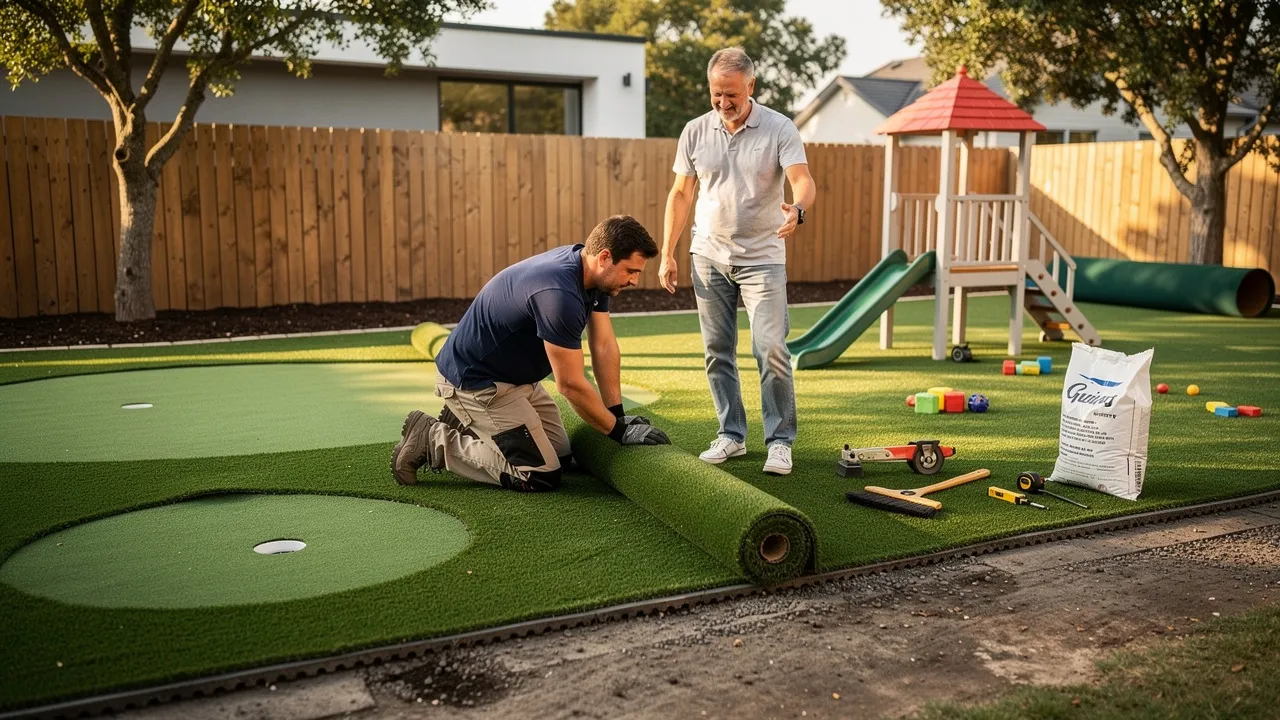
The installation sequence should move from site control to surface finishing:
- Measure and plan the equipment area, fall zones, access, seams, edges, and drainage route.
- Remove vegetation and existing landscaping, then excavate to the selected system depth.
- Build and compact the sloped aggregate base and install the required drainage and impact layers.
- Lay out the turf, acclimate it, trim it to the site, and keep the grain facing in the same direction.
- Cut and join the pieces, secure the perimeter and transitions, and add required infill if the product calls for it.
- Brush and groom the finished surface, then inspect it before use.
This order keeps the foundation ahead of the visible finish.
When a project uses more than one roll, align the pieces edge to edge and join them with seaming cloth. The cited installation guidance says to secure the seaming cloth with landscape anchors or 6-inch galvanized nails. Trim carefully around equipment and keep the turf grain consistent. If installation is not done precisely, turf may buckle or wrinkle and seams may show.
Use the product instructions for infill quantity, placement, brushing, and edge fastening rather than treating every turf product as interchangeable. The cited sequence includes an aggregate drainage base, turf placement and acclimation, trimming, aligned grain, connected seams, secured edges, required infill, and final brushing and grooming. If you cannot perform the excavation, compaction, cutting, joining, or securing work accurately, the physically demanding installation should move to a qualified installer rather than proceed by trial and error.
A cited Thumbtack data set describes national artificial-turf installation costs ranging from around $2,709 to $7,660, with most people paying around $4,569. That range measures broad U.S. artificial-turf installations, not a guaranteed playground price in Missouri or Kansas. The cited source identifies area, preparation work, and turf type as cost factors, so a playground quote should separate those items from impact-system and fall-zone requirements.
Compare quotes by construction scope and fall height
A playground quote should describe construction scope before it presents a total. In many projects, base construction and drainage layers account for 30% to 50% of total installation cost, according to the cited cost guidance. Playground size and shape affect material requirements, while irregular shapes and numerous cutouts can increase waste and slow installation. Fall height is the biggest cost driver in the cited guidance because higher equipment requires more impact absorption beneath the surface and affects shock-pad thickness and type.
The cited cost source says moving from a low-impact play area to a 3-meter fall-height system can increase total project cost by 30% or more. That figure describes the source’s comparison, not every project. Ask each installer to identify the equipment fall height used for the proposal and to show how that height changes the turf, shock pad, infill, base, and documentation.
A February 25, 2026 Hall Turf pricing example describes total costs of $3,000 to $7,500 for a 500-square-foot playground area, depending on turf type and installation requirements. The figure measures a 500-square-foot example, not your property. The same cited example says a DIY setup may save between $1,725 and $6,000 in labor costs, while its pricing guide says materials, labor, and site preparation can add an additional $1.50 to $3.00 per square foot. Keep each figure tied to its source and project condition.
Provide accurate measurements and photographs during the quotation phase. Ask for a written scope that identifies:
- Play equipment, fall heights, and required surfacing boundaries.
- Turf, infill, shock pad or underlayment, base, drainage, and edge components.
- Removal, excavation, grading, aggregate, compaction, seams, fasteners, and cleanup.
- Accessibility-related work and any site condition treated as an allowance.
- Maintenance expectations and what inspection or testing is included.
Comparable quotes describe the same work. A lower headline number may reflect a narrower scope rather than a lower cost for the same system.
Turn the finished surface into an inspection routine
The finished playground turf surface needs an inspection routine from the first weeks onward. During the first few weeks, inspect for settling, edge lifting, and seam issues; afterward, remove debris, rinse, brush, and check the infill routinely. Regular inspections should identify wear, loosening, and other damage, with a checklist covering edges, seams, and areas under playground equipment.
Use a schedule that makes high-use areas visible:
- Weekly: Clear debris, rinse the surface, and spot-check landing zones under swings and slides for visible compaction.
- Monthly: Use a power sweeper to redistribute infill and lift the pile, then hand-groom high-wear zones with a turf rake.
- Same day: Clean spills, food, and pet waste with an enzymatic cleaner; do not let organic mess sit on a surface children are using.
- Annually: Check drainage points for clogging and inspect infill depth in landing zones.
The CPSC handbook also says to check surfacing under swings and at slide exits, rake displaced loose-fill back into place when applicable, and consider larger drainage issues when puddles recur.
Landing zones under slides and swings can show compaction before the rest of the surface looks worn. Check those areas for compacted infill, and check low points and drainage channels for debris, water pooling, and backing degradation. Inspect edges, seams, loosening, visible damage, and settling after severe weather or unusual use. If a defect affects a fall zone, restrict use of that area until the condition has been evaluated and addressed.
The play equipment itself belongs on the inspection checklist. Check openings so they are either smaller than 3½ inches wide or larger than 9 inches. For institutional or high-traffic installations, the cited maintenance guidance recommends field-hardness testing against the 200 Gmax threshold. Those checks address different concerns: equipment openings relate to entrapment, while field-hardness testing relates to the surfacing condition.
Stop and seek qualified evaluation for unresolved risks
Stop the installation when fall protection, drainage, base condition, hard surfaces, or installation quality remains uncertain. Proper site preparation, drainage, depth, and edge containment are important for playground-surfacing safety and longevity; even high-quality surfacing can fail if it is improperly installed. The cited installation guidance recommends professional installation because the work requires skill, expertise, specialized tools, and substantial physical effort.
A visible defect does not always mean the entire system must be replaced, but the base condition determines the repair boundary. A poor installation can usually be repaired when the problem is limited to seams, edges, or small areas and the base is sound. A failed base typically requires a partial or full rebuild. Do not lay new turf over a failed foundation and expect the surface problem to disappear.
Pause use or construction while you resolve missing or mismatched test documentation. ASTM F1292 tests surfacing for G-max and Head Injury Criterion values; the cited guidance says passing surfaces must have a G-max below 200 and an HIC below 1,000 at the designated fall height. Compare a test report with the system, method, fall height, and installation conditions being evaluated.
Obtain qualified help before proceeding when any of these conditions applies:
- The equipment fall height or required fall zone is unclear.
- The proposed turf, pad, infill, and test documentation do not match.
- The site has recurring pooling, soft clay-heavy soil, erosion, or no clear drainage outlet.
- Concrete, asphalt, pavement, or another structural surface remains beneath the equipment.
- The compacted base is uneven, soft, or too shallow for the selected system.
- Edges lift, seams separate, wrinkles form, or the surface settles after installation.
Do not trade an unresolved foundation or fall-protection question for a faster finish.
Use the assessment to request a property-specific next step
Your next step should be based on the site record: equipment layout, fall heights, existing surface, drainage path, soil and base conditions, system components, test method, installation scope, and maintenance plan. General planning can show which questions remain open, but a qualified professional must decide individual site suitability, required construction details, and the appropriate project scope. For a playground project in Kearney, Kansas City, or the surrounding Kansas and Missouri area, we offer free on-site consultations and written quotes for turf installation.
What should a playground turf plan confirm before installation?
What should go under artificial turf for a playground?
Use a complete playground surfacing system rather than turf alone. Depending on the equipment and specification, it may include a compacted aggregate base, drainage layers, an impact-absorbing shock pad or underlayment, turf, infill, and secure edge containment. The proposed turf, pad, infill, base, fall height, and installation method should be documented as one tested system.
Can playground turf be installed directly over dirt or existing grass?
No. Remove grass, roots, loose material, and organic matter, then excavate and build a properly compacted base with a drainage path. Turf placed directly on bare soil may fail to drain or remain level, while decomposed material left below the base can contribute to settling and surface problems.
How do I know whether a playground turf system is suitable for the equipment?
Start with the equipment fall height and required fall zones, then verify that the test documentation covers the complete installed system. In the United States, the project commonly uses ASTM F1292 when that is the named specification. Confirm that the report matches the proposed turf, infill, shock pad, base assumptions, installation depth, and fall height; a grass-like appearance or a report for a different system is not enough.
When should children stay off an installed playground turf area?
Restrict use when the surface has lifted edges, separated seams, wrinkles, settling, damaged areas, recurring water pooling, or another defect affecting a fall zone. Have the condition evaluated before reopening the area. For institutional or high-traffic installations, field-hardness testing may also be appropriate when the surface condition is uncertain.
What information should I gather before requesting a playground turf installation quote?
Record the equipment layout, fall heights, fall-zone dimensions, total area, irregular shapes or cutouts, existing surface, drainage concerns, access limits, and photographs. Ask each proposal to identify removal, excavation, base and drainage work, turf, impact layer, infill, edging, seams, fasteners, cleanup, testing documentation, and maintenance expectations so the scopes can be compared directly.