
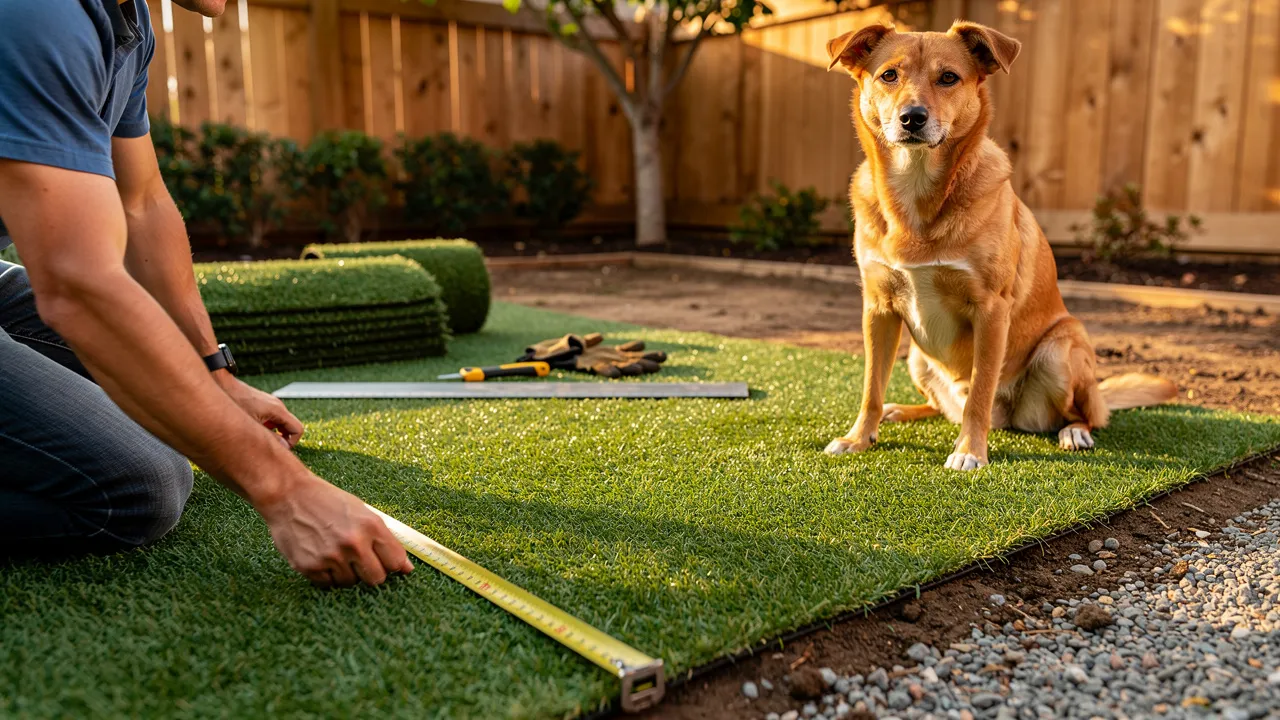

Build a property-specific pet-turf scope worksheet
A practical budget treats the project as a complete installed system: measured area, ground preparation, turf, labor, drainage, infill, edging, seams, odor-control features, and the installation method.
That distinction matters for a dog run because the visible grass is only one layer of the work. Two areas with the same measured size may require different preparation, drainage work, or cutting because their ground conditions and layouts differ. Use the completed worksheet to produce a preliminary budget range; the result depends on the property and is not a binding quote.
Treat service life as a planning assumption rather than a price input. A 10-15-year-or-more lifespan is a conditional planning range when installation and routine cleaning are good; traffic, climate, product quality, dog count, activity pattern, local exposure, installation quality, and cleaning routine also affect the discussion. It is not a guarantee for a particular property.
Measure the planned dog-run area
The planned dog-run area should be measured before you apply any price. Use a tape measure, record the dimensions of each section, and account for irregular shapes instead of relying on a rough visual estimate. For a rectangular section, multiply length by width. A 20-foot by 15-foot area measures 300 square feet.
Use this short measurement process:
- Mark the intended installation boundary, including the area where dogs will relieve themselves and move regularly.
- Measure each rectangular section separately.
- Add the section totals to create the measured square footage.
- Note curves, narrow passages, planting-bed edges, gates, slopes, and other features that may affect the amount of turf purchased or the installation work.
The result is your measured area, not yet the quantity that will be priced or purchased.
A 300-square-foot example shows how the measurement connects to material planning. At a listed pet-grass material rate of $8 per square foot, 300 square feet would produce a material expense of $2,400. That example covers the material calculation only; it does not include labor, removal, base work, drainage, infill, edging, disposal, or other applicable charges. Treat the result as a way to understand the formula, not as a price for a Kearney or Kansas City installation.

Adjust measured area for turf rolls and seams
The purchased turf area may exceed the measured ground area because artificial turf comes in fixed-width rolls. Rolls are usually 15 feet wide and sometimes 12 feet wide, so a curved boundary, angled section, or final strip can create offcuts that you still pay for. Seams and overlap can also change the quantity needed.
For your working calculation, keep two figures separate:
- Measured area: the square footage inside the planned dog-run boundary.
- Waste-adjusted area: the amount used for budgeting after accounting for roll width, seams, overlap, curves, and other layout waste.
Do not apply a made-up waste percentage to every property. The amount depends on how the planned area fits the available roll width and how much cutting the layout requires. A simple rectangle may use material more efficiently than a narrow run with several corners.
A waste-adjusted square-foot calculation produces a budget range rather than a binding quote. Regional conditions, base preparation, and product grade affect the result, and the final quantity may depend on the installation layout. Give the installer your measurements and a sketch or photos of the boundary so the material quantity, seams, and cutting plan can be evaluated together.
Calculate a preliminary installed-system budget
The preliminary budget starts with waste-adjusted area multiplied by the selected turf rate. One pricing method expresses the base calculation as area multiplied by turf rate and a scale factor, followed by site-preparation costs. In practical terms, organize the estimate as:
Waste-adjusted area × selected turf rate = turf-material allowance
Turf-material allowance + labor + preparation + other applicable work = preliminary project budget
Use a scale factor only when the calculator or installer defines what it represents. Do not insert an unexplained multiplier. The estimate should show whether each amount is priced per square foot, as a project allowance, or as a separate fixed charge.
A 300-square-foot example can show the difference between material and installation. If labor is around $3 to $6 per square foot, the installation-cost example is $900 to $1,800 for 300 square feet. Combining that labor example with the $2,400 material example produces a preliminary material-and-labor subtotal of $3,300 to $4,200 before removal, base construction, drainage, infill, edging, disposal, and other work. Those figures come from separate examples, so they are not a local quote for your dog run.
Keep the layers visible rather than placing one unexplained number beside the total. A transparent worksheet makes it easier to see whether a low figure excludes ground work or whether a higher figure includes work that another estimate prices separately.
Your preliminary worksheet should give each cost layer its own line:
- Waste-adjusted turf quantity and selected turf rate
- Labor and installation method
- Existing-grass removal and disposal
- Leveling, excavation, aggregate base, and grading
- Drainage work and water-management features
- Infill, odor-control layers, seams, edging, and materials
- Any access, custom-cut, or scope-change allowance
Compare the completed worksheet with a written estimate by confirming whether turf, base preparation, infill, labor, disposal, drainage, and edging are included or priced separately.
Separate removal and ground preparation from turf cost
Ground preparation can include removing existing grass, leveling the surface, excavating, and adding a base layer. These steps occur before the turf is installed and can materially affect the price because the condition of the ground determines how much work and material the site needs. Preparation is also part of the drainage and turf-longevity discussion, so it should not be hidden inside an unexplained turf rate.
One 2026 source listed a crushed-rock sub-base at $2 - $5 per square foot and old-lawn removal and haul-away at $1 - $3 per square foot. Those figures describe published reference amounts, not a universal Kearney or Kansas City charge. Include the base and removal as separate lines until the site-specific scope establishes what applies.
Published lawn-removal figures vary by method and source. One source reported professional stripping and haul-away at roughly $1.00 - $2.50 per square foot, while the same source described a DIY approach using a rented sod cutter and disposal at $0.45 - $1.13 per square foot. The DIY range reflects equipment rental and disposal assumptions rather than a professional installation scope.
A separate 2026 source reported old-lawn removal and haul-away at $1 - $3 per square foot. Keep these ranges separate instead of averaging them. Ask whether your estimate includes stripping, loading, hauling, disposal, and any surface correction after removal.
Project size can affect the per-square-foot result, but scale is not a reason to assume a discount for every dog run. A smaller, narrow, or difficult-to-access pet area may not share that condition, so compare the work included rather than applying the percentage to your own property.
Add pet-use, drainage, and installation requirements
Pet use should be part of the cost model from the beginning. Include the number of dogs, their activity level, and the expected wear when you describe the project. A relief area used by several active dogs may call for a different scope than a small run used occasionally, but the installation estimate must connect any recommendation to the actual site and use.
Layout also affects labor. Slopes, curves, tight spaces, seams, edging, and custom cuts can increase installation complexity and labor costs compared with a flat, open area. Mark those features on your measurement sketch so the square-foot calculation does not hide the work required to build the system.
A pet-turf estimate may need to identify infill, edging, drainage, odor-control layers, specialty infill, seams, and systems intended to manage water or pet urine. Drainage belongs in the ground-work discussion, not as an afterthought. Ask how water will move through and away from the planned area, especially if the property has a history of standing water or slow drainage.
A published pricing reference reported labor at $5 - $12 per square foot generally and Kansas City skilled labor at $3.45 - $12 per square foot. A separate source said sophisticated drainage solutions might add $0.25 - $3.00 per unit area. Preserve the source’s wording for that drainage figure because it does not establish one universal local unit or charge.
Ongoing care belongs in the comparison even though it may not appear in the installation subtotal. Separate measured area, site preparation, turf and labor, drainage, infill, odor-control features, installation method, and ongoing care when you build the pet-turf cost model. This structure lets you ask whether a quote covers the system you want rather than comparing turf rates that represent different products or scopes.
Classify each price by what it includes
Published figures are not directly interchangeable because they may describe material only, a complete installation, different product grades, different markets, or different dates.
The different scopes prevent a meaningful average.
Use three scope labels when reading a published figure: material only, complete installation, or unclear. Material-only pricing cannot be compared directly with an installed-system amount. One reported installed range is $9.40 - $17.00 per square foot when turf, aggregate base, weed barrier, infill, and labor are included. A separate 1,000-square-foot example ranges from $8,000 to $15,000. Keep both as nonbinding reference entries rather than treating either as a quote for a particular property.
For your project, use published figures as reference points while keeping the calculation tied to waste-adjusted area, product grade, preparation, and local conditions. The Kearney and Kansas City cost model should describe the complete installed system, including turf, ground work, drainage, infill, odor-control features, installation method, and care. Current local pricing must come from the written scope prepared for the actual property.
Compare written pet-turf quotes on the same scope
Two or three pet-turf quotes can differ substantially when they describe different buried work. That observation is not a Kansas City rate, but it illustrates why a lower total may reflect a different scope rather than a better price.
Use the same written-scope checklist for every estimate:
- Measured area, installation boundary, and waste or seam assumptions
- Existing-grass removal, disposal, excavation, leveling, grading, and base material
- Base depth and material, including whether the quote specifies three inches or four to six inches where that comparison applies
- Turf type, quality, backing, installation materials, seams, and edging
- Labor, installation method, access conditions, and custom cuts
- Infill, odor-control layers, drainage route, and water-management work
- Exclusions, care instructions, estimated timeline, and the process for scope changes
A quote with three inches of base rather than four to six inches reduces excavation and base volume. A published reference also cautioned that recycled-asphalt fines may create drainage problems over time as they compact. Ask for the specified depth and material instead of comparing only the final total.
Drainage questions should be answered before installation. Ask the estimate to explain existing water-management issues, proposed drainage work, exclusions, and how changes to the scope will be handled. Evaluate the full installed system: site preparation, supporting base, drainage route, turf, infill, edges, seams, and post-installation care instructions.
A quote is easier to compare when every installer responds to the same list. If one estimate includes drainage and odor-control layers while another lists only visible turf and labor, the per-square-foot figures describe different purchases.

Get professional review for unresolved site conditions
A preliminary calculation cannot resolve site conditions that require inspection or a detailed installation plan. Ask the installer to address each zone’s use, dog pressure, sun and shade, drainage history, existing surface, relief area, and cleaning expectation. Before installation, ask how drainage concerns, seams, edges, infill, site preparation, and the estimated installation timeline will be handled.
Bring your measured area, photos, boundary sketch, dog-use notes, and drainage history to the discussion. Those details help connect the arithmetic to the property instead of treating a generic rate as the answer.
Keep unresolved site conditions, system components, and care obligations open instead of treating a product description as proof of fit. A slope, tight access point, curved edge, unclear existing surface, or unresolved water-management issue can change the work required even when the measured area stays the same.
Ask the installer to identify exclusions and explain the process for changes to the scope in the estimate. A qualified local installer should determine individual suitability, current pricing, and the final written scope from the property conditions and selected materials.
Move from a preliminary budget to a current local quote
Your preliminary budget is ready for the next discussion when it shows the measured and waste-adjusted area, intended dog use, existing surface, removal needs, base work, drainage concerns, turf and infill preferences, odor-control requirements, edging, seams, and care expectations. Request a free, site-specific pet-turf quote from Hall Turf using the Get a free quote link.
Include any questions about licensing, product certifications, CAD files, testing documentation, exclusions, and scope changes in the written discussion. Current pricing and the final installation scope depend on the actual Kearney or Kansas City property, its ground conditions, and the materials selected.
What should a pet owner confirm before accepting an artificial-turf quote?
Does an artificial turf cost per square foot figure usually include installation?
Not necessarily. A published figure may cover turf material only, while another may include labor, aggregate base, weed barrier, infill, removal, drainage, or edging. Before using any rate for a Kearney or Kansas City dog run, confirm whether it is material-only or part of a complete installed-system price.
How much extra turf should I buy for an irregular dog run?
Do not apply one automatic waste percentage. Measure the installation boundary, then account for fixed-width rolls - usually 15 feet and sometimes 12 feet - along with curves, narrow sections, angles, seams, and overlap. The installer should confirm the waste-adjusted quantity from the layout, because paid offcuts can vary substantially between properties.
What should I send an installer before requesting a pet-turf estimate?
Provide the measured area, a boundary sketch or photos, the number of dogs, expected activity, existing surface, removal needs, drainage history, access limitations, slopes, curves, and cleaning expectations. Also identify whether the area is primarily a relief zone, a play area, or both. These details help the installer evaluate preparation, drainage, turf, infill, odor-control features, seams, edging, and care requirements.