
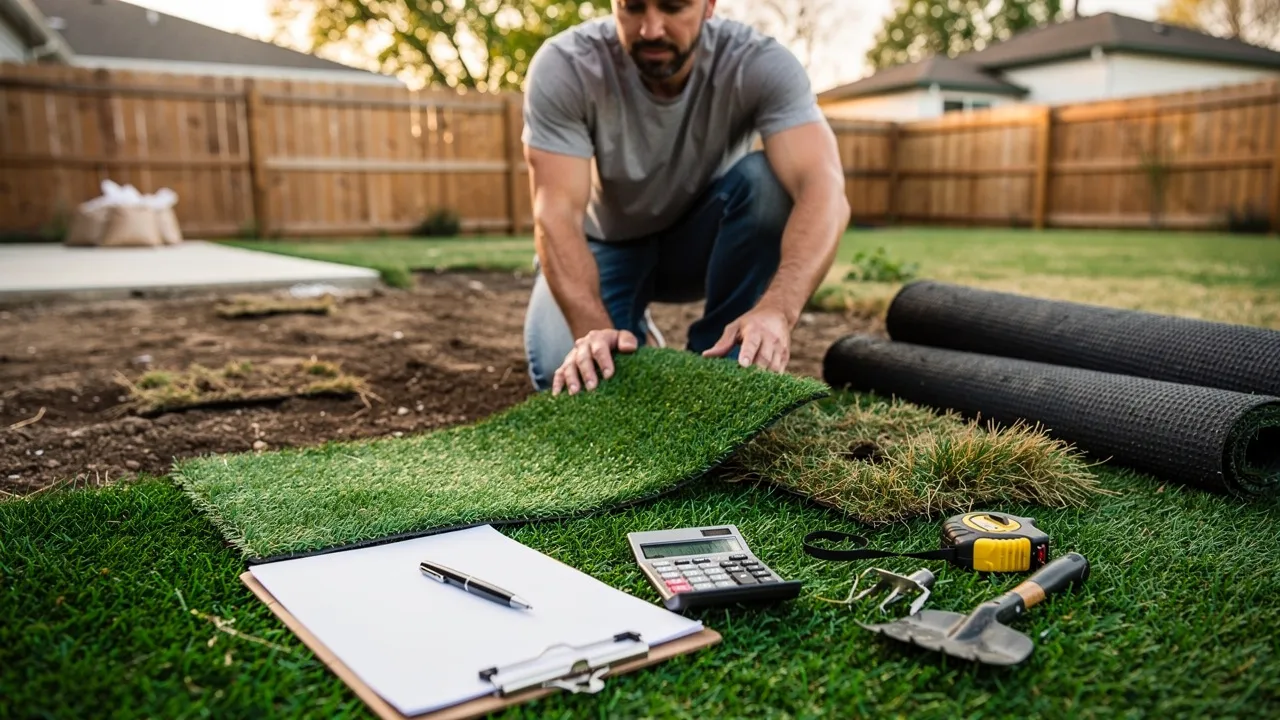

Model the budget with comparable scenarios
A Kansas City backyard artificial-turf budget is more useful as a set of comparable scenarios than as one average rate. Start with a reference area that matches your yard - published estimates include 500- and 1,000-square-foot examples - then keep the product, preparation, and installation assumptions visible as you test the budget.
A preliminary budget can use area × turf rate × scale factor = base price, then add site-preparation costs. Treat the scale factor as a worksheet adjustment, not a guaranteed local rate. Its purpose is to show which assumption moves the total and which items still need a property-specific assessment.
Published figures provide context, but they do not establish the price for a particular property. One national cost guide reports that most professionally installed artificial turf in the United States lands between roughly $5 and $20 per square foot, including materials and labor. Turf quality, ground work, and project size affect the exact number.
A separate 2026 estimate places installed artificial turf at $8 - $18 per square foot: standard landscape grass at $8 - $14, pet-friendly turf at $10 - $18, sport and multi-use turf at $9 - $16, putting greens at $15 - $25, and budget or economy grass at $6 - $10. A 2026 estimate places a 500-square-foot backyard at roughly $4,000 - $9,000 with professional landscape or pet turf. The same estimate lists budget grass at $3,000 - $5,000, standard landscape turf at $4,000 - $7,000, pet-friendly turf at $5,000 - $9,000, and a putting green at $7,500 - $12,500. Another estimate places a 1,000-square-foot artificial grass project at $8,000 - $15,000.
Do not average these ranges into a single rate. Put each reported figure beside its area, product type, date, and included work. Then use the differences to identify which assumptions need checking in a local quote.
Build the first scenario worksheet in four passes:
- Set the reference area from your measurements, or use the 500- or 1,000-square-foot examples only as comparison points.
- Assign a reported product or installed range to each scenario and record what it includes.
- Add preparation, access, removal, drainage, and finishing work only when the scope shows they are separate.
- Mark each unresolved item for confirmation in an itemized written quote.
The result is a transparent planning range with visible assumptions, not a number that appears precise while leaving the ground work unexplained.
Convert the yard into a reference area
Treat the yard as a set of measured inputs for the scenario worksheet, not as one approximate lawn size. Smaller yards can cost more per square foot because setup and delivery costs are spread across less area. In Kansas City, Missouri, total square footage and layout complexity are reported as major bill drivers, while custom cuts around curved garden beds or hardscaping increase job difficulty.
Measure the space carefully and consider using an online area calculator to help prevent miscalculations. For a practical first pass, divide an irregular yard into rectangles or other simple shapes, calculate each area, and add the sections together. Keep separate notes for areas that will use different turf or require different preparation.
Record these details with your measurements:
- Length and width of each lawn section.
- Curved garden beds, trees, planting areas, patios, walkways, retaining edges, and other cut lines.
- Changes in elevation, narrow passages, gates, stairs, and the route materials would need to travel.
- Areas where the existing surface will remain beside the turf.
- Locations where water collects or where the ground appears soft after rain.
- Whether the backyard is one open rectangle or several separated sections.
Use the area total as the fixed input for each scenario, then keep layout and access as separate adjustment notes. A 600-square-foot rectangle with direct access can require different cutting, edging, and delivery work from a 600-square-foot yard divided by pavers and curved beds. Making those differences visible prevents two yards with the same area from being treated as the same model.
Turf selection and removal also belong in the worksheet. Turf cost varies by quality, type, and supplier; one estimate places turf at $2 to $15 per foot, with durability and aesthetics influencing price. Grass removal costs are reported at $0.88 to $1.84 per foot, depending on the method used. Treat both figures as source-specific planning references rather than fixed Kansas City rates, and record whether your project involves an existing lawn, bare soil, gravel, concrete, or another surface.
Finish the measurement stage with photographs from several angles. Include the property edge, access route, existing lawn, drainage trouble spots, and any feature that interrupts the turf area. Those images will not replace a site assessment, but they can help you describe the project consistently when requesting written estimates.
Hold the product assumption constant
Keep the measured area and site conditions fixed while you change only the product assumption. Comparing totals without first deciding whether you are considering entry-level, standard, or premium turf can make a product difference look like an installation difference when the products are not equivalent.
One guide reports the following turf-product ranges:
- Entry-level turf: around $1.50 - $2.50 per square foot.
- Mid-range standard turf: $2.50 - $3.50 per square foot.
- Premium products: $3.50 - $5 per square foot or more.
These figures describe reported product price bands, not a complete installed project total. They should not be added to a separate installed range unless you know whether the installed figure already includes the turf. Other project categories can affect the total, including base preparation, drainage, edging, and infill.
Material type can provide another scenario distinction. One guide reports polypropylene material at $2 - $7 per square foot for decorative areas or light foot traffic. The same guide reports polyethylene material at $2 - $5 per square foot, with a more natural appearance. Those descriptions do not decide which product fits your backyard; they give you questions to ask about intended use, appearance, and the work included in the estimate.
Create three worksheet rows rather than one blended total:
- Basic landscape scenario: an entry-level product with a straightforward open layout and no assumed specialty features.
- Standard residential scenario: mid-range landscape turf with the appearance and traffic expectations you want for the backyard.
- Higher-specification scenario: premium turf or a product selected for a particular use, more complex layout, or higher appearance expectation.
Keep the measured area, existing surface, and access notes unchanged while testing these rows. That isolates the product assumption before preparation and installation are added.
Then add preparation and installation categories separately.
The useful question is not simply, “Which turf costs less?” It is, “Which product assumption am I using, and what other work remains outside that product figure?” Write the answer at the top of each worksheet so that later quotes can be compared against the same starting point.
Stress-test preparation and access
Treat preparation as a separate sensitivity block in the scenario worksheet rather than hiding it inside one total.
For a Kansas City or nearby Kansas and Missouri backyard, assign each condition to one of three planning states: included in the reported range, a separate possible cost, or a site question that needs assessment. Review these categories:
- Removal of grass, roots, debris, or another existing surface.
- Excavation and disposal or haul-away.
- Leveling, grading, and correction of slopes.
- Base material, spreading, watering if required by the process, and compaction.
- Drainage work where the existing ground does not move water as needed.
- Edging around beds, paths, patios, and property boundaries.
- Seams, infill, and the equipment needed to finish the surface.
- Access limits that affect delivery, excavation, or removal.
A sloped yard may require additional preparation. One guide reports potential installation-estimate increases of 15% to 50% for challenging terrain and reports that site preparation can add $1 to $3 per square foot. That figure is a source-specific planning reference, not a surcharge that applies to every sloped property.
On a difficult new-build site, excavation, grading, base construction, and drainage can account for 40% to 50% of the installation budget. Poor soil, steep slopes, limited access, or existing drainage problems can increase that share. The visible lawn area therefore cannot establish the required work beneath the surface by itself.
A 2026 guide reports that a crushed-rock sub-base adds $2 - $5 per square foot and that removing and hauling away an old lawn adds $1 - $3 per square foot. Those are separate reported additions with their own conditions; do not assume both apply, and do not add them to a quote until you know whether the estimate already includes the same work.
One cost guide reports a 2025 site-preparation range of $6.50 to $15.00 for work covering ground leveling, debris removal, and drainage solutions. That range differs from the narrower sub-base and old-lawn figures because the category includes different tasks. Ask what the number measures before using it in your worksheet.
Mark uncertainty rather than hiding it. If you do not know whether the yard needs excavation, additional base, or drainage work, place that item in a “needs assessment” column. A preliminary budget that identifies an unresolved condition is more useful than a low total built on an assumption.

Keep published figures in separate rows
Treat published artificial-turf figures as separate worksheet rows, not as ingredients for one automatic total. Before you compare rows, identify the source, date, unit, population or project type, and included work. A material-only range is not interchangeable with an installed range, and a broad site-preparation category may overlap with base or labor lines.
| Planning input | Reported figure | What the figure measures |
|---|---|---|
| Turf materials | $2 - $8 per square foot | Materials in one national cost guide |
| Professional labor | $3 - $12 per square foot | Labor in the same national guide |
| Site preparation | $6.50 - $15.00 | Ground leveling, debris removal, and drainage solutions in a 2025 guide |
| Base preparation | About $4 - $10 per square foot | Base preparation in another cost guide |
| Installation labor | $2 - $7 per square foot | Installation labor in that guide, with possible category overlap |
One national cost guide reports materials at about $2 to $8 per square foot and professional labor at about $3 to $12 per square foot. Professional labor can include excavation, grading, base compaction, turf cutting and installation, seaming, edge securing, and infill; the same guide reports $3 to $12 per square foot depending on job difficulty and yard size.
Another guide reports $6.50 to $15.00 for site preparation covering ground leveling, debris removal, and drainage solutions in 2025. A separate guide reports about $4 to $10 per square foot for base preparation and $2 to $7 per square foot for installation labor. Those categories sometimes overlap in contractor estimates, so review what each line includes before adding them together.
Keep the table as a range ledger rather than a formula that automatically produces a total. If a contractor’s labor line already includes excavation and base compaction, leave the separate national labor row out of that comparison. If a broad site-preparation line includes drainage, do not add another drainage allowance without identifying a separate system or task.
Two quotes using the same turf can differ widely because of the base underneath. Compare the scope before comparing the rate. A useful quote comparison asks:
- Is the figure for material, labor, preparation, or the complete installation?
- Does the square-foot figure include removal and disposal?
- Are base depth, compaction, drainage, edging, infill, and seams listed separately?
- Does the labor line include excavation and grading?
- Is the estimate based on the same measured area and layout?
Only compare scenario totals after every included row has a defined scope or is clearly marked for confirmation.
Run DIY and professional paths through the model
Run the same product and site assumptions through two installation paths before choosing a budget scenario. DIY and professional installation are different scopes, not merely two prices for the same task. DIY installation requires site preparation and the necessary tools. DIY installation offers lower upfront costs but requires effort and carries risk.
| Decision factor | DIY installation | Professional installation |
|---|---|---|
| Cost structure | You may avoid some labor charges, but you still budget for turf, base, drainage, infill, removal, disposal, and tools. | The estimate may combine labor, preparation, materials, and finishing work; ask for each line separately. |
| Preparation | You handle removal, grading, compaction, shaping, and surface checks. | The quoted scope should identify who performs excavation, grading, base preparation, and compaction. |
| Tools | You need a shovel, rake, plate compactor, level, rubber mallet, utility knife, sharp scissors, measuring tape, and string line. | Ask whether equipment and delivery are included in the quoted labor or listed separately. |
| Finish work | You handle cutting, seaming, edge securing, brushing, and infill placement. | Ask whether seams, edging, infill, and final preparation are included. |
| Site uncertainty | You carry the consequences of an incorrect grade, weak base, poor seam, or unresolved drainage condition. | Request a written scope that identifies how uncertain site conditions will be assessed and priced. |
| Appropriate starting point | A small, straightforward area may be easier to define, but the full preparation sequence still applies. | A site with slopes, poor access, drainage questions, or complicated cuts calls for a detailed assessment before work begins. |
One guide estimates a complete DIY installation, including base, drainage, infill, and turf, at $5 to $15 per square foot. The same source estimates professional installation at $15 to $40 or more per square foot. Those figures come from one guide and may represent different project scopes, so they should not be treated as a universal DIY-versus-professional price rule.
Another 2026 estimate reports that large open yards price 10% - 20% lower per foot at scale. That estimate does not mean every large backyard receives that adjustment, and it does not remove the need to compare the actual layout and preparation work.
A 2026 estimate reports that a crushed-rock sub-base adds $2 - $5 per square foot and that tearing out and hauling away an old lawn adds $1 - $3 per square foot. Those costs can affect either path when the work applies. DIY does not make excavation, hauling, compaction, or drainage disappear; it changes who performs and manages the work.
Use the DIY row only after you can describe the entire sequence, obtain the necessary tools, and account for the site conditions. Use the professional row when the grade, drainage, access, base, or measurements remain unclear, and move to a written site-specific scope before treating either path as a dependable total.
Turn the selected scenario into a quote worksheet
The selected scenario becomes the quote worksheet: send the same area, product assumption, and site notes to each installer so the resulting scopes price the same model.
Include these project details:
- Total square footage and the dimensions of each separate section.
- A sketch or photographs showing curves, beds, hardscaping, paths, gates, stairs, and narrow access points.
- The existing surface, including lawn, bare soil, gravel, concrete, or mixed conditions.
- Visible slopes, soft areas, standing water, erosion, or places where water collects after rain.
- Your intended use of the backyard, such as general residential activity, pets, children, entertaining, or a combination.
- The turf scenario you want priced: entry-level, standard, premium, or a specified product type.
- Whether old grass, roots, debris, and soil must be removed and hauled away.
- Any known restrictions on access, delivery, excavation, disposal, or working around existing features.
Ask for an itemized written quote that separates turf, base, infill, old-surface removal, edging, drainage, and labor. The request should identify the measured area and scenario used for the calculation and distinguish allowances from confirmed work.
Request a written scope that details base depth, drainage method, and seam placement. Ask how the process prevents standing water or odor after rain. Those questions connect the visible finish to the construction work underneath it.
Use this question list when reviewing each response:
- What square footage and layout did you price?
- What existing-surface removal and disposal are included?
- What base material and depth are included, and how will it be compacted?
- What drainage work is included, excluded, or conditional on site findings?
- Where will seams and edging occur?
- What infill is included, and how is it priced?
- Which labor tasks are included in the quoted installation line?
- Which conditions could change the estimate, and how will those changes be approved?
- Which parts of the scope are allowances rather than fixed project items?
Do not compare a complete scope against a turf-only number. If a quote combines several categories, ask for the included tasks in writing before using it beside a more detailed estimate.

Flag conditions that block a dependable total
Use an unresolved-condition flag when the visible lawn does not explain the work below it. Property grade, drainage, maintenance space, and construction access can change the scope, so the visible lawn area alone is not enough to establish the required preparation.
Pause the budget exercise and seek qualified help when any of these conditions applies:
- You cannot establish reliable measurements because the yard has several irregular sections.
- Water collects, moves toward the house, or remains after rain.
- The yard slopes, contains soft soil, or appears to need substantial grading.
- Materials or equipment cannot reach the work area through a normal gate or side passage.
- The estimate does not explain base depth, drainage, removal, edging, seams, or infill.
- Two estimates use the same turf but differ sharply because their preparation scopes are unclear.
- A contract leaves conditional work or change-order pricing undefined.
Another DIY guide estimates materials at $4.50 to $11.50 per square foot and says most 150- to 600-square-foot projects take 1 to 3 days. Those figures do not remove the need for excavation, compaction, shaping, seaming, and testing. Treat the time and material figures as guide-specific planning information, not as a schedule or total for your backyard.
Do these things first:
- Preserve your measurements, photos, layout sketch, and site observations.
- Mark every condition that could change excavation, grading, base, drainage, or access.
- Request a written scope that separates confirmed work from allowances.
- Ask how changes will be measured, priced, and approved.
- Compare quotes only after the included work is clear.
Do not rely on an unverified total price, skip site preparation, or choose a turf product before the ground conditions are understood. Do not treat a contractor’s square-foot rate as comparable to a material-only figure. If drainage, measurements, access, contract language, or estimate inclusions remain unclear, keep those worksheet flags open until the written scope resolves them.
Turn the completed budget brief into a local quote
A reliable backyard artificial-turf budget is a documented set of assumptions: measured area, selected turf scenario, visible and subsurface site conditions, and a written list of included work. Use that brief to replace broad published ranges with a property-specific scope, and decide only after the estimate explains preparation, drainage, base, removal, edging, infill, seams, and labor.
Before committing a substantial budget, have a qualified professional assess individual site suitability when grade, drainage, access, measurements, or contract terms remain uncertain. A clear written scope gives you the basis for comparing the work and the price together.