
Use a three-part fitted-grass fit review
Use a three-part fit review before treating fitted artificial grass as a suitable lawn-replacement project. First test site fit: existing surface, soil, slope, drainage, access, and buried or private lines. Then test system fit: intended use, turf and infill choices, edges, seams, and care. Finally test commitment fit: the complete scope, price assumptions, maintenance, and material lifecycle. This keeps a property-specific decision separate from a generic installation description.
Artificial grass installation has grown in popularity, driven in part by droughts, busy lifestyles, and interest in lower-maintenance outdoor spaces. For homeowners in Kearney, Kansas City, Overland Park, Olathe, Lee’s Summit, and nearby Kansas or Missouri suburbs, mark each part of the review as clear, unresolved, or requiring qualified evaluation. The result is a go, pause, or revise-the-scope decision - not a conclusion based only on turf appearance.
A basic property screen can narrow the decision before you request an estimate. Start with these questions:
- What surface is present now: natural grass, compacted soil, concrete, roots, mulch, or mixed material?
- Where does rainwater move, and does water pool or drain slowly after wet weather?
- How will you use the space: general lawn, a pet area, a play area, entertaining, or several purposes?
- Can equipment and materials reach the work area without unusual removal or access work?
- Are sprinkler pipes, low-voltage lighting, or other private lines beneath or near the proposed lawn?
- Do local regulations or HOA rules permit artificial grass?
When artificial turf is installed with a subbase, one published source recommends an excavation depth of 3-4 inches. Treat that figure as an installation reference, not a promise about your yard. Soil, existing construction, drainage, and the selected system can change the required preparation.
Artificial grass also creates a long-term material decision. One source estimates artificial grass’s shelf life at 10-20 years and says reuse is difficult; recycling requires specialist plants and a specific cleaning process. A project therefore deserves more than a surface-color comparison. Ask how the proposed product, foundation, use, maintenance plan, and eventual removal fit your plans for the property.
The decision is a go when the site can be prepared appropriately, the system matches the way you will use the yard, and the quote makes the complete scope clear. It is a pause when drainage, utilities, access, rules, or preparation remain uncertain.
Use the fitting scope to test quote completeness
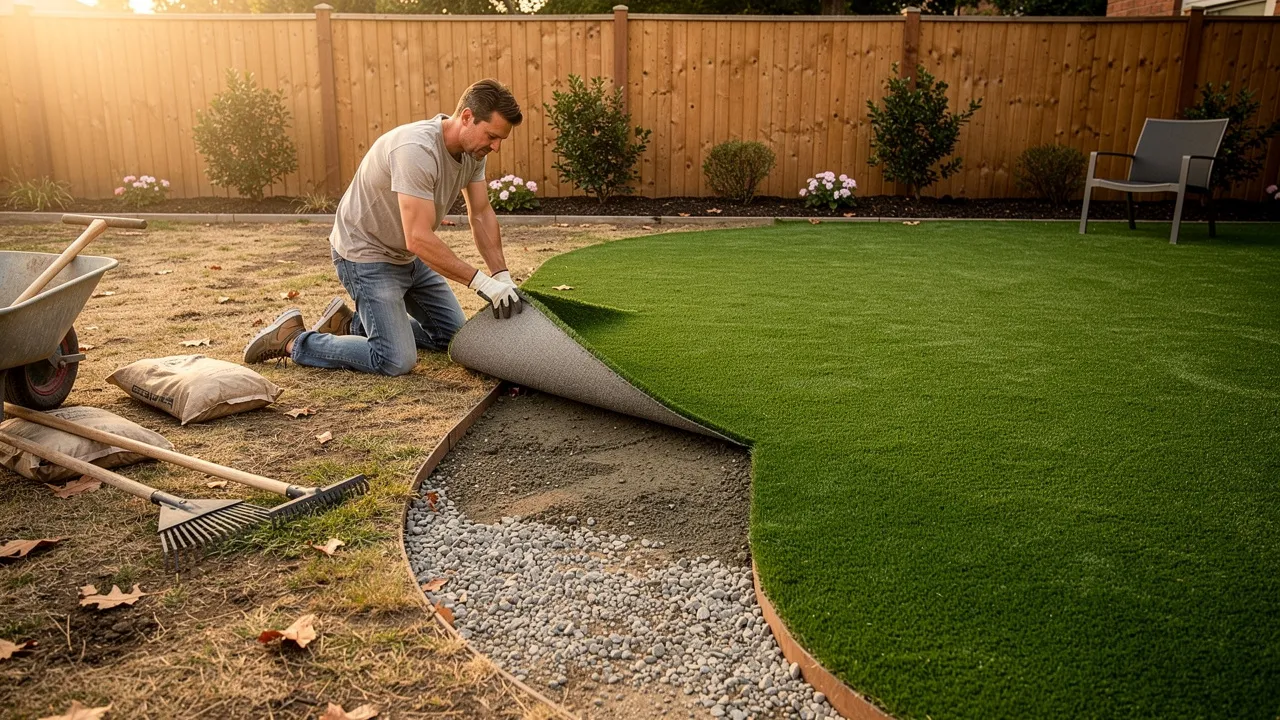
Professionally fitted artificial grass is a complete ground-and-surface project, not a purchase of turf to place over an existing lawn. Fitting typically involves site planning, surface removal, base preparation and compaction, turf fitting and seaming, edge securing, infill, and final grooming. Existing grass or concrete is typically removed, but each installation situation is unique and should be assessed for its actual conditions.
The visible grass is only the final layer. The underlying work controls the shape, water path, stability, transitions, and seam layout. A quote that names only the turf product or square footage leaves important project questions unanswered.
Use the usual fitting sequence as a scope audit rather than a DIY recipe. A complete proposal should account for five linked stages:
- Layout: measurements, turf direction, seams, borders, and access.
- Clearance: removal of existing grass, vegetation, debris, roots, rocks, or other obstructions as the site requires.
- Foundation: preparation, grading, compaction, and drainage work.
- Surface: turf cutting, alignment, seaming, and edge securing around the yard’s features.
- Finish: specified infill, grooming, cleanup, and inspection.
This sequence helps reveal omissions in a quote without deciding the right depth, drainage design, or material for a particular yard. Those details belong in the site assessment and documented scope.
A Kansas City-area FAQ says its premium artificial turf typically lasts 15-20 years or more with proper installation and essential maintenance. The same FAQ says its premium turf is chosen for extreme temperature changes, heavy rainfall, snow, ice, and strong ultraviolet exposure. Those statements describe that source’s premium products, not every turf system or every residential yard.
The same Kansas City-area FAQ says its premium turf products are UV-stabilized to resist fading and are backed by its 15-year warranty. Ask for the proposed product’s actual warranty terms and the installation conditions that affect coverage. A service-life or warranty statement cannot replace a review of your foundation, use, maintenance, and site conditions.

Record the site conditions that can change the build
A residential yard assessment should connect the existing surface to the proposed use before anyone chooses a turf product. Proper base preparation and drainage are essential to long-term performance and a professional-looking installation. For a property in Kearney or the Kansas City area, record the yard’s shape, measurements, access points, slope, soil behavior, drainage patterns, irrigation, lighting, trees, beds, walkways, and areas where people or pets will spend time.
Clay-heavy soil holds moisture longer and requires enhanced drainage. If water pools or drains slowly, the site may need additional drainage measures before the base is installed; grading can direct water toward a suitable drainage point. Do not assume that a visible low spot will disappear beneath turf. Ask how the proposed grade and drainage path address it.
Build a site record that lets installers price the same conditions:
- Measured area and boundaries, including transitions, gates, steps, trees, beds, and paths.
- Existing surface and obstructions, including grass, weeds, roots, rocks, debris, and mulch.
- Water behavior, including pooling, slow drainage, slope, and clay-heavy soil.
- Access constraints such as narrow gates, stairs, retaining walls, or fences.
- Intended use, including ordinary foot traffic, pets, children’s play, furniture, or multiple uses.
- Known private lines and the utility information collected before excavation.
Label each item known, unresolved, or requiring qualified review. Carry unresolved items into the quote instead of treating a standard preparation depth or base design as a property-specific answer.
Underground and private lines require separate attention. Before digging, contact the applicable 811 utility-locate service to have underground lines marked. Tell the installer about private sprinkler pipes and low-voltage lighting lines because utilities do not mark them. Existing sprinkler heads in the turf area may need to be located, capped, or removed, and the irrigation system should be checked before work begins.
These checks are part of deciding whether the proposed installation can proceed as planned. Do not begin excavation, remove irrigation components, or alter drainage until the lines and proposed work area have been reviewed.
Compacted level soil creates a firm foundation and helps prevent settling that can cause bumps or depressions in artificial turf. A site with uncertain fill, a pronounced slope, slow drainage, or buried features deserves a written explanation of the preparation approach. The installer should identify which conditions are included in the quote and which conditions would require additional work.
Treat the foundation as a scope boundary
The foundation determines whether the finished lawn has a stable, usable surface. Ground preparation includes removing existing grass, weeds, and rocks, compacting the soil, and creating a smooth surface. On soil, artificial turf needs a subbase; one installation guide specifies removing existing soil up to 2-1/2 inches deep after clearing the surface.
Proper base preparation is crucial for drainage and synthetic turf longevity. A geotextile membrane can help prevent weed growth, while decomposed granite or crushed rock can improve stability. Proper drainage is critical to prevent water from pooling, and a compacted base layer helps rainwater flow away efficiently.
A published installation guide specifies a base made from 2-3 inches of Class 2 Road Base followed by 1/4 inch of Decomposed Granite, with watering and vibrating-plate compaction used to create a firm, level, smooth base. That is one guide’s method, not a universal specification for every Kansas or Missouri property. Soil, drainage, product requirements, access, and local installation practice can change the design.
The practical quote question is whether the installer has described the foundation in enough detail for you to understand what you are paying for. Ask for the planned excavation depth, base materials, layer thicknesses, compaction method, grading approach, drainage measures, and treatment of unsuitable or unexpected soil.
A weed barrier can help prevent weeds from penetrating the turf underside while allowing drainage. The barrier is part of a system; it does not replace removal of existing growth, a stable base, or a drainage plan.
Multiple turf pieces also need deliberate joining. Join pieces edge to edge with seaming cloth or tape, and secure the cloth with landscape anchors or 6-inch galvanized nails. Ask where seams will fall in relation to the main viewing direction, foot traffic, furniture, trees, and borders. A quote should identify whether seam materials, adhesive, edge restraints, anchors, and cleanup are included.
The base is critical to the turf system’s stability and integrity. Improper installation can reduce performance and accelerate damage, while inadequate excavation and compaction may cause dips or valleys and may fall outside product coverage.
Do not judge the project by the sample blade or color before you understand the foundation. Ask the installer to show how the proposed base, compaction, grade, drainage, seams, and edges fit together.
Match turf-system choices to the yard’s use
Infill is brushed into artificial turf to support its appearance and performance; without infill, the turf can become flattened and matted over time. Silica sand infill can stabilize turf, keep blades upright, help prevent matting, and add weight that helps prevent movement.
A published installation guide describes round silica sand as standard infill and specifies 1-3 pounds per square foot; it also says not to install infill while the turf or infill is wet. Treat that quantity as the cited guide’s specification, not as a universal amount for every product. Ask why the proposed infill fits your turf, use, drainage, pets, and maintenance plan.
Intended use should drive the system choices. High-footfall areas may need more durable infill and reinforced seams, while budget varies with infill, base material, and anchoring methods. A general front lawn, a dog area, and a children’s play space should not automatically receive the same specification.
Pet turf benefits from a quickly draining base; drainage panels may help move liquid away faster and control odors. Tell the installer the actual use before the product and base are selected.
Seams and edges affect the finished system as much as the turf roll. Installers can join turf seams with seaming cloth or tape and secure them with adhesive or anchors; perimeter edges also require securing. One installation method uses 5-6 inch nails spaced approximately 3-6 inches apart around the perimeter and uses seam tape with synthetic turf adhesive to join panels.
Those dimensions describe one installation method. Ask which edge and seam method the quote includes, how the installer will handle curves and trees, and whether transitions to concrete, planting beds, fences, or pavers are part of the scope.
Roll layout affects waste and seam placement. A published installation guide states that landscape and playground turf comes in 15-foot-wide rolls, while putting-green material comes in 12-foot-wide rolls. Your residential lawn may use a different product, so ask the installer to show the planned direction, roll layout, cut plan, and expected seam locations before approving the design.

Account for weather, performance, and installation quality
Artificial turf may become hotter than natural grass in sunny, warm weather, raising heat-illness and skin-burn concerns; the exact difference in risk varies with turf and local conditions. A review of synthetic turf research says people exercising on synthetic turf may experience hotter ground-level temperatures than on natural grass, but the exact increase in risk is difficult to determine because turf types and local environmental conditions vary.
One study cited by a health-research source found that on a 90-degree day, artificial turf reached up to 166 degrees Fahrenheit versus about 98 degrees Fahrenheit for grass; the source says this can increase athletes’ risk of dehydration, heatstroke, and thermal burns. That study concerns athletic-field conditions, so do not transfer its measurements directly to a residential yard. Use the finding to ask how a proposed system will be used during hot, sunny weather.
Artificial turf does not eliminate water use. In some cases it may be irrigated temporarily to reduce high surface temperatures, and it may require antimicrobial treatment and periodic infill replacement. A water-conservation report says artificial turf may reduce irrigation and mowing maintenance costs, but it may still require brushing, sanitization, infill replacement, and irrigation for heat conditions and playability.
That trade-off matters if your reason for changing the lawn is water use. Ask whether the proposed residential system is expected to need rinsing, cooling, sanitation, or other water-related care, and keep those conditions in the written maintenance plan.
Installation quality affects the system after the crew leaves. Improper installation can reduce performance and accelerate damage; inadequate excavation and compaction may cause dips or valleys and may fall outside product coverage. One source says a professionally compacted, properly drained, and sealed artificial turf system can last 15-20 years under regular residential use.
That estimate depends on the stated conditions and does not promise a service life for your yard. Compare how each quote addresses the foundation, drainage, use, maintenance, and product coverage before treating a service-life statement as meaningful.
Apply the cost lens after the site-fit review
Cost is the commitment-fit test, not a standalone product comparison. Artificial turf generally costs more upfront than keeping a natural lawn, while a natural lawn has recurring costs such as water, fertilizer, weed control, seed, mower and equipment upkeep, and often lawn service. Compare the installed project with the ongoing care you expect, without treating either option as cost-free.
One cost source estimates installed artificial grass at $8 - $20 per square foot all-in and materials at $1.50 - $5 per square foot; the same source says the final price varies with preparation difficulty. Use those figures to identify cost variables, not to predict a Kearney or Kansas City property’s quote.
A Kansas City, Missouri, estimate reports an average of $5,785 for a standard residential yard; excavation may add $140 to $555, and the final price depends on material, yard size, and preparation complexity. The estimate’s location and description matter. A yard in Kansas City, Missouri, is not automatically comparable to a smaller property in Kearney, a sloped yard in Overland Park, or a restricted-access yard in Lee’s Summit.
Use published numbers to identify cost drivers, not to predict your project total. The estimate should replace broad averages with your measured area, proposed materials, preparation assumptions, drainage work, access conditions, and intended use.
Material type can change the price and the stated performance profile. One Kansas City, Missouri, source describes nylon as the most durable option at $5 - $8 per square foot and local polypropylene as medium durability at $5 - $10 per square foot. These are source-specific material descriptions and prices, not a reason to choose one fiber without considering your yard.
Ask each installer to separate the cost of turf from infill, base, edging, drainage, seams, labor, removal, disposal, access work, and tax or other charges that apply. Ask what happens if the crew finds unsuitable soil, buried debris, unexpected roots, or an irrigation line.
A comparable quote should answer the same questions for every installer:
- What measured area and turf layout does the price cover?
- What existing material will be removed, and how will disposal be handled?
- What base, compaction, grading, drainage, weed barrier, edging, infill, and seam materials are included?
- What labor, equipment, access work, and site protection are included?
- Which product, fiber, backing, color, infill, and warranty terms apply?
- What maintenance does the installer expect for this use?
- Which conditions could change the price, and how will changes be approved?
The goal is not to select the lowest number in isolation. The goal is to compare complete systems whose assumptions are visible.
Test the maintenance commitment
Artificial grass requires less maintenance than natural grass, but it still needs rinsing, brushing, debris removal, and periodic upkeep. Artificial turf eliminates mowing and routine lawn irrigation, but it still requires inspection, cleaning, grooming, infill management, drain maintenance, repair, and eventual replacement.
That makes the care decision simpler, not zero-maintenance. You may trade mowing, fertilizer, and routine irrigation for surface cleaning, grooming, drainage checks, seam observation, infill care, and occasional repairs.
Your maintenance plan should match the yard’s actual use.
- Removing leaves and other debris.
- Rinsing and cleaning the surface.
- Brushing or grooming fibers.
- Checking infill condition and replenishing or decompacting it when needed.
- Inspecting seams, transitions, drains, and cleanouts.
- Sanitizing pet areas or removing contaminants where relevant.
- Arranging repairs or periodic testing where the use requires it.
Ask which tasks you can perform and which tasks the installer recommends assigning to a service provider.
The right maintenance question is whether the required care fits your household and use of the yard. A low-traffic front lawn may need a different routine from a pet area, play area, or heavily used entertaining space. Put the expected cleaning, brushing, drainage, infill, sanitation, inspection, repair, and replacement responsibilities beside the quote so the initial price does not hide the ongoing obligation.
Make the quote answer the fit review
Use the three-part fit review to make quotes comparable. Give each installer the same site record and ask for written answers to the unresolved items.
Site fit
- Which existing surfaces and obstructions require removal?
- What excavation, base, grading, and drainage work is included?
- Which access, irrigation, private-line, or soil conditions are assumptions in the price?
System fit
- Which turf, fiber, infill, edging, and seam choices match the intended use?
- How will the system be finished around trees, beds, paths, steps, gates, and transitions?
- What maintenance does the proposed system require?
Commitment fit
- What total scope, exclusions, and change conditions support the price?
- Which product and workmanship coverage applies, and what installation conditions affect it?
- What care, inspection, repair, and eventual replacement responsibilities should be expected?
A quote becomes useful when it makes the site conditions, selected system, ongoing care, and price changes visible together.
Ask about the turf system:
- Which turf product and fiber material are proposed, and why do they fit your intended use?
- Where will seams fall, and how will the crew join and secure them?
- Which infill is included, in what quantity, and what care does it require?
- How will edges, curves, trees, beds, steps, gates, and transitions be finished?
- If the yard is used by pets or children, what drainage, sanitation, or padding components are included?
- What maintenance does the proposed system require, and who is expected to perform it?
- What product and workmanship coverage applies, and which installation conditions are excluded?
Infill supports the appearance and performance of artificial turf, while high-footfall areas may need more durable infill and reinforced seams.
Ask about the price and completion standard:
- Does the price include removal, disposal, base construction, drainage, turf, seams, edging, infill, grooming, cleanup, and access work?
- What assumptions support the price, including measured area, soil condition, access, and utility locations?
- How will additional work be identified and approved before it is performed?
- What will you receive after installation to describe the product, care routine, warranty, and repair process?
- How will final grading, drainage flow, seams, edges, and surface appearance be inspected?
Improper installation can reduce performance and accelerate damage, and inadequate excavation or compaction may cause dips or valleys that may fall outside product coverage. A clear answer to these questions helps you compare scope rather than comparing unexplained totals.
Pause for qualified evaluation when a fit condition is unresolved
A site-specific evaluation is warranted before work begins when your yard has pooling or slow drainage, clay-heavy soil, an uncertain slope, difficult access, an existing surface that may need removal, or private irrigation and electrical lines. Pet areas and play areas also deserve a system review because drainage panels or padding may be part of the appropriate design.
Hall Turf recommends assessing your specific needs and consulting with professionals about artificial grass installation options. Use that consultation to resolve the build questions that cannot be answered from a photograph or a generic square-foot estimate.
Before disturbing the site, take these steps:
- Check whether local regulations or HOA guidelines permit artificial grass.
- Ask how drainage, grading, base preparation, and unexpected soil conditions will be handled.
Do not excavate, cap lines, alter drainage, or order turf until these decisions are clear. A source discussing sub-base materials says compacted MOT Type 1 with fine granite dust is used in its method and that sharp sand is cheaper but holds water and shifts over time; that source is in a United Kingdom context, so treat it as a comparison point rather than a Kansas or Missouri specification.
Request the next site-specific step
A residential yard is a reasonable candidate when the property can support the required preparation, the drainage and intended use are addressed, and the quote describes the complete turf system rather than only the visible grass. Bring your measurements, access notes, drainage observations, utility information, intended use, maintenance expectations, and questions about product coverage to the assessment.
A qualified professional should decide individual suitability when slope, drainage, soil, utilities, structural conditions, local rules, or specialized pet and play requirements could change the work. Request a written scope that makes those conditions and assumptions clear before you commit to excavation or installation.
If the property screen supports moving forward, an on-site assessment and documented estimate are the practical next steps. Use that conversation to turn the yard’s conditions and intended use into a defined installation scope.