
Start with a scope-matched putting-green budget
Putting-green installation cost is best treated as a scope calculation rather than a universal rate. Your preliminary budget should connect the planned square footage with the green’s application, site preparation, contours, access, drainage, and requested features.
A reported professional-installation range is $11 - $30 per square foot. The same source gives reported examples of $5,500 - $15,000 for 500 square feet and $11,000 - $30,000 for 1,000 square feet. Those figures depend on size, accessibility, special features, and location, so they are planning references rather than a price for your Kearney or Kansas City property.
Another 2026 guide places a 300-square-foot backyard putting green near $4,500 - $12,000 when site preparation and contour work are included. A 500-square-foot backyard project may fall near $7,500 - $20,000 under the same stated conditions. The wide spread matters: two projects with the same footprint can include different excavation, base construction, drainage, shaping, turf, and accessories.
Start with the intended use before choosing a number. A compact practice green, a shaped backyard zone with fringe, and a larger training layout should not be budgeted from the same line item. Record the area, identify the design features, separate one-time installation from future care, and ask for a complete local quote once the scope is clear.
Calculate the preliminary project total
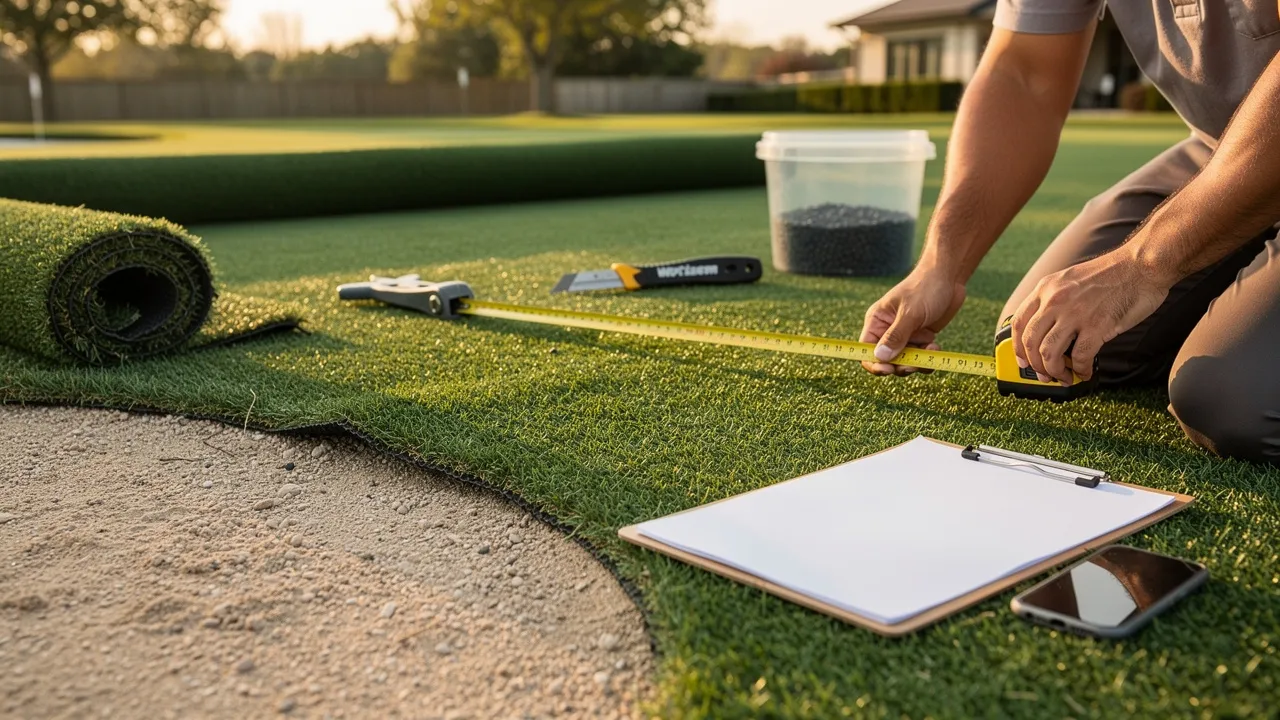
A preliminary project total begins with measured area, not an assumed package price. Measure each part of the proposed green and account for irregular shapes before multiplying anything. A simple rectangle may be calculated from length times width; curved or divided areas need to be measured in sections and added together.
Use separate budget lines for the main cost categories:
- Turf material: multiply the planned area by the selected turf price per square foot. For example, 500 square feet at $10 per square foot produces a $5,000 material estimate.
- Installation labor: multiply the planned area by the applicable labor rate. For example, 500 square feet at $8 per square foot produces a $4,000 labor estimate.
- Site preparation: list existing-grass removal, leveling, base construction, and drainage as separate questions or allowances rather than assuming they are included in the turf rate.
- Design and accessories: add contours, fringe, edging, cups, flags, drainage improvements, or other requested features only when they are part of your plan.
A 2025 guide reported $6.50 - $15.00 for ground leveling, debris removal, and drainage solutions, but that figure does not establish the same area basis as every other preparation estimate. Treat it as a dated planning reference and ask what unit and work scope a quote uses before placing it in your calculation.
A cost worksheet should show both the arithmetic and the inclusions. For example, a 500-square-foot plan could display the selected turf rate multiplied by 500, the labor rate multiplied by 500, and separate lines for removal, base work, drainage, shaping, and accessories. The worksheet is a planning aid; it is not a quote.
Base preparation may add about $4 - $10 per square foot, and installation labor may range from $2 - $7 per square foot in one planning reference. Those categories sometimes overlap in contractor estimates, so do not add both ranges automatically. Read each line as a description of included work before comparing totals.
The most useful first calculation is therefore a scope test: what area will be covered, what surface exists now, what base and drainage work may be required, and which golf-specific features are wanted? If any answer is unknown, mark that line as unresolved instead of hiding it inside a single per-square-foot assumption.
Use size and application to interpret published ranges
Putting-green size and application change how a per-square-foot figure should be read. A 2026 planning guide gives the following reported combinations of application, area, and installed cost:
| Putting-green application | Area | Reported installed total | Reported cost per square foot |
|---|---|---|---|
| Basic practice green | 150-300 sq ft | $2,200 - $4,800 | $14 - $22 |
| Par-3 backyard zone | 300-500 sq ft | $4,500 - $8,500 | $13 - $20 |
| Par-5 training layout | 800-1,200 sq ft | $10,000 - $18,000 | $12 - $18 |
| Large pro-style green with fringe | 1,500-3,000 sq ft | $18,000 - $36,000+ | $10 - $16 |
Each row describes a different application and size band. The figures are not a promise for a Kansas City-area project, and the plus sign in the final total means that the reported range extends above $36,000.
A second pricing guide places projects under 400 square feet around $30 - $35 per square foot, projects from 400 to 2,000 square feet around $25 - $30, and projects of 2,000 square feet or more around $20 - $25. The same guide explains that a compact green can carry a higher unit price because excavation, delivery, grading, and crew setup may cost nearly the same even when less turf is installed.
The difference between the table and those size bands is a reason to match scope before choosing a rate. A basic practice green may not contain the same contouring, fringe, drainage, or training elements as a larger design. An 800-square-foot entertainment green may include multiple holes, fringe, and shaped contours while spreading mobilization and foundation work over more surface area; its total price may be higher while its unit price may be lower.
For your preliminary budget, select the row that most closely resembles your intended use, then list every feature that makes your project different from that row. Do not use the lowest number merely because the square footage appears similar.
A 500-square-foot project illustrates why ranges should remain visible. One guide places a 500-square-foot backyard putting-green project near $7,500 - $20,000 when site preparation and contour work are included. Another reported professional-installation example places 500 square feet at $5,500 - $15,000. The different scopes and methods mean the figures should not be blended into a new average.
Use the range as a question prompt: does the proposed total include removal, base material, grading, drainage, contours, fringe, edging, labor, and cleanup? A quote that answers those questions is more useful than a single rate with no scope.
Separate a putting green from a basic lawn installation
A putting green has a different installation objective from a basic artificial lawn area: the finished surface must support a predictable ball roll, so the base, grade, turf, seams, and contours need to be considered together. A putting-green installed price reflects site preparation, design complexity, and access. A green that rolls true requires a stable base, quality turf, and precise installation.
Putting-green base construction can include excavation, 4-6 inches of compacted aggregate, and grading for drainage. A standard artificial-turf installation can use a compacted crushed-stone base of about 3-4 inches. Those depths are not interchangeable specifications for every property; the difference shows why your quote should identify the proposed assembly and the site conditions supporting it.
A general lawn estimate can therefore be a poor substitute for a putting-green budget. It may not describe the shaping, short-pile turf, ball-roll requirements, fringe, cup locations, or precision needed for your design.
Putting turf selection is another distinction between the two scopes. Quality putting turf typically uses a short pile around 3/8 inch to 1/2 inch so the ball rolls on top of the blades rather than sinking into taller fibers. The turf itself commonly represents about $6 - $14 per square foot for nylon or premium polypropylene systems. The material figure applies to those stated putting-turf systems, not to every artificial-grass product.
Contour work adds another layer. Shaping and screeding time increase as putting-green contours and elevation changes become more complex. A flat practice area and a multi-level design may occupy similar footage while requiring different preparation and installation work. Put the intended breaks, slopes, holes, fringe, and chipping areas on the design brief before comparing prices.
Map the site factors that move the rate
Artificial-turf cost can be affected by project size and scope, material and construction quality, site preparation, infill, layout and accessibility, and additional clearing or relocation services. A putting-green estimate should turn each factor into a visible question rather than leaving the entire effect inside a broad rate.
The main site and design checks are:
- Footprint and shape: Curves, tight spaces, seams, edging, and custom cuts increase installation complexity and labor compared with a flat, open lawn.
- Surface condition: Existing grass, soil, roots, debris, slopes, or drainage problems can change removal, grading, base, and water-management work.
- Turf and construction quality: Higher-quality synthetic grass costs more, and extensive cutting and shaping may add project time and anticipated cost.
- Infill: Infill adds weight, helps keep synthetic grass in place, protects blades from ultraviolet damage, and varies in cost and performance by option.
- Access: Difficult access may require additional time and equipment. Gates, stairs, long carries, and the need to move or remove other items can affect labor and mobilization.
A 2026 guide reports general turf cost at $2 - $15 per square foot, depending on quality, type, and supplier. The figure is for turf generally, not specifically for a short-pile putting system.
General artificial-turf planning ranges also vary by source and product population. One guide describes low, mid, and high ranges as $5 - $8 per square foot, $8 - $12 per square foot, and $12 - $18+ per square foot, respectively. Another source reports high-quality artificial-turf materials alone at $2 - $6.40 per square foot and says labor typically accounts for 50-60% of total project cost. Neither set of figures should be treated as a complete putting-green price.
Grass removal is another separate line. One planning guide places grass removal at $0.88 - $1.84 per square foot, depending on the method used. The rate does not include every possible excavation, grading, base, or drainage task, so it should not be used as a substitute for a site-specific preparation allowance.
The practical use of these ranges is diagnostic. If a draft estimate gives you one turf rate but says nothing about quality, shape, access, infill, removal, or drainage, the estimate is not yet detailed enough for a reliable comparison.

Audit the estimate by cost category
A putting-green estimate becomes easier to compare when materials, preparation, labor, and related work appear as separate categories. The categories below are planning references from different guides, so they are not a menu of amounts to add automatically.
| Cost category | Reported planning figure | What to ask about |
|---|---|---|
| Putting turf for nylon or premium polypropylene systems | About $6 - $14 per sq ft | Does the line cover putting turf only, or other materials too? |
| Materials in an early general turf reference | About $4 - $9 per sq ft | Which product and quality level does the figure represent? |
| Base preparation | About $4 - $10 per sq ft | Does it include excavation, aggregate, grading, and drainage? |
| Installation labor | About $2 - $7 per sq ft | Does labor overlap with preparation or other line items? |
| Site preparation for 1,000 sq ft of turf | $1,000 - $5,000 | What work and site conditions produce the allowance? |
The putting-turf figure comes from a guide describing nylon or premium polypropylene systems. The materials, base, and labor figures come from a separate planning reference that warns that categories can overlap. The site-preparation total comes from another source and is stated for 1,000 square feet of turf. Keep each population and unit attached to its own figure.
Estimate auditing means checking inclusions, not forcing every published range into one total. If a quote lists base preparation at $4 - $10 per square foot and labor at $2 - $7 per square foot, ask whether excavation, aggregate placement, grading, drainage, delivery, or crew setup already appears elsewhere. These categories sometimes overlap and should not be added without reviewing what each line includes.
Site preparation may include removing existing grass, leveling the ground, and drainage solutions. The work can be modest on one property and extensive on another. A $1,000 - $5,000 estimate for 1,000 square feet therefore needs to remain tied to its stated area and scope rather than being converted into a universal rate for your green.
Before comparing two totals, place them side by side and mark each line as included, excluded, or unclear. A lower total with missing drainage or base work is not directly comparable to a higher total that includes those items.
Price the golf-specific additions
Golf-specific additions should appear as defined scope lines because they can change both the area being priced and the labor required. Advanced contours and shaping are reported to add about $2 - $5 per square foot. That figure applies to the reported upgrade category, not to every type of grading or base work.
The design brief should identify whether you want:
- Advanced contours or elevation changes: mark their location and intended breaks so shaping and screeding can be discussed separately.
- Fringe or collar turf: reported at $6 - $12 per square foot of fringe area. Measure the fringe separately from the putting surface.
- A chipping or fairway zone: reported at $8 - $18 per square foot for that area. Identify the area rather than applying that figure to the entire green.
- Perimeter edging or mow strips: reported at $8 - $20 per linear foot, depending on material. Measure the perimeter length, not just the green’s square footage.
- Drainage beyond the base: French drains or catch basins are reported to often add $2 - $5 per square foot of green footprint. Ask whether the allowance covers design, materials, excavation, and connection work.
Lighting, hardscape accents, cups, flags, boulders, or retaining elements may also need their own scope lines when they are part of the design. The key budgeting rule is simple: price an added feature against the area, length, fixture, or other unit that actually measures it.
A feature list protects your preliminary total from hidden scope changes. Write down the number and location of holes, the width of fringe, any chipping or fairway area, the perimeter treatment, contour zones, and drainage improvements before requesting a price. Additional drainage systems, infill materials, and custom designs can add to installation cost.
A compact green with one simple practice area should be calculated differently from a shaped entertainment green with multiple holes and fringe. Avoid describing both projects as merely 500 square feet. The footprint is only one input; the feature schedule explains what the crew must build within and around it.
Choose between DIY planning and professional installation
DIY and professional installation are two available paths for artificial turf. We offer DIY and professional installation options for artificial turf.
| Decision factor | DIY path | Professional installation path |
|---|---|---|
| Pricing reference | DIY putting-green kits with interlocking base panels are reported at about $13 - $18 per square foot. | A complete project price should identify preparation, base, turf, labor, shaping, drainage, and accessories. |
| Reported kit size | About 200-500 square feet for the cited kits. | The scope can be designed around the property and requested application. |
| Base and grade | You must understand what the kit includes and what the site still requires. | A professional estimate should identify base preparation, grading, and installation details. |
| Main budgeting risk | The kit price may not represent site preparation, drainage, access, or additional features. | The estimate may still be incomplete if those items are not listed. |
The DIY figures describe kits with interlocking base panels, not every possible self-installed system. Professional installation does not remove the need for a detailed scope; it gives you a way to discuss site-specific base, grade, turf, and feature requirements.
DIY planning may fit when the area, kit contents, access, and base requirements are clearly understood. Professional help becomes more useful when the property has slopes, drainage questions, difficult access, complex contours, or a design where ball roll depends on precise grading and installation.
A cutting-corners warning also belongs in the decision. One source reports that cutting corners on product quality or installation can reduce realistic lifespan to as little as 5-8 years before visible wear, matting, or seam failure. That statement applies under those conditions and does not predict the life of every putting green.
Before choosing either path, compare the full scope: kit or turf, base, excavation, drainage, edging, shaping, tools, delivery, cleanup, and future infill needs. If the DIY price covers only a visible surface or modular kit, do not compare it directly with a professional total that includes site work.
Prepare a quote brief for a Kansas City installer
A Kansas City-area quote brief should give the installer enough information to separate measured work from assumptions. Prepare these details before requesting current pricing:
- Location and access: note whether the project is in Kearney, Kansas City, Overland Park, Olathe, Lee’s Summit, Lenexa, Liberty, or another nearby community. Describe gate width, stairs, long carries, driveway access, and any route restrictions. Difficult access can require extra labor and equipment and increase project time and expenses.
- Measurements: provide total square footage, dimensions of each irregular area, perimeter length, and the planned area for fringe or chipping zones. Precise measurement and accounting for irregular shapes improve the initial estimate.
- Existing surface: identify grass, soil, concrete, roots, debris, slopes, and any structures or landscaping that may need removal or relocation.
- Water and irrigation: show low points, current drainage paths, standing-water concerns, and irrigation lines. If an irrigation system is present, capping or removing sprinklers is a common installation step.
- Design: list the number of holes, intended contours, fringe, chipping or fairway areas, edging, cups, flags, and any lighting or hardscape features.
- Product questions: ask which putting turf, base material, infill, seams, and edging are included, and which items are allowances or optional additions.
A written brief makes two estimates easier to compare because each installer receives the same area, site conditions, and requested features.
Kansas City labor figures should be read with their stated definitions. One 2026 guide says labor usually adds $5 - $12 per square foot depending on project complexity and local labor rates, while the same passage reports a Kansas City skilled-labor average of $3.45 - $12 per square foot. Those figures use different descriptions, so ask whether a proposed rate covers installation labor only or also preparation and related work.
A national artificial-lawn estimate published for May 2026 starts at $16.08 - $19.74 per square foot and is customized by location, size, and project options. That figure describes artificial lawn installation rather than a Kansas City putting-green quote, so use it only as broad context and do not substitute it for a project-specific total.
Ask the installer to identify the included square footage, each preparation task, the proposed base depth, drainage work, turf product, labor, feature pricing, cleanup, and any exclusions. A quote that states its boundaries gives you a better basis for deciding whether the project is ready to proceed.
A standard installation sequence can include removing 3-4 inches of grass and soil, setting the grade for drainage, building a compacted 3-4 inch crushed-stone base, then rolling out, seaming, securing, infilling when required, and brushing the turf. If sprinklers are present, capping or removing them can also be part of the work.
The sequence is a checklist for discussing scope, not a universal specification for every putting green. Putting-green base descriptions may use 4-6 inches of compacted aggregate, and site conditions can change the excavation, drainage, and grading plan. Ask the installer to explain the proposed assembly for your soil, slope, access, and design rather than assuming that one depth applies everywhere.
Keep installation separate from ongoing care
Installation cost and ongoing care are separate budget categories. Ongoing maintenance expenses for synthetic turf are estimated at $200 - $500 each year in one guide. That figure is an estimate for synthetic turf generally, not a guaranteed annual cost for every putting green in the Kansas City area.
Ongoing turf requirements vary with usage and climate. Regular, low-effort tasks can minimize long-term expense, while infill replenishment may require periodic material purchases. Put routine care, occasional infill, cleaning, and any access needed for maintenance into a separate ownership section of your worksheet rather than adding them to the one-time installation rate.
An installation warranty covers labor and workmanship separately from the turf material. One source describes a 2-year installation warranty as a reasonable standard. Use that distinction when reading a quote: ask which issues concern installation, which concern the turf product, how long each coverage lasts, and what work or conditions are excluded.
Warranty questions do not change the initial square-foot calculation, but they clarify what the quoted installation line represents. Keep the answers with your project records so the installation scope and future care plan remain separate.
Seek qualified evaluation for complex site conditions
Complex site conditions deserve a property-specific evaluation before you rely on a per-square-foot estimate. Difficult access may require additional time and equipment, while demolition, debris removal, relocation, tree roots, sod or soil removal, and drainage corrections can change the putting-green cost. Tight gates, long carries, and stairs can also raise labor and mobilization costs.
Request an evaluation when your site has one or more of these conditions:
- poor or uncertain soil;
- a steep grade or multiple elevation changes;
- existing drainage problems or a low point near the planned green;
- tree roots or substantial sod and soil removal;
- a narrow gate, stairs, long material carry, or limited equipment access;
- a design with extensive contours, multiple holes, fringe, or drainage features.
On a difficult new-build site, excavation, grading, base construction, and drainage can account for 40-50% of the installation budget. Poor soil, steep slopes, limited access, or existing drainage problems can increase that share. That percentage applies to a difficult new-build site, not every putting-green project.
A complete project quote is necessary for accurate artificial-grass pricing. A 2026 New York City estimate places artificial-grass materials at roughly $2.26 - $9.01 per square foot and labor at $4.51 - $10.20 per square foot before separately charged expenses. Those figures apply to New York City and artificial grass generally, not to a Kansas City putting-green project, so they should not be transferred to your budget.
The useful boundary is broader: a rate without the property, application, included work, and current local conditions cannot establish your final price. For a complex Kearney or Kansas City-area site, give the installer your measurements, photographs or access notes, drainage information, existing-surface details, and complete feature list before judging whether an estimate is workable.
Request a project-specific putting-green quote
A useful putting-green budget has four parts: measured area, scope-matched installation references, separate lines for site and golf-specific work, and a current quote that identifies what each line includes. Use your square footage to build a preliminary calculation, but keep conflicting published ranges attached to their stated application and conditions.
Before you proceed, assemble the measurements, access notes, existing-surface details, drainage and irrigation information, turf preferences, contours, fringe, chipping areas, edging, and accessories. A qualified local installer can evaluate how those property conditions affect the design and final price. The goal is not to find a universal rate; it is to turn your proposed green into a clearly priced scope for a Kearney or Kansas City-area project.
Putting-green installation cost FAQs
How much does artificial turf installation cost per sq ft for a 1,000-square-foot putting green?
Published planning references report about $11,000 - $30,000 for a professionally installed 1,000-square-foot putting green. Another 2026 guide places an 800-1,200-square-foot training layout at $10,000 - $18,000. These figures are scope-dependent and may include different levels of preparation, contours, drainage, turf, and accessories, so they are not a quote for a Kearney or Kansas City property.
Why can two putting-green estimates with the same square footage differ substantially?
The estimates may cover different turf products, excavation, base construction, drainage, contours, access conditions, labor, fringe, edging, or accessories. Cost categories can also overlap; for example, a quote may include preparation within labor rather than listing it separately. Compare each estimate by included work, exclusions, units, and project scope instead of adding every published rate together.
Are DIY putting-green kit prices comparable with professional installation totals?
Usually not without checking the scope. Reported DIY kits with interlocking base panels cost about $13 - $18 per square foot for sizes of about 200-500 square feet, but that figure may not include excavation, drainage, access, tools, delivery, or added features. A professional total may include site preparation, a compacted base, precise grading, seams, shaping, and cleanup. Compare the complete work list before judging either option.
What is the difference between a turf-material warranty and an installation warranty?
A turf-material warranty concerns the synthetic-grass product, while an installation warranty concerns labor and workmanship. Installation coverage may address problems such as seam separation, base settling, or drainage issues traceable to the installation. One source describes a 2-year installation warranty as a reasonable standard, but the actual coverage, exclusions, and duration should be confirmed in the written project terms.
What ongoing costs should be kept separate from the installation budget?
Routine care, cleaning, infill replenishment, and potential repairs should be tracked separately from the one-time installation price. One guide estimates ongoing synthetic-turf maintenance at $200 - $500 per year, but that is not a guaranteed cost for every putting green. Usage and climate affect the care requirements, so ask which future tasks and materials the estimate does not include.