
What top dressing is meant to do for a putting green
Top dressing is a natural-grass putting-green maintenance practice that applies sand across the surface to dilute organic matter in the upper rootzone. The practice can also improve surface smoothness, firmness, and uniformity when the material, timing, and application fit the green’s condition.
Sand helps distribute that organic matter through the upper rootzone rather than allowing an excessive concentration near the surface. The purpose is not to cover a problem with a random layer of material; it is to manage the relationship between growing turf, sand, organic matter, water, and play.
Your green’s need for top dressing depends on how quickly the turf is growing and how much use it receives. Turf species, weather, fertility, and moisture also affect the maintenance requirement. A green receiving heavy play may need rapid growth to recover from ball marks and traffic, and rapid growth can create more thatch that requires management.
That makes top dressing a condition-based practice rather than a universal calendar task. It most directly concerns natural-grass greens with active growth and substantial play, where organic matter from growth and traffic needs management. Before choosing a material or interval, identify whether you are managing ordinary organic-matter accumulation, a surface that has become soft or uneven, a drainage concern, or an established soil layer. The answer changes what top dressing can reasonably address.
Use three questions to establish whether the practice is relevant to your green:
- Is the putting surface natural grass rather than a synthetic surface?
- Is the turf actively growing and producing organic matter that needs dilution?
- Are surface smoothness, firmness, thatch, ball marks, moisture, or traffic affecting the maintenance decision?
If you cannot answer those questions, collect information about the grass, rootzone, surface condition, and use pattern before selecting sand. A qualified professional can help assess the green when those details are uncertain.
Balance thatch, smoothness and firmness
Thatch is the layer of dead and living plant material just below the turf surface, and top dressing dilutes that layer with sand. A small amount of thatch helps a putting green receive shots and withstand traffic, so removing or eliminating all thatch is not the objective. Some thatch helps create a smooth, firm, stable, and resilient surface.
The maintenance problem begins when organic matter accumulates faster than the green can manage it. Excessive thatch can make the surface soft and spongy, increase foot-printing and rutting, and contribute to deep ball marks and undesirable putting conditions. An excessive layer can also retain too much water near the surface, creating conditions favorable to algae, moss, and annual bluegrass invasion.
Insufficient thatch creates a different problem. Turf with too little thatch can become prone to wear and disease because traffic and maintenance equipment compress tender turf against abrasive sandy soil. Top dressing therefore has to support a balance, not simply reduce a measurement as far as possible.
Surface firmness is closely tied to that balance. A high percentage of undiluted organic matter in the top 2 centimeters of the soil profile can produce a soft green even under dry conditions. Conditions closest to the surface affect firmness most, which is why a sand program has to be considered alongside growth, traffic, moisture, and the existing rootzone.
Look for patterns rather than treating a single symptom as a diagnosis. A surface that feels soft, develops deep ball marks, shows foot-printing, or holds moisture may indicate that organic matter and water movement need assessment. A surface that wears easily or shows disease pressure may point to a different imbalance.
Top dressing can support smoothness and firmness, but it does not guarantee a particular ball roll or playing result. A light and frequent program can help dilute surface organic matter, yet the amount and frequency still need to match the turf’s growth rate and the green’s management goals. The practical question is not whether more sand is always better; it is whether the planned application supports the surface without creating a new layer or imposing unnecessary stress.
Recognize when the issue is soil layering
Soil layering is a different problem from ordinary organic-matter dilution. A layer forms when materials with different physical characteristics restrict the movement of water through the rootzone. Even a small layer can create turf-health and playability issues because differing soil textures can slow infiltration.
More often than not, layering leads to excess moisture near the surface, shallow rooting, increased disease incidence and severity, and soft playing conditions. Uniform soils without layering allow water to move more freely and support good drainage, healthy turf, and firm conditions. If water remains near the surface after irrigation or rain, adding more material without understanding the profile can make the problem harder to resolve.
Top dressing alone cannot resolve existing soil layering. Cultivation is needed, and in most cases the cultivation must include removing material rather than simply burying the layer under more sand. The required cultivation program depends on the layer’s depth and severity, so the visible symptom does not determine the treatment by itself.
Buildup can also change the shape of a putting green over time. The change may be minor, but it can become severe enough to eliminate hole locations. Unless extreme care is taken, greens on courses more than 10 to 20 years old usually experience significant changes in shape, while it is rare to find a course 50 years or older without significant loss of hole locations. Those age ranges describe course observations, not a diagnosis of your green.
Treat the following combination as a reason to pause before applying more sand:
- Water remains near the surface or drainage has changed.
- The green is soft even when weather and irrigation do not explain the condition.
- Roots appear shallow, disease pressure has increased, or turf is declining.
- The surface profile may contain different materials or a previous layer.
- Contours, edges, or usable hole locations appear to be changing.
These signs do not identify the cause on their own. They indicate that profile assessment and, where appropriate, cultivation should be considered before a routine top-dressing application.

Choose sand for the existing rootzone
Topdressing sand should be selected after assessing the existing rootzone’s physical characteristics and evaluating how the green performs. Many topdressing sand mixes are used, so a bag labeled for putting greens does not establish that the material is compatible with your particular surface.
Start by documenting the conditions that the material is meant to address:
- Excess organic matter near the surface.
- Excess silt or clay.
- Water retention that is greater or lower than expected.
- Ruts from equipment or traffic.
- A surface that is excessively firm or soft.
- Deep ball marks or recurring surface damage.
The material choice should follow that assessment. Topdressing sand needs to be compatible with the existing rootzone, as determined by laboratory testing, because incompatible sand can restrict water movement and hold excess water near the surface. A material that appears similar in the hand can behave differently once it is incorporated into a distinct soil profile.
Sand-based greens with layering issues require particular care. The sand used for backfilling should be the same sand used in construction, and it should not contain organic matter when the goal is to support drainage. This instruction applies to sand-based greens with layering issues; it is not a universal blend recommendation for every putting green.
Do not choose material by color, price, or availability alone. Record the grass type, rootzone construction, visible surface condition, drainage behavior, maintenance history, and management goal. Those details give a turf professional or laboratory a basis for evaluating compatibility. Without them, an exact blend, application rate, or schedule would be guesswork.
Set timing around growth, weather and workload
Topdressing timing should follow turf growth, weather, moisture, fertility, grass type, and play volume rather than a single schedule. A light and frequent program is an important part of diluting organic matter at the surface, but the appropriate balance depends on the green’s condition and management goals.
Cool-season putting greens generally receive more frequent top dressing in spring and fall than during the heat of summer. Warm-season greens need more top dressing during hot summer months. In some regions top dressing may stop during winter, while other regions may require applications throughout the year. Every situation is different.
Heavy use can change the maintenance demand. When a green receives a lot of play, turf may need rapid growth to recover from ball marks and traffic. Rapid growth creates more thatch, which can increase the need for top dressing. A low-use green with slower growth may require a different approach from a heavily played green even when the two greens appear similar.
One cited guide recommends top dressing every 7 to 14 days to support thatch dilution, playability, and plant health. That interval is a source-specific recommendation, not a universal schedule for every natural-grass putting green. Use it as a point for discussion only after considering growth rate, species, season, weather, moisture, fertility, play volume, and the condition of the rootzone.
For ultradwarf putting greens, a separate management recommendation is to raise the height of cut by 25% heading into fall while the grass is actively growing, then raise it by another 25% heading into winter dormancy. That mowing guidance does not establish a top-dressing rate or timing; it illustrates why grass type and seasonal growth stage matter when you plan maintenance.
Frequent sand top dressing matched to turf growth rate can begin firming a green in two or three months, while a noticeable change in measured firmness and ball reaction generally takes 12 to 18 months. Those timeframes are reported for that specific maintenance context and should not be treated as a promise about your green’s appearance or play.

Coordinate application with cultivation and incorporation
Top-dressing application should be coordinated with the condition of the green and any cultivation planned for the same maintenance period. Core aeration removes organic matter and allows that material to be replaced with sand top dressing, making aeration an important part of some long-term maintenance programs. Aeration is not required for every application, and existing layering can require a more specific cultivation plan.
A general sequence may include these steps:
- Assess the surface, rootzone, moisture behavior, organic matter, and current playing condition.
- Select compatible material for the existing profile rather than choosing a universal blend.
- Coordinate cultivation with the condition being managed.
- Apply material consistently across the intended surface.
- Completely backfill aeration holes with sand when aeration is part of the work.
- Incorporate and distribute the material so high and low spots are not left uneven.
- Allow for the temporary disruption created by the operation before judging the longer maintenance effect.
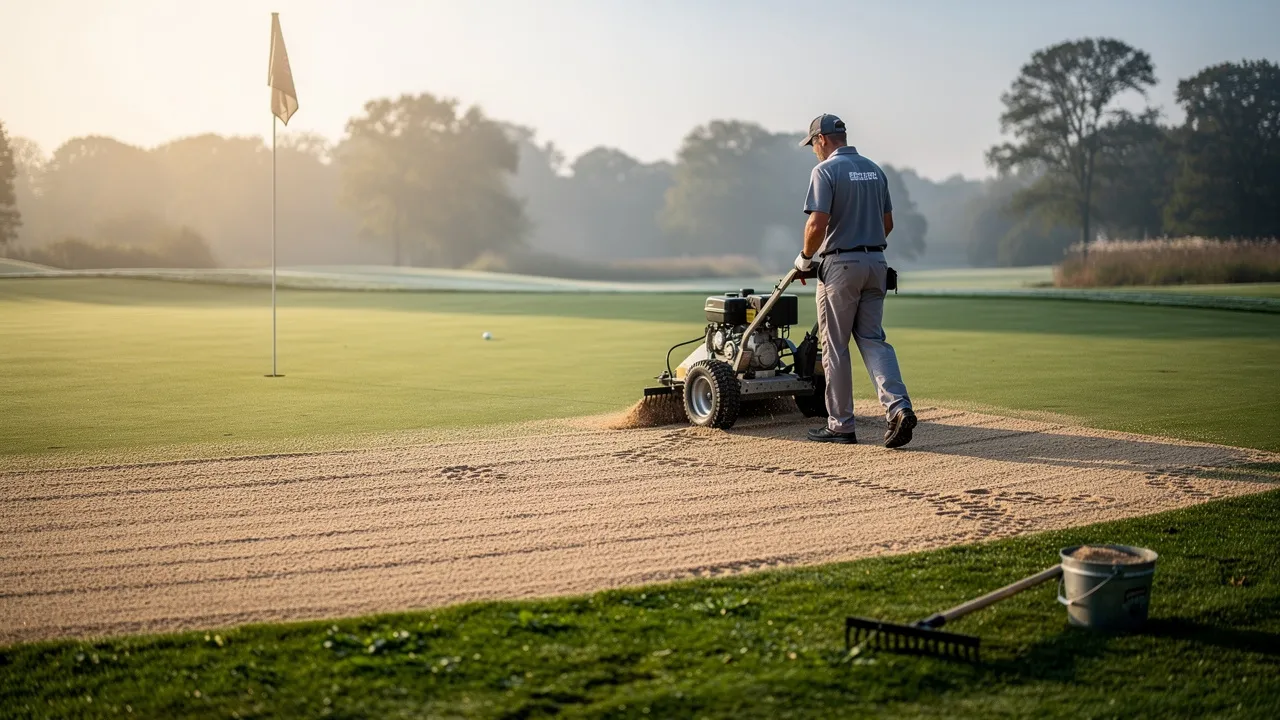
Proper top-dressing machinery helps produce a consistent application. Without suitable machinery, applications may be inconsistent and produce uneven results; a rake, leveling rake, or drag mat can help even out high and low spots of material, although each tool distributes material only as effectively as it is used.
Top dressing can occasionally disrupt play, so applications are often scheduled when fewer rounds are expected. Frequent applications may permit a low amount of sand per application and create less disruption to ball roll than a delayed application that requires more material at once.
Around 20% annual surface disruption has traditionally been used as a rule-of-thumb goal for maintaining organic matter levels, although some courses maintain firm conditions without reaching that threshold. Treat the figure as a planning reference, not a universal requirement. Your grass, rootzone, growth rate, use pattern, and management goals determine whether that approach fits.

Weigh regular applications against their trade-offs
Regular top dressing can help manage organic matter and maintain a smoother, firmer surface, but the practice has costs and short-term effects that belong in the maintenance decision. Top dressing can damage cutting units, temporarily reduce plant health or vigor, and cause a short-term lapse in greens performance. Schedule and material choices should account for those effects rather than treating them as unexpected failures.
Coarse sand particles harvested during mowing after top dressing can also contribute to long-term degradation of soil physical properties. That risk makes particle selection and compatibility more consequential than simply applying whatever sand is available. The intended benefit has to be weighed against what the mowing and rootzone system can tolerate.
Application frequency has its own trade-off. Using very low top-dressing rates more frequently subjects turf to physiological stress and requires substantial labor. Ultra-low volumes applied so frequently may not produce a tangible net benefit. That caution does not reject regular top dressing; it argues for matching rate and frequency to growth, organic-matter management, labor, equipment, and playability.
Use the following decision path:
- If organic matter is accumulating and the rootzone is compatible with the planned sand, a measured program may be appropriate.
- If the green is already showing layering, excess moisture, or shallow rooting, investigate the profile before adding more material.
- If the operation would create unacceptable disruption, coordinate the timing and application method instead of removing the practice without assessing the maintenance consequence.
- If the proposed rate is extremely low and the frequency is unusually high, account for turf stress and labor before approving the plan.
The practical target is a maintenance approach that fits the green’s condition. A lower rate is not automatically gentler, and a more frequent schedule is not automatically more effective.
Keep natural-grass and artificial-turf care separate
Natural-grass putting greens and artificial putting greens are different surface types, so natural-grass top-dressing guidance should not be transferred automatically to synthetic turf. Natural-grass top dressing works within a living turf and rootzone system where organic matter, thatch, roots, growth, and cultivation affect the decision.
Identify the surface before you plan maintenance, then use the care instructions for that synthetic system rather than assuming that sand intended for natural-grass organic-matter management is appropriate. The question is not whether a material looks like sand; it is whether the material and method belong to the surface you own or manage.
For a natural-grass green, document the grass type, rootzone, organic matter, moisture behavior, surface firmness, traffic, and ball-mark pattern before discussing top dressing. For an artificial green, document the turf system, infill or surface components, drainage base, seams, edges, and the maintenance instructions associated with that installation. Keep the two maintenance plans separate.
If you are unsure which surface you have, do not apply a natural-grass top-dressing program as a trial. Confirm the surface construction and its intended maintenance method first. A general putting-green label does not tell you whether a surface is natural grass or synthetic, and the wrong maintenance category can make the next decision harder rather than clearer.

Know when the green needs professional assessment
A putting green needs site-specific assessment when the rootzone, moisture behavior, material compatibility, or surface condition is uncertain. The assessment should connect what you observe on the surface with what is happening below it rather than treating every soft spot or ball mark as a top-dressing problem.
Seek qualified putting-green advice when you notice any of the following:
- Suspected soil layering or water that remains near the surface.
- Shallow rooting, increased disease pressure, or recurring turf decline.
- Excess organic matter, silt, or clay in the rootzone.
- Ruts, excessive firmness, excessive softness, or deep ball marks.
- Uncertainty about the sand used in construction or the compatibility of a new material.
- Contours or usable hole locations that appear to be changing.
- Uneven application results caused by unsuitable equipment or inconsistent incorporation.
The cultivation program for soil layering depends on the layer’s depth and severity. Material selection likewise depends on the existing rootzone and the green’s performance. Those dependencies are why an exact blend, application rate, or schedule should not be chosen from a general article alone.
Prepare useful information before the discussion:
- Identify whether the surface is natural grass or artificial turf.
- Record the grass type if the green is natural grass.
- Describe the rootzone or construction materials if known.
- Photograph soft areas, ruts, deep ball marks, standing moisture, and contour changes.
- Note irrigation, rainfall response, play volume, mowing, aeration, and previous top-dressing activity.
- Describe the outcome you are trying to manage, such as organic-matter accumulation, firmness, smoothness, or drainage.
This record gives a qualified professional a clearer basis for deciding whether top dressing, cultivation, testing, or another maintenance step belongs in the plan.
Plan the next maintenance discussion
Top dressing is relevant when you have a natural-grass putting green and a condition-based reason to manage organic matter, thatch, smoothness, firmness, or surface uniformity. The sound next step is to identify the surface, document the rootzone and current condition, then discuss compatible material, timing, cultivation, incorporation, equipment, and expected disruption.
Do not use top dressing as a substitute for investigating established layering, abnormal moisture, or changing contours. Do not choose an exact blend, rate, or schedule without the grass type, surface condition, climate, rootzone, and management goals. A qualified putting-green professional should decide individual site suitability from those conditions.
For a new backyard green, we offer installation of backyard putting greens for golf lovers.
Putting-Green Top-Dressing FAQs
Can top dressing correct a putting green with drainage problems?
Not by itself when the problem is established soil layering. Adding more material can bury the layer and make it harder to resolve; cultivation, potentially including material removal, may be needed, with the approach depending on the layer’s depth and severity. Persistent surface moisture, shallow rooting, or soft conditions warrant profile assessment before another application.
What information should be ready before planning top dressing for a putting green?
Record whether the surface is natural grass or synthetic, the grass type and rootzone if known, moisture behavior, organic-matter or thatch concerns, traffic, ball-mark patterns, previous applications, and any aeration or cultivation. This information helps determine whether top dressing, testing, cultivation, or another maintenance step is appropriate and helps identify compatible material.