
Define “best” by the putting result you need
The best artificial turf for a putting green depends on your practice goals, not on a single product label or specification. A surface for occasional family games has a different job from a practice green used to repeat distance control, start-line work, and breaking putts.
Your project also has to fit the property. A green in a Kearney backyard may face different space, drainage, shade, access, and maintenance conditions from a commercial installation in Kansas City. The visible turf is only one part of the playing system. Infill, backing, base construction, seams, edges, water movement, and the installation plan all affect what you receive.
Compare each proposal against the same questions:
- What type of putting practice will you do most often?
- Who will use the green, and how frequently?
- Do you want a forgiving recreational surface, a practice-oriented surface, or a feature that gives appearance greater weight?
- What speed, firmness, and ball response do you want to target?
- How much routine brushing, clearing, and infill care will you accept?
- What site conditions could change the base, drainage, access, or labor scope?
Putting-green options should be compared using consistent criteria that include intended use, construction, infill, and project requirements. That approach gives you a defensible shortlist without pretending that one turf type works for every golfer, yard, or commercial setting.
Start with putting-specific surface construction
Putting-green turf is a synthetic surface designed to mimic the roll of a real green. Its very short, dense pile is intended to provide a consistent, smooth roll, unlike general landscape turf, which is designed to look and feel like a lawn.
Putting-green turf is typically between 3/8 and 5/8 of an inch, whereas general landscape artificial turf has a pile height of 1.5 inches or more. The same guide says landscape turf at 1.5 inches or more creates too much resistance for putting and produces slow, unpredictable ball response. Treat those figures as comparison guidance, not as a substitute for the specifications of the proposed product.
Pile height affects the way the ball interacts with the fibers. Shorter pile, closer to 0.5 inches, reduces friction and improves control and speed. Taller pile, toward 1.5 inches and above, increases cushioning but introduces more variability in roll. Lower pile heights with heavier face weight favor consistent ball roll, while fringe and hybrid products can serve adjacent play areas where you want a visual transition or a different surface response.
Ball speed is a function of pile height, fiber material, density, and infill. Short fibers and high fiber density can produce faster, more consistent speeds by reducing deformation and surface drag. High-density turf also helps limit footprints and low spots. A design guide describes monofilament fibers as an option for a smooth, upright surface that supports consistent ball roll.
Ask for the complete profile rather than a single height number:
- Pile height and the measurement method used.
- Face weight and any published density information.
- Fiber structure, such as monofilament or another construction.
- Whether the product is made for putting rather than general landscaping.
- The backing and infill system specified for that turf.
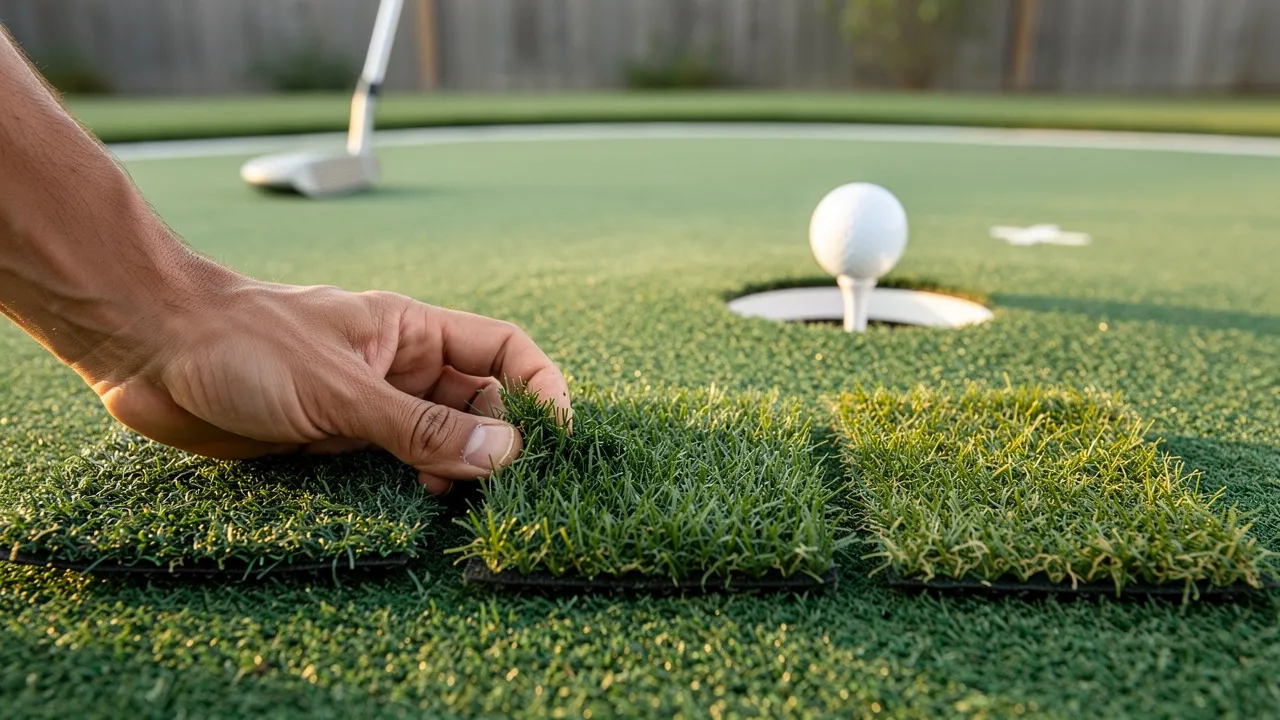
- A sample large enough for you to observe ball response.
One product guide lists examples ranging from 0.62 inches for Pro Putt 42 to 1.875 inches for Luxe Flow 75. Those are examples from that guide’s product range, not a recommended range for every putting green. Use the narrower putting-specific profile as the starting point, then compare the proposed turf with your intended speed, use, and surrounding design.
Face weight measures the ounces of yarn per square yard above the backing, and higher face weight generally means a denser lawn. Face weight is useful for comparing construction, but it should be read alongside pile height, fiber structure, density, backing, and infill rather than treated as a standalone putting-quality score. A proposed product sheet should identify those measurements for side-by-side comparison.
Compare fiber materials by play and exposure
Nylon and polyethylene differ in the way they are described for repeated use, firmness, and heat exposure, so fiber material belongs in the comparison rather than being treated as a minor product detail.
| Criterion | Nylon | Polyethylene |
|---|---|---|
| Surface feel and response | Supports a firmer playing surface when the complete system is properly specified | May suit a project where softer feel or a different landscape treatment has greater weight |
| Heat exposure | Has a higher melting point and is described as a strong choice for putting greens and [heat-exposed areas | Polyethylene turf starts](https://gogreensynturf.com/blogs/resources/nylon-artificial-turf-vs-polyethylene-when-to-choose) to soften and change shape at around 175 degrees Fahrenheit |
| Decision question | Does repeated putting, foot traffic, reflected sunlight, or a firm practice response make resilience a priority? | Does the proposed system have a documented reason for using polyethylene on this specific green? |
Nylon artificial grass has a higher melting point than polyethylene, providing more margin in heat-exposed conditions. Polyethylene starts to soften and change shape at around 175 degrees Fahrenheit. That figure describes the guide’s material comparison; it is not a prediction of the temperature at your property or a promise about a particular product.
Consider exposure as well as play. A sunny backyard, a green beside reflective glazing, and a shaded commercial courtyard create different questions. Ask how the proposed fiber is expected to behave in the actual location, and request product documentation rather than assuming that a material label settles the decision.
A separate guide says good materials combined with correct installation routinely deliver 15+ years of service in residential settings. That statement is a general residential expectation, not a warranty or lifespan promise for your project. Treat installation quality, care, exposure, and the product’s written terms as separate parts of the decision.
Polypropylene has a slightly stiffer feel, can appear plastic if the pile is too short, and is more prone to flattening than polyethylene or nylon. Polypropylene can underperform compared with polyethylene or nylon as a primary fiber in hot, sunny sites. UV-stabilized fibers and backings with documented testing address UV exposure and fading. A hot, sunny site therefore calls for documented product testing rather than a decision based on a material label alone.

Treat speed as a target, not a product promise
Stimp rating measures how many feet a golf ball rolls on your putting surface during testing.
Backyard speed recommendations differ. Another guide reports typical speeds of 8-10 for backyard greens and 10-13 for real golf greens. A separate guide aims for 10-11 on a Stimpmeter for more realistic gameplay. These figures represent different targets and standards, not a single universally best setting.
Choose the target from the practice result you want:
- Course-style or advanced practice: A faster target may be appropriate when you are deliberately practicing pace and break, provided the rest of the system supports it.
Do not approve a product because its listing gives a speed number without explaining the test conditions, turf profile, infill, and installation assumptions.
Put your speed target in writing before comparing proposals. Ask whether the target refers to a finished installed green, what surface area was tested, and how the contractor expects the turf and infill to work together. Test several putts from different directions if a sample is available. The goal is a playing result that matches your practice, not the largest number in a product description.

Evaluate infill as part of the whole playing system
Putting-green turf commonly uses infill to support the fibers and stabilize the playing surface. Silica sand is a typical infill material, but the appropriate type and amount depend on the turf system and project.
Infill weighs down the turf, helps keep fibers upright, and influences ball speed. Too little infill can make a green feel bouncy, while too much can make it play faster than you want.
Treat the turf and infill as a matched pair. Your comparison should cover:
- The infill material and why it is specified for the selected turf.
- The intended depth or application amount.
- How the material will be distributed across slopes, edges, seams, and cup areas.
- Whether the infill is expected to support a stated speed target.
- How the surface will be brushed, leveled, or replenished during care.
- What condition should prompt an adjustment rather than another layer of infill.
Around 0.5 to 0.75 inches is a putting-green pile-height reference; short pile rolls true and fast, while taller pile slows and causes the ball to wander. That guidance shows why infill should not be used to compensate for a turf profile that does not suit putting.
Ask for a sample with the proposed infill, not only a bare turf swatch. Roll balls from more than one direction and compare pace, firmness, and response near the edges. If the proposal gives an infill quantity, record whether it describes the complete green, a particular product, or a general installation approach. The stated amount should remain tied to the specified turf and the project’s conditions.
Installation guidance recommends spreading and brushing silica infill in multiple passes to achieve the desired depth and density and help provide coverage and compaction. After initial application and brushing, the finished surface should be inspected for even distribution and desired depth, with more infill added where areas appear sparse or need additional support. Golf balls can be rolled across the finished putting green after infill is evenly distributed and brushed in to test ball roll and surface performance. Ball behavior can then be observed and the infill amount adjusted if needed, with the goal of a smooth, consistent, and true ball roll.
Match the turf profile to the green’s users
The green’s users should determine the balance between roll consistency, durability, appearance, and maintenance. Practice greens prioritize durability and consistent roll, while showpiece greens may place more weight on appearance. Recreational putting turf is different from material intended for a scratch golfer; recreational turf is generally slower than professional turf, while professional-grade turf needs regular grooming and leveling of the infill.
Use this comparison to identify the trade-offs before you choose a profile:
| Project profile | Put more weight on | Trade-off to recognize | Questions to ask |
|---|---|---|---|
| Regular individual practice | Repeatable roll, shape retention, and a usable speed | A denser, firmer surface may require more deliberate care | Does the turf support repeated practice and the target speed? |
| Family or occasional recreation | Forgiving pace, approachable layout, and practical maintenance | A slower or softer setup may not reproduce advanced practice conditions | Will the surface suit different skill levels and the care you will perform? |
| Landscape feature with putting included | Appearance, transitions, and coordination with adjacent areas | Fringe or hybrid turf is not the same as putting turf | Which areas are for putting, and which are for circulation or visual framing? |
| Commercial or shared use | Density, shape retention, access, edges, and maintenance planning | Repeated traffic may increase care and installation requirements | How will the system handle traffic around cups and access routes? |
Landscape turf examples range from 38 oz for Bermuda to 75 oz for Luxe Flow 75. Those figures describe that guide’s landscape examples, not a universal face-weight threshold for putting greens. Use face weight as one comparison point alongside pile height, density, fiber, backing, and infill.
A 3/16 inch gauge or tighter gives a smoother, denser surface. Ask whether the proposed gauge applies to the putting turf itself and whether the product documentation defines the measurement consistently.
Drainage claims require special care in the Kansas and Missouri context. A Florida-focused guide says superior putting-green products can allow water to pass through at rates exceeding 30 inches per hour per square yard, helping a green dry after a storm and limiting soft spots or standing water. Because this rate comes from a Florida-focused source, it does not establish how a proposed system will perform in Kearney or Kansas City.
Check the backing, base, seams, and water path
The backing, base, seams, edges, and water path determine whether the visible turf has a stable platform. A stable, wrinkle-resistant backing helps avoid ripples and humps that can throw putts offline, while the base and installation affect how the surface behaves.
A good artificial putting green needs a smooth, non-directional putting turf surface, a firm and carefully graded base, and clean seams and edges working together.
Drainage can be more challenging for a putting green because the system may require more infill depth and the turf carpet may not have the perforated backing used by other synthetic turf systems. Without a properly pitched base, water can puddle. That makes the water path a design question, not merely a turf specification.
Walk the proposed site in Kearney, Kansas City, or the surrounding area with these questions in hand:
- Where does water come from during a heavy rain?
- Where will water leave the green?
- Does the existing yard have low areas or signs of pooling?
- How will the layout work with downspouts, paths, patios, fences, and access routes?
- Will the green receive enough sunlight for the planned setting, and how will shaded areas be managed?
- Can players and maintenance equipment reach the surface without crossing delicate edges?
- Where will seams, cups, transitions, and retaining edges be placed?
Slopes of 1-2% are described in one guide as suitable for gentle breaks, and slopes should direct water away from the green to help prevent pooling and maintain turf integrity. That figure is a planning reference rather than a universal construction instruction. The appropriate grade depends on the design, drainage arrangement, existing elevations, and installation details.
One installation sequence starts by clearing debris and vegetation and digging down approximately 6 inches to create a solid base for drainage and stability. Do not turn that sequence into an automatic prescription for your property. Use it as a prompt to ask what excavation, base preparation, grading, and drainage work the proposal includes and why.
A weed barrier over crusher dust is described as helping prevent weeds from penetrating the putting green and keeping the surface low-maintenance. Seaming putting-green turf is described as very hard, and making the seam line disappear is described as near impossible; installation guidance says seams should be avoided. Quote requests should identify the planned seam approach and weed-control layers instead of leaving those details outside the scope.

Include maintenance and project complexity in the comparison
Artificial putting-green turf requires less routine care than natural grass and does not require mowing, fertilizing, or watering schedules. Maintenance can still help preserve consistent ball roll, appearance, and performance.
Your care comparison should be specific enough to affect the choice:
- Clear leaves, dust, silt, and other debris from the surface.
- Brush the turf as directed so the synthetic blades remain upright and evenly balanced.
- Watch for changes in pace, softness, low spots, seams, or areas around cups that receive repeated traffic.
- Ask how infill should be checked, leveled, or replenished.
- Identify which cleaning products and tools are suitable for the proposed system.
- Decide who will perform routine care for a residential, commercial, or shared-use green.
Regular clearing and proper brushing help keep synthetic blades upright, clean, and evenly balanced. Removing dust, silt, and leaves helps preserve true-roll characteristics and limit moisture-related wear. Those actions are maintenance steps, not a promise that every surface will maintain identical performance without inspection.
Project complexity also changes the comparison. Putting-green project cost varies with turf material, base and drainage requirements, labor and installation complexity, and selected features or accessories. A flat, accessible layout with straightforward edges is a different scope from a contoured design with difficult access, drainage work, multiple cups, fringe, lighting, or other features.
Ask each proposal to separate the surface, foundation, drainage, labor, features, and ongoing-care assumptions. A lower headline number may represent a narrower scope rather than a different value from a more complete proposal. Compare what each price includes before comparing the amounts.
Lifting or gapping at a seam is described as a quick professional repair when addressed early, so the care plan should state how seam problems are reported and handled. A targeted infill top-up plus brushing usually restores the look and feel of fibers matted by high-wear arcs such as children’s play routes and dog sprints. A maintenance comparison should identify high-wear areas even when the primary purpose of the green is putting practice.
Build a quote-evaluation checklist
A quote-evaluation checklist turns your preferences into questions that can be answered side by side. Prepare the same project brief for each proposal so that differences in turf, installation scope, and assumptions remain visible.
Include these items in your request:
- Intended use: Describe who will putt, how often the green will be used, and whether the priority is recreational play, repeated practice, course-style training, or appearance.
- Layout: Provide the approximate footprint, shape, number and location of cups, desired breaks, fringe areas, access routes, and nearby features.
- Turf profile: Request the product name, pile height, fiber material, fiber structure, density or face-weight information, gauge, backing, and whether the turf is designed specifically for putting.
- Speed target: State the target you want to discuss and ask how the proposed turf, infill, installation, and testing method support it.
- Infill plan: Ask for the material, application approach, expected amount, distribution method, and future care requirements.
- Foundation and water path: Ask what clearing, excavation, base preparation, grading, drainage, compaction, and edge work are included. Ask which site conditions could change that scope.
- Seams and transitions: Request the planned seam locations, edge treatment, cup installation, fringe connection, and approach to areas that receive repeated foot traffic.
- Documentation: Ask what product certifications, CAD files, testing documentation, installation instructions, and written product terms are available for the proposed system.
- Sample testing: Test samples when possible. Compare ball response, firmness, speed, appearance, and the interaction between turf and infill before approving a profile.
- Care and project handoff: Ask what brushing, clearing, infill maintenance, cleaning, inspection, and repair tasks the finished system requires.
Match pile height, fiber type, density, and infill to your performance and environmental requirements. Testing samples and consulting suppliers can help you determine whether a chosen product meets your performance targets before installation.
One putting-green installation approach uses 4 inches of road base followed by 1 inch of crusher dust to create a firm foundation and smooth playing surface. Treat those dimensions as that sequence’s specified approach, not as a universal design for every Kansas City-area site. The same installation guidance specifies 2 to 2.5 pounds of fine silica sand per square foot. Ask whether any proposed quantity applies to your exact turf, infill, base, and layout before using it in a scope comparison.
Hall Turf describes itself as a licensed contractor, so a Hall Turf quote request can include a question about the proposed installation scope and contractor status relevant to the project. Product certifications, CAD files, and testing documentation should be requested for the specific system being proposed rather than treated as interchangeable paperwork.
Seek professional evaluation when site or performance questions remain
Professional evaluation becomes more useful when the site, speed target, or installation method remains uncertain after you compare the specifications. A green’s performance is stated in one 2026 cost guide as 90% dependent on base construction, and the same guide says most homeowners find professional installation necessary for true ball roll without erratic bounces.
Pause before approval if any of these questions remain unanswered:
- Can the proposed base remain firm and accurately shaped under the expected use?
- Where will rainwater go, and what happens if the site currently holds water?
- Can the desired breaks and speed target be achieved without creating an unusable or inconsistent surface?
- What equipment is needed for compaction, grading, seams, infill, and testing?
- Does the proposal explain who is responsible if site conditions change during preparation?
- Can you compare the finished system rather than only the turf roll?
DIY installation is possible, but it carries a different performance burden from purchasing materials. A 2026 cost guide says self-installation materials typically range from $5 to $15 per square foot. That figure covers materials, not total project cost or equivalent performance.
Use DIY only when you can control the site, understand the proposed construction sequence, obtain the required equipment, and accept responsibility for the finished result. If drainage, grading, undulations, access, or consistent roll remains unresolved, request a site-specific assessment before selecting the turf.
Achieving a rock-hard surface and precise undulations is described as requiring specialized compaction equipment and laser-leveling expertise. A site assessment should clarify which equipment and preparation steps are included when a proposal promises shaped breaks or a firm, consistent roll.
Turn the comparison into a Kansas City-area consultation
Your comparison is ready for a project discussion when it identifies the intended users, speed target, turf profile, infill plan, site conditions, drainage questions, maintenance expectations, and installation scope. Bring your layout, photos or measurements, preferred practice result, and unanswered questions so the discussion can focus on the actual green rather than a generic product label.
For a Kearney or Kansas City project, we offer installation of backyard putting greens for golf lovers. We recommend a consultation on the options for putting-green installation so the turf, infill, base, drainage, and design can be considered together. A qualified professional should decide whether the proposed system fits your site-specific conditions and performance requirements.