
Start with the roll you want to create
Putting greens turf is built for ball roll, not simply for the appearance of a lawn. An artificial putting green uses a short, dense synthetic pile designed to mimic the smooth, consistent roll of a real green, while landscape turf generally serves a different purpose. That distinction gives you the first filter for comparing systems: start with how you want the ball to move, then assess the surface, infill, base, drainage, and finish that can support it.
A Stimp rating gives you a way to describe speed. The average Stimp rating on a home putting green is 9-11 feet, meaning the ball rolls that distance after release at a set speed; higher ratings mean faster ball roll. Brushing with a putting-green roller can lower the rating, while adding more infill can raise it, although the effect depends on the selected system. Treat the number as a design target rather than a promise about an uninspected property.
Your intended use should determine the next question. A green for occasional family practice may call for a different turf approach from a green used for structured training or serious practice. Recreational putting turf is very different from material intended for a scratch golfer, and professional-grade turf can require more grooming and infill management. Write down who will use the green, how often you expect to practice, and whether you want a forgiving roll or a more demanding practice surface before you compare products.
Set a practical speed target before comparing systems
A Stimp rating measures the distance, in feet, that a golf ball rolls across a flat section of green after being released at a set speed. A green that rolls 10 feet is a 10 on the Stimp. The measurement helps you describe the playing surface, but it does not tell you whether the speed suits your practice goals, layout, or maintenance capacity.
For a backyard green, one guide recommends considering a Stimp speed between 8 and 10 feet and starting near 8 for a more forgiving surface. Another guide reports an average home putting-green rating of 9-11 feet. Those ranges differ, so use them as reference points rather than as a universal specification. Ask for the target speed of the actual surface you are considering.
American golf-course Stimpmeter readings generally range from 7 feet to 12 feet, depending on factors such as slope, contours, green size, grasses, weather, and budget. A championship-course range is a different use case from a backyard practice green. The USGA says a Stimpmeter is not intended for course comparisons, so another course’s speed should be treated as a starting point rather than copied directly.
Faster is not necessarily better. Keeping green speed above 10 feet consistently usually causes difficult-to-manage turf problems and is not recommended; championship-course speeds can range from 10 to 13 feet. Choose a target that matches your users and routine instead of choosing the highest number available.
Use these questions to turn a general speed preference into a project requirement:
- What speed should the finished green target?
- Is that target appropriate for casual practice, regular training, or more demanding play?
- Which surface is being used, and what Stimp range does its manufacturer publish?
- How will the installer set the speed through the surface, infill, brushing, or rolling?
- Will the green be measured in a defined test area and in both directions at handover?
Record the answer with the proposed system. A documented target is more useful than a description such as “fast” or “course-like.”
Stimpmeter testing also needs controlled conditions when the test area is reasonably level; testing up or down a slope or over mounds can produce misleading data. Initial testing should use a cleanly mowed, dry, smooth surface on a calm day. Separate notes should identify whether later readings were taken on a wet, non-mowed, recently rolled, or frequently rolled surface, because those conditions can change the recorded speed. Time of day and recent topdressing are additional conditions worth recording when comparing readings. This distinction matters when a quoted speed and a later homeowner check do not match: the difference may reflect the test conditions rather than a change in the turf system. Ask the installer to record the test area and relevant surface conditions alongside the handover speed. A condition-matched baseline gives the homeowner a clearer reference for deciding whether brushing, rolling, or other permitted maintenance has changed the playing speed.

Match turf and infill to skill level and upkeep
Putting-green turf systems differ in how they create speed, support the fibers, and demand care. Recreational turf is generally slower than professional turf, and professional-grade turf needs regular grooming with its infill regularly leveled. Some products are designed to work without infill, while other systems use infill as part of the playing surface. Compare the system as a whole rather than comparing pile height or turf color by itself.
| System consideration | What it changes | What you should ask |
|---|---|---|
| Recreational or higher-performance turf | The expected roll, skill demand, and care routine | Is the surface intended for casual practice or a more demanding practice target? |
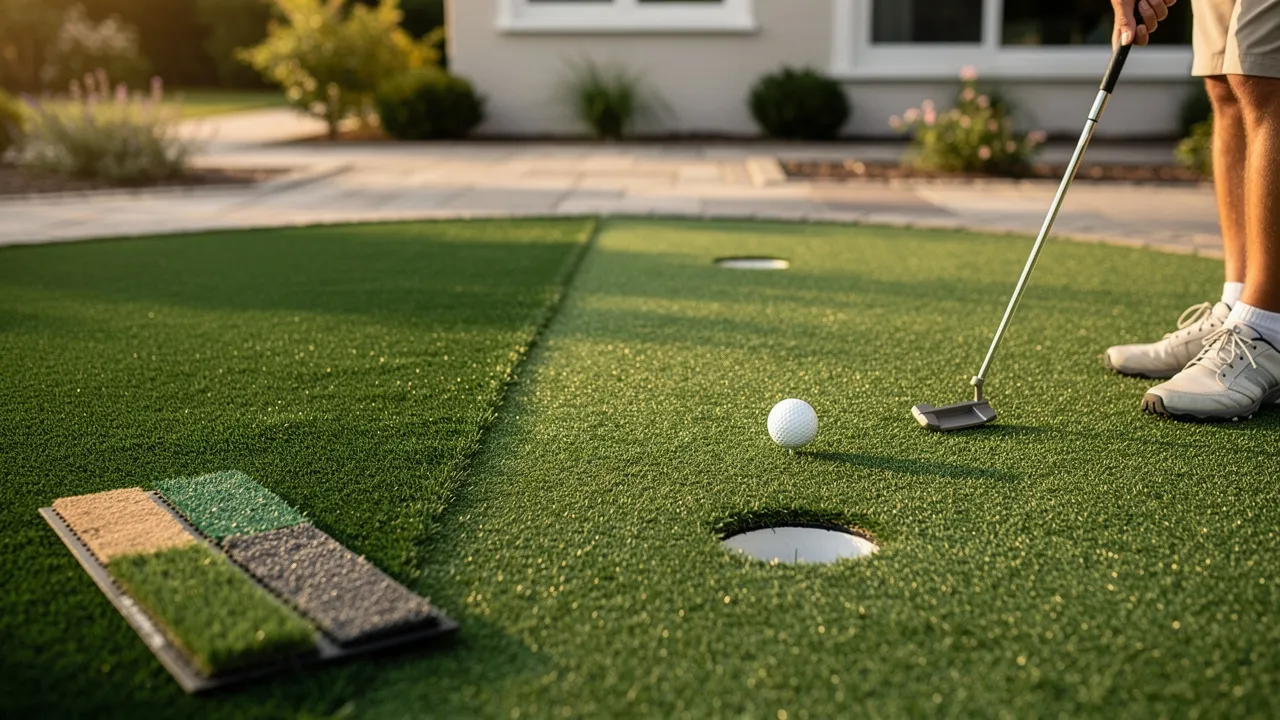
| Texturized surface | A short pile of about half an inch and about 1.5-2.5 pounds of Envirofill 30/50 per square foot for this configuration | What pile height and infill specification apply to this product? |
| Sand-filled surface | A taller 1-1 1/4-inch pile and, for this configuration, as much as 4-6 pounds per square foot of round raw sand ballast topped with 1/2-1 pound of 16/30 Envirofill per square foot | What material, amount, and brushing method does the selected system require? |
| No-infill product | A system that may operate without infill, although compatible infill may be used for feel or fiber support | Is infill required, optional, or unsuitable for this surface? |
The quantities shown apply to the specific systems described in the table, not to every putting surface. Use the selected product’s specifications for the actual installation.
Putting-green speed can be adjusted by varying the type and amount of infill; denser infill rolls faster than looser infill. Too much or too little infill can leave an uneven surface that affects ball roll. Moisture also slows the roll, and a cited guide reports ratings from 9 to 12.5 for two nylon surfaces, so the turf’s published range matters before you discuss adjustments.
A backyard putting-green guide recommends starting near 8 for a more forgiving surface, then adjusting pile height and infill density to dial in faster speeds as putting skills improve. That approach only applies when the selected system is designed for those adjustments. Ask whether future brushing, rolling, or infill changes are permitted by the product specification, and ask how those changes affect the care routine.
Choose the lower-maintenance path when your priority is convenient recreational practice and you do not want a recurring grooming task. Choose a more adjustable or professional-grade system when you will use the green often enough to measure and maintain its speed. In either case, ask for the required grooming method, infill depth, and speed-setting process before treating the turf as suitable for your project.
Check how the property supports the target roll
The playing surface depends on the material beneath it. The subgrade should be smooth and firm, match the general slope of the finished grade, and have no water-holding depressions.
Before you compare systems, inspect the proposed footprint for existing dips, soft areas, standing water, clay-heavy or heavily compacted soil, the relationship to the house and hardscape, and access for aggregate or equipment. Use those observations to frame the base and drainage scope for the selected system.
Drainage requires both surface pitch and a sub-base that lets water exit. A putting green that holds water can grow moss, soften underfoot, and eventually heave. Use clean rock and sand for drainage materials; limestone chat, decomposed granite, or other permeable imported materials are recommended. On clay or heavily compacted soil, extra drainage under the base may be needed so water does not pool.
Ask how water will leave the proposed green during heavy rain, where the outlet will be, and whether the base needs additional drainage. Do not treat fast-draining turf backing as a complete drainage plan; water still needs a route through the base and away from the site.
USGA putting-green drainage guidance provides a technical reference for larger or more engineered installations. The guidance places lateral drain pipes not more than 15 feet apart, specifies a minimum continuous slope of 0.5 percent for drain pipes, and specifies a gravel layer with a minimum depth of 4 inches. Those dimensions belong to the cited USGA construction guidance and should not be copied into every residential project without a site and system assessment.

Match installation scope to the selected system
Installation details determine whether a selected system can deliver its intended roll and upkeep. Confirm that the proposed base, seams, edge restraint, cup areas, and infill treatment match the product specification.
For a speed-focused comparison, ask how the target Stimp range will be established, whether the surface permits later brushing, rolling, or infill adjustment, and how the finished speed will be checked. At handover, the test stretch, rolls in both directions, and recorded result can provide a baseline for later checks.
This keeps turf selection tied to the complete playing system rather than to the turf surface alone.
Avoid a thin, uncompacted, or uneven base, ignored slope, mismatched grain direction, rushed seams, under-secured edges, and uneven or incorrectly measured infill. These are construction decisions, not cosmetic details. Ask which parts of the proposed scope address compaction, grading, drainage, seams, edge restraint, and grooming rather than accepting a quote that names only the turf product.
Depending on usage and care, a quality synthetic-turf putting green can last as long as 25 years. That expectation depends on the complete system and its care, not on the turf roll alone.
Site shape can also change scope. One cited cost example lists perimeter and interior drainage at $200 - $1,500 depending on lot slope and runoff paths, while another source says curved or sloped yards may see installation costs increase by 15% to 20% because of additional materials and labor. Treat those figures as planning references from their stated examples, not as a Kansas or Missouri quote.
Choose contours and cups for the way the green will be played
Cup placement and contour design should serve your practice goals. Most residential putting greens have 3-5 cups, and cup placement can create interesting putts that require you to read breaks across the green’s contour. Decide whether you need several starting points, longer putts, chipping practice, or a simple surface for repeat practice before adding tiers, fringe, or shaped breaks.
A three-cup, single-tier green is a lower-cost configuration than one with additional cups or tiers, but that does not make it suitable for every property. A larger layout may give you more practice positions, but every additional contour or feature adds design, base-shaping, finish, or drainage questions.
Cup stability belongs in the construction discussion. Putting-green cups in compacted dirt can shift or settle from rainwater, foot traffic, and repeatedly pulling the flag in and out; placing cups in concrete is recommended. Ask how the cup sleeves will be supported, how the surrounding grade will be finished, and how the installation will keep the cup area consistent with the rest of the green.
Cup and break design can add $150 - $500 per cup plus contour labor. For planning, an installed regulation 4.25-inch cup with a removable flagstick is priced at $150 - $250, while contour-break labor adds $2 - $4 per square foot over a flat surface. These figures are planning examples, not a local project price.
Set the care routine and service-life expectation
Synthetic turf maintenance does not require mowing, fertilizing, or watering schedules, although routine care helps preserve consistent ball roll, appearance, and performance. Routine care focuses on keeping the surface clean, maintaining turf fibers and infill, and identifying small problems before they require more extensive repairs.
Your care plan should state:
- How leaves, dirt, and other debris will be removed.
- How the fibers will be brushed or groomed.
- Whether the selected system uses infill and how it should be leveled.
- Which tools are suitable for the surface.
- What condition should prompt a repair or service call.
Professional-grade putting-green turf needs regular grooming, and its infill needs to be regularly leveled. A no-infill product may have a different routine, so do not apply a sand-filled system’s maintenance instructions to a product that was designed to operate without infill.
Check infill depth once a year, or as often as every six months in higher-use areas, using an infill gauge and the infill manufacturer’s depth guidelines. Apply compatible infill evenly and brush it in when the selected system calls for it. Too much or too little material can affect the surface and ball roll, so use the product’s stated depth rather than adding material by appearance alone.
Most high-quality artificial putting greens can last between 15 and 25 years when properly installed and maintained; some premium systems may last longer in residential settings with moderate foot traffic. If product quality or professional installation with proper base preparation is lacking, realistic lifespan can drop, sometimes to as little as 5 to 8 years before visible wear, matting, or seam failure sets in.
A guide to installation warranties describes a 2-year installation warranty as a reasonable standard because most installation-related problems surface within the first couple of years if they are going to appear. Ask what the installation warranty covers separately from the turf material, and keep the written care requirements with the project documents.
Keep cost comparisons tied to the playing system
Backyard putting greens cost $15 to $40 per square foot in a published cost guide. The range describes backyard projects broadly, not a guaranteed Kearney or Kansas City price. Smaller greens under 400 square feet tend toward the higher end, while greens of 2,000 square feet or more can have a lower per-square-foot rate. Larger greens still require more materials, labor, and preparation, so a lower unit price does not mean a lower total price.
Mobilization costs often do not scale linearly with square footage. Fixed operational expenses can make smaller greens more expensive per square foot than larger installations because equipment, base materials, and crews still have to reach the site. Build your budget from both the footprint and the work required to prepare it.
Cost is a secondary filter after the playing target is clear. Size, layout, and site work affect the budget: a simple, flat layout costs less than a green with multiple holes, contours, fringe cuts, or integrated chipping areas. Fixed mobilization expenses can make smaller greens more expensive per square foot, even when a larger green costs more overall.
When comparing systems, separate the turf and infill specification from the base, drainage, seams, edge restraint, and labor. That distinction keeps a low material price from being mistaken for a comparable installed price.
Premium synthetic turf tends to cost more but is described as delivering better ball roll, durability, and realism; cheaper options may reduce upfront cost but often sacrifice performance and longevity. Putting-green kits may appear less expensive upfront but often lack the customization, durability, and performance of professionally installed greens, while minimal base preparation can lead to uneven surfaces and higher maintenance needs over time.
DIY kits can run about $4 to $20 per square foot depending on the system and materials, and one supplier places DIY putting-green systems as low as $4 to $6 per square foot. Those figures describe materials or kit pricing, not a complete installed project. Compare like with like by asking whether each price includes base work, drainage, cups, seams, edges, infill, labor, and cleanup.
Compare installation paths by speed control and upkeep
DIY installation can reduce labor cost, but it still requires excavation tools, compaction equipment, and precision skills for base shaping, seams, and infill. For a speed-focused project, compare whether the selected system’s base and infill requirements can be met with the available equipment; material price alone does not describe the finished playing surface.
A DIY approach may reduce initial cost but can result in poor drainage and inconsistent ball roll. The decision turns on whether the chosen surface can be installed and maintained at its intended speed, not simply on the price of the turf.
DIY material examples range from $5 to $15 per square foot. Performance depends heavily on base construction, and a firm surface with precise undulations can require specialized compaction equipment and laser-leveling expertise. A separate drainage-and-grading example lists labor and base at $5 - $8 per square foot; keep that figure separate from the DIY material range.
For a professional comparison, specify the target Stimp range, selected surface, infill approach, and handover measurement. The scope should identify the test stretch, rolls in both directions, the recorded baseline, and what may change speed later. Compare any stated timeline, play-speed method, seam work, and warranty terms as separate parts of the offer.
- Can you excavate and remove unsuitable material without damaging nearby features?
- Can you shape, compact, and check the base before laying turf?
- Can you create the required drainage path and keep water away from the foundation?
- Can you cut, seam, and secure the turf without visible gaps or loose edges?
- Can you apply the specified infill evenly and measure the finished roll?
If any answer is no, request a professional scope for comparison. The lower material price does not remove the precision work beneath the surface.
Turn the selected system into a quote-ready brief
A quote-ready brief should describe the project before you ask for a price. For a Kearney or Kansas City-area putting green, prepare the following information:
- The property location and the approximate usable footprint.
- Whether the green is for casual practice, regular training, or more demanding play.
- Your preferred speed range and whether you want a more forgiving starting point.
- The number of cups, desired contours, fringe, and any chipping area.
- Existing grass, soil, concrete, slope, standing-water, and access conditions.
- Your preferred maintenance routine and tolerance for grooming or infill management.
Hall Turf offers installation of backyard putting greens for golf lovers, and Hall Turf can customize putting greens to your specific space and skill level. Use those project details to make the consultation specific rather than asking only for a generic turf price.
Ask the installer to answer these system questions in the proposed scope:
- What speed will the finished green be set to?
- Which surface is being used, and what speed range does the product publish?
- How will the speed be set through the surface, infill, brushing, or rolling?
- Will the green be measured at handover?
- What may change the speed later, and what maintenance restores the intended range?
- Which base, drainage, cup, seam, edge, and infill tasks are included?
The answers should identify the actual system and the work required to make it playable. A verbal promise of a fast or realistic green is not a measurable specification. Hall Turf is a licensed contractor; ask Hall Turf to identify the product certifications, CAD files, and testing documentation that support the proposed system.
A handover measurement gives you a baseline for later checks. Name the test stretch, roll in both directions, and write the number down so you can compare it after the first winter. The Stimpmeter is a 36-inch aluminum bar with a V-shaped groove; its notch is about 30 inches from the tapered end and releases the ball when the bar is raised to about 20 degrees. Ask whether the installer will use this method or another defined measurement method, and record the method with the result.
Seek professional evaluation when site uncertainty changes the decision
Site uncertainty should change your next step when the footprint has standing water, unclear grading, heavily compacted or clay soil, difficult access, or an existing surface whose condition is unknown. Extra drainage under the base may be needed on clay or heavily compacted soil, and the proposed subgrade must provide a firm, smooth path for the finished grade. Do not select turf first and postpone these questions until after the quote.
Concrete requires its own assessment. Hall Turf assesses concrete condition to ensure a solid foundation before installing artificial grass. If your proposed putting green sits on concrete, include cracks, slope, drainage, surface level, and access in the brief rather than assuming that an existing slab is ready.
One cost guide lists labor and base at $5 - $8 per square foot, with sub-base excavation to 3-4 inches described as required and deeper excavation possible on expansive clay lots. The same example places a flat lot with good natural drainage at the low end of drainage cost and says expansive clay, a negative slope toward the house, or a green beside a hardscape wall can push drainage cost up $1,000 - $3,000. The source is an Arizona cost example, so use these figures to identify cost questions, not to predict a Kansas or Missouri price.
Request an evaluation when those conditions are visible or uncertain. A site-specific decision can then account for the actual base, water path, access, and finish required.
A quote for uncertain grading, drainage, soil, access, or concrete conditions should identify which assumptions may change after site evaluation. Separating preliminary scope from confirmed work helps the reader compare estimates without treating unresolved site conditions as fixed.
Request the next site-specific step for your putting green
Your project brief should now connect the intended use, speed target, turf and infill system, footprint, drainage conditions, layout, care routine, and budget questions. A qualified professional should decide whether the proposed system suits the specific property after those conditions are assessed. We recommend a consultation to discuss the appropriate options for your putting-green installation in the Kearney or Kansas City area.
What should you confirm before choosing putting-green turf?
Does putting green turf need infill?
It depends on the turf system. Some professional or sand-filled surfaces require regular infill management, while some products are designed to work without infill. Confirm whether infill is required, optional, or unsuitable, then follow the selected product’s specifications for application, brushing, and depth checks.
Can putting green turf be installed over concrete?
It may be possible when the existing concrete provides a suitable foundation, but its condition must be assessed first. Check for cracks, slope, drainage, surface level, and access before treating the slab as installation-ready. The project may require preparation to create a firm, smooth surface and a workable water path.
What speed should a backyard putting green have?
Published guidance differs: one guide recommends about 8-10 feet for backyard greens, while another reports a 9-11-foot average for home greens. Treat these as reference ranges rather than universal specifications, and choose a target based on intended use, skill level, surface, and maintenance capacity. Ask for the finished speed to be measured in a defined test area in both directions and recorded as a baseline.
How should I compare a no-infill surface with a sand-filled system?
Compare the complete care and performance requirements rather than the turf appearance alone. A no-infill product may simplify upkeep, while a sand-filled system can use infill to support fibers and influence speed and feel. Ask about the required pile height, infill material and depth, grooming method, speed adjustments, and future top-ups before selecting a system.