
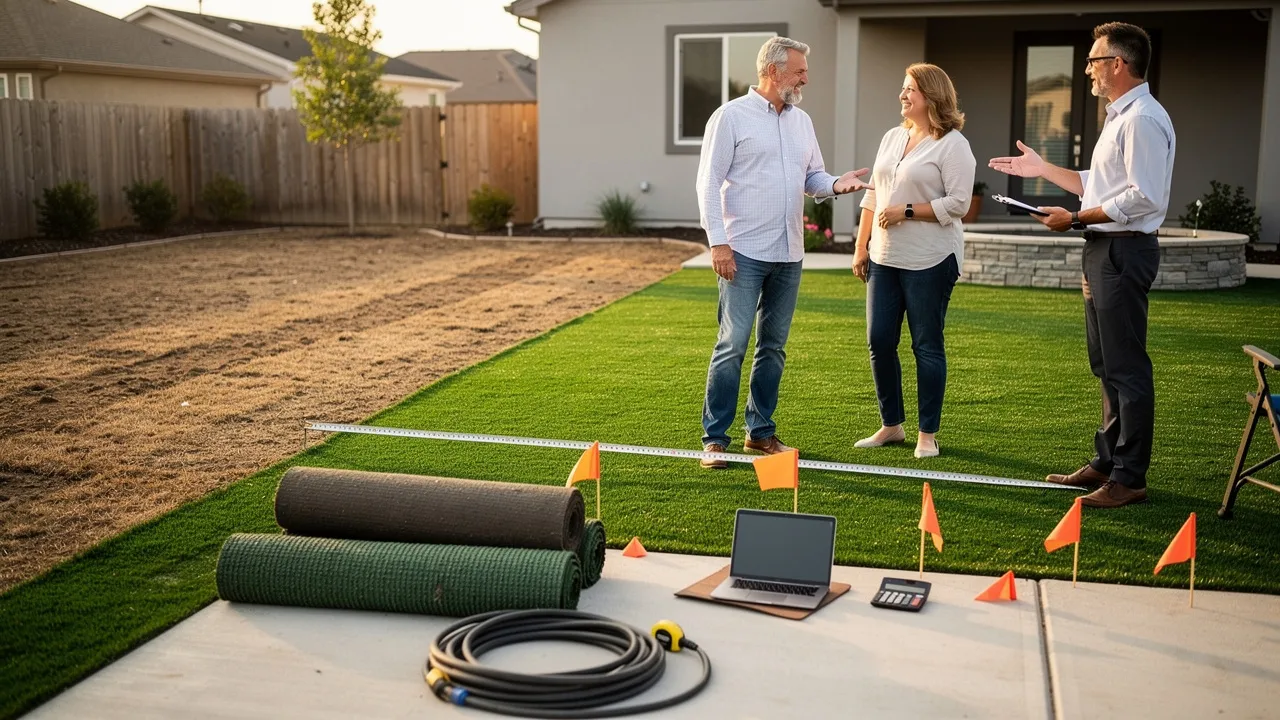

Build the complete installed-system budget before comparing prices
An artificial grass lawn budget should price the complete installed system, not just the visible turf. Your preliminary total should account for the lawn area, turf selection, existing-lawn removal, base preparation, drainage, infill, edging, seams, labor, access, layout complexity, and finishing work. Artificial turf project costs can vary with turf selection, project size, site conditions, base preparation, drainage, edging, infill, accessories, and whether the work is completed as a DIY project or by a contractor.
A Kansas City, Kansas cost report provides a useful local reference, but not a promise for your property. The report is based on data reported on September 17, 2019, so treat it as a dated planning reference rather than a current quote for a yard in Kearney, Kansas City, Overland Park, Olathe, or another nearby suburb.
The budget becomes more useful when every figure has an explanation. Ask what surface the price covers, how much preparation is included, whether old grass will be removed, and which drainage or access conditions could change the total. Turf quality, pile height, backing, drainage, compacted gravel, weed-barrier preparation, slopes, stairs, decorative edges, and warranty length can all affect the estimate.
Use this process to create a working budget:
- Measure the actual area, including curves and separate lawn zones.
- Choose the type and specification of landscape turf you are considering.
- List removal, base, drainage, edging, infill, seams, and access conditions separately.
- Compare the scope behind each price instead of comparing price per square foot alone.
- Leave room for site conditions that cannot be confirmed until the property is assessed.
That approach gives you a defensible planning range without implying that a national or local average applies directly to your front or back lawn.
Separate turf selection from construction work
Turf selection affects the materials portion of your artificial grass budget, while construction work determines how the selected product is supported and finished. A turf sample can look affordable until the estimate adds the base, labor, drainage details, edging, seams, and other installation components.
Hall Turf’s published cost guide states that turf material typically ranges from $2 to $12.55 per square foot, with quality and type affecting the material price. Published cost references use different product categories and price ranges. Those categories come from different published guides, so do not combine them into one universal price ladder or assume that a product belongs to a category without checking its specification.
Pile height is one specification to record when you compare products. The cited guide lists low pile height as 12 millimeters, mid pile height as 28-35 millimeters, and high pile height as 40 millimeters or more. Pile height alone does not determine whether a landscape turf product suits your yard, but recording it helps you compare products that are being presented as alternatives.
Ask for these material details in plain language:
- Turf type and intended residential landscape use.
- Pile height, blade shape, color variation, and backing description.
- Drainage characteristics and any stated installation conditions.
- Infill type and the amount included in the scope.
- Edging, seam materials, fasteners, and areas where custom cuts are required.
The foundation belongs in a separate part of the worksheet. Sub-base preparation provides drainage and helps prevent sinking; RealCostIQ reports that sub-base preparation and labor together account for roughly 50-60% of project cost. That percentage describes the cited calculator’s project-cost model, not every installation. It does show why a low turf-material price cannot represent the entire installed budget. Compare the turf specification and the construction scope as two connected but distinct parts of the same project.

Measure the actual installation area and layout
The installation area determines how much turf, base material, infill, edging, and labor your project may require. Measure the front or back lawn rather than estimating from the property’s total lot size, and record each separate turf zone if a walkway, planting bed, patio, driveway, or other hardscape divides the yard.
Accurately measure the installation area while factoring in curves and slopes. For a simple rectangle, multiply length by width, then record the dimensions and the location of the measurement. For an irregular lawn, divide the space into rectangles or triangles, measure each part, and add the areas together. A sketch with labels is more useful than a single number because it shows where seams, transitions, gates, steps, and narrow work routes may occur.
Your area worksheet should include:
- Length and width for each rectangular section.
- Approximate dimensions for curved or angled sections.
- Slopes, level changes, steps, and retaining edges.
- Garden beds, trees, posts, drains, utility features, and hardscape transitions.
- Gate width, side-yard width, and the route from the material delivery point to the work area.
Total square footage and layout complexity are major bill drivers. Larger areas require more materials and time, while custom cuts around curved garden beds or hardscaping increase job difficulty. A small, irregular side yard can therefore require more cutting and seaming per square foot than a larger open rectangle.
Do not round a complicated layout down just to produce a lower preliminary figure. Mark the measured area as approximate, attach a sketch or photographs, and ask for the installer to confirm the quantity during the site review. Your goal at this stage is a transparent starting point: the quote should later show whether the measured area changed and why.

Add lawn removal, base preparation, and haul-off
Lawn replacement includes more than laying synthetic grass over the existing surface. Replacing natural grass is slightly more expensive than starting from bare soil because sod removal adds cost, so your worksheet should budget for removal and installation as separate lines.
For planning, a crushed-rock sub-base is listed at $2 - $5 per square foot, while removing and hauling away an old lawn is listed at $1 - $3 per square foot. Those figures are planning references, not allowances that apply automatically to every Kansas or Missouri property. The final amount depends on the existing surface, depth of removal, disposal route, access, and the base design required for the installation.
Separate the foundation work into visible questions:
- Will existing grass, roots, soil, concrete, mulch, or another surface be removed?
- How deep will the excavation or removal be?
- Where will removed material go, and is hauling included?
- What aggregate or crushed-rock base is specified?
- How will the base be graded, compacted, and checked before turf placement?
- Is a weed barrier included, and where will edging meet beds, paths, or hardscape?
This separation helps you identify an incomplete comparison. A turf-only price may look lower than an installed price because removal, haul-off, aggregate, compaction, infill, edging, or cleanup sits outside the quoted amount. A standard local estimate may include basic site preparation but exclude major excavation or complex drainage work.
If your yard has an existing lawn, include photographs of the grass, soil, low areas, and any visible roots or surface damage with your request. If the project begins from bare soil, say so explicitly. The starting condition changes the work that must be performed, so the quote should identify the condition it assumes rather than silently treating removal as included or excluded.

Price drainage, grading, and terrain as separate site conditions
Drainage, grading, and terrain can change the installation scope before turf is placed. A flat, open yard and a sloped yard with low areas may have the same measured square footage but require different excavation, base preparation, water-management work, labor, and equipment.
A separate guide gives $2 to $5 per square meter for proper grading and base preparation when leveling uneven terrain or adding drainage systems. These figures use different units and may cover different work. Treat them as broad, source-specific planning references rather than adding them together or applying either allowance as a universal rule.
Your site-condition notes should describe what you can see:
- Areas where water collects after rain.
- Slopes, uneven grades, erosion, or soil that appears soft or unstable.
- Existing drains, downspouts, sump outlets, irrigation lines, and utility features.
- Locations where the lawn meets a foundation, retaining wall, patio, driveway, or sidewalk.
- Any place where water must move toward, away from, or around the proposed turf area.
Ask the installer to distinguish ordinary base preparation from additional grading or drainage work. The written scope should identify whether the price assumes a level surface, includes a drainage design, or depends on a condition that has not yet been confirmed. This matters in the Kansas City and Kearney area, where a property’s particular slope, soil, runoff path, and access can differ from the next yard even when both projects are described as residential lawn replacement.
Do not use a preparation allowance to decide that a difficult yard is unaffordable or that a simple yard will cost the same as a published example. Use the allowance to identify what must be examined, then request a property-specific assessment before treating the figure as part of a final budget.
Adjust for access, seams, edging, and custom cuts
Access and layout affect the labor needed to move materials, prepare the site, position turf, create seams, and finish the edges. A large open lawn with direct access is a different work problem from a narrow side yard, a fenced back yard reached through a small gate, or a front lawn interrupted by beds and hardscape.
Slopes, curves, and tight spaces raise installation complexity, while seams, edging, and custom cuts increase labor costs. Difficult site access may require additional labor and specialized tools, which can increase installation costs. These conditions do not automatically determine your price, but they belong in the scope because they change how the work can be performed.
Walk the proposed route before requesting a quote and record:
- The narrowest gate, path, stair, or side-yard section.
- The distance from the delivery point to the work area.
- Fences, walls, gates, steps, trees, decks, and other obstacles.
- The number of separate turf sections and likely seam locations.
- Curved beds, paver borders, retaining edges, drains, posts, and utility covers.
Photographs should show both the full yard and the details that affect movement or cutting. Include a wide image from each approach, then closer images of gates, stairs, slopes, narrow routes, existing edges, and low areas. A sketch can mark the proposed turf boundary and the route for materials.
When comparing quotes, ask whether access, mobilization, equipment, seams, edging, custom cuts, and cleanup are included. If a quote lists a single installation total without describing these items, you cannot tell whether the difference reflects a better product, a more complete scope, or a site condition that has not been priced. Keep the question practical: ask what work the amount covers and what condition would trigger a change.
Use square-foot pricing as one planning input
Square-foot pricing helps you compare project scenarios, but it should not replace the total-scope review. The same per-square-foot figure can produce very different totals depending on the measured area, and two similar totals can cover different materials or preparation work.
Smaller artificial-turf jobs can cost more per square foot than larger jobs. Larger installations can cost less per square foot through economies of scale; QuoteIQ reports that large open yards price 10-20% lower per foot at scale. The scale effect is not a promise that a larger yard will receive a particular discount. It is a reason to ask how minimum mobilization, equipment, delivery, setup, and labor are allocated across the project.
Use two calculations instead of one:
- Multiply your approximate area by a published planning rate to create a rough scenario.
- Add or separately list removal, base, drainage, access, layout, edging, seams, infill, and other work that the rate may not include.
- Divide the resulting project total by the measured area only after you know what the total covers.
- Compare the resulting unit cost with other quotes only when the areas, products, inclusions, and exclusions are reasonably similar.
A per-square-foot figure can hide a fixed cost on a small project or spread a large open-area efficiency across a bigger installation. It can also hide an omitted item. For example, a quoted rate may include standard preparation while excluding old-lawn removal, hardscape removal, major grading, complex drainage, or difficult access.
Use unit pricing to test your assumptions, not to select an installer by a single number. A clear quote should show the measured area, the product or system specified, the work included, and the conditions that could change the price.
Create a transparent preliminary budget worksheet
A preliminary budget worksheet turns a broad cost question into a list of assumptions you can test. Separate lawn area, turf type, site preparation, existing-lawn removal, access, drainage, and layout complexity because each factor can affect the estimate.
Create these worksheet lines:
- Measured turf area, with separate zones if the yard is divided.
- Turf specification, including type, pile height, backing, drainage description, and infill.
- Existing-surface removal, loading, disposal, and any hardscape removal.
- Aggregate base, excavation, grading, compaction, weed barrier, and drainage work.
- Edging, seams, fasteners, custom cuts, transitions, and cleanup.
- Access, delivery, equipment, stairs, narrow routes, and other site constraints.
- Optional features or landscape work that should be priced separately.
- Assumptions, exclusions, and conditions requiring an on-site decision.
Use the worksheet in three passes. First, measure and describe the yard without choosing a price. Second, select one or two turf specifications and record the material assumptions. Third, request a written scope that fills in the construction lines. This order keeps a product preference from becoming an accidental promise about the entire installation.
Keep a separate 5-10% planning reserve for unexpected base work. A 5-10% contingency is a planning reserve applied to your preliminary project budget; it is not a fee that must appear in every quote. Estimate early with a detailed plan to help prevent change orders later, but keep the contingency separate from the contractor’s stated price so you can see which conditions remain uncertain.
A published cost example prices a 1,000-square-meter project at around $12,360, or approximately $12.4 per square meter, while smaller areas may have significantly higher expenses. That example uses a different project scale and unit from a typical residential Kansas City yard, so use it only to understand why scale can affect unit pricing, not as a direct budget for your property.
This format prevents a product price from being mistaken for an installed total. It also makes two estimates easier to compare: a lower number may exclude old-lawn removal, difficult access, or complex drainage, while another may include those items. A difference is meaningful only after the measured area, turf specification, inclusions, exclusions, date, location, and unit are aligned. Material and labor figures should remain labeled separately when a source presents them separately. An all-in breakdown should remain labeled as an all-in example rather than combined with a material-only or labor-only range.
Use a separate note for the property facts that a general calculation cannot settle. Record whether the starting surface is natural grass, bare soil, or another material; whether water collects; whether the yard has slopes or narrow access; and whether utilities or hardscape may affect the work. Those notes do not create a price, but they show why a final project estimate needs an on-site review. Keep the 5-10% planning reserve separate from any contractor total, and state which assumptions would use it. The reserve is a way to organize uncertainty around unexpected base work, not a substitute for a written scope.
A completed worksheet should therefore let you answer three questions before requesting an estimate: what area is being priced, what system is being priced, and which work remains unconfirmed? If any answer is unclear, mark it for clarification rather than filling the gap with a national rate or a neighboring property’s example. The resulting document gives the installer a consistent starting point and gives you a way to compare the written scope with the original assumptions.
Interpret United States and Kansas City-area planning examples carefully
United States and Kansas City-area price examples can help you test a preliminary budget, but each example has a date, jurisdiction, method, and list of included work. Published prices can vary with land value, labor markets, and disposal costs; one 2026 guide says Midwest and South ranges are near the national average, while coastal metro areas show higher quotes and rural markets often trend toward the lower end. That broad comparison does not establish a current rate for Kearney, Kansas City, or any particular suburb.
The report’s cited data was reported on September 17, 2019. The same report says standard installation pricing includes labor, basic site preparation, crushed rock base, infill, mid-grade artificial grass or synthetic turf, and standard finishing, but excludes laying sod, sports surfaces, major excavation work, and complex drainage solutions.
The same ProMatcher report lists these mid-grade lawn turf installation ranges, with the cited reports dated September 17, 2019:
- Kansas City, Missouri: $8.07 - $12.44 per square foot.
- Independence, Missouri: $7.87 - $12.13 per square foot.
- Olathe, Kansas: $7.93 - $12.22 per square foot.
The Kansas City, Missouri estimate includes labor, basic site preparation, a crushed rock base, infill, mid-grade artificial grass, and standard finishing. It excludes laying sod, sports surfaces, major excavation work, and complex drainage solutions. The Independence, Missouri estimate includes standard turf, site preparation, gravel, cutting, seaming, finishing, and cleanup. It excludes natural grass, additional landscaping, putting greens, athletic fields, commercial-grade turf, and difficult topography.
Angi published another Kansas City, Missouri example on August 22, 2026. For a 500-square-foot lawn in Kansas City, Missouri, Angi reports local-average material costs from $925 to $3,700 and labor costs from $1,850 to $4,170. Those are separate material and labor ranges, so do not present either range as an all-in project price without checking the source’s scope.
A different standard-installation breakdown, published on November 15, 2026, lists component categories for a 500-square-foot installation. It includes turf, sod removal, aggregate base rock, weed-barrier fabric, infill, edging, seam materials, labor, mobilization, equipment, overhead, and margin.
The standard-installation breakdown lists these component ranges:
- Turf: $2.00 - $3.75 per square foot.
- Sod removal and haul-off: $0.75 - $1.75 per square foot.
- Aggregate base rock: $0.50 - $1.10 per square foot.
- Infill: $0.30 - $0.60 per square foot.
- Edging: $0.20 - $0.70 per square foot.
- Excavation, grading, and base compaction labor: $1.25 - $2.50 per square foot.
- Laying, seaming, nailing, and infill labor: $1.25 - $2.50 per square foot.
- Mobilization, equipment, overhead, and margin: $0.90 - $1.75 per square foot.
Use these examples as labeled scenarios. Write down the date, location, area, turf type, inclusions, exclusions, and whether the source separates materials from labor or describes an all-in installation. Then ask for a local quote that uses the same categories. A figure becomes useful when you know what it measures; without that context, a price per square foot is only a partial comparison.

Prepare property details and questions for a comparable quote
A comparable quote request gives the installer the property details needed to describe the same project you have budgeted. Planning estimates vary with project size, turf type, and site conditions, while hardscape removal, grading, drainage issues, and utility conflicts require confirmation during an on-site assessment.
Prepare a short project packet before you request an estimate:
- Property location and the front-yard or back-yard area under consideration.
- Approximate measurements, a sketch, and photographs from several angles.
- Existing surface: natural grass, bare soil, mulch, concrete, pavers, or another material.
- Visible slopes, low areas, erosion, standing water, drains, downspouts, and irrigation features.
- Gate widths, stairs, side-yard routes, fences, walls, and other access constraints.
- Desired turf appearance, pile-height range, color preference, and intended residential use.
- Existing beds, trees, patios, walkways, driveways, and edges that must remain.
Use these questions to make the written scopes easier to compare:
- What measured area and turf specification does the estimate use?
- Is existing lawn or another surface removed, loaded, hauled away, and disposed of?
- What depth and material are specified for the base, and how will compaction be handled?
- Are grading, drainage, edging, seams, infill, transitions, equipment, and cleanup included?
- Which access or layout conditions could change the price?
- What work is excluded, and what condition would require a revised scope?
- Which portions of the estimate remain subject to an on-site assessment?
Send the same information and questions to each installer you are comparing. If one quote includes removal and drainage while another leaves both outside the price, the totals do not describe the same project. Ask for an explanation of the difference rather than choosing the smaller number.
Request technical documentation with the written scope
A written technical scope should connect the product you are considering to the work required on your property. When you request a written scope from us, ask us to identify the proposed turf system, measured area, base design, drainage assumptions, edging, seams, infill, removal, access conditions, cleanup, exclusions, and the conditions that could change the estimate.
Ask us to state the contractor status that applies to the project and to attach any relevant product certifications, CAD files, and testing documentation for the specified system. These documents should be tied to the product and application rather than listed as general labels. If a document does not apply to the turf, infill, base, drainage component, or installation detail being proposed, ask what part of the scope it supports.
If your project involves a designed transition to a patio, walkway, planting bed, retaining edge, or other landscape feature, request drawings or marked-up plans that show those interfaces. If you are working with an architect or designer, provide the same technical package so dimensions, finish elevations, product specifications, and installation responsibilities are clear from concept through installation.
Use the documentation request as a scope check, not as a substitute for the property inspection. A certification or drawing can describe a product or design detail; it cannot independently confirm the soil, slope, access route, drainage condition, utility location, or removal work at your property. Hall Turf is described as a licensed contractor, and the written scope should identify the contractor status applicable to your project.
Use an on-site evaluation when the worksheet cannot verify conditions
An on-site evaluation is needed when your worksheet cannot confirm the conditions that drive preparation or installation work. Planning estimates based on typical installed rates cannot account for hardscape removal, grading, drainage issues, or utility conflicts; those conditions are confirmed during an on-site assessment.
Request an on-site review when you see or suspect:
- A slope, uneven grade, soft soil, erosion, or a low area that holds water.
- Existing concrete, pavers, retaining structures, buried edging, or other surfaces requiring removal.
- A drainage outlet, irrigation line, utility feature, downspout, or foundation condition near the turf boundary.
- A narrow gate, stair route, tight side yard, or other access constraint.
- Multiple lawn zones, curved beds, unusual transitions, or a layout that needs extensive seaming.
Use the visit to resolve assumptions rather than asking only for a single total. Ask which area was measured, which surface will be removed, how the base and drainage will be handled, where water will move, how materials will reach the work area, and which items remain excluded. Have the written scope reflect the answers.
A site review does not make every future condition predictable, but it gives the estimate a property-specific basis. Use the worksheet to prepare the questions and the evaluation to confirm the conditions that a general calculator cannot see.
Turn the worksheet into a property-specific next step
A property-specific next step begins with a measured area and a written list of assumptions. Carry your turf choice, removal notes, base and drainage questions, access details, layout sketch, requested documentation, and contingency into the quote discussion. Compare complete scopes rather than treating a single national figure or square-foot rate as the answer.
For a front or back lawn in Kansas City, Kearney, or a nearby Kansas or Missouri suburb, use the preliminary worksheet to show what you know and to identify what still requires an on-site decision. A qualified professional should determine whether the proposed system and installation work suit your individual property before you commit to the project.
What should you confirm before accepting an artificial grass estimate?
Can a national artificial grass cost estimate be used for a Kansas City-area yard?
Use it only as a planning reference, not as a property-specific price. Kansas City-area estimates vary by location, labor and disposal conditions, turf specification, access, removal, grading, drainage, and what the quoted scope includes. A Kansas City, Kansas reference based on data reported in 2019 listed $7.93 - $12.22 per square foot for mid-grade lawn turf, but that dated range should be confirmed with a current local assessment.
Why can two artificial grass quotes for the same yard differ so much?
The quotes may measure different areas or include different work. Compare the turf specification, existing-lawn removal, haul-off, base depth and material, grading, drainage, edging, seams, infill, access, equipment, cleanup, overhead, and exclusions. A lower total may omit preparation or difficult site conditions rather than represent a more efficient installation.
What property conditions should trigger an on-site artificial grass assessment?
Request an assessment when the yard has slopes, soft or uneven soil, standing water, erosion, existing hardscape, drainage or irrigation features, utility conflicts, narrow access, stairs, multiple lawn sections, or complex curves and transitions. General calculators cannot confirm those conditions, and the final scope may change after the site is inspected.
How should homeowners budget for an irregular or small artificial grass area?
Measure each lawn zone and account for curves, slopes, seams, edging, access, removal, base work, and drainage instead of multiplying a single rate by an approximate area. Smaller projects can carry a higher per-square-foot cost because fixed mobilization, equipment, delivery, and labor are spread across less area.